
Explain in detail family planning in community medicine in detailed
Reading File
Searching sources...
Family planning in community medicine covers population control strategies, contraceptive methods, national programs, and reproductive health services. Let me search the textbook library comprehensively.
Finding Sources
Finding Sources
Park's Textbook is the primary community medicine source. Let me read the main family planning section comprehensively.
Reading File
Finding Sources
Reading File
Finding Sources
Reading File
Reading File
Reading File
Reading File
Reading File
Reading File
Reading File
Reading File
Finding Sources
Finding Sources
Reading File
I now have comprehensive content from Park's Textbook covering all major aspects. Let me compile the complete detailed answer.
Searching Images
contraceptive methods family planning diagram
Here is a thorough, structured account of Family Planning in Community Medicine, drawn primarily from Park's Textbook of Preventive and Social Medicine.
Family Planning in Community Medicine
1. Definition
The WHO Expert Committee (1971) defined family planning as:
"A way of thinking and living that is adopted voluntarily, upon the basis of knowledge, attitudes and responsible decisions by individuals and couples, in order to promote the health and welfare of the family group and thus contribute effectively to the social development of a country."
A second WHO Expert Committee further defined it as practices that help individuals or couples to:
- (a) Avoid unwanted births
- (b) Bring about wanted births
- (c) Regulate intervals between pregnancies
- (d) Control the time at which births occur in relation to parental age
- (e) Determine the number of children in the family
2. Family Planning as a Basic Human Right
- The UN Conference on Human Rights at Tehran (1968) first recognized family planning as a basic human right.
- The Bucharest World Population Conference (1974) stated: "All couples and individuals have the basic human right to decide freely and responsibly the number and spacing of their children."
- The World Conference of the International Women's Year (1975) reinforced the right of women to decide on the number and spacing of their children.
3. Scope of Family Planning Services
Family planning is not synonymous with birth control - it is broader. According to a WHO Expert Committee (1970), it includes:
- Proper spacing and limitation of births
- Advice on sterility
- Education for parenthood
- Sex education
- Screening for pathological conditions (e.g., cervical cancer)
- Genetic counselling
- Premarital consultation and examination
- Pregnancy tests
- Marriage counselling
- Preparation of couples for their first child
- Services for unmarried mothers
- Teaching home economics and nutrition
- Providing adoption services
4. Health Aspects of Family Planning
Family planning and health have a two-way relationship:
Benefits to Mother's Health
- Reduction in maternal mortality (spacing prevents high-risk pregnancies)
- Reduced anaemia, exhaustion from repeated childbirth
- Reduction in complications of unintended pregnancy
Benefits to Child's Health
- Adequate birth spacing (minimum 2 years) reduces neonatal/infant mortality
- Better nutrition and breastfeeding opportunity
- Reduced risk of prematurity and low birth weight
Benefits to Family and Society
- Better resource allocation per child
- Improved maternal and child nutrition
- Reduced population pressure
5. Contraceptive Methods (Fertility Regulating Methods)
Contraceptive methods are broadly grouped into two classes:
I. Spacing Methods
A. Barrier Methods
These prevent live sperm from reaching the ovum. They require high motivation but have no systemic side effects and offer some protection against STIs and pelvic inflammatory disease.
Physical Methods:
1. Condom (Male)
- Made of latex rubber; trade name in India: NIRODH (Sanskrit: "prevention")
- Failure rate: 3-15 per 100 woman-years (HWY) under typical use
- Only contraceptive that also protects against STIs/HIV
- Should be used with every act of intercourse; unroll before use
- Supplied free through government programmes
2. Diaphragm (Female)
- A dome-shaped rubber cap placed over the cervix before intercourse
- Must be used with spermicidal cream/jelly
- Failure rate: 6-16 per HWY
- Requires fitting by a trained provider; must remain in place for 6 hours post-coitus
- Not widely used in India
3. Cervical Cap
- Smaller than diaphragm; fits over the cervix
- Failure rate slightly higher than diaphragm
Chemical Methods (Spermicides):
- Creams, jellies, foams, tablets, suppositories containing surfactants (e.g., nonoxynol-9)
- Kill or immobilize sperm
- Failure rate: 6-20 per HWY when used alone
- Best used in combination with barrier methods
Combined Methods:
- Condom + spermicide
- Diaphragm + spermicide
- More effective than either alone
B. Intra-Uterine Devices (IUDs)
IUDs are inserted into the uterine cavity; they are among the most effective reversible contraceptive methods.
Mechanism of Action:
- Inhibit sperm transport and fertilization
- Copper ions have a direct toxic effect on sperm
- Alter the endometrium to prevent implantation
- Stimulate local foreign body inflammatory reaction in the uterus
Classification:
| Generation | Type | Example |
|---|---|---|
| First | Inert (plastic) | Lippes Loop |
| Second | Copper-bearing | Cu-T 200, Cu-T 380A, Multiload Cu-375 |
| Third | Hormone-releasing | Progestasert, Mirena (LNG-IUS) |
Lippes Loop: Double-S shaped polyethylene device with barium sulphate (for X-ray detection) and nylon tail. Available in 4 sizes (A, B, C, D); larger sizes (C & D) for multiparous women.
Copper IUDs: Numbers in names denote copper surface area in mm² (e.g., Cu-T 380A = 380 mm² copper). Newer devices (Cu-T 380A) effective for up to 10 years.
Timing of Insertion:
- Best during menstruation or within 10 days of period onset
- Post-puerperal: 6-8 weeks after delivery
- Immediate postpartum (first week) - higher expulsion risk
- Not recommended immediately after 2nd trimester abortion
Effectiveness: Pregnancy rate ~3-5 per 100 users in first year.
Contraindications: Pregnancy, active PID, STI, uterine anomaly, unexplained vaginal bleeding, copper allergy (for copper IUDs).
Complications and Side Effects:
- Menorrhagia and dysmenorrhoea (common, especially with inert IUDs)
- Expulsion (highest in first year)
- Pelvic inflammatory disease (PID)
- Ectopic pregnancy risk if device fails
- Perforation of uterus (rare, ~1 per 1000 insertions)
- Not suitable as first choice for nulliparous women (higher expulsion and PID rates)
Follow-up: After first menstrual period, then after 3rd period, then every 6-12 months.
C. Hormonal Contraceptives
When properly used, these are the most effective spacing methods.
1. Combined Oral Contraceptive Pills (COCPs)
Contain synthetic oestrogen (ethinyl oestradiol or mestranol) and progestogen (levonorgestrel, norethindrone, etc.).
Mechanism:
- Primary: Suppression of ovulation (via inhibition of LH and FSH)
- Secondary: Thick cervical mucus impeding sperm
- Altered endometrium reducing implantation probability
Types:
- Monophasic pills: Fixed dose in each pill
- Biphasic/triphasic pills: Varying oestrogen/progestogen ratios across cycle
- Low-dose pills: Ethinyl oestradiol 20-35 mcg (current standard)
Effectiveness: ~0.1 per HWY with perfect use; ~5-8 per HWY with typical use (nearly 100% effective when taken correctly).
Adverse Effects:
- Cardiovascular: Increased risk of venous thromboembolism, myocardial infarction, cerebral thrombosis - especially with smoking and increasing age. Risk markedly higher in women >35 who smoke.
- Hypertension: Occurs in ~5% of users
- Headache, nausea, breast tenderness (minor effects)
- Depression, libido changes
- Metabolic: Altered glucose tolerance, lipid changes
- Breakthrough bleeding: More common with low-dose pills
Benefits (non-contraceptive):
- Reduced risk of endometrial and ovarian cancer
- Reduced dysmenorrhoea and menorrhagia
- Protection against PID and benign breast disease
- Improvement in acne
Contraindications: History of thromboembolic disease, stroke, ischaemic heart disease, liver disease, undiagnosed vaginal bleeding, oestrogen-dependent tumours, pregnancy, breastfeeding <6 weeks postpartum, smoking + age >35.
2. Progestogen-Only Pill (POP / "Mini-pill")
- Contains only progestogen; taken daily without a pill-free interval
- Suitable for breastfeeding mothers and those with contraindications to oestrogen
- Works mainly by thickening cervical mucus
3. Injectable Contraceptives
A. Progestogen-Only Injectables:
- DMPA (Depo-Provera): 150 mg medroxyprogesterone acetate every 3 months (12 weeks)
- NET-EN (Noristerat): 200 mg norethisterone enanthate every 2 months
- Highly effective; failure rate < 1 per HWY
- Side effects: Menstrual irregularities (most common), amenorrhoea, weight gain, delay in return of fertility after stopping
- Suitable for women who forget daily pills
B. Combined Injectable Contraceptives:
- Cyclofem/Cycloprovera, Mesigyna - given monthly
- Failure rate: <0.2% for Cyclofem; <0.4% for Mesigyna
4. Subdermal Implants (Norplant)
- 6 silastic (silicone rubber) capsules each containing 35 mg levonorgestrel, inserted subdermally in forearm/upper arm
- Provides contraception for >5 years; reversible on removal
- Failure rate: ~0.2 per HWY
- Norplant-2: 2 rods, easier insertion and removal
- Side effects: Menstrual irregularities, local reactions at insertion site
D. Post-Conceptional Methods (Emergency Contraception)
Emergency Contraceptive Pills (ECPs):
- Levonorgestrel 1.5 mg single dose OR 0.75 mg × 2 doses 12 hours apart
- Must be taken within 72 hours of unprotected intercourse (the sooner, the more effective)
- Reduces risk of pregnancy by ~75%
- Does NOT induce abortion if implantation has already occurred
Mifepristone (RU-486):
- Antiprogesterone; used for medical termination of early pregnancy
- Given with misoprostol for complete expulsion
E. Natural Family Planning Methods (NFP)
Methods based on avoiding intercourse during the fertile period:
-
Calendar (Rhythm) Method (Ogino-Knaus method): Calculate fertile period based on previous cycle lengths (ovulation ~14 days before next period). Failure rate: 14-47 per HWY. Unreliable with irregular cycles.
-
Basal Body Temperature (BBT) Method: Temperature rises 0.2-0.5°C after ovulation due to progesterone effect. Record temperature every morning before activity; avoid intercourse until 3 days after sustained rise.
-
Cervical Mucus Method (Billings/Ovulation Method): Fertile period identified by clear, slippery, stretchable cervical mucus ("spinnbarkeit"). Peak day = last day of clear mucus. Avoid intercourse until 4th day after peak.
-
Symptothermal Method: Combines BBT + cervical mucus + calendar.
Limitations: Require high motivation, discipline, regular cycles; not suitable for women with irregular cycles or poor literacy. WHO advisory group states these have "very little application particularly in developing countries."
5. Lactational Amenorrhoea Method (LAM):
- Breastfeeding suppresses ovulation through prolactin-mediated inhibition of GnRH
- Effective only if: fully breastfeeding + amenorrhoeic + <6 months postpartum (all three must be present)
- No more than 5-10% of women conceive during lactational amenorrhoea
- Once menstruation returns, breastfeeding no longer provides protection
II. Terminal Methods (Sterilization)
Sterilization is a one-time, permanent contraceptive procedure for couples desiring no more children.
Advantages over other methods:
- Does not require sustained motivation
- Most effective contraceptive protection (failure rate < 0.5%)
- Most cost-effective method
- Each procedure averts 1.5-2.5 births per woman
In India: Female sterilizations = ~85%, male sterilizations = ~10-15% of all sterilizations.
A. Female Sterilization (Tubectomy)
Approaches:
- Laparoscopic sterilization - most common; done under general anaesthesia
- Minilaparotomy - small incision below navel; done under local anaesthesia; suitable in postpartum period
- Colpotomy (vaginal approach) - less common
Techniques for tubal occlusion:
- Pomeroy's method: Loop of fallopian tube ligated and cut (most common)
- Fimbriectomy: Removal of fimbriated end
- Hulka clip, Filshie clip, Fallope rings (reversible to some degree)
- Electrocoagulation (via laparoscope)
Timing:
- Interval (any time in menstrual cycle, ideally luteal phase)
- Postpartum (within 7 days or after 6 weeks)
- Post-abortion (immediately after)
Effectiveness: Failure rate: 0.5 per HWY (occasional recanalization).
Complications: Anaesthetic risks, injury to bowel/bladder/blood vessels, post-sterilization syndrome (menstrual irregularities), regret.
Reversal (recanalization): Success rates are low - approximately 40-70% depending on technique used; microsurgery gives best results.
B. Male Sterilization (Vasectomy)
Procedure: Ligation, excision, or occlusion of the vas deferens through a small scrotal incision. Can be done under local anaesthesia as an outpatient procedure.
No-scalpel vasectomy (NSV): A special puncture technique (introduced from China); smaller wound, less bleeding, faster recovery. India has widely adopted NSV.
Effectiveness: Failure rate: < 0.15 per HWY.
Post-procedure: Azoospermia confirmed at 3 months or after 20-25 ejaculations. Temporary use of another contraceptive method recommended until then.
Advantages over tubectomy: Simpler, safer, cheaper, done under local anaesthesia, lower complication rate.
Complications: Haematoma (most common), wound infection, sperm granuloma, epididymo-orchitis.
Reversal (vasovasostomy): Success ~50-80%; best results if reversal done within 10 years.
6. Effectiveness of Contraceptive Methods (Pearl Index)
The Pearl Index = number of pregnancies per 100 woman-years (HWY) of use.
| Method | Failure Rate (per 100 HWY) |
|---|---|
| Combined pill | 0.1 (perfect), ~5 (typical) |
| DMPA injectable | <1 |
| Copper IUD | 0.6-0.8 |
| Vasectomy | <0.15 |
| Tubectomy | ~0.5 |
| Condom | 3-15 |
| Diaphragm + spermicide | 6-16 |
| Rhythm method | 14-47 |
| No method | 80-90 |
7. The Medical Termination of Pregnancy (MTP) Act 1971
MTP is considered a post-conceptional method and part of the family planning programme.
Five conditions under which pregnancy can be terminated:
- Medical: Continuation endangers the mother's life or causes grave injury to physical/mental health
- Eugenic: Substantial risk of child being born with serious physical/mental handicaps
- Humanitarian: Pregnancy resulting from rape
- Socio-economic: Environmental factors (social or economic) likely to injure mother's health
- Contraceptive failure: Anguish of unwanted pregnancy from failure of any contraceptive method - unique to Indian law; virtually allows abortion on request
Gestational limits:
- Up to 12 weeks: One Registered Medical Practitioner (with gynaecology/obstetrics experience)
- 12-20 weeks: Requires opinion of two Registered Medical Practitioners
- Consent of guardian required for women <18 years and those of unsound mind
Where: Only government hospitals or MTP Act-approved facilities.
8. National Family Welfare Programme (India)
Historical Evolution
| Period | Key Developments |
|---|---|
| 1952 | India launched national family planning programme - first country in the world to do so |
| 1961-66 (3rd Five Year Plan) | Family planning declared "the very centre of planned development"; shift from clinic approach to extension education |
| 1965 | Introduction of Lippes Loop; structural reorganization; separate Department of Family Planning created in 1966 |
| 1969 | All India Hospital Postpartum Programme (AIHPP) introduced |
| 1972 | Medical Termination of Pregnancy (MTP) Act |
| 1976 | First National Population Policy (April 1976); forced sterilization campaign (disaster) |
| 1977 | Janata Government: voluntary basis declared; Ministry renamed "Family Welfare" |
| 1982-83 | National Health Policy formulated; goal of NRR=1 by year 2000 |
| 1985-86 | Universal Immunization Programme started |
| 1996 | Target-free approach adopted; Community Needs Assessment (CNA) approach |
| 2000 | National Population Policy (NPP 2000) with medium-term goal: TFR = 2.1 by 2010 |
| 2005 | National Rural Health Mission (NRHM); RCH-II launched |
National Population Policy 2000 (NPP 2000)
Immediate objective: Address unmet needs for contraception, health infrastructure, and health personnel.
Medium-term objective: Bring Total Fertility Rate (TFR) to replacement level (2.1) by 2010.
Long-term objective: Achieve a stable population by 2045 at a level consistent with sustainable economic growth, social development, and environmental protection.
Key targets:
- Reduce IMR to <30 per 1,000 live births
- Reduce MMR to <100 per 100,000 live births
- Achieve universal immunization
- Reduce prevalence of anaemia
- Promote delayed marriage (girl > 18, boy > 20)
- Make school education up to Class 10 free and compulsory
RCH Programme (Reproductive and Child Health)
Launched 1997; replaced the vertical Target-based programme. Key components:
- Maternal health (ANC, safe delivery, postpartum care)
- Child health (immunization, nutrition, IMNCI)
- Family planning (all methods, quality of care)
- STI/RTI management
- Adolescent health
9. Postpartum Programme
The All India Hospital Postpartum Programme (AIHPP) was introduced in 1969 as a hospital-based, maternity-centred approach to family planning. It promotes acceptance of family planning methods in the postpartum period when:
- Women are highly receptive
- Medical infrastructure is present
- It can be combined with post-delivery follow-up
Services offered: IUD insertion (immediate or post-puerperal), sterilization, counselling, oral pills prescription.
10. Couple Protection Rate (CPR)
CPR = Percentage of eligible couples (wife aged 15-44) effectively protected against pregnancy by any contraceptive method.
- Target set in National Health Policy: 60% CPR by year 2000
- Used as the main indicator of family planning programme performance
- India's CPR was ~48% at the time of Park's writing
11. Targets of the Family Planning Programme
Under NPP 2000, specific demographic and health targets were set:
- Reduce crude birth rate to 21 per 1,000
- Reduce crude death rate to 9 per 1,000
- Reduce IMR to <30 per 1,000 live births
- Reduce MMR to <100 per 100,000 live births
- Achieve NRR = 1 (Net Reproduction Rate of 1)
12. Cafeteria Approach to Contraception
A key concept in modern family planning programming:
"There is no single method likely to meet the social, cultural, aesthetic and service needs of all individuals and communities. The present approach is to provide a cafeteria choice - to offer all methods from which an individual can choose according to his needs and wishes."
This replaced the target-based approach and is now the accepted standard in family planning counselling.
13. Voluntary Agencies in Family Planning
- Family Planning Association of India (FPAI): Founded 1949, headquarters Mumbai; pioneering role in family planning propagation; member of International Planned Parenthood Federation (IPPF)
- Population Council of India
- Family Planning Foundation
- IPPF (International): World's largest private voluntary organization for family planning; headquarters London
- UNFPA: UN Fund for Population Activities; funds research, services, training
- USAID, Ford Foundation, Pathfinder Fund, World Bank: International funding bodies
Summary Table: Classification of Contraceptive Methods
CONTRACEPTIVE METHODS
│
├── SPACING METHODS
│   ├── Barrier Methods
│   │   ├── Physical: Condom, Diaphragm, Cervical cap
│   │   ├── Chemical: Spermicides
│   │   └── Combined: Condom + spermicide
│   │
│   ├── Intra-Uterine Devices (IUDs)
│   │   ├── Inert: Lippes Loop
│   │   ├── Copper: Cu-T 380A, Multiload 375
│   │   └── Hormonal: Mirena (LNG-IUS)
│   │
│   ├── Hormonal Contraceptives
│   │   ├── Combined Oral Pills (COCPs)
│   │   ├── Progestogen-Only Pill (POP)
│   │   ├── Injectables: DMPA, NET-EN, Cyclofem
│   │   └── Implants: Norplant
│   │
│   ├── Post-Conceptional Methods
│   │   ├── Emergency pills (Levonorgestrel)
│   │   └── MTP (mifepristone + misoprostol)
│   │
│   └── Natural Methods
│       ├── Calendar/Rhythm method
│       ├── BBT method
│       ├── Cervical mucus (Billings) method
│       ├── Symptothermal method
│       └── Lactational amenorrhoea (LAM)
│
└── TERMINAL METHODS
    ├── Female sterilization (Tubectomy/Laparoscopy)
    └── Male sterilization (Vasectomy/NSV)
Source: Park's Textbook of Preventive and Social Medicine - the authoritative reference for community medicine in India
Explain contraceptive methods in detail in such a way like advandated and dissadvantes
Reading File
Searching sources...
Finding Sources
Finding Sources
Goldman-Cecil and Park's both have comprehensive content. Let me read both in parallel.
Reading File
Reading File
Reading File
Reading File
Reading File
Reading File
Reading File
Reading File
Reading File
Reading File
Reading File
Reading File
I found a useful diagram. Let me fetch it and also read the sterilization advantages/disadvantages section.
Loading Image
Reading File
I now have comprehensive material from Park's textbook and Goldman-Cecil. Let me compile the complete, detailed advantages and disadvantages answer for every contraceptive method.
Contraceptive Methods - Detailed Advantages and Disadvantages
Based on Park's Textbook of Preventive and Social Medicine & Goldman-Cecil Medicine
Overview
"Each contraceptive method has its unique advantages and disadvantages. The success of any contraceptive method depends not only on its effectiveness in preventing pregnancy but on the rate of continuation of its proper use."
- Park's Textbook of Preventive and Social Medicine
The Pearl Index (number of pregnancies per 100 woman-years of exposure) is used to measure contraceptive effectiveness.
CLASSIFICATION OF CONTRACEPTIVE METHODS
CONTRACEPTIVE METHODS
├── SPACING METHODS
│   ├── A. Barrier Methods (Physical, Chemical, Combined)
│   ├── B. Intra-Uterine Devices (IUDs)
│   ├── C. Hormonal Contraceptives
│   ├── D. Post-Conceptional Methods
│   └── E. Natural Methods
└── TERMINAL METHODS (Sterilization)
    ├── Male Sterilization (Vasectomy)
    └── Female Sterilization (Tubectomy)
A. BARRIER METHODS
1. Male Condom (NIRODH)
Mechanism: Sheath of latex rubber placed over the erect penis before intercourse; prevents sperm from entering the vagina.
Failure Rate: 2-14 per 100 woman-years (typical use); 2-3 per 100 WY (perfect use)
| ✅ ADVANTAGES | ❌ DISADVANTAGES |
|---|---|
| Easily available (pharmacies, no prescription needed) | May slip off or tear during intercourse if used incorrectly |
| Safe - no systemic side effects whatsoever | Reduces sexual sensation for some men |
| Inexpensive; free under government programmes | Requires motivation and correct use at every coitus |
| Easy to use; no medical supervision required | Many men do not use them regularly or carefully |
| Light, compact, disposable | Requires interruption of sexual activity to apply |
| Only contraceptive that protects against STIs/HIV | Not 100% effective if used inconsistently |
| Reversible - immediately on stopping use | Latex allergy possible (rare) |
| Protects against PID and cervical cancer | Dependent on male cooperation |
| Can be used as backup for other methods | Failure rate higher than pill or IUD |
| No effect on lactation | Single-use only - new condom per act |
2. Female Condom
Mechanism: Polyurethane pouch lining the vagina with inner ring (covers cervix) and outer ring (stays outside vagina); prelubricated with silicone.
Failure Rate: 5 per 100 WY (typical use)
| ✅ ADVANTAGES | ❌ DISADVANTAGES |
|---|---|
| Effective barrier against STIs/HIV - woman-controlled | High cost (more expensive than male condom) |
| Can be inserted before intercourse (no interruption) | Less cosmetically acceptable to many |
| No hormonal side effects | Noisier during intercourse |
| Suitable when male partner refuses condom | Lower acceptance rates |
| Made of polyurethane - suitable for latex allergy | Higher failure rate than male condom |
| Woman has control over use | Requires practice to insert correctly |
3. Diaphragm
Mechanism: Dome-shaped rubber cap placed over the cervix before intercourse; used with spermicidal cream/jelly.
Failure Rate: 6-16 per 100 WY (typical use)
| ✅ ADVANTAGES | ❌ DISADVANTAGES |
|---|---|
| No systemic side effects | Must be fitted by a trained provider (not self-selected) |
| Woman-controlled method | Requires fitting and insertion skills |
| Reusable (economical over time) | Must be inserted before every act of intercourse |
| Some protection against STIs and cervical cancer | Must remain in place for 6 hours after intercourse |
| Can be inserted hours before intercourse | Requires spermicide - adds cost and inconvenience |
| No effect on hormones or fertility | May be dislodged during vigorous intercourse |
| Reversible immediately | Not suitable in cases of uterine prolapse or poor muscle tone |
| Not widely available in developing countries | |
| Bladder pressure - may predispose to UTI | |
| Must be re-fitted after weight change or childbirth |
4. Cervical Cap
Mechanism: Smaller latex/rubber cap fitting directly over the cervix; used with spermicide.
Failure Rate: Slightly higher than diaphragm (~16 per 100 WY in parous women)
| ✅ ADVANTAGES | ❌ DISADVANTAGES |
|---|---|
| Can be left in place longer than diaphragm (up to 48 hrs) | Difficult to fit - requires provider skills |
| No systemic side effects | Higher failure rate in parous women |
| Woman-controlled | May become dislodged |
| Reusable | Requires spermicide |
| Not widely available |
5. Spermicides (Chemical Methods)
Mechanism: Creams, jellies, foams, tablets, suppositories containing agents like nonoxynol-9 that kill or immobilize sperm.
Failure Rate: 6-20 per 100 WY (alone); much lower in combination with barrier
| ✅ ADVANTAGES | ❌ DISADVANTAGES |
|---|---|
| No prescription required; easily available | High failure rate when used alone |
| Immediate action; can use just before intercourse | Repeated use of nonoxynol-9 may increase risk of STIs (disrupts vaginal epithelium) |
| No systemic side effects | Local irritation or allergic reaction in some users |
| Provides some lubrication | Must be applied 15-30 minutes before intercourse |
| Effective for only one act (must reapply) | Messy; interferes with spontaneity |
| No effect on fertility after stopping | Not reliable as sole method |
| Inexpensive | Effectiveness varies with correct placement |
B. INTRA-UTERINE DEVICES (IUDs)
Overview
| Type | Example | Effective Life |
|---|---|---|
| 1st generation (Inert) | Lippes Loop | Until removed |
| 2nd generation (Copper) | Cu-T 380A, Multiload-375 | 5-10 years |
| 3rd generation (Hormonal) | Mirena (LNG-20), Progestasert | 5-10 years |
Failure Rate: 0.6-3 per 100 WY (copper IUD); <0.2 per 100 WY (hormonal IUD)
General IUD Advantages and Disadvantages
| ✅ ADVANTAGES | ❌ DISADVANTAGES |
|---|---|
| Highly effective (among the best reversible methods) | Requires trained provider for insertion and removal |
| Long-lasting, single-decision contraception | Increased menstrual blood loss and dysmenorrhoea (especially inert IUDs) |
| No daily action required (unlike pill) | Risk of expulsion (highest in first year) |
| Independent of timing of intercourse | Risk of pelvic inflammatory disease (PID) |
| No systemic hormonal side effects (copper/inert types) | Increased risk of ectopic pregnancy if device fails |
| Does not affect lactation | Not recommended as first choice for nulliparous women |
| Cost-effective over long term | Uterine perforation (rare: ~1/1000 insertions) |
| Can be used as emergency contraception (copper IUD within 5 days) | Requires follow-up care |
| Fertility returns rapidly after removal | Risk of infection increases with multiple partners |
| Widely acceptable in developing countries | Contraindicated in active STI/PID, pregnancy, uterine anomaly |
Copper IUD (Cu-T 380A) - Additional Points
| ✅ EXTRA ADVANTAGES over Inert IUD | ❌ EXTRA DISADVANTAGES |
|---|---|
| Lower expulsion rate | May increase menstrual bleeding and cramps vs. inert devices |
| Smaller size - easier fitting, even in nulliparous | Copper content depleted over time (needs replacement) |
| Better tolerated by nulliparous women | Copper allergy (rare) |
| Increased contraceptive effectiveness | |
| Effective as post-coital contraceptive (within 3-5 days) |
Hormonal IUD (Mirena / LNG-IUS)
| ✅ ADVANTAGES | ❌ DISADVANTAGES |
|---|---|
| Lowest failure rate: 0.2 per 100 WY | Expensive |
| Significantly reduces menstrual blood loss - beneficial in menorrhagia | Initial irregular bleeding/spotting (first 3-6 months) |
| Less dysmenorrhoea | Amenorrhoea (can be distressing to some women) |
| Reduces risk of ectopic pregnancy compared to copper IUD | Requires provider for insertion/removal |
| Treats endometriosis symptoms | May cause systemic progestogenic effects |
| Effective for 5-10 years |
C. HORMONAL CONTRACEPTIVES
1. Combined Oral Contraceptive Pill (COCP)
Mechanism: Synthetic oestrogen (ethinyl oestradiol 20-35 mcg) + progestogen (levonorgestrel, norethisterone); suppresses ovulation, thickens cervical mucus, alters endometrium.
Failure Rate: 0.1 per 100 WY (perfect use); ~5-8 per 100 WY (typical use)
| ✅ ADVANTAGES | ❌ DISADVANTAGES |
|---|---|
| Nearly 100% effective when taken correctly | Must be taken daily (same time each day) - compliance required |
| Highly reliable spacing method | Cardiovascular risk: VTE, MI, stroke (especially smokers >35 yrs) |
| Regulates menstrual cycle; predictable withdrawal bleeding | Hypertension in ~5% of users |
| Reduces menstrual blood loss and dysmenorrhoea | Nausea, breast tenderness, headache, mood changes |
| Reduces risk of endometrial cancer by 20-60% | Weight gain (~25% of users; usually <2 kg) |
| Reduces risk of ovarian cancer by 40-60% | Slight decrease in libido |
| Reduces risk of colorectal cancer ~20% | Adverse effect on lactation (reduced milk volume by 42%) |
| Reduces risk of benign breast disease | Slight delay in return of fertility after stopping |
| Reduces risk of PID | Metabolic effects: altered lipids, glucose tolerance |
| Reduces ectopic pregnancy risk | Increased risk of breast cancer by ~20% (small absolute risk) |
| Reduces ovarian cysts | Cholestatic jaundice; hepatocellular adenoma (rare) |
| Improves acne and hirsutism | Drug interactions (rifampicin, anticonvulsants reduce efficacy) |
| Protects against osteoporosis (with oestrogen) | Breakthrough bleeding in early cycles |
| No effect on future fertility overall (only slight delay) | Contraindicated: smokers >35, hypertension, migraine with aura, history of thrombosis, liver disease, oestrogen-sensitive cancer |
| Can be used until menopause | No protection against STIs |
| Reduces symptoms of endometriosis | Pill must not be used if breastfeeding <6 weeks postpartum |
Non-Contraceptive Benefits Summary:
- ↓ Dysmenorrhoea, menorrhagia
- ↓ Endometrial cancer, ovarian cancer, colorectal cancer
- ↓ PID, ectopic pregnancy
- ↓ Ovarian cysts, benign breast disease
- ↑ Bone density
2. Progestogen-Only Pill (POP / "Mini-pill")
Mechanism: Progestogen only; thickens cervical mucus primarily; variable ovulation suppression.
Failure Rate: 0.5-3 per 100 WY
| ✅ ADVANTAGES | ❌ DISADVANTAGES |
|---|---|
| Safe in breastfeeding mothers (does not reduce milk) | Must be taken at the same time every day (3-hour window) |
| Suitable when oestrogen is contraindicated (smokers, HTN, thrombosis risk) | Irregular menstrual bleeding (spotting, irregular periods) |
| No oestrogen-related side effects (no VTE risk increase) | Slightly less effective than combined pill |
| Can be used in perimenopausal women | Amenorrhoea in some users |
| Reduces dysmenorrhoea | Slight increase in ectopic pregnancy risk if failure occurs |
| Safe in older women with cardiovascular risk factors | No protection against STIs |
| Does not reduce risk of ovarian/endometrial cancer like COCP |
3. Injectable Contraceptives
A. DMPA (Depo-Provera) - given every 3 months
Mechanism: Medroxyprogesterone acetate 150 mg IM; suppresses ovulation + thickens cervical mucus.
Failure Rate: < 1 per 100 WY
| ✅ ADVANTAGES | ❌ DISADVANTAGES |
|---|---|
| Highly effective; forgetting not an issue | Menstrual irregularities (most common complaint) - irregular bleeding then amenorrhoea |
| Long-acting (once in 3 months) | Delayed return to fertility (up to 12-18 months after stopping) |
| Suitable for women who forget daily pills | Cannot be reversed immediately if side effects occur (lasts 3 months) |
| Suitable for breastfeeding mothers (after 6 weeks) | Weight gain |
| No oestrogen side effects | Loss of bone mineral density with prolonged use |
| Reduces seizure frequency in epileptics | Mood changes, depression in some users |
| Can be used by women with sickle cell disease | No protection against STIs |
| Reduces risk of endometrial cancer | |
| Protects against PID | |
| Reduces sickle cell crises |
B. NET-EN (Noristerat) - given every 2 months
| ✅ ADVANTAGES | ❌ DISADVANTAGES |
|---|---|
| Same as DMPA but shorter dosing interval means faster return to fertility | Must be given every 2 months (more frequent than DMPA) |
| Effective and reversible | Menstrual irregularities |
| Suitable for breastfeeding (after 6 weeks postpartum) |
4. Subdermal Implants (Norplant / Norplant-2 / Implanon)
Mechanism: 6 silastic capsules (Norplant) or 2 rods (Norplant-2) containing levonorgestrel implanted subdermally in upper arm; releases hormone slowly for 5+ years.
Failure Rate: ~0.2 per 100 WY over 3 years
| ✅ ADVANTAGES | ❌ DISADVANTAGES |
|---|---|
| Highly effective (comparable to sterilization) | Irregular menstrual bleeding (most common complaint) |
| Long-acting (5+ years) - no daily action | Surgical procedure required for insertion and removal |
| Reversible - fertility returns rapidly after removal | Local reaction/pain at insertion site |
| No daily compliance required | Expensive |
| Suitable for breastfeeding mothers | Requires trained provider |
| No oestrogen side effects | Headache, acne, weight gain in some users |
| User cannot feel it in place (discreet) | Visibility or palpability under skin may concern some women |
| Can be removed at any time if side effects are bothersome | Not protective against STIs |
| Protects against ectopic pregnancy | Difficult removal if capsules are deeply placed |
5. Vaginal Ring (NuvaRing)
Mechanism: Flexible ring containing levonorgestrel (or combined hormone); worn in vagina for 3 weeks, removed for 1 week.
| ✅ ADVANTAGES | ❌ DISADVANTAGES |
|---|---|
| Hormone absorbed through vaginal mucosa - bypasses liver (lower dose possible) | Some women uncomfortable with vaginal insertion |
| User-controlled; self-inserted | May be felt by partner during intercourse |
| Monthly attention only | Increased vaginal discharge/irritation |
| Avoids daily pill-taking | Not widely available in India |
| Regular menstrual cycles | Must be stored in cool conditions |
| No injections needed |
D. POST-CONCEPTIONAL METHODS
1. Emergency Contraceptive Pills (ECPs)
Mechanism: High-dose levonorgestrel (1.5 mg single dose or 0.75 mg × 2 doses, 12 hours apart) prevents ovulation or delays it; taken within 72 hours of unprotected intercourse.
| ✅ ADVANTAGES | ❌ DISADVANTAGES |
|---|---|
| Reduces pregnancy risk by ~75% after unprotected intercourse | Not suitable for regular use (only emergency) |
| Easy to use; available OTC in India | Nausea, vomiting (common) |
| No prescription needed for levonorgestrel EC | Menstrual cycle disruption |
| Backup option after condom failure or missed pills | Less effective as time passes after intercourse |
| Does not interrupt established pregnancy | No protection against STIs |
| Not as effective as regular contraception |
2. Menstrual Regulation
Aspiration of uterine contents 6-14 days after a missed period; before pregnancy is confirmed.
| ✅ ADVANTAGES | ❌ DISADVANTAGES |
|---|---|
| Avoids unwanted early pregnancy | Requires suction equipment and provider |
| Simple vacuum aspiration technique | Only applicable very early (6-14 days of missed period) |
| No medication required | Psychological impact |
| Quick recovery | Incomplete aspiration possible |
E. NATURAL FAMILY PLANNING (NFP) METHODS
1. Calendar / Rhythm Method (Ogino-Knaus)
Mechanism: Abstain from intercourse during the calculated fertile period (Day 8 to Day 21 in a 28-day cycle).
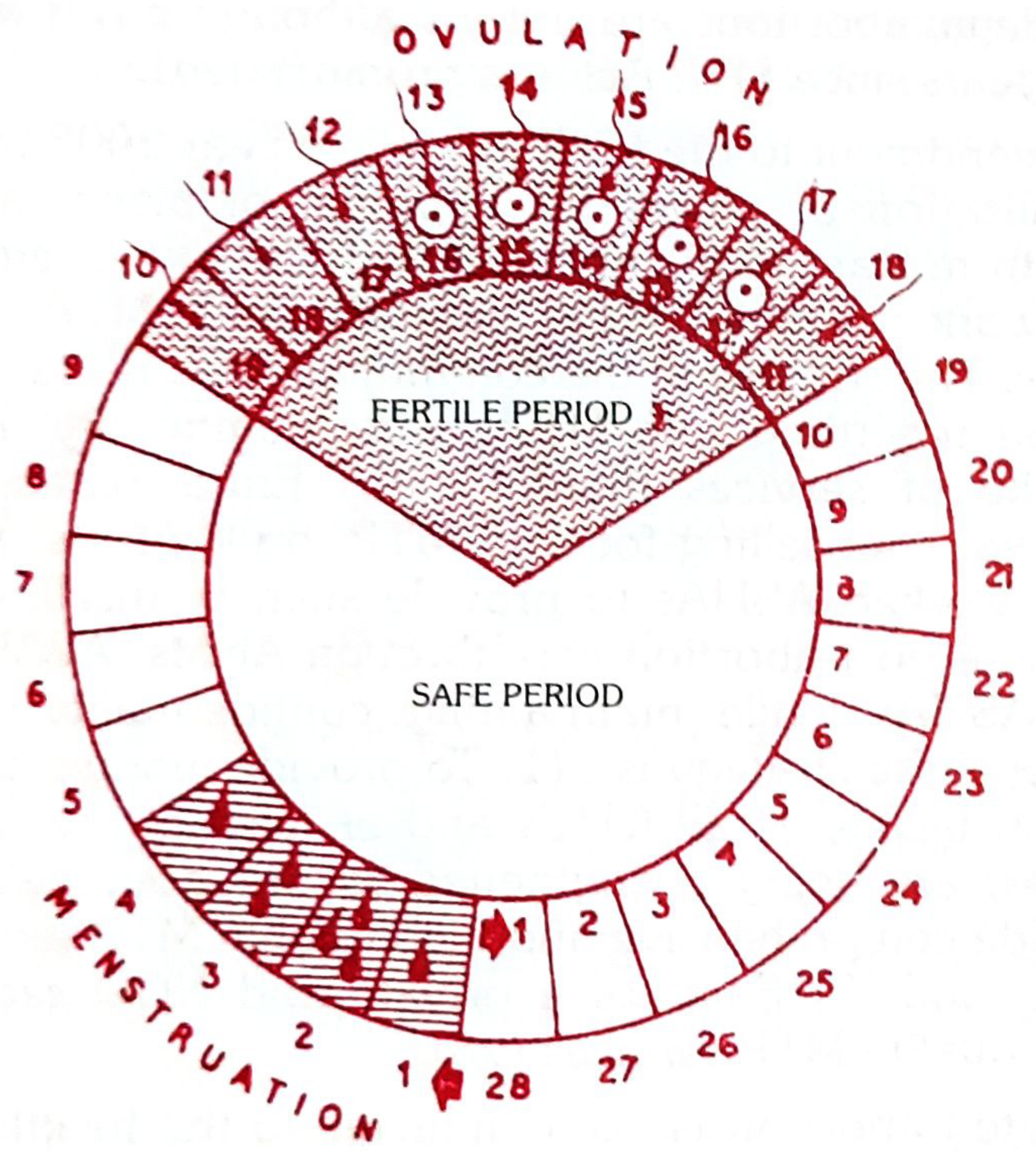
Failure Rate: 9-47 per 100 WY
| ✅ ADVANTAGES | ❌ DISADVANTAGES |
|---|---|
| No cost whatsoever | Very high failure rate (9-47/100 WY) |
| No devices, no drugs | Requires regular menstrual cycles - unreliable in irregular cycles |
| No side effects | Requires high motivation and mathematical skill |
| Acceptable to all religious groups | Prolonged period of abstinence (~half the month) |
| No medical supervision needed | Not applicable in postnatal period |
| Empowers couples to understand fertility | Risk of ectopic pregnancy (late-cycle conception) |
| No protection against STIs | |
| Poor reliability in developing countries |
2. Basal Body Temperature (BBT) Method
Mechanism: Temperature rises 0.3-0.5°C after ovulation (progesterone effect); abstain until 3 days of sustained rise observed.
Failure Rate: 1-3 per 100 WY (perfect use); higher typically
| ✅ ADVANTAGES | ❌ DISADVANTAGES |
|---|---|
| No cost or devices after thermometer purchase | Requires a special sensitive thermometer |
| No hormonal side effects | Temperature must be taken every morning before any activity |
| Increases woman's awareness of her body | Many factors falsely elevate temperature (illness, alcohol, stress, poor sleep) |
| Only signals after ovulation has already occurred - retroactive | |
| Does not identify the beginning of the fertile period (pre-ovulatory) | |
| Long period of abstinence required if used alone | |
| High compliance demand | |
| Not suitable for women with irregular temperature patterns |
3. Cervical Mucus Method (Billings / Ovulation Method)
Mechanism: Identify fertile period by observing clear, slippery, stretchable (spinnbarkeit) cervical mucus; abstain from peak day until 4th day after peak.
Failure Rate: 3-22 per 100 WY
| ✅ ADVANTAGES | ❌ DISADVANTAGES |
|---|---|
| No cost | Requires training and practice to identify mucus changes |
| Identifies pre-ovulatory fertile period (unlike BBT) | Vaginal infections or semen can mask mucus changes |
| No devices or hormones | Requires daily observation and recording |
| Acceptable to all religious groups | Ovulation may not always be preceded by typical mucus |
| Increases reproductive self-awareness | Requires abstinence for significant portion of cycle |
| Not suitable in women with chronic vaginal discharge | |
| Long learning curve |
4. Symptothermal Method
Combines BBT + cervical mucus + calendar calculations.
| ✅ ADVANTAGES | ❌ DISADVANTAGES |
|---|---|
| More reliable than any single NFP method | Very demanding - requires mastery of multiple observations |
| Cross-checks multiple signs (identifies both pre- and post-ovulatory safety) | Requires high motivation, education, and regular cycles |
| No cost or side effects | Prolonged abstinence required |
| Accepted by all religious communities | Not suitable for most women in developing countries |
5. Lactational Amenorrhoea Method (LAM)
Mechanism: Full breastfeeding suppresses GnRH via prolactin, preventing ovulation.
Condition: Effective ONLY when all three criteria are met:
- Fully/exclusively breastfeeding
- Amenorrhoeic (no menstrual period)
- Baby < 6 months old
Failure Rate: < 2 per 100 WY when all 3 criteria met
| ✅ ADVANTAGES | ❌ DISADVANTAGES |
|---|---|
| Natural, no cost, no devices | Only works when all three criteria are strictly met |
| Promotes breastfeeding and infant nutrition | Effective for only 6 months maximum |
| No hormonal or physical side effects | As soon as menses return, no longer protective |
| Culturally and religiously acceptable | Supplementary feeding reduces its effectiveness |
| Protects against pregnancy while supporting infant health | No protection against STIs |
| Widely applicable in developing countries | Many women misapply criteria and rely on it incorrectly |
F. TERMINAL METHODS (Sterilization)
1. Male Sterilization (Vasectomy / No-Scalpel Vasectomy - NSV)
Mechanism: Ligation/excision of vas deferens through small scrotal incision under local anaesthesia; prevents sperm from entering ejaculate.
Failure Rate: < 0.15 per 100 WY
| ✅ ADVANTAGES | ❌ DISADVANTAGES |
|---|---|
| Most effective male contraceptive method | Considered permanent - reversal success only 50-80% |
| Simpler, safer, and cheaper than female sterilization | Requires acceptance of permanent childlessness |
| Done under local anaesthesia as an outpatient | Not immediately effective - needs ~30 ejaculations to clear sperm |
| Very low complication rate | Scrotal haematoma (most common early complication) |
| One-time procedure - no sustained motivation needed | Wound infection (~3% of patients) |
| No effect on sex drive, erection, or orgasm | Sperm granuloma (common, usually self-limiting) |
| No hormonal side effects | Spontaneous recanalization (0-6% risk) |
| Sperm production and hormone levels unchanged | Autoimmune response to sperm (up to 54% develop sperm antibodies) |
| Highly cost-effective | Psychological complaints (impotence, fatigue) in men coerced |
| NSV technique: smaller wound, less bleeding, faster recovery | Failure due to wrong identification of vas (rare) |
| Sexual function unaffected |
Important Note: Not effective immediately - must use another method until azoospermia is confirmed (~3 months / 30 ejaculations).
2. Female Sterilization (Tubectomy / Laparoscopic Sterilization)
Mechanism: Tubal occlusion by ligation (Pomeroy), clips (Hulka, Filshie), rings (Fallope ring), or coagulation via laparoscope/minilaparotomy.
Failure Rate: ~0.5 per 100 WY (occasional recanalization)
| ✅ ADVANTAGES | ❌ DISADVANTAGES |
|---|---|
| Highly effective - near permanent contraception | Requires surgery, general or regional anaesthesia |
| One-time decision, lifelong protection | Operative risks: bowel/bladder/vessel injury |
| No daily action or sustained motivation needed | Anaesthetic complications possible |
| No hormonal side effects | Essentially permanent - reversal success only 40-70% |
| Most cost-effective long-term contraceptive | Regret rate significant (especially young women) |
| Each procedure averts 1.5-2.5 future births | Post-sterilization syndrome: menstrual irregularities (debated) |
| Can be done postpartum (within 7 days or 6 weeks after delivery) | If it fails, higher risk of ectopic pregnancy |
| Can be combined with other postpartum procedures | Psychological impact if performed under pressure/coercion |
| Minilaparotomy can be done under local anaesthesia | |
| No effect on menstrual cycle or hormones (non-hormonal methods) | |
| Reduces risk of ovarian cancer (some evidence) |
COMPARATIVE SUMMARY TABLE
| Method | Pearl Index (failures/100 WY) | Key Advantage | Key Disadvantage | STI Protection |
|---|---|---|---|---|
| Male condom | 2-14 | Only STI-protective contraceptive | Requires consistent use | ✅ YES |
| Female condom | 5-21 | Woman-controlled, STI protective | Expensive, less acceptable | ✅ YES |
| Diaphragm + spermicide | 6-16 | No systemic effects | Requires fitting, less effective | Partial |
| Spermicide alone | 6-20 | OTC, no hormones | Very high failure rate | ❌ NO |
| Lippes Loop (inert IUD) | 3-5 | Long-lasting, reversible | Increased bleeding, expulsion | ❌ NO |
| Copper IUD (Cu-T 380A) | 0.6-0.8 | Highly effective, 10 years, non-hormonal | Increased menstrual bleeding | ❌ NO |
| Hormonal IUD (Mirena) | <0.2 | Treats menorrhagia, 10 years | Expensive, requires insertion | ❌ NO |
| COCP (Combined pill) | 0.1-8 | Near 100% effective + many non-contraceptive benefits | Cardiovascular risk, daily compliance | ❌ NO |
| POP (Mini-pill) | 0.5-3 | Safe in breastfeeding, no oestrogen risks | Strict timing, irregular bleeding | ❌ NO |
| DMPA (Depo) injection | <1 | 3-monthly, no daily compliance | Irregular bleeding, delayed fertility return | ❌ NO |
| Norplant implant | ~0.2 | 5+ years, no compliance needed | Surgical insertion/removal | ❌ NO |
| Emergency contraception | ~75% reduction | Post-coital rescue method | Not for regular use, not 100% | ❌ NO |
| Calendar method | 9-47 | No cost, no side effects | Very high failure rate, irregular cycles | ❌ NO |
| BBT method | 1-20 | No cost, no devices | Retroactive only, strict compliance | ❌ NO |
| Cervical mucus method | 3-22 | Identifies pre-ovulatory fertile period | Training required, infections interfere | ❌ NO |
| LAM | <2 (when criteria met) | Natural, promotes breastfeeding | Only 6 months, strict criteria | ❌ NO |
| Vasectomy | <0.15 | Simplest, cheapest permanent method | Permanent, not immediate | ❌ NO |
| Tubectomy | ~0.5 | Most effective female permanent method | Surgery required, permanent | ❌ NO |
Key Principle: The Cafeteria Approach
Since no single contraceptive method suits all people, the modern approach in family planning is to offer a "cafeteria choice" - providing all available methods and allowing individuals to choose according to their personal needs, cultural context, medical profile, and reproductive goals. This replaced the old target-based system and is the accepted standard today.
Sources: Park's Textbook of Preventive and Social Medicine; Goldman-Cecil Medicine, International Edition
This is a shared conversation. Sign in to Orris to start your own chat.