
Prostate carcinoma with revised Gleason scoring and prognostic markers with recent updates md pathology 10 marks question
Reading File
Searching sources...
Finding Sources
Finding Sources
Searching PubMed
prostate carcinoma Gleason grading prognostic markers
Good - found relevant sections. Now let me read the key pathology content from Robbins and Bailey & Love simultaneously.
Reading File
Reading File
Finding Sources
Excellent - found rich content. Let me read more of the Robbins pathology section on Gleason grading and prognostic markers.
Reading File
Finding Sources
Finding Sources
Now let me read the core Robbins pathology section on Gleason grading and morphology:
Reading File
Reading File
Excellent - let me now read the Gleason grading/grade group section from Robbins more completely:
Reading File
Searching Images
Gleason grading system prostate carcinoma histology patterns
I now have comprehensive material. Let me also fetch the Robbins diagram for the Gleason grading system:
Loading Image
Loading Image
I now have all the material needed for a comprehensive 10-mark MD Pathology answer. Let me compose it.
Prostate Carcinoma: Revised Gleason Scoring and Prognostic Markers
(10-mark MD Pathology Answer)
Introduction
Adenocarcinoma of the prostate is the most common malignancy in males, accounting for 29% of all male cancers (299,010 new cases projected in 2024 in the USA). Its biologic behavior ranges from clinically indolent tumors - managed by active surveillance - to aggressive, rapidly fatal disease. Accurate grading and identification of prognostic markers are therefore central to management.
- Robbins, Cotran & Kumar Pathologic Basis of Disease, p. 906
Pathogenesis: Key Molecular Events
Risk factors: Androgens, dietary carcinogens (charred meats/animal fats), chronic inflammation, and germline variants (e.g., MYC).
Stepwise molecular progression (Fig. 21.31, Robbins):
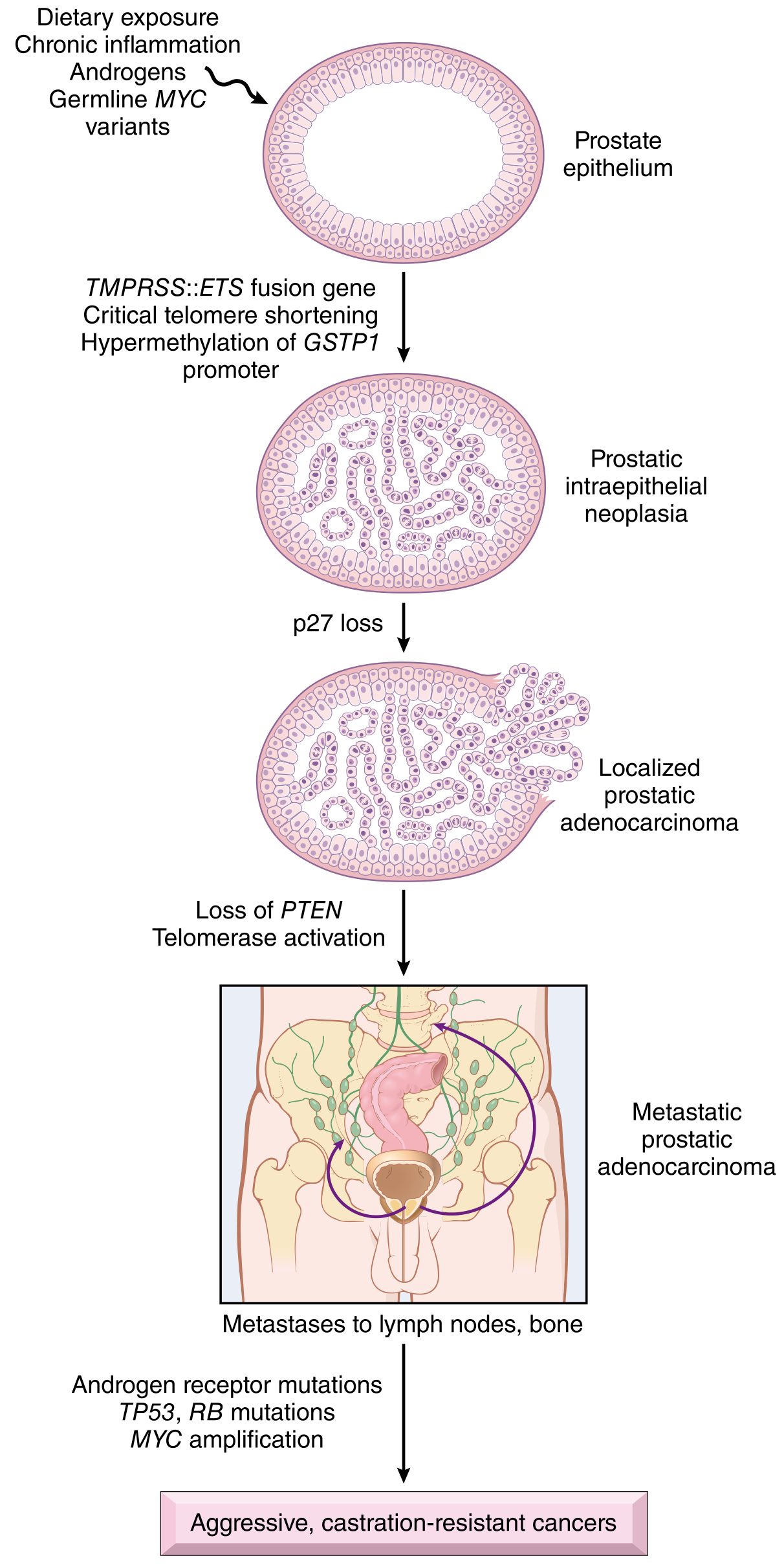
Key genomic events include:
- TMPRSS2:ERG gene fusion - present in 50-60% of localized prostate cancers; brings ETS family oncogenic transcription factors under androgen control. An early and seminal event, found in HGPIN and early-stage cancer.
- GSTP1 hypermethylation - impairs detoxification of polycyclic aromatic hydrocarbons.
- PTEN loss - cooperates with TMPRSS2:ERG fusions to drive early tumor progression.
- p27 (CDKN1B) loss - transition from HGPIN to localized adenocarcinoma.
- TP53, RB mutations + MYC amplification - castration-resistant, aggressive stage.
Precursor Lesion: High-Grade PIN (HGPIN)
- Prostatic intraepithelial neoplasia (PIN) consists of architecturally benign acini or ducts lined by cytologically atypical cells.
- HGPIN is found in ~80% of radical prostatectomy specimens that also harbor carcinoma.
- It shares genetic alterations with invasive carcinoma (TMPRSS2:ERG fusions, telomere shortening).
- HGPIN alone on needle biopsy carries a lower risk of subsequent cancer detection than previously thought; rebiopsy is not mandatory unless risk factors are present.
Morphology
Gross
- 70% arise in the peripheral zone (posterior), making them palpable on digital rectal examination.
- Cut surface: gritty, firm gray-white tissue.
- Sometimes difficult to delineate from surrounding stroma.
Microscopy (Acinar Adenocarcinoma)
| Feature | Benign Glands | Malignant Glands |
|---|---|---|
| Basal cell layer | Present | Absent |
| Architecture | Branching, papillary infolding | Tightly packed, no branching |
| Nuclear size | Small, regular | Enlarged, prominent nucleoli |
| Cytoplasm | Pale | Amphophilic or pale-clear |
| Perineural invasion | Absent | Characteristic |
| Mitoses | Rare | Uncommon (grade-dependent) |
Key diagnostic features: Perineural invasion is specific for malignancy. The absence of basal cells (highlighted by p63/CK5/14 IHC) and positive AMACR (α-methylacyl-CoA racemase) staining (82-100% sensitivity) support the diagnosis.
The Gleason Grading System (Original and Revised)
Original Gleason System
Described by Donald Gleason in 1966, the system stratifies tumors into 5 architectural grades based on the degree of glandular differentiation:
| Grade | Histological Pattern |
|---|---|
| 1 | Well-formed uniform round glands, closely packed, well-circumscribed nodule |
| 2 | Similar to Grade 1 but glands more loosely arranged, edges less circumscribed |
| 3 | Infiltrating discrete glands of variable size; small glands common |
| 4 | Fused/cribriform glands; poorly formed, ragged glands |
| 5 | No glandular differentiation; solid sheets, cords, or single cells infiltrating stroma |
- Because prostate cancer is heterogeneous, a primary grade (dominant pattern) and a secondary grade (second most frequent pattern) are assigned.
- Gleason Score = Primary grade + Secondary grade (range: 2-10).
- Scores ≤6: low risk; 7: intermediate; 8-10: high risk.
ISUP 2005 Revised Gleason System
The 2005 International Society of Urological Pathology (ISUP) consensus conference made critical revisions:
- Grades 1 and 2 are no longer assigned on needle biopsies - their biologic behavior is similar to Grade 3, creating overgrading confusion; minimum score on biopsy is now 6 (3+3).
- Grade 3 redefined: Only well-formed discrete, individual glands (no longer includes cribriform glands).
- Cribriform and poorly formed glands reassigned to Grade 4 (cribriform = adverse histology).
- Tertiary pattern: When a tertiary (third) pattern is present in radical prostatectomy, the highest grade replaces the secondary grade in the score (e.g., 3+4 with tertiary 5 becomes effectively higher risk).
- Gleason scores 2-5 eliminated from clinical reporting.
ISUP 2014/WHO 2016 Grade Groups (Epstein et al.)
Gleason scores were reorganized into 5 Grade Groups to address the problem of compressing most tumors into scores 6-10, and to better communicate prognosis:
| Grade Group | Gleason Score | Prognosis |
|---|---|---|
| GG 1 | ≤6 (3+3) | Excellent - almost no metastatic potential |
| GG 2 | 7 (3+4) | Favorable intermediate |
| GG 3 | 7 (4+3) | Unfavorable intermediate (worse than 3+4) |
| GG 4 | 8 (4+4, 3+5, 5+3) | Poor |
| GG 5 | 9-10 (4+5, 5+4, 5+5) | Very poor |
Key clinical significance of Grade Groups:
- GG 1 (Gleason score ≤6): Essentially no metastatic potential - suitable for active surveillance.
- The 3+4 vs 4+3 distinction is prognostically significant - a 4+3 (GG3) behaves significantly worse.
- Grade Group is now used alongside TNM staging to generate combined prognostic stage groups (AJCC 8th edition).
- Patients with GG1 previously labeled "cancer" were experiencing unnecessary psychological harm and overtreatment - renaming as "Grade Group 1" helps communicate the indolent nature.
(Bailey and Love's Short Practice of Surgery 28th ed., p. 8843)
Pathologic Staging (pTNM)
- pT2: Organ-confined
- pT3a: Extraprostatic extension
- pT3b: Seminal vesicle invasion
- pT4: Invasion of bladder, rectum, or adjacent structures
- N1: Regional lymph node (obturator, paraaortic) metastasis
- M1: Bone metastases (characteristically osteoblastic - distinguishes from most other bone metastases)
Prognostic Markers
Established Prognostic Factors
1. Gleason Grade Group / Score
The single most important histologic prognostic factor. Grade Group strongly correlates with pathologic stage, biochemical recurrence, metastatic potential, and cancer-specific survival. - Robbins, p. 908
2. PSA (Prostate-Specific Antigen)
- Kallikrein family serine protease; normally liquefies seminal coagulum.
- Elevated in cancer, BPH, prostatitis, and infarction - organ-specific but NOT cancer-specific.
- Suboptimal screening specificity, but serial PSA after treatment is highly valuable for monitoring recurrence.
- PSA density (PSA/prostate volume) and PSA velocity (rate of rise) improve specificity.
- % free PSA: Lower free/total PSA ratio is associated with higher probability of cancer.
3. Pathologic Stage (TNM)
Extraprostatic extension (pT3a), seminal vesicle invasion (pT3b), and lymph node positivity are independent adverse prognostic factors.
4. Surgical Margins
Positive surgical margins after radical prostatectomy predict biochemical recurrence.
5. Perineural Invasion (PNI)
Presence on needle biopsy correlates with extraprostatic extension and adverse outcome.
Molecular/Immunohistochemical Prognostic Markers
6. AMACR (P504S)
Upregulated in prostate cancer; diagnostic rather than strictly prognostic. Sensitivity: 82-100%.
7. TMPRSS2:ERG Gene Fusion
- Present in 50-60% of prostate cancers.
- Associated with higher risk for prostate cancer-specific death in men on watchful waiting (some studies), though data are mixed in surgical series.
8. PTEN Loss
- Tumor suppressor loss activates PI3K/Akt pathway.
- Detected by FISH or IHC; associated with higher grade, extraprostatic extension, and worse prognosis.
- ETS fusions + PTEN loss together confer a more aggressive phenotype.
9. Ki-67 (Proliferation Index)
High Ki-67 correlates with high Gleason grade and worse outcome.
10. p53 Mutation
Associated with castration-resistant disease and metastatic progression.
11. AR (Androgen Receptor) Mutations/Amplification
Drives castration-resistant prostate cancer (CRPC); prognostic for treatment failure.
12. DNA Ploidy
Aneuploid tumors carry worse prognosis; tetraploid/aneuploid DNA content correlates with higher Gleason grade and risk of recurrence.
13. PCA3 (Prostate Cancer Antigen 3)
Urine-based non-coding RNA test; more specific than PSA for cancer detection; does not rise with BPH.
Genomic Classifiers (Newer Updates)
- Oncotype DX Genomic Prostate Score (GPS): 17-gene expression assay on biopsy tissue; predicts pathologic upgrade and adverse pathology in low/intermediate risk disease.
- Prolaris (cell-cycle progression score): 31-gene expression assay; predicts biochemical recurrence and prostate cancer-specific mortality.
- Decipher (GenomeDx): 22 RNA biomarkers; predicts metastasis after radical prostatectomy; validated in multiple cohorts.
- BRCA1/2, ATM mutations (HRR genes): Germline or somatic; predictive for benefit from PARP inhibitors (olaparib, rucaparib) in CRPC.
Adverse Histologic Features (2019 ISUP Update)
- Cribriform architecture in Grade 4: Associated with worse outcomes than non-cribriform Grade 4; should be reported separately.
- Intraductal carcinoma of the prostate (IDC-P): Distinct entity from HGPIN; associated with high-grade, high-stage cancers and worse biochemical recurrence. Should be reported regardless of invasive grade.
- Lymphovascular invasion: Independent predictor of metastasis.
Summary Table: Prognostic Risk Stratification
| Risk Category | PSA | Grade Group | Clinical Stage |
|---|---|---|---|
| Very Low | <10 ng/mL | GG1 | T1c |
| Low | <10 ng/mL | GG1 | T1-T2a |
| Favorable Intermediate | 10-20 ng/mL | GG1-2 | T2b-c |
| Unfavorable Intermediate | 10-20 ng/mL | GG3 | T2b-c |
| High | >20 ng/mL OR GG 4-5 | T3a | |
| Very High | Any | GG5 | T3b-T4 |
Key Points for Exam
- Gleason score is PRIMARY grade + SECONDARY grade; range 2-10 (but in practice now 6-10 on biopsy).
- 2005 ISUP revision abolished Grades 1 and 2 on biopsy; redefined Grade 3 (no cribriform); assigned cribriform to Grade 4.
- Grade Groups (2014 ISUP/WHO 2016): GG1 (≤6) to GG5 (9-10) - better prognostic stratification.
- GG1 tumors almost never metastasize; appropriate for active surveillance.
- 3+4 (GG2) has better prognosis than 4+3 (GG3) even though both are Gleason score 7.
- PSA: organ-specific, not cancer-specific; serial post-treatment PSA is gold standard for monitoring.
- AMACR positive + basal cell markers (p63, CK5/14) absent = diagnostic of adenocarcinoma.
- TMPRSS2:ERG fusion is the most common recurrent genetic alteration (50-60%).
- PTEN loss + ETS fusion = more aggressive phenotype.
- Cribriform Grade 4 and intraductal carcinoma (IDC-P) are adverse histologic features in 2019 ISUP update.
- Bone metastases are characteristically osteoblastic - due to factors secreted by tumor cells that stimulate osteoblasts.
- Genomic classifiers (Decipher, Prolaris, Oncotype DX GPS) add prognostic value beyond Gleason grade and PSA.
Sources:
- Robbins, Cotran & Kumar Pathologic Basis of Disease (10th ed.), Chapter 21 (Male Genital System), pp. 906-910
- Bailey and Love's Short Practice of Surgery (28th ed.), Chapter 84 (Prostate), pp. 8828-8870
- Campbell-Walsh-Wein Urology, Chapters 83-84 (Molecular Biology and Pathology of Prostate Cancer)
- ISUP 2005 and 2014 Consensus Conferences (Epstein et al.)
- WHO Classification of Urinary and Male Genital Tumours, 5th ed. (2022)
This is a shared conversation. Sign in to Orris to start your own chat.