
Non communicable disease definition explain epidemiology of cancer and national tobacco control program .
Reading File
Now let me search the medical library for all three topics in parallel.
Finding Sources
Finding Sources
Finding Sources
Reading File
Reading File
Finding Sources
Finding Sources
Reading File
Finding Sources
Reading File
Reading File
Reading File
Reading File
Reading File
Finding Sources
Reading File
Finding Sources
I now have enough information from the textbooks to compile a thorough answer. Let me also fetch the cancer incidence diagram.
Loading Image
I now have comprehensive content from the textbooks. Here is the full, well-structured answer:
Non-Communicable Diseases, Epidemiology of Cancer, and National Tobacco Control Programme
1. Non-Communicable Diseases (NCDs) - Definition
NCDs are diseases that are not transmitted from person to person. They are conditions of long duration and generally slow progression. The WHO defines them as a group of chronic diseases that include cardiovascular diseases, cancers, chronic respiratory diseases, and diabetes.
Key characteristics of NCDs:
- Non-infectious - not caused by microorganisms and not transmissible
- Chronic - prolonged course, often lifelong
- Not self-limiting - rarely resolve spontaneously
- Multifactorial - result from a combination of genetic, physiological, environmental, and behavioral factors
- Largely preventable - through modification of risk factors
Major Categories of NCDs (WHO)
- Cardiovascular diseases (heart attacks, stroke)
- Cancers
- Chronic respiratory diseases (asthma, COPD)
- Diabetes mellitus
- Mental health disorders
- Injuries and accidents (also classified as NCDs)
NCD Risk Factors
According to Park's Textbook of Preventive and Social Medicine, the major modifiable risk factors are:
- Tobacco use: Kills almost 7 million people per year (including 600,000 from second-hand smoke; 170,000 of these are children). In 2016, 1.1 billion smokers worldwide, >80% daily. Tobacco causes approximately 71% of lung cancers, 42% of chronic respiratory disease, and nearly 10% of cardiovascular disease.
- Physical inactivity: ~1.6 million deaths/year. Inactive individuals have 20-30% increased risk of all-cause mortality.
- Harmful use of alcohol: ~3.3 million deaths/year, accounting for 5.9% of all global deaths; >5.1% of DALYs attributable to alcoholism. Linked to cancer, CVD, liver cirrhosis, and violence.
- Unhealthy diet: Inadequate fruit/vegetable intake and excess salt increase risk of CVD and cancer.
- Overweight/obesity, raised blood pressure, raised blood glucose, raised cholesterol
India's Dual Burden
India faces a dual health challenge. While communicable diseases like diarrhoea, TB, and neonatal disorders remain a burden, NCDs (heart disease, stroke, diabetes) are rising significantly. The precise burden varies by state, with states at different epidemiological transition levels (ETL). - Park's Textbook of Preventive and Social Medicine
2. Epidemiology of Cancer
Global Impact
- In 2020, cancer caused over 9.9 million deaths worldwide - nearly 1 in 6 of all deaths
- Due to population growth and aging, cancer cases and deaths are projected to reach 21.4 million cases and 13.2 million deaths by 2030
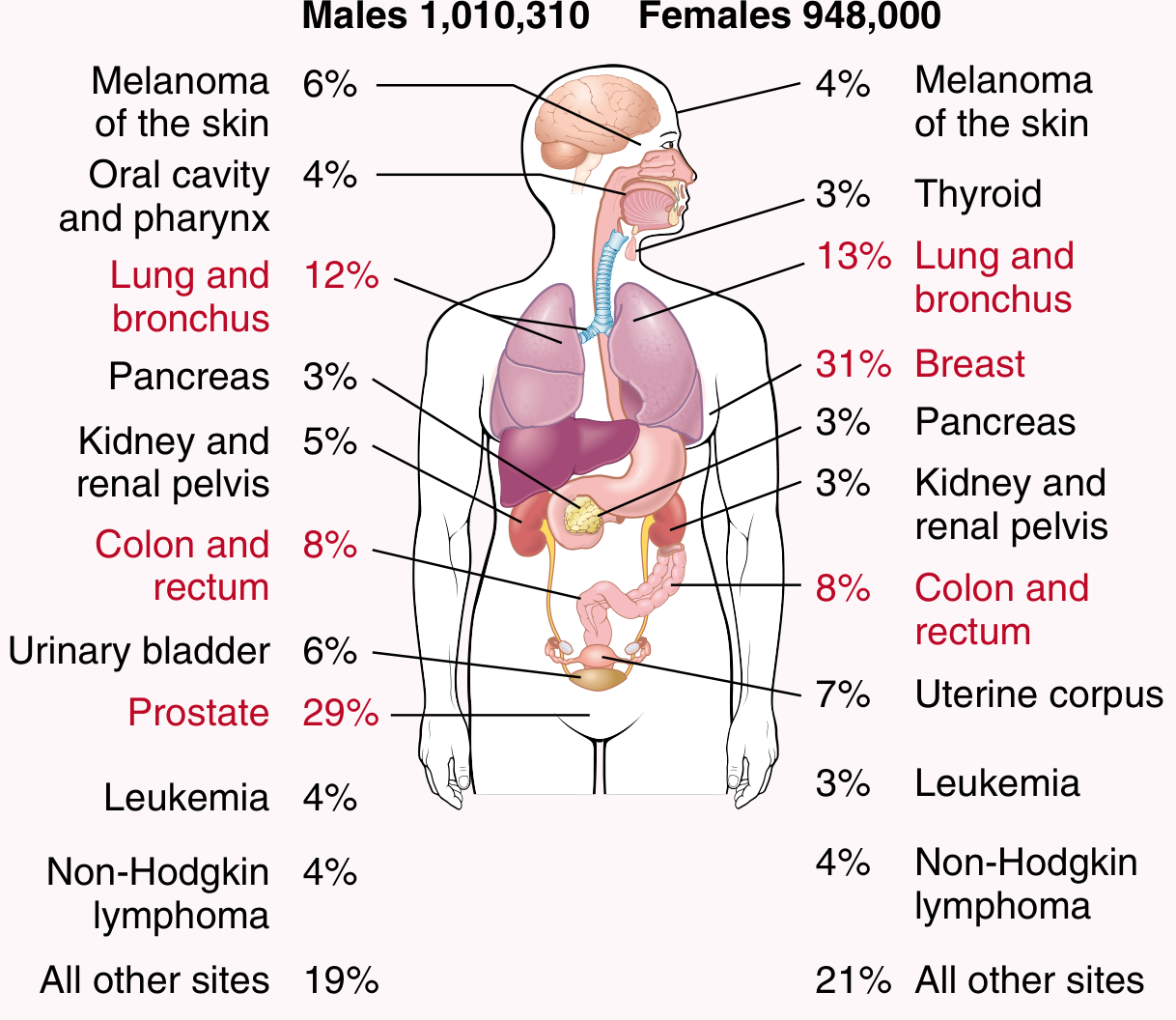
- In males: most common cancers are prostate, lung, and colon/rectum
- In females: breast, lung, and colon/rectum are most frequent
- Cancers of the lung, female breast, prostate, and colon/rectum constitute more than 50% of all cancer diagnoses and deaths in the United States
Trends Over Time
- During the last 50 years of the 20th century, age-adjusted cancer death rates increased in both males and females
- Since 1990, cancer death rate in males has decreased by approximately 20% - mainly due to lower rates of lung, prostate, and colorectal cancer
- Since 1991, cancer death rate in females has fallen by approximately 10% - due to reductions in breast and colorectal cancer deaths
- Decreased tobacco use is responsible for reduction in lung cancer deaths
- Improved detection and treatment account for decreases in colorectal, breast, and prostate cancer rates
Geographic and Racial Variation
- Geographic variation in cancer incidence results mostly from different environmental exposures: smoking, alcohol, diet, obesity, reproductive history, carcinogen exposure
- Prostate cancer is the most common male cancer in the US and developed countries, while cancers of liver, stomach, esophagus, bladder, and lung top the list in other regions
- Breast cancer incidence is much higher in high-resource countries than in low-resource nations
- Racial/ethnic disparities are largely due to differences in social determinants of health (access to healthcare, socioeconomic factors), not biologic differences
Environmental Factors (Major)
| Factor | Cancer Association |
|---|---|
| Infectious agents | ~15% of all cancers worldwide (HPV → cervical cancer, head & neck; HBV/HCV → hepatocellular carcinoma) |
| Tobacco smoking | Lung, oropharynx, larynx, esophagus, bladder, kidney |
| Alcohol | Oropharynx, larynx, esophagus; hepatocellular carcinoma (via cirrhosis) |
| Diet | Colorectal, prostate, breast cancer (linked to high fat, low fiber intake) |
| Obesity | 11% of cancers in females and 5% in males; especially endometrial (60% associated with obesity) |
| Reproductive history | Lifelong estrogen exposure increases risk of breast and endometrial cancer |
| Environmental carcinogens | UV rays, asbestos, arsenic, air pollutants, grilled meat |
Age and Cancer
- Cancer is the leading cause of death in people aged 45-64 years in the United States
- It is second only to heart disease in those over age 65
- Rising incidence with age is explained by accumulation of somatic mutations
- In children (<15 years): cancer accounts for ~10% of all deaths; acute leukemia and CNS tumors account for ~60% of childhood cancer deaths
- Pediatric cancers are more commonly caused by inherited mutations and less by environmental carcinogens
Acquired Predisposing Conditions
-
Chronic inflammation: e.g., Barrett esophagus (esophageal adenocarcinoma), chronic hepatitis (hepatocellular carcinoma), H. pylori gastritis (gastric cancer)
-
Hormonal imbalance: Excessive estrogen stimulation in breast and endometrial cancer
-
Pre-neoplastic lesions: Dysplasia of epithelial linings (e.g., cervical dysplasia detected by Pap smear)
-
Robbins, Cotran & Kumar Pathologic Basis of Disease; Robbins & Kumar Basic Pathology
3. National Tobacco Control Programme (NTCP)
Legislative Background: COTPA 2003
The Cigarettes and Other Tobacco Products (Prohibition of Advertisement and Regulation of Trade and Commerce, Production, Supply and Distribution) Act, 2003 (COTPA) was passed by Parliament in April 2003, notified in the Gazette of India on 25th February 2004.
Key provisions:
- Prohibition of smoking in public places (rules in force from 2nd October 2008)
- Prohibition of direct and indirect advertisement of cigarettes and tobacco products
- Prohibition of sale of tobacco products to persons below 18 years of age
- Prohibition of sale near educational institutions
- Mandatory pictorial health warnings on tobacco packs (85% of principal display area on both sides - 60% picture + 25% text; in force from April 1, 2016)
- Mandatory depiction of tar and nicotine contents on tobacco packs
- 34 states/UTs banned manufacture, sale, and storage of gutka and pan masala containing tobacco or nicotine (2014-15)
National Tobacco Control Programme (NTCP)
Launched under the 11th Five Year Plan to:
- Facilitate implementation of tobacco control laws
- Create awareness about harmful effects of tobacco
- Fulfill obligations under the WHO-Framework Convention on Tobacco Control (FCTC)
Pilot phase: Launched in 2007-08 covering 16 districts in 9 states
Current coverage: 108 districts in 31 states
Main Components of NTCP
- Public awareness and mass media campaigns for awareness building and behavioral change
- Establishment of tobacco product testing laboratories
- Mainstreaming programme components as part of health delivery under the NRHM framework
- Mainstream research and training on alternate crops and livelihood with nodal ministries
- Monitoring and evaluation, including surveillance (e.g., Adult Tobacco Survey)
- Dedicated tobacco control cells for effective implementation and monitoring of anti-tobacco initiatives
- Training of health and social workers, NGOs, school teachers
- School programme for youth
- Tobacco cessation facilities at district and community level
NTCP at Community Health Centre (CHC) Level
Essential services:
- Health education and IEC activities on harmful effects of tobacco and second-hand smoke
- Promoting quitting of tobacco and offering brief advice to all smokers/tobacco users
- Making CHC premises tobacco-free and displaying mandatory signages
Desirable services:
-
Setting up a Tobacco Cessation Clinic by training a counselor in tobacco cessation
-
Park's Textbook of Preventive and Social Medicine
Summary Table
| Topic | Key Points |
|---|---|
| NCD Definition | Chronic, non-transmissible, multifactorial diseases; 4 main groups: CVD, cancer, chronic respiratory, diabetes |
| NCD Burden | Responsible for ~70% of global deaths; top risk factors: tobacco, physical inactivity, alcohol, unhealthy diet |
| Cancer Epidemiology | 9.9 million deaths in 2020; projected 13.2 million by 2030; top sites: lung, breast, prostate, colorectal |
| Cancer Risk Factors | Tobacco, infections (HPV, HBV), alcohol, obesity, diet, carcinogens, age, genetic predisposition |
| NTCP | Launched 11th FYP; covers 108 districts, 31 states; 9 components including cessation, IEC, legislation enforcement |
This is a shared conversation. Sign in to Orris to start your own chat.