
Reduction criteria for Distal end radius fractures
Reading File
The reduction criteria for distal radius fractures include: radial length >11mm, radial inclination >22°, volar tilt 11-12°, and articular step-off <2mm. Let me pull the full details from the textbooks.
Searching sources...
Finding Sources
Finding Sources
Reading File
Reading File
Finding Sources
Finding Sources
Reading File
Reading File
Reading File
Loading Image
Here is a complete, textbook-based summary of the reduction criteria for distal end radius fractures.
Reduction Criteria for Distal End Radius Fractures
Normal Radiographic Anatomy (the "11-22-11" rule)
These are the baseline values you are trying to restore:
| Parameter | Normal Value |
|---|---|
| Radial height (radial length) | 11-12 mm |
| Radial inclination | 22-23 degrees |
| Volar tilt | 11-12 degrees |
| Ulnar variance | ±2 mm |
Radiographic Measurements - How to Take Them
The three key radiographic measurements are shown in the X-ray below:
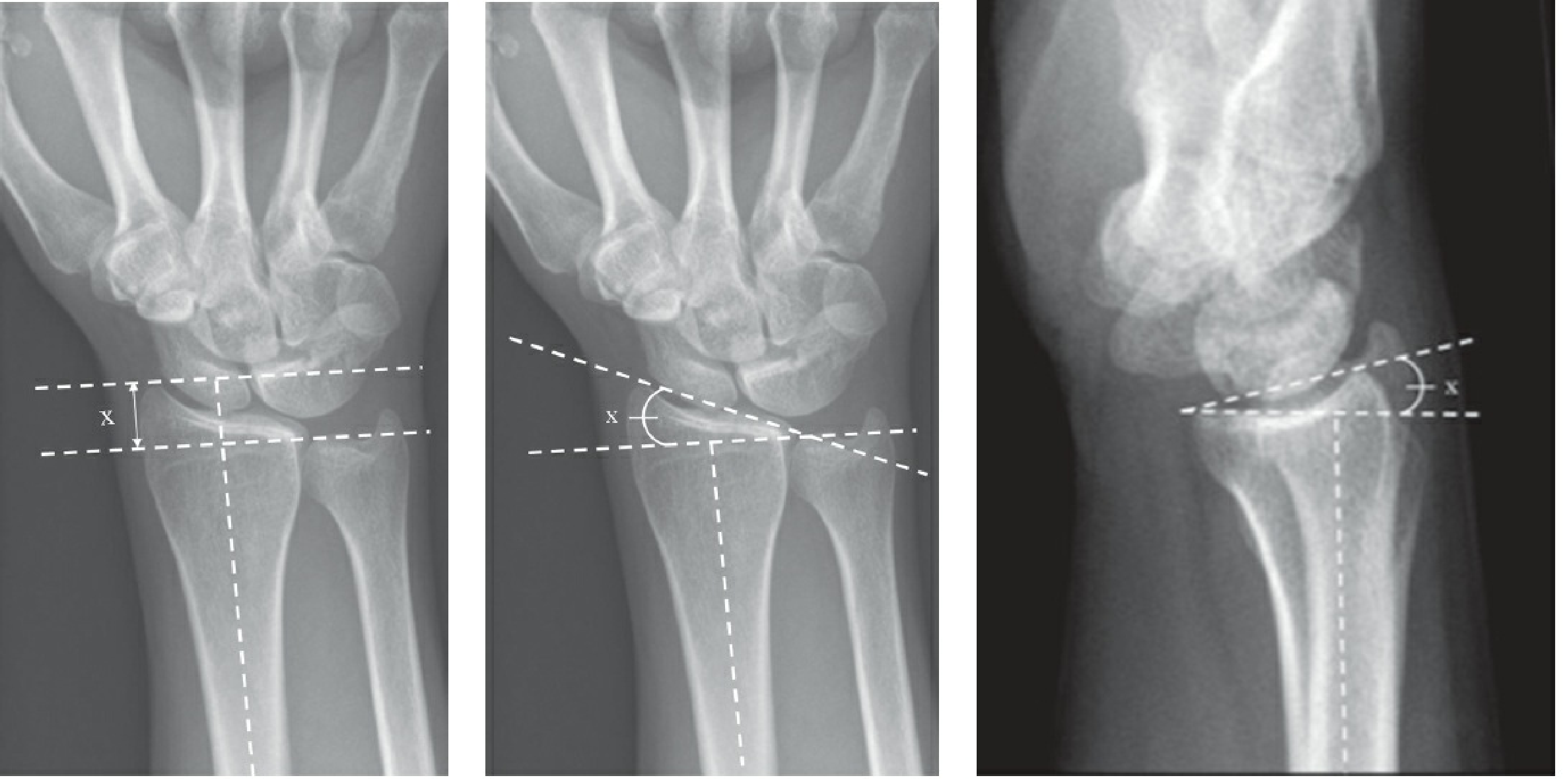
- Radial height (A): Distance on PA view between two parallel lines perpendicular to the radial shaft - one at the distal ulnar head, one at the radial styloid. Average 11-12 mm (normal range 8-18 mm).
- Radial inclination (B): Angle on PA view between a line perpendicular to the radial shaft and a line from the DRUJ to the radial styloid. Average 22-23 degrees (normal range 12-30 degrees).
- Volar tilt (C): Angle on true lateral view between a line perpendicular to the radial shaft and a line connecting the volar and dorsal rims of the distal radius. Average 11-22 degrees (normal range 0-28 degrees).
Criteria for Acceptable Reduction (Campbell's Operative Orthopaedics, 15th Ed.)
| Criterion | Normal | Acceptable |
|---|---|---|
| Ulnar variance (radial length) | ±2 mm (lunate facet vs. ulnar head) | No more than 2 mm shortening relative to ulnar head |
| Radial height | 12 mm | Less than 3 mm shortening |
| Palmar (volar) tilt | 11 degrees of volar tilt | Less than 10 degrees of dorsal tilt |
| Radial inclination | 20 degrees (lunate facet to radial styloid) | No less than 10 degrees |
| Intraarticular step or gap | None | Less than 2 mm of either |
Graham's Criteria for Acceptable Healing (Campbell's Operative Orthopaedics, 15th Ed.)
A broader set of criteria used to assess healed fractures and define malunion:
| Criterion | Acceptable Measurement |
|---|---|
| Radioulnar length | Radial shortening <5 mm at DRUJ compared with contralateral wrist |
| Radial inclination | ≥15 degrees on PA film |
| Radial tilt (sagittal) | Between 15 degrees dorsal tilt and 20 degrees volar tilt |
| Articular incongruity | ≤2 mm at radiocarpal joint |
Miller's Review - Quick Summary (Acceptable Reduction)
- Radial shortening: <3 mm
- Dorsal tilt: <10 degrees
- Intraarticular step-off: <2 mm
Indications for Surgery (Failure of Acceptable Reduction)
Parameters associated with poor outcome and likely need for operative management:
- Intraarticular step-off >2 mm at radiocarpal joint
- Step-off >1-2 mm at DRUJ
- Dorsal angulation >20 degrees
- Radial inclination <10 degrees
- Loss of sagittal tilt 20-30 degrees
- Radius shortening >6 mm (causes DRUJ dysfunction)
- Fractures with >25-30 degrees of angulation in frontal or sagittal plane
Lafontaine Criteria - Predicting Instability After Reduction
If 3 or more of the following are present on the initial radiograph, secondary displacement despite closed reduction is likely, suggesting the need for operative management:
- Dorsal angulation >20 degrees
- Dorsal comminution
- Intra-articular radiocarpal fracture
- Associated ulna fracture
- Age over 60
Note: Nesbitt et al. later validated these criteria and found age was the strongest single predictor of secondary displacement. MacKenney et al. (reviewing ~4,000 fractures) identified age, ulnar variance, and metaphyseal comminution as the most consistent predictors - and notably, dorsal angulation was not a significant predictor in that study.
Clinical Monitoring Guidance
For fractures treated closed with radiographic features that increase instability risk: weekly radiographs for the first 3 weeks are recommended so early surgical intervention can occur if the fracture displaces unacceptably.
- Campbell's Operative Orthopaedics, 15th Ed. 2026 - Table 62.13
- Rockwood and Green's Fractures in Adults, 10th Ed. 2025
- Miller's Review of Orthopaedics, 9th Ed.
This is a shared conversation. Sign in to Orris to start your own chat.