
Im 1st year mbbs student at Hngu university [ Bhagyoday medical college Kadi ] in exam imp questions list i saw one question is 8 mark question is Tca cycle [ cycle, energetic, regulation ]give a answer of this question easy to understand English language,when I read this question answer I understand easily, give answer this type when I read this question answer first time so much answer I understand easily in first time and when i write this in exam my sir will give me full out of full marks and easy to read and understand,answer give as 1 st year mbbs [ Biochemistry ]and easy to understand and write Thank you
Reading File
Finding Sources
Finding Sources
Reading File
Reading File
Reading File
Reading File
Reading File
Reading File
Now I have all the information I need from both Lippincott's and Basic Medical Biochemistry. Let me also fetch the TCA cycle diagram image to include it.
Loading Image
Loading Image
I now have everything I need. Here is a complete, exam-ready answer written specifically for a 1st year MBBS student at Bhagyoday Medical College.
TCA Cycle (Krebs Cycle / Citric Acid Cycle)
8 Marks - Biochemistry | 1st Year MBBS
INTRODUCTION
The TCA cycle (Tricarboxylic Acid cycle), also called the Krebs cycle or Citric Acid cycle, was discovered by Sir Hans Krebs in 1937. It is the final common pathway for the oxidation of carbohydrates, fats, and proteins. It is a cyclic series of 8 reactions that takes place in the mitochondrial matrix.
Simple way to remember: "The TCA cycle burns acetyl CoA to make energy (ATP) using oxygen."
PART 1: THE CYCLE (Steps)
Location
- Mitochondrial matrix (inner membrane for one step)
Starting Material
- Acetyl CoA (2-carbon compound) - comes from pyruvate (glycolysis), fatty acids (beta-oxidation), or amino acids
- Acetyl CoA enters the cycle by joining with Oxaloacetate (OAA) (4-carbon compound)
The 8 Steps - Easy Table
| Step | Substrate | Product | Enzyme | What happens | Coenzyme produced |
|---|---|---|---|---|---|
| 1 | OAA (4C) + Acetyl CoA (2C) | Citrate (6C) | Citrate synthase | Condensation | - |
| 2 | Citrate (6C) | Isocitrate (6C) | Aconitase | Isomerization (via aconitate) | - |
| 3 | Isocitrate (6C) | α-Ketoglutarate (5C) | Isocitrate dehydrogenase | Oxidative decarboxylation | NADH + CO₂ |
| 4 | α-Ketoglutarate (5C) | Succinyl CoA (4C) | α-Ketoglutarate dehydrogenase complex | Oxidative decarboxylation | NADH + CO₂ |
| 5 | Succinyl CoA (4C) | Succinate (4C) | Succinyl CoA synthetase (thiokinase) | Substrate-level phosphorylation | GTP |
| 6 | Succinate (4C) | Fumarate (4C) | Succinate dehydrogenase | Oxidation | FADH₂ |
| 7 | Fumarate (4C) | Malate (4C) | Fumarase (Fumarate hydratase) | Hydration | - |
| 8 | Malate (4C) | Oxaloacetate (4C) | Malate dehydrogenase | Oxidation | NADH |
Memory Tip for intermediates: "Citrate Is Krebs' Starting Substrate For Making Oxaloacetate" C - Citrate, I - Isocitrate, K - α-Ketoglutarate, S - Succinyl CoA, S - Succinate, F - Fumarate, M - Malate, O - Oxaloacetate
Key points about the cycle:
- 2 carbons enter as Acetyl CoA; 2 carbons leave as CO₂
- OAA is regenerated at the end - so the cycle can keep running
- The cycle is a closed loop - it does NOT consume OAA net
PART 2: ENERGETICS
Per 1 turn of TCA cycle (per 1 acetyl CoA oxidized):
| Product | Amount | ATP yield each | Total ATP |
|---|---|---|---|
| NADH | 3 | × 2.5 ATP | = 7.5 ATP |
| FADH₂ | 1 | × 1.5 ATP | = 1.5 ATP |
| GTP | 1 | × 1 ATP | = 1 ATP |
| TOTAL | = 10 ATP |
Note: Using the modern P/O ratios (NADH = 2.5 ATP, FADH₂ = 1.5 ATP). Some older books use NADH = 3 ATP, FADH₂ = 2 ATP giving 12 ATP. Both values are acceptable - just be consistent.
Per 1 molecule of Glucose (2 turns of TCA cycle):
- Glucose → 2 Pyruvate (glycolysis) → 2 Acetyl CoA (PDH complex) → 2 turns of TCA cycle
- TCA alone gives: 2 × 10 = 20 ATP
Summary of what TCA produces per turn:
- 3 NADH (at steps 3, 4, 8)
- 1 FADH₂ (at step 6)
- 1 GTP (at step 5)
- 2 CO₂ (at steps 3 and 4)
PART 3: REGULATION
The TCA cycle is regulated to match the cell's energy demand. When ATP is low → cycle speeds up. When ATP is high → cycle slows down.
Three Key Regulated Enzymes:
1. Citrate Synthase (Step 1)
- Inhibited by: Citrate (product inhibition), ATP, NADH, Succinyl CoA
- Activated by: OAA (substrate increases its activity), ADP
2. Isocitrate Dehydrogenase (Step 3) - MOST IMPORTANT REGULATORY ENZYME
- Inhibited by: ATP, NADH (high energy state)
- Activated by: ADP, Ca²⁺ (low energy state / exercise)
3. α-Ketoglutarate Dehydrogenase Complex (Step 4)
- Inhibited by: NADH, Succinyl CoA (products)
- Activated by: Ca²⁺
Simple Rule to Remember:
High energy (high ATP/NADH) = TCA slows down Low energy (high ADP) = TCA speeds up
Regulation Diagram:
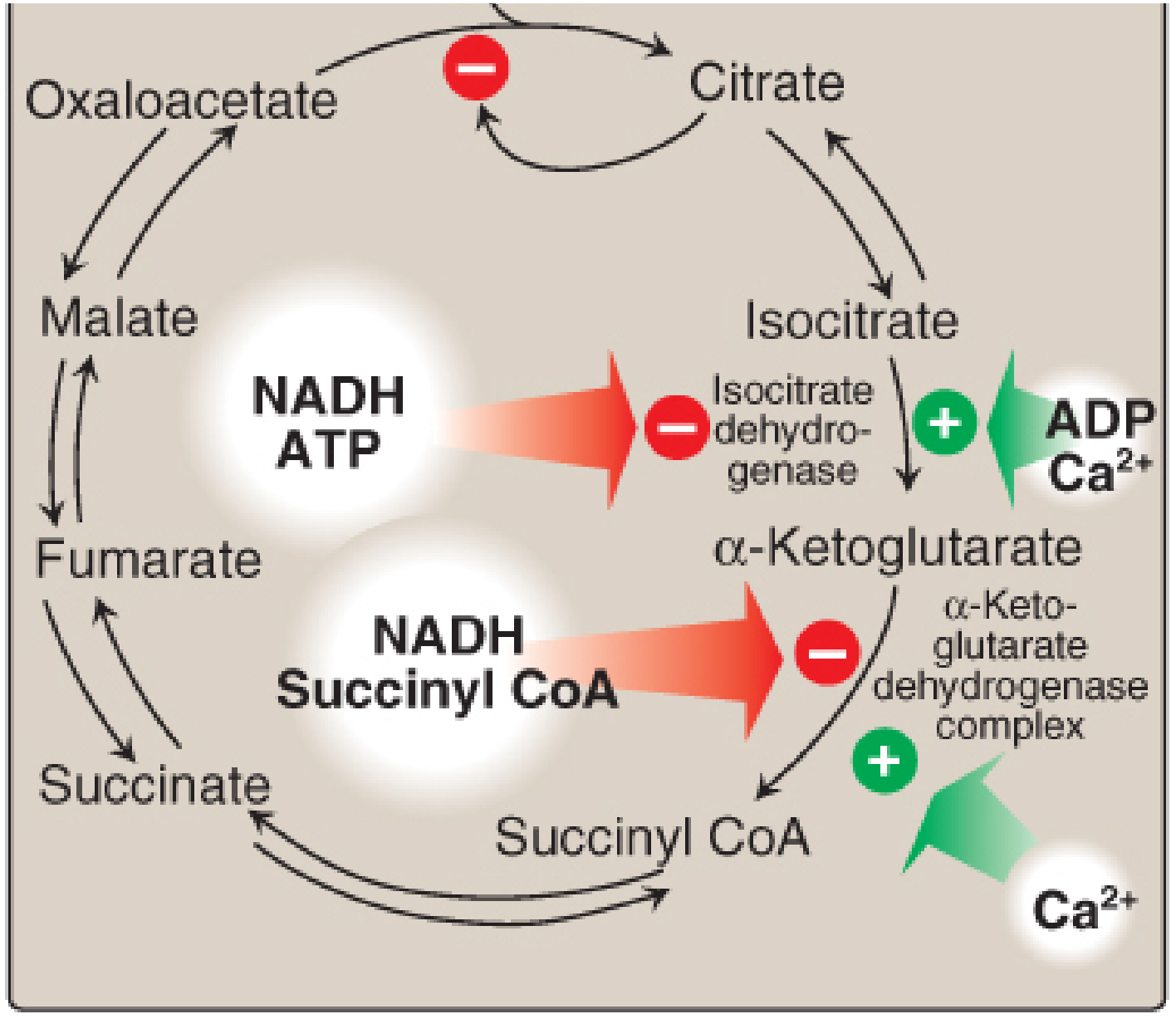
Role of Calcium (Ca²⁺):
- During muscle contraction, Ca²⁺ increases inside mitochondria
- Ca²⁺ activates isocitrate dehydrogenase and α-ketoglutarate dehydrogenase
- This increases TCA rate to meet energy demands of exercise
ADDITIONAL IMPORTANT POINTS FOR EXAMS
Where does TCA cycle occur?
- Mitochondrial matrix (all enzymes except succinate dehydrogenase, which is on the inner mitochondrial membrane)
What feeds into the TCA cycle?
- Carbohydrates: Glucose → Pyruvate → Acetyl CoA
- Fats: Fatty acids → Acetyl CoA (via beta-oxidation)
- Amino acids: Many amino acids enter as intermediates (OAA, α-KG, fumarate, etc.)
Anaplerotic Reactions:
- When TCA intermediates are removed for biosynthesis, they must be replaced
- Example: Pyruvate carboxylase converts Pyruvate → OAA (replenishes OAA)
Clinical Significance:
- Deficiency of thiamine (Vitamin B₁) impairs the α-ketoglutarate dehydrogenase complex → Wernicke's encephalopathy
- Arsenic poisoning inhibits lipoic acid-dependent enzymes (PDH complex and α-KG dehydrogenase)
- Fluoroacetate (rat poison) inhibits aconitase → TCA is blocked
QUICK REVISION SUMMARY (Write this in exam for full marks)
| Details | |
|---|---|
| Location | Mitochondrial matrix |
| Starting material | Acetyl CoA + OAA → Citrate |
| No. of steps | 8 |
| NADH produced | 3 per turn |
| FADH₂ produced | 1 per turn |
| GTP produced | 1 per turn |
| CO₂ released | 2 per turn |
| Total ATP per turn | ~10 ATP |
| Key regulatory enzymes | Citrate synthase, Isocitrate DH, α-KG DH complex |
| Activators | ADP, Ca²⁺ |
| Inhibitors | ATP, NADH, Succinyl CoA |
Source: Lippincott's Illustrated Reviews: Biochemistry, 8th ed.; Basic Medical Biochemistry - A Clinical Approach, 6th ed.
Good luck in your exam! This structure - Introduction, Cycle steps (table), Energetics, Regulation - is exactly what examiners want to see for an 8-mark question. Write each part clearly with headings, include the table of intermediates, and end with the summary table.
This is a shared conversation. Sign in to Orris to start your own chat.