
Explain pathophysiology and pharcotherapy of parkinson
I'll start by reading the medical library skill, then search for comprehensive information on Parkinson's pathophysiology and pharmacotherapy in parallel.
Reading File
Now I'll run parallel searches across the library for pathophysiology and pharmacotherapy of Parkinson's disease.
Finding Sources
Finding Sources
Searching PubMed
"Parkinson disease"[MeSH Terms] AND "pathophysiology"[MeSH Terms]
!
HTTP 502 for https://eutils.ncbi.nlm.nih.gov/entrez/eutils/esearch.fcgi?tool=orrisai&email=dev%40orris.ai&api_key=***&db=pubmed&term=%28%22Parkinson+disease%22%5BMeSH+Terms%5D+AND+%22pathophysiology%22%5BMeSH+Terms%5D%29+AND+%28%22Systematic+Review%22%5Bpt%5D+OR+%22Review%22%5Bpt%5D%29+NOT+%22Retracted+Publication%22%5Bpt%5D&retmode=json&retmax=3&sort=relevance&datetype=pdat&reldate=730
We encountered an error while processing your request. Please try again or reach out to us for help.
Explain pathophysiology and pharcotherapy of parkinson
Reading File
Good. This is a broad topic - I'll run parallel searches across the library for headings, pathophysiology content, and pharmacotherapy content simultaneously.
Finding Sources
Finding Sources
Finding Sources
Searching PubMed
"Parkinson disease"[MeSH Terms] AND "pathophysiology"
Excellent results. Now I'll read the most comprehensive neurology sources - Bradley & Daroff's neurology block (which has dedicated PD chapter) and Katzung's pharmacology block for pharmacotherapy, in parallel.
Reading File
Reading File
Finding Sources
Finding Sources
Good. Now let me pull the main pathophysiology block from Bradley & Daroff's and more pharmacotherapy detail from Katzung.
Reading File
Reading File
Let me get the key pathophysiology and the levodopa/MAO-B sections from Katzung.
Reading File
Reading File
Now let me get the key pathophysiology section (basal ganglia circuitry, Lewy bodies, alpha-synuclein) and the MAO-B/selegiline section from Katzung.
Reading File
Reading File
Let me get the core pathophysiology (basal ganglia model) and amantadine sections, plus fetch the key diagram.
Reading File
Loading Image
Now let me get the basal ganglia circuitry diagram and the key pharmacotherapy diagram, plus amantadine section.
Loading Image
Reading File
Finding Sources
I now have comprehensive material. Let me also fetch the pharmacological strategies diagram and get the levodopa adverse effects section.
Loading Image
Reading File
I now have comprehensive material from Katzung's Basic & Clinical Pharmacology 16th ed and Bradley & Daroff's Neurology. I have everything needed for a thorough response. Let me now compose the full answer.
Parkinson's Disease: Pathophysiology and Pharmacotherapy
Part 1 - Pathophysiology
1. Core Neuropathology
Parkinson's disease (PD) is a progressive neurodegenerative disorder in which symptoms typically emerge between 55 and 65 years of age. The defining neuropathological feature is the selective loss of dopaminergic neurons in the substantia nigra pars compacta (SNpc) - the pigmented neurons projecting via the nigrostriatal pathway to the corpus striatum (caudate nucleus + putamen). Symptoms only become apparent after roughly 70-80% of these neurons have been lost.
Beyond the substantia nigra, neurodegeneration also affects:
- The locus coeruleus (noradrenergic)
- Dorsal vagal nucleus (autonomic)
- Enteric nervous system
- Olfactory bulb and cortical areas
The hallmark pathological finding at autopsy is the Lewy body - an eosinophilic intraneuronal inclusion body composed predominantly of alpha-synuclein protein aggregates. Misfolded alpha-synuclein is thought to propagate in a prion-like fashion through neural networks, explaining the staging of neurodegeneration (Braak staging).
2. Basal Ganglia Circuit Model
The pathophysiology of motor symptoms is best understood through the direct/indirect pathway model of basal ganglia circuitry:
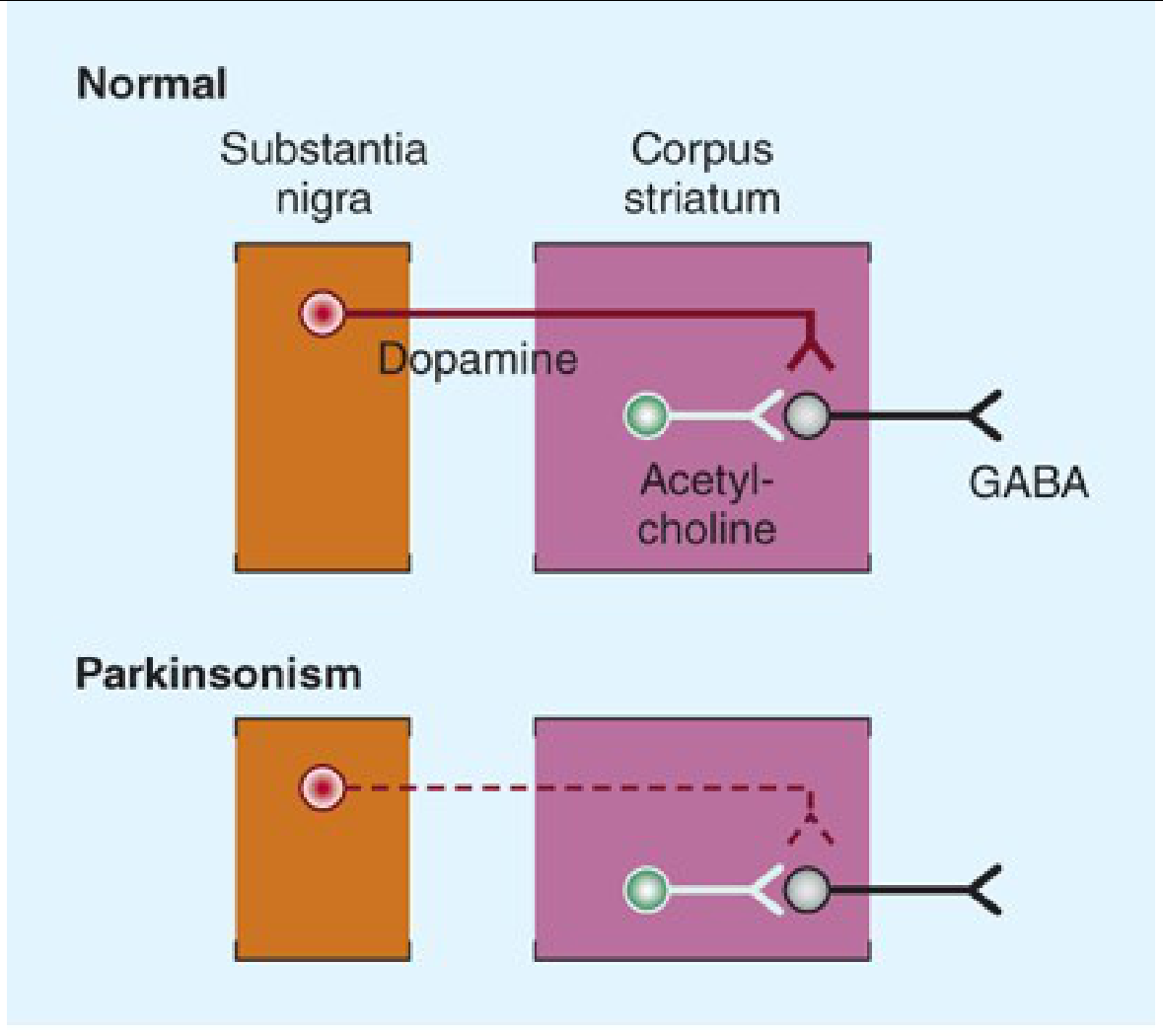
Katzung's Basic and Clinical Pharmacology, 16e
The basic circuitry involves three interacting neuronal loops linking the cortex, basal ganglia, and thalamus. The major neurotransmitters and their roles:
| Structure | Normal Role | In PD |
|---|---|---|
| SNpc dopaminergic neurons | Inhibit indirect pathway (via D2), facilitate direct pathway (via D1) | Degenerate - dopamine falls |
| Direct pathway (striatum → GPi/SNpr) | Inhibits GPi → disinhibits thalamus → facilitates movement | Underactive |
| Indirect pathway (striatum → GPe → STN → GPi) | Activates GPi → inhibits thalamus → suppresses movement | Overactive |
| Subthalamic nucleus (STN) | Glutamatergic excitation of GPi | Overactive - excessive glutamate |
| Globus pallidus internus (GPi) | GABAergic inhibition of thalamus | Overactive |
Net result in PD: Loss of dopamine → indirect pathway overactivity and direct pathway underactivity → GPi overactivity → excessive thalamic inhibition → reduced cortical motor activation → bradykinesia, rigidity, and tremor.
In PD, there is a selective loss of dopaminergic neurons (dashed, red in the diagram), causing the inhibitory dopamine signal to the striatum to fail. Simultaneously, striatal cholinergic activity becomes relatively dominant - an imbalance that underlies tremor and rigidity and is exploited pharmacologically.
3. Neurotransmitter Imbalance Summary
| Neurotransmitter | Change in PD | Clinical Consequence |
|---|---|---|
| Dopamine (nigrostriatal) | Decreased | Bradykinesia, rigidity, postural instability |
| Acetylcholine (striatal) | Relatively increased | Tremor (rest tremor), rigidity |
| Glutamate (STN output) | Increased | Excitotoxicity, motor suppression |
| Norepinephrine (locus coeruleus) | Decreased | Autonomic dysfunction, postural hypotension |
| Serotonin | Decreased | Depression (very common in PD) |
4. Clinical Features (from Circuit Dysfunction)
Cardinal motor features (TRAP):
- Tremor at rest (4-6 Hz "pill-rolling")
- Rigidity ("cogwheel" or "lead-pipe")
- Akinesia / bradykinesia
- Postural instability (late feature)
Non-motor features (from extra-nigral degeneration):
- Anosmia (often precedes motor symptoms by years)
- REM sleep behavior disorder
- Constipation / autonomic dysfunction
- Depression and anxiety
- Cognitive impairment / dementia (late)
- Dysphagia (present in up to 82% on objective testing)
Part 2 - Pharmacotherapy
The pharmacological strategy targets the dopamine deficiency (augment dopamine) and/or the cholinergic excess (reduce acetylcholine). The diagram below summarizes the key sites of drug action:
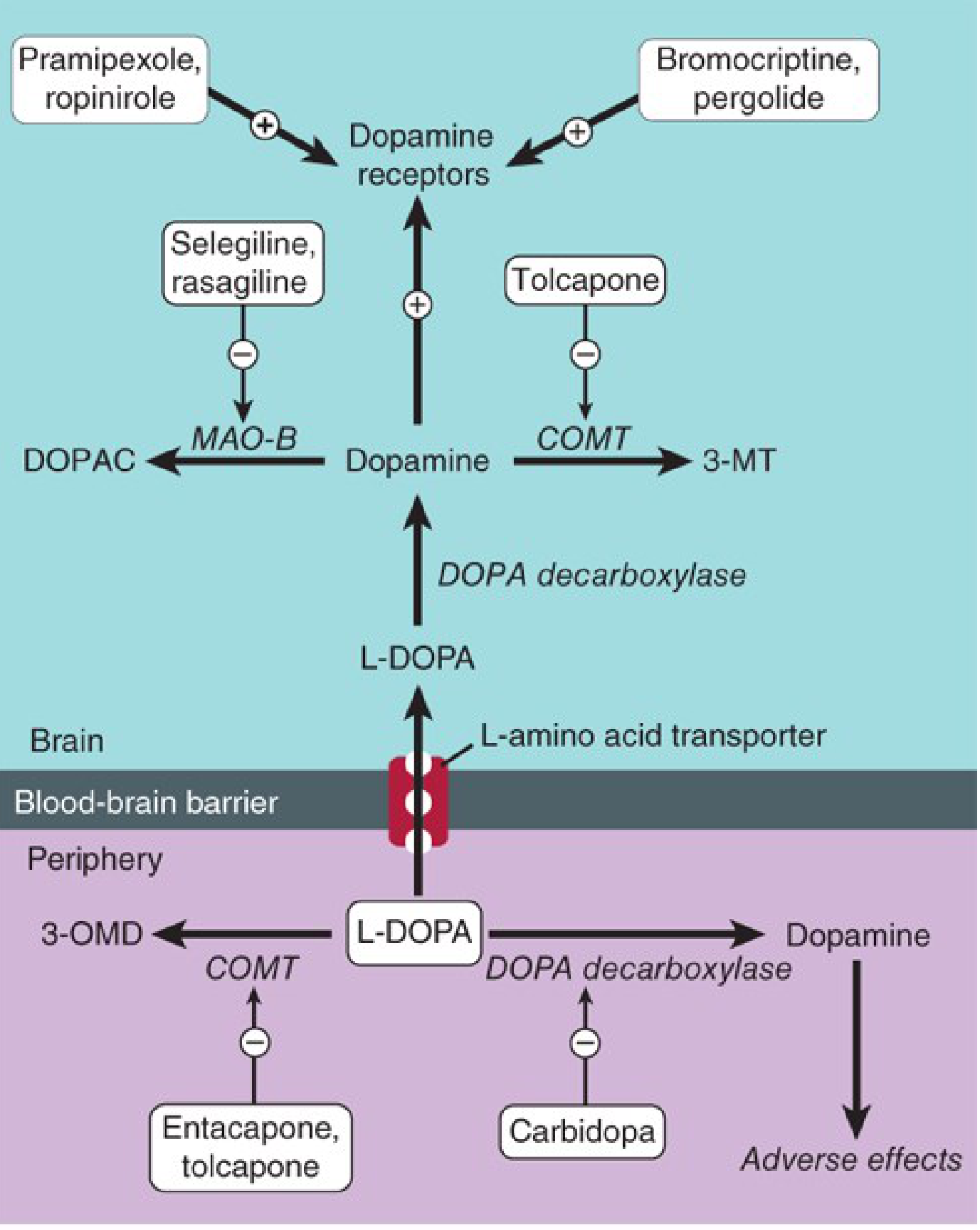
Katzung's Basic and Clinical Pharmacology, 16e - Drug targets in dopamine metabolism at the synapse and periphery
Drug Class 1: Levodopa (L-DOPA) + Carbidopa
Mechanism: Dopamine itself cannot cross the blood-brain barrier (BBB). Levodopa, its immediate metabolic precursor, crosses the BBB via the L-amino acid transporter (LAT) and is decarboxylated to dopamine in the brain. Carbidopa is a peripheral DOPA decarboxylase inhibitor that does NOT cross the BBB - it blocks the peripheral conversion of levodopa to dopamine, thereby:
- Reducing peripheral side effects (nausea, vomiting, cardiac arrhythmias)
- Increasing the fraction of levodopa reaching the brain (by ~5x)
- Allowing a lower levodopa dose
Benefit: Most effective drug for PD - particularly excellent for bradykinesia. About one-third of patients respond very well.
Key formulations:
- Sinemet (carbidopa/levodopa 25/100, 10/100, 25/250)
- Rytary - extended-release capsules
- Parcopa - orally disintegrating tablet
- Stalevo - combination with entacapone (COMT inhibitor)
- Duopa/Duodopa - intestinal gel infusion for advanced PD with severe fluctuations
Adverse effects:
Peripheral (blocked by carbidopa):
- Nausea, vomiting (80% without carbidopa; much less with it)
- Postural hypotension
- Cardiac arrhythmias
Central (not blocked by carbidopa):
- Motor fluctuations with long-term use:
- "Wearing off" - benefit wears off before next dose
- "On-off" phenomenon - unpredictable switches between mobile ("on") and immobile ("off") states
- Dyskinesias - involuntary choreiform movements (peak-dose or biphasic)
- Psychiatric effects: hallucinations, confusion, psychosis, impulse control disorders
Drug Class 2: Dopamine Agonists
Mechanism: Directly stimulate postsynaptic dopamine receptors (primarily D2 family), bypassing the degenerating presynaptic neurons. Benefits are mostly via D2 receptor stimulation; D1 stimulation may enhance the effect.
Key agents:
| Drug | Receptor | Notes |
|---|---|---|
| Pramipexole | D2/D3 preferential | Non-ergot; first-line monotherapy |
| Ropinirole | D2/D3 | Non-ergot; first-line monotherapy |
| Rotigotine | D1, D2, D3 | Transdermal patch - continuous delivery |
| Apomorphine | D2 potent agonist | Subcutaneous "rescue" for off-periods; onset ~10 min |
| Bromocriptine | D2 agonist (ergot) | Now rarely used for PD |
| Pergolide | D1+D2 (ergot) | Withdrawn in US - valvular heart disease |
Clinical use: Often used as first-line therapy (especially in patients <70 years) to delay levodopa and reduce risk of long-term motor complications. Also used as add-on to levodopa for "wearing off."
Adverse effects: More mental side effects than levodopa, including somnolence (sudden "sleep attacks" - critical for drivers), hallucinations, impulse control disorders (gambling, hypersexuality), peripheral edema, nausea, and postural hypotension. Contraindicated in psychotic illness, recent MI, and active peptic ulceration. Ergot-derived agonists should be avoided in peripheral vascular disease.
Drug Class 3: MAO-B Inhibitors
Mechanism: Monoamine oxidase B (MAO-B) selectively metabolizes dopamine in the brain. Inhibiting MAO-B retards dopamine breakdown, prolonging and enhancing its effect. These drugs do NOT inhibit MAO-A at therapeutic doses (avoiding the "cheese effect").
| Drug | Dose | Notes |
|---|---|---|
| Selegiline | 5 mg BID (breakfast + lunch) | Irreversible; metabolized to amphetamine metabolites; may cause insomnia |
| Rasagiline | 1 mg/day (mono) or 0.5-1 mg/day (adjunct) | Irreversible; more potent than selegiline; no amphetamine metabolites |
| Safinamide | 50-100 mg/day | Also inhibits glutamate release; ONLY as adjunct to levodopa |
Key interactions (dangerous - AVOID):
- Meperidine, tramadol, methadone → serotonin syndrome risk
- Dextromethorphan (in OTC cold preparations)
- Cyclobenzaprine, St. John's wort
- SSRIs / TCAs (use cautiously - theoretical serotonin syndrome)
- Non-selective MAO inhibitors → hypertensive crisis risk
Drug Class 4: COMT Inhibitors
Mechanism: Catechol-O-methyltransferase (COMT) metabolizes levodopa peripherally (to 3-OMD) and centrally (dopamine to 3-MT). COMT inhibitors block this, increasing levodopa bioavailability and extending dopamine action. They are always given as adjuncts to levodopa - they have no benefit as monotherapy.
| Drug | Action | Key Feature |
|---|---|---|
| Entacapone | Peripheral only | Preferred agent; 200 mg with each levodopa dose (up to 6x/day) |
| Tolcapone | Central + peripheral | More potent, longer-acting; hepatotoxicity risk - requires LFT monitoring |
| Opicapone | Peripheral, long-acting | Once daily 50 mg at bedtime; newer agent |
Adverse effects: Dyskinesia, nausea, confusion (from increased levodopa exposure - reduce levodopa dose by ~30%); diarrhea, orange urine discoloration, orthostatic hypotension. Tolcapone: rare acute hepatic failure - requires signed consent + LFT monitoring every 2-4 weeks for first 6 months.
Drug Class 5: Amantadine
Mechanism: Weak NMDA glutamate receptor antagonist; may also promote dopamine release and inhibit dopamine reuptake. Anti-glutamatergic action is thought to reduce dyskinesias in the indirect striatal pathway.
Clinical uses:
- Mild early PD (short-term benefit; may wear off after weeks)
- Reduction of levodopa-induced dyskinesias in advanced disease (this is its most important current indication)
Adverse effects: Livedo reticularis, peripheral edema, CNS effects (hallucinations, confusion, psychosis), urinary retention, heart failure. Abrupt withdrawal can cause hyperpyrexia and acute exacerbation of parkinsonism.
Drug Class 6: Anticholinergics (Antimuscarinics)
Mechanism: Block the relatively overactive striatal cholinergic activity that results from dopamine depletion. Restoring the dopamine-acetylcholine balance helps tremor and rigidity but has little effect on bradykinesia.
| Drug | Daily Dose |
|---|---|
| Trihexyphenidyl | 6-20 mg |
| Benztropine mesylate | 1-6 mg |
| Biperiden | 2-12 mg |
| Orphenadrine | 150-400 mg |
| Procyclidine | 7.5-30 mg |
Adverse effects: Dry mouth, blurred vision, urinary retention, constipation, cognitive impairment, hallucinations. Poorly tolerated in elderly or cognitively impaired patients.
Drug Class 7: Adenosine A2A Antagonist
Istradefylline (Nourianz): an analog of caffeine; selective antagonist of adenosine A2A receptors in the striatum. Used as adjunct to carbidopa-levodopa to reduce "off" periods (20 or 40 mg daily). Side effects: dyskinesias, dizziness, constipation, hallucinations.
Summary Table: Pharmacotherapy at a Glance
| Drug/Class | Mechanism | Main Use | Key ADR |
|---|---|---|---|
| Levodopa + carbidopa | DA precursor + peripheral DDI | First-line, best efficacy | Motor fluctuations, dyskinesias, hallucinations |
| Dopamine agonists (pramipexole, ropinirole) | D2/D3 receptor agonist | First-line (young pts), add-on | Somnolence, impulse disorders, hallucinations |
| Selegiline / Rasagiline / Safinamide | MAO-B inhibitor | Early mono or adjunct to L-DOPA | Serotonin syndrome risk (drug interactions) |
| Entacapone / Tolcapone / Opicapone | COMT inhibitor | Adjunct to L-DOPA, reduce "off" | Dyskinesias, diarrhea, hepatotoxicity (tolcapone) |
| Amantadine | NMDA antagonist | Dyskinesias, mild early PD | Livedo reticularis, hallucinations |
| Anticholinergics (trihexyphenidyl etc.) | Muscarinic blocker | Tremor & rigidity (NOT bradykinesia) | Confusion, urinary retention (avoid in elderly) |
| Istradefylline | Adenosine A2A antagonist | Adjunct - reduce "off" time | Dyskinesias, hallucinations |
| Apomorphine (s.c.) | Potent D2 agonist | Rescue for off-periods | Severe nausea (need antiemetic pretreatment) |
Non-pharmacological Interventions
- Deep Brain Stimulation (DBS) of the subthalamic nucleus (STN) or globus pallidus internus (GPi): modulates overactive basal ganglia circuitry; used for advanced PD with motor fluctuations or dyskinesias not controlled medically. STN-DBS allows greater medication reduction; GPi-DBS provides better dyskinesia control with a relatively safer neuropsychiatric profile.
- Focused ultrasound thalamotomy: for medically refractory tremor-predominant PD.
- Duodenal infusion of carbidopa-levodopa gel (Duopa): for severe response fluctuations in advanced disease.
Sources:
- Katzung's Basic and Clinical Pharmacology, 16th Edition - Chapter 28: Pharmacologic Management of Parkinsonism
- Bradley and Daroff's Neurology in Clinical Practice - Parkinson Disease sections
- Adams and Victor's Principles of Neurology, 12th Edition
- Recent review: Stocchi et al., Nat Rev Neurol 2024 Dec - Parkinson disease therapy: current strategies and future research priorities (PMID 39496848)
This is a shared conversation. Sign in to Orris to start your own chat.