
Explain each and everything about transition stage
Asking for Preferences
Which transition stage are you referring to?
Could you clarify what you mean by "transition stage"? For example:
- Labor/childbirth - the transition phase of the first stage of labor (8-10 cm dilation)
- Adolescence - the developmental transition from childhood to adulthood
- Group dynamics - Tuckman's forming-storming-norming model
- Nursing/caregiving - Bridges' transition model
- Something else entirely - like a transition in physics, chemistry, music, etc.
Please specify so I can give you the most accurate and thorough answer!
Transition stage of carbohydrate metabolism
The transition stage (also called the pyruvate dehydrogenase reaction or the link reaction) is the step that connects glycolysis to the TCA cycle. Pyruvate is converted to Acetyl-CoA in the mitochondrial matrix, releasing CO2 and producing NADH in the process.
Searching sources...
Reading File
Finding Sources
Finding Sources
Finding Sources
Finding Sources
Reading File
Reading File
Reading File
Reading File
Reading File
Loading Image
Loading Image
Loading Image
Now I have all the information needed. Let me compile a comprehensive answer.
The Transition Stage of Carbohydrate Metabolism
The transition stage (also called the link reaction or oxidative decarboxylation of pyruvate) is the critical metabolic bridge between glycolysis (cytoplasm) and the TCA/Krebs cycle (mitochondrial matrix). It is carried out by the Pyruvate Dehydrogenase Complex (PDC/PDHC).
1. Where It Fits in Carbohydrate Metabolism
Glucose  →  (Glycolysis)  →  Pyruvate  →  [TRANSITION STAGE]  →  Acetyl CoA  →  TCA Cycle  →  ETC  →  ATP
                             (cytoplasm)    (mitochondrial matrix)
- Pyruvate, the end product of glycolysis in the cytoplasm, must enter the mitochondria via a pyruvate transporter on the inner mitochondrial membrane.
- Inside the mitochondrial matrix, it is converted to Acetyl CoA - the entry molecule for the TCA cycle.
2. The Overall Reaction
Pyruvate + CoA + NAD⁺ → Acetyl-CoA + CO₂ + NADH
This reaction is:
- Irreversible (cannot run in reverse under physiological conditions)
- Oxidative decarboxylation - pyruvate is both oxidized and loses a CO₂
- Produces 1 NADH per pyruvate (so 2 NADH per glucose, since glycolysis produces 2 pyruvates)
3. The Pyruvate Dehydrogenase Complex (PDC)
The PDC is a massive multienzyme complex located in the mitochondrial matrix. It contains multiple copies of three core enzymes and two regulatory enzymes.
Core Enzyme Subunits
| Subunit | Enzyme Name | Coenzyme | Function |
|---|---|---|---|
| E1 | Pyruvate decarboxylase (PDH) | TPP (thiamine pyrophosphate) | Decarboxylates pyruvate; forms hydroxyethyl-TPP |
| E2 | Dihydrolipoyl transacetylase | Lipoic acid, CoA | Oxidizes and transfers the acetyl group to CoA |
| E3 | Dihydrolipoyl dehydrogenase | FAD, NAD⁺ | Reoxidizes lipoic acid; generates NADH |
Regulatory Subunits (embedded within the complex)
| Subunit | Action |
|---|---|
| PDH kinase | Phosphorylates E1 → INACTIVATES PDC |
| PDH phosphatase | Dephosphorylates E1 → ACTIVATES PDC |
- Basic Medical Biochemistry - A Clinical Approach - 6e, p. 844
- Biochemistry, 8th ed Lippincott Illustrated Reviews, p. 334
4. The Five-Step Reaction Mechanism
The diagram below shows the complete step-by-step mechanism:
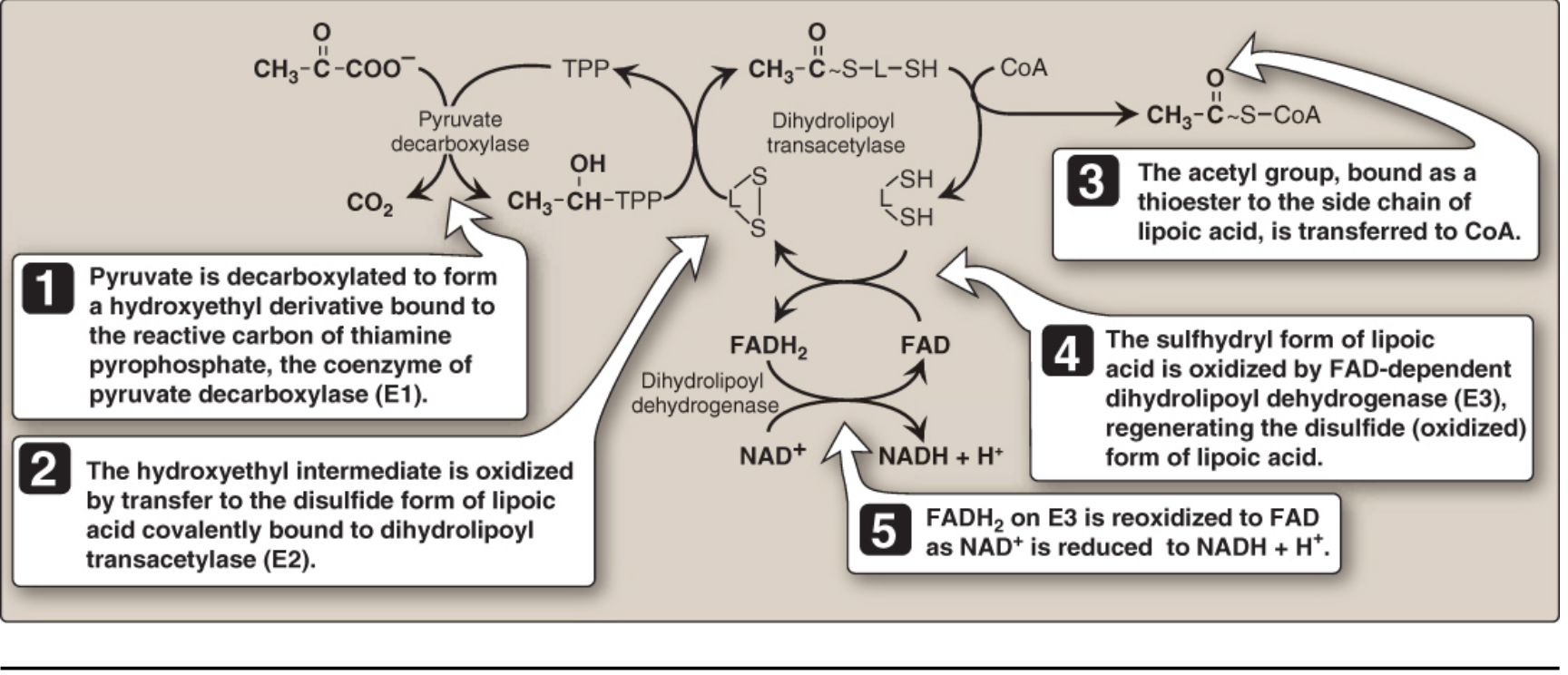
Step 1 (E1 - TPP): Pyruvate is decarboxylated. CO₂ is released and a hydroxyethyl group becomes bound to TPP (the reactive carbon of thiamine pyrophosphate).
Step 2 (E2 - Lipoic acid): The hydroxyethyl intermediate is oxidized and transferred to the disulfide form of lipoic acid (covalently bound to E2), forming an acetyl-lipoic acid thioester intermediate.
Step 3 (E2 - CoA): The acetyl group is transferred from lipoic acid to CoA, forming Acetyl-CoA (the product). Lipoic acid is now in its reduced (dithiol) form.
Step 4 (E3 - FAD): The reduced (sulfhydryl) form of lipoic acid is reoxidized by FAD in the E3 subunit, regenerating the disulfide form of lipoic acid. FAD is reduced to FADH₂.
Step 5 (E3 - NAD⁺): FADH₂ on E3 is reoxidized back to FAD as NAD⁺ is reduced to NADH + H⁺. This NADH feeds directly into the electron transport chain.
- Biochemistry, 8th ed Lippincott Illustrated Reviews, p. 334
5. Coenzymes Involved and Their Vitamin Sources
| Coenzyme | Vitamin Source | Enzyme |
|---|---|---|
| TPP (Thiamine pyrophosphate) | Vitamin B1 (Thiamine) | E1 |
| Lipoic acid | Lipoic acid (synthesized in body) | E2 |
| CoA (Coenzyme A) | Pantothenic acid (B5) | E2 |
| FAD | Riboflavin (B2) | E3 |
| NAD⁺ | Niacin (B3) | E3 |
All coenzymes except lipoic acid are derived from B vitamins - this is why B-vitamin deficiencies severely disrupt energy metabolism.
6. Regulation of the PDC
The PDC is tightly regulated to match the cell's energy needs. Regulation occurs by two main mechanisms:
A. Covalent Regulation (Primary)
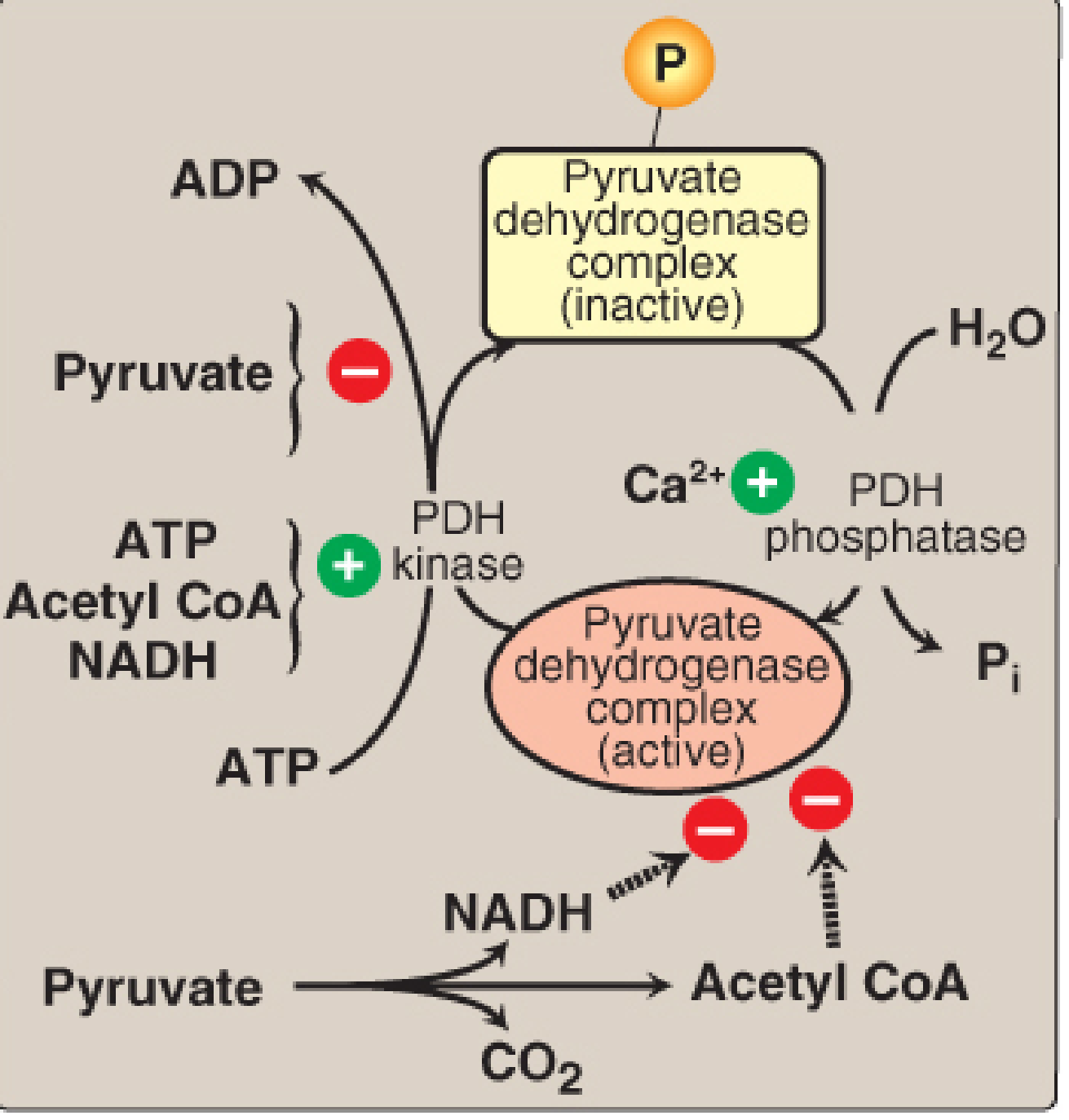
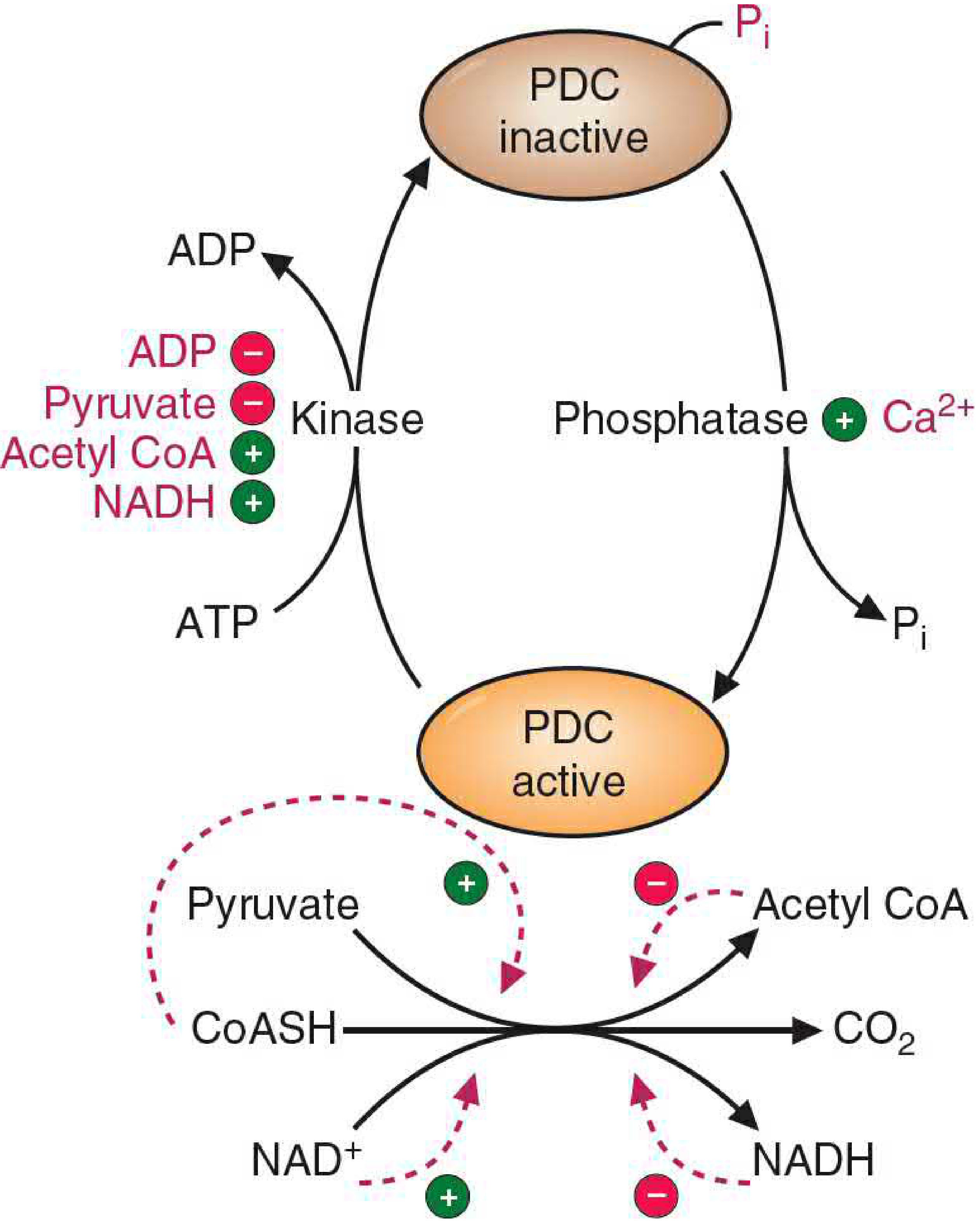
PDH Kinase (inactivates PDC by phosphorylation):
- Activated by: ATP, Acetyl-CoA, NADH (products of energy-replete states)
- Inhibited by: ADP, pyruvate (signals that more energy is needed)
PDH Phosphatase (activates PDC by dephosphorylation):
- Activated by: Ca²⁺ (especially important in cardiac and skeletal muscle during contraction - Ca²⁺ release during muscle contraction stimulates energy production)
B. Allosteric/Product Inhibition (Secondary)
- Acetyl-CoA and NADH (the products) directly inhibit PDC.
- CoA and NAD⁺ (the substrates) antagonize this inhibition.
- This ensures that when fatty acid oxidation is already supplying sufficient Acetyl-CoA, the PDC is automatically shut off to prevent overflow.
C. Hormonal Regulation
- Insulin activates PDC in adipocytes (by activating PDH phosphatase) - this promotes glucose oxidation after a meal.
- Basic Medical Biochemistry - A Clinical Approach - 6e, pp. 845-847
- Biochemistry, 8th ed Lippincott Illustrated Reviews, p. 335
7. Energy Yield from the Transition Stage
Per glucose molecule (2 pyruvates are formed from glycolysis):
| Product | Amount |
|---|---|
| Acetyl-CoA | 2 |
| CO₂ released | 2 |
| NADH produced | 2 |
Each NADH from the mitochondrial matrix yields ~2.5 ATP via oxidative phosphorylation, so the transition stage contributes ~5 ATP equivalents per glucose.
8. Significance and Clinical Relevance
Why it is irreversible - a metabolic key point
Because the PDC reaction is irreversible, animals cannot convert fats (Acetyl-CoA) back to glucose (gluconeogenesis). Acetyl-CoA cannot be converted back to pyruvate, which is why fatty acids cannot serve as gluconeogenic precursors in humans.
Clinical Conditions Related to PDC
| Condition | Cause | Effects |
|---|---|---|
| PDC Deficiency (Leigh syndrome) | Mutation in E1-α subunit (X-linked dominant) | Congenital lactic acidosis, neurodegeneration, muscle spasticity, early death; brain most affected |
| Thiamine (B1) Deficiency (Wernicke's encephalopathy, beriberi) | Lack of TPP coenzyme for E1 | PDC cannot function; pyruvate and lactate accumulate; neurological damage; worsened by high-carbohydrate diet |
| Arsenic Poisoning | Arsenite binds thiol groups of lipoic acid → blocks E2 | Pyruvate and lactate accumulate; neurological disturbances; death |
| Diabetes mellitus (poorly controlled) | High fatty acid oxidation → high Acetyl-CoA/NADH → PDC kinase activated → PDC inhibited | Glucose not properly oxidized despite high blood glucose |
- Biochemistry, 8th ed Lippincott Illustrated Reviews, pp. 335-337
- Basic Medical Biochemistry - A Clinical Approach - 6e, pp. 844-848
Summary at a Glance
| Feature | Detail |
|---|---|
| Location | Mitochondrial matrix |
| Substrate | Pyruvate + CoA + NAD⁺ |
| Product | Acetyl-CoA + CO₂ + NADH |
| Enzyme complex | Pyruvate Dehydrogenase Complex (PDC) |
| Subunits | E1 (TPP), E2 (Lipoic acid + CoA), E3 (FAD + NAD⁺) |
| Regulation | Kinase (inactivates) / Phosphatase (activates); product inhibition by Acetyl-CoA & NADH |
| Activators | Ca²⁺, ADP, Pyruvate, CoA, NAD⁺, Insulin |
| Inhibitors | ATP, Acetyl-CoA, NADH |
| Irreversible? | Yes - this is why fats cannot be converted to glucose |
| ATP yield | ~5 ATP equivalents per glucose (via 2 NADH) |
This is a shared conversation. Sign in to Orris to start your own chat.