
Give me the mx of OP poisoning in flowcharts also clinical sign and symptoms diagnosis criteria ok visual flashcards
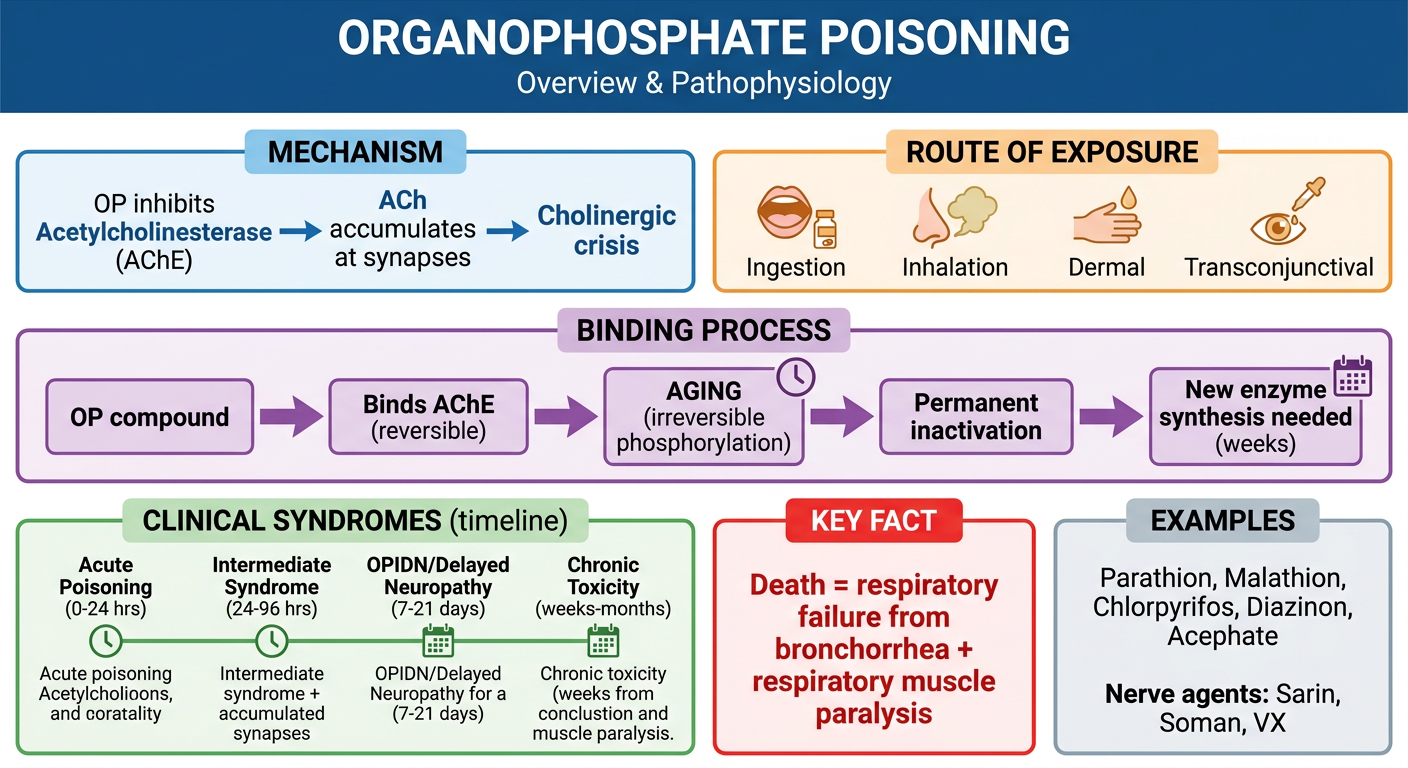
Medical visual flashcard for Organophosphate (OP) Poisoning - Overview and Pathophysiology. Clean clinical study card design with dark blue header reading "ORGANOPHOSPHATE POISONING" and subtitle "Overview & Pathophysiology". Include these sections clearly organized: MECHANISM box: "OP inhibits Acetylcholinesterase (AChE) → ACh accumulates at synapses → Cholinergic crisis" ROUTE OF EXPOSURE box with icons: Ingestion | Inhalation | Dermal | Transconjunctival BINDING PROCESS flowchart: OP compound → Binds AChE (reversible) → AGING (irreversible phosphorylation) → Permanent inactivation → New enzyme synthesis needed (weeks) CLINICAL SYNDROMES (timeline): 1. Acute Poisoning (0-24 hrs) 2. Intermediate Syndrome (24-96 hrs) 3. OPIDN/Delayed Neuropathy (7-21 days) 4. Chronic Toxicity (weeks-months) KEY FACT box in red: "Death = respiratory failure from bronchorrhea + respiratory muscle paralysis" EXAMPLES box: Parathion, Malathion, Chlorpyrifos, Diazinon, Acephate | Nerve agents: Sarin, Soman, VX Use a clean, bright medical textbook style with color coding. Bold typography, organized layout with clear sections, white background with colored section headers.
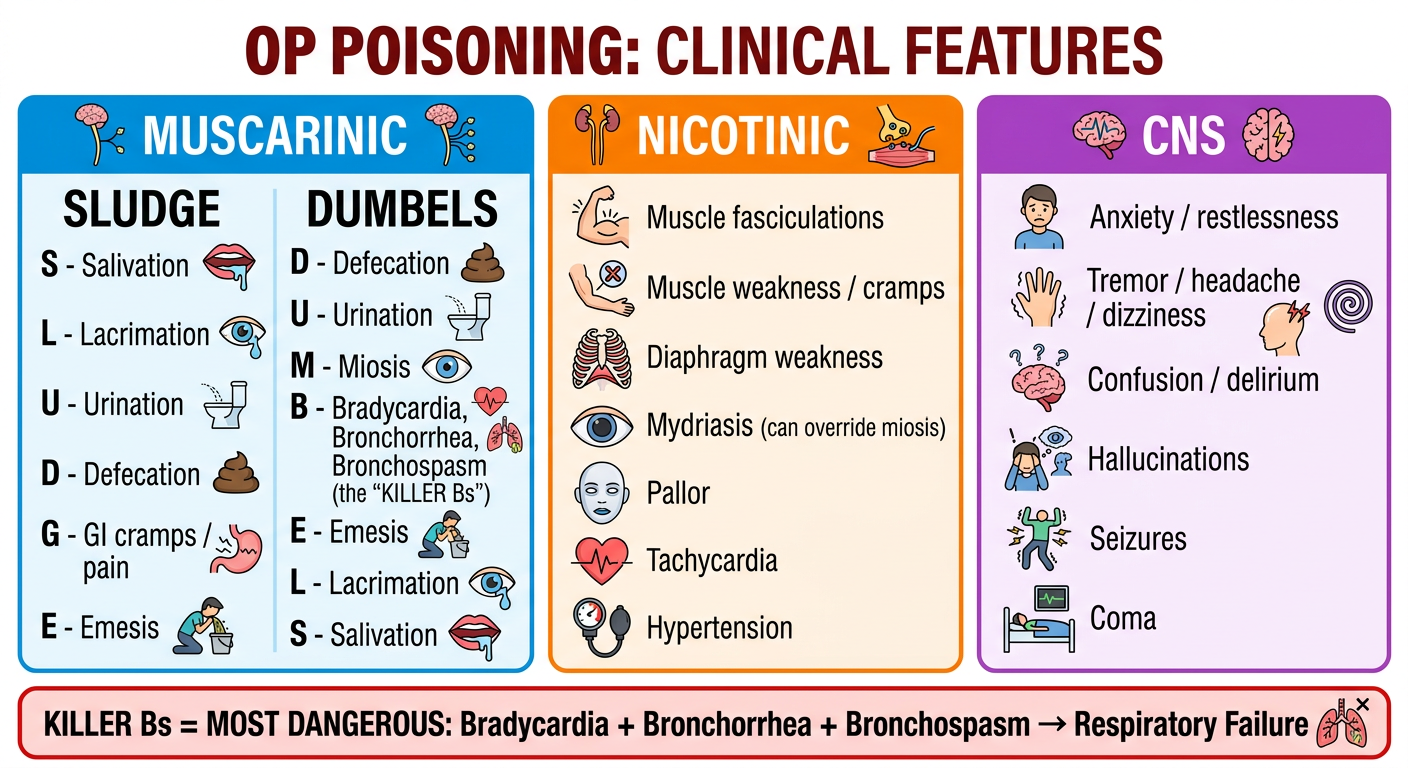
Medical visual flashcard for Organophosphate Poisoning - Clinical Signs and Symptoms. Bright, color-coded study card. Title: "OP POISONING: CLINICAL FEATURES" in bold dark red at top. Three large colored columns side by side: LEFT COLUMN - MUSCARINIC (blue header, parasympathetic effects): Mnemonics prominently: SLUDGE and DUMBELS SLUDGE: S - Salivation L - Lacrimation U - Urination D - Defecation G - GI cramps / pain E - Emesis DUMBELS: D - Defecation U - Urination M - Miosis B - Bradycardia, Bronchorrhea, Bronchospasm (the "KILLER Bs") E - Emesis L - Lacrimation S - Salivation MIDDLE COLUMN - NICOTINIC (orange header, sympathetic/NMJ): Muscle fasciculations Muscle weakness / cramps Diaphragm weakness Mydriasis (can override miosis) Pallor Tachycardia Hypertension RIGHT COLUMN - CNS (purple header): Anxiety / restlessness Tremor / headache / dizziness Confusion / delirium Hallucinations Seizures Coma Bottom bar: "KILLER Bs = MOST DANGEROUS: Bradycardia + Bronchorrhea + Bronchospasm → Respiratory Failure" Clean white background, large readable fonts, colored icons, medical flashcard style.
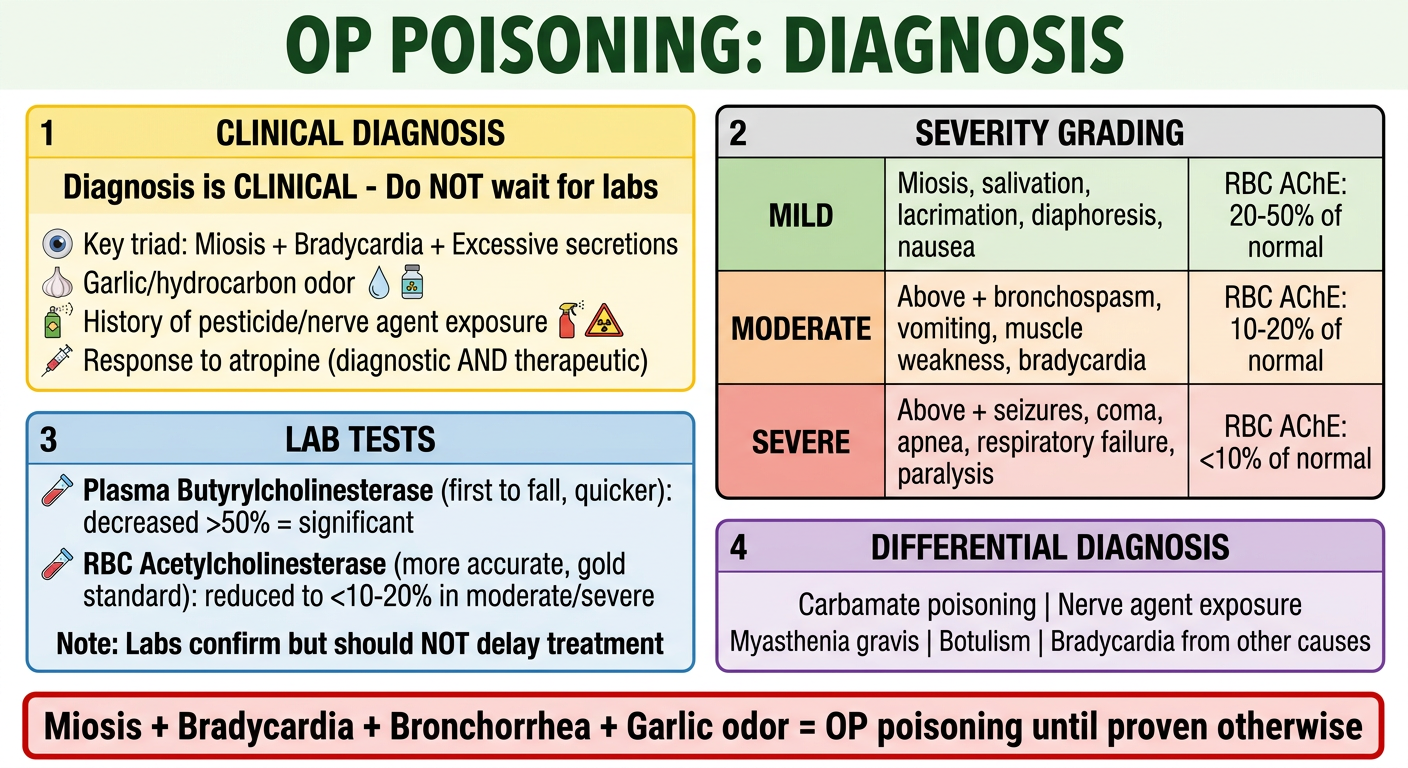
Medical visual flashcard for Organophosphate Poisoning - Diagnosis Criteria. Clean clinical study card. Title at top in bold dark green: "OP POISONING: DIAGNOSIS" Section 1 - CLINICAL DIAGNOSIS (yellow background box): "Diagnosis is CLINICAL - Do NOT wait for labs" Key triad: Miosis + Bradycardia + Excessive secretions Garlic/hydrocarbon odor History of pesticide/nerve agent exposure Response to atropine (diagnostic AND therapeutic) Section 2 - SEVERITY GRADING table with 3 rows: MILD: Miosis, salivation, lacrimation, diaphoresis, nausea - RBC AChE: 20-50% of normal MODERATE: Above + bronchospasm, vomiting, muscle weakness, bradycardia - RBC AChE: 10-20% of normal SEVERE: Above + seizures, coma, apnea, respiratory failure, paralysis - RBC AChE: <10% of normal Section 3 - LAB TESTS box: Plasma Butyrylcholinesterase (first to fall, quicker): decreased >50% = significant RBC Acetylcholinesterase (more accurate, gold standard): reduced to <10-20% in moderate/severe Note: Labs confirm but should NOT delay treatment Section 4 - DIFFERENTIAL DIAGNOSIS box: Carbamate poisoning | Nerve agent exposure | Myasthenia gravis | Botulism | Bradycardia from other causes Bottom red alert: "Miosis + Bradycardia + Bronchorrhea + Garlic odor = OP poisoning until proven otherwise" White background, organized boxes with color coded sections, large readable medical flashcard style.
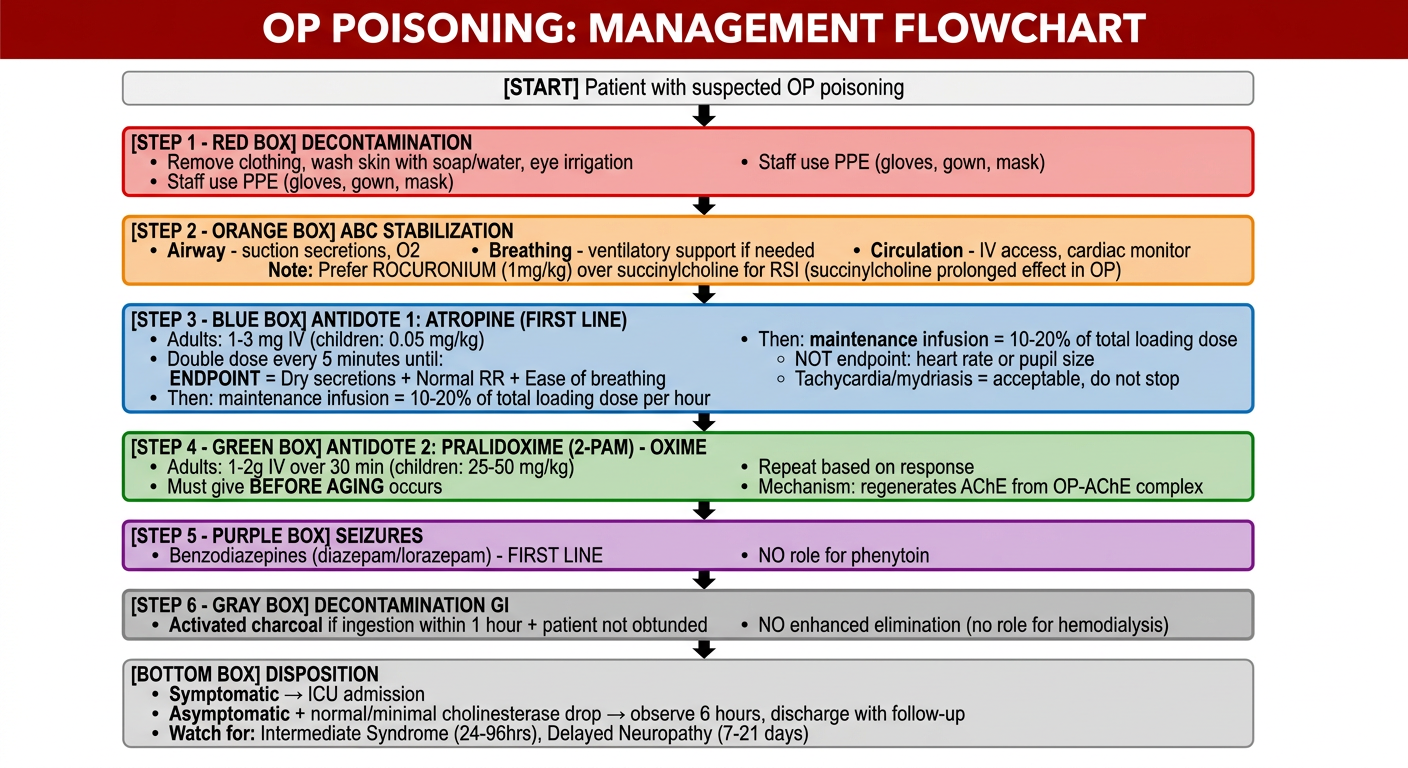
Medical clinical flowchart flashcard for Organophosphate (OP) Poisoning Management. Title at top in bold white on dark red background: "OP POISONING: MANAGEMENT FLOWCHART" Show a clear top-to-bottom flowchart with decision boxes: [START] Patient with suspected OP poisoning ↓ [STEP 1 - RED BOX] DECONTAMINATION Remove clothing, wash skin with soap/water, eye irrigation Staff use PPE (gloves, gown, mask) ↓ [STEP 2 - ORANGE BOX] ABC STABILIZATION Airway - suction secretions, O2 Breathing - ventilatory support if needed Circulation - IV access, cardiac monitor Note: Prefer ROCURONIUM (1mg/kg) over succinylcholine for RSI (succinylcholine prolonged effect in OP) ↓ [STEP 3 - BLUE BOX] ANTIDOTE 1: ATROPINE (FIRST LINE) Adults: 1-3 mg IV (children: 0.05 mg/kg) Double dose every 5 minutes until: ENDPOINT = Dry secretions + Normal RR + Ease of breathing Then: maintenance infusion = 10-20% of total loading dose per hour NOT endpoint: heart rate or pupil size Tachycardia/mydriasis = acceptable, do not stop ↓ [STEP 4 - GREEN BOX] ANTIDOTE 2: PRALIDOXIME (2-PAM) - OXIME Adults: 1-2g IV over 30 min (children: 25-50 mg/kg) Must give BEFORE AGING occurs Repeat based on response Mechanism: regenerates AChE from OP-AChE complex ↓ [STEP 5 - PURPLE BOX] SEIZURES Benzodiazepines (diazepam/lorazepam) - FIRST LINE NO role for phenytoin ↓ [STEP 6 - GRAY BOX] DECONTAMINATION GI Activated charcoal if ingestion within 1 hour + patient not obtunded NO enhanced elimination (no role for hemodialysis) ↓ [BOTTOM BOX] DISPOSITION Symptomatic → ICU admission Asymptomatic + normal/minimal cholinesterase drop → observe 6 hours, discharge with follow-up Watch for: Intermediate Syndrome (24-96hrs), Delayed Neuropathy (7-21 days) Clean white background, colored boxes, arrows between steps, medical textbook quality.
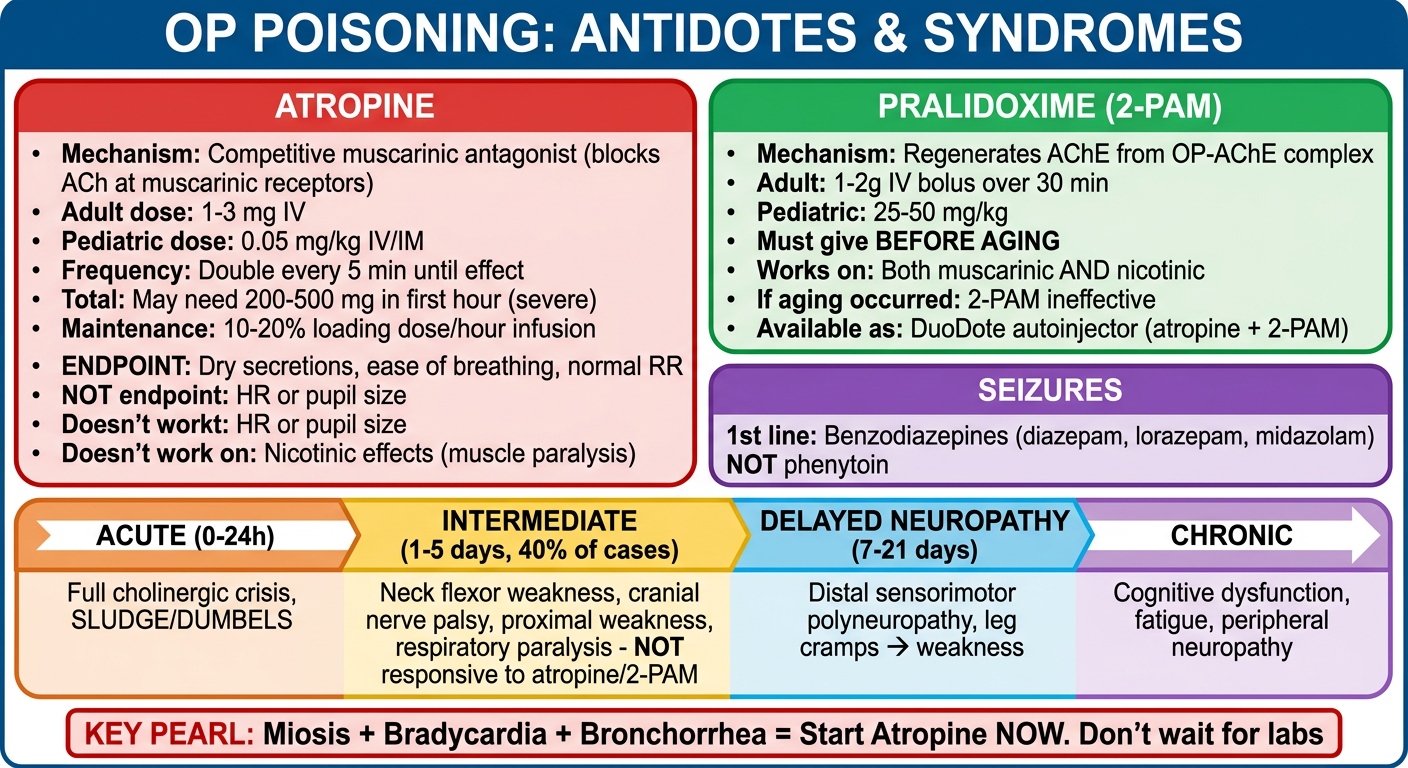
Medical visual flashcard for Organophosphate Poisoning - Antidotes, Dosing and Clinical Syndromes. Clean colorful study card. Title: "OP POISONING: ANTIDOTES & SYNDROMES" in bold white on dark blue background. TOP HALF - ANTIDOTE DOSING TABLE (two columns side by side): LEFT - ATROPINE box (red): Mechanism: Competitive muscarinic antagonist (blocks ACh at muscarinic receptors) Adult dose: 1-3 mg IV Pediatric dose: 0.05 mg/kg IV/IM Frequency: Double every 5 min until effect Total: May need 200-500 mg in first hour (severe) Maintenance: 10-20% loading dose/hour infusion ENDPOINT: Dry secretions, ease of breathing, normal RR NOT endpoint: HR or pupil size Doesn't work on: Nicotinic effects (muscle paralysis) RIGHT - PRALIDOXIME (2-PAM) box (green): Mechanism: Regenerates AChE from OP-AChE complex Adult: 1-2g IV bolus over 30 min Pediatric: 25-50 mg/kg Must give BEFORE AGING Works on: Both muscarinic AND nicotinic If aging occurred: 2-PAM ineffective Available as: DuoDote autoinjector (atropine + 2-PAM) MIDDLE - SEIZURES box (purple): 1st line: Benzodiazepines (diazepam, lorazepam, midazolam) NOT phenytoin BOTTOM HALF - 4 CLINICAL SYNDROMES timeline (horizontal): ACUTE (0-24h): Full cholinergic crisis, SLUDGE/DUMBELS INTERMEDIATE (1-5 days, 40% of cases): Neck flexor weakness, cranial nerve palsy, proximal weakness, respiratory paralysis - NOT responsive to atropine/2-PAM DELAYED NEUROPATHY (7-21 days): Distal sensorimotor polyneuropathy, leg cramps → weakness CHRONIC: Cognitive dysfunction, fatigue, peripheral neuropathy Bottom red box: "KEY PEARL: Miosis + Bradycardia + Bronchorrhea = Start Atropine NOW. Don't wait for labs" Bright colors, bold fonts, organized boxes, medical textbook quality flashcard.
🧪 ORGANOPHOSPHATE (OP) POISONING - Complete Study Cards
📌 Card 1 - Overview & Pathophysiology
📌 Card 2 - Clinical Signs & Symptoms (SLUDGE / DUMBELS / Nicotinic / CNS)
📌 Card 3 - Diagnosis Criteria & Severity Grading
📌 Card 4 - Management Flowchart
📌 Card 5 - Antidotes, Dosing & Clinical Syndromes Timeline
QUICK REFERENCE WRITTEN SUMMARY
Pathophysiology
Clinical Features
| System | Features |
|---|---|
| Muscarinic (SLUDGE/DUMBELS) | Salivation, Lacrimation, Urination, Defecation, GI pain, Emesis; Killer Bs: Bradycardia, Bronchorrhea, Bronchospasm; Miosis |
| Nicotinic | Fasciculations, muscle weakness/cramps, diaphragm weakness, tachycardia, hypertension, mydriasis, pallor |
| CNS | Anxiety, tremor, headache, confusion, hallucinations, seizures, coma |
Diagnosis
- Clinical diagnosis - do not wait for labs
- Triad: Miosis + Bradycardia + Excessive secretions
- Garlic/hydrocarbon odor
- RBC AChE (gold standard): <10-20% = moderate-severe
- Plasma BChE: first to fall, easier to measure (>50% drop = significant)
| Severity | Features | RBC AChE |
|---|---|---|
| Mild | Miosis, secretions, N/V | 20-50% |
| Moderate | Bronchospasm, bradycardia, weakness | 10-20% |
| Severe | Seizures, coma, apnea, paralysis | <10% |
Management Flowchart (Step-by-Step)
- Decontaminate - Remove clothing, wash skin, PPE for staff
- ABC - Airway suction, O2, ventilation; prefer rocuronium (not succinylcholine - prolonged in OP)
- Atropine (anti-muscarinic):
- Adults: 1-3 mg IV, double every 5 min until secretions dry
- Children: 0.05 mg/kg
- Endpoint = dry secretions + ease of breathing (NOT HR or pupils)
- May need 200-500 mg in first hour for severe cases
- Maintenance: 10-20% of loading dose/hour
- Pralidoxime (2-PAM) (oxime - regenerates AChE):
- Adults: 1-2 g IV over 30 min | Children: 25-50 mg/kg
- Must give BEFORE aging
- Benzodiazepines for seizures (NOT phenytoin)
- Activated charcoal (if ingestion <1 hr, patient awake/protected airway)
- No role for hemodialysis/enhanced elimination
4 Clinical Syndromes Timeline
| Syndrome | Onset | Features | Treatment |
|---|---|---|---|
| Acute | 0-24 hrs | Full cholinergic crisis | Atropine + 2-PAM |
| Intermediate (IMS) | 1-5 days (40% of cases) | Neck flexors, cranial nerves, proximal limb, respiratory paralysis | Supportive only (NO atropine/2-PAM response) |
| Delayed Neuropathy (OPIDN) | 7-21 days | Distal sensorimotor polyneuropathy | Supportive |
| Chronic | Weeks-months | Cognitive dysfunction, autonomic dysfunction | Supportive |
Please give a proper flashcard according to indian scenario
Which exam or clinical context are you preparing for? · Which aspect should be most emphasized in the Indian context?
organophosphate poisoning management India MBBS guidelines chlorpyrifos monocrotophos atropine pralidoxime
https://www.jbclinpharm.org/articles/developing-a-standard-t…
Indian MBBS medical flashcard for Organophosphate (OP) Poisoning - India-specific Overview. Clean, vibrant study card for Indian medical students. Title at top in bold white on dark green background: "OP POISONING - INDIA SCENARIO" with subtitle "Most Common Poisoning Admission in India" EPIDEMIOLOGY box (light yellow): - #1 cause of poisoning ICU admissions in India - 4-30% mortality in Indian studies - Most common: INTENTIONAL / suicidal (especially young adults, farmers) - Common in: South India, Central India, rural agricultural belt - WHO classifies India as high-burden country COMMON AGENTS IN INDIA box (orange, two columns): Highly Toxic (WHO Class I - BANNED/restricted): • Monocrotophos (Monocil) - most common in south India • Phorate (Thimet) • Methyl Parathion (Folidol) - banned 2020 • Dichlorvos (DDVP, Nuvan) • Methamidophos Moderately Toxic (WHO Class II - still in use): • Chlorpyrifos (Dursban, Durmet) - MOST COMMON currently • Quinalphos • Acephate • Dimethoate • Profenofos MECHANISM box (blue): OP → inhibits AChE → ACh accumulates → Cholinergic crisis KEY: Irreversible binding → AGING → New AChE synthesis needed (weeks) INDIAN CLINICAL PEARL (red box): "Long transport time + delayed presentation = AGING already occurred = 2-PAM LESS EFFECTIVE" "Patients often arrive hours after ingestion in rural Indian hospitals" Bottom: Sources cited from Indian tertiary care studies + WHO/Lancet 2008 White background, bold colors, large readable fonts, medical flashcard style.
Indian MBBS medical visual flashcard - Organophosphate Poisoning Clinical Features. Bright colorful study card. Title: "OP POISONING: CLINICAL FEATURES" bold white on dark red header. Three color-coded columns: MUSCARINIC (blue column) - "SLUDGE + DUMBELS + Killer Bs": SLUDGE mnemonic: S - Salivation (excessive drooling) ← VERY COMMON in India L - Lacrimation (tearing) U - Urinary incontinence D - Defecation / Diarrhea G - GI cramps / vomiting E - Emesis DUMBELS mnemonic: D - Defecation U - Urination M - Miosis (pin-point pupils) ← KEY SIGN B - Bradycardia, Bronchorrhea, Bronchospasm = "KILLER Bs" E - Emesis L - Lacrimation S - Salivation/Sweating Also: Blurred vision, increased bronchial secretions NICOTINIC (orange column) - "MTWHF" mnemonic: M - Muscle fasciculations ← ASK IN VIVA T - Tachycardia (can override bradycardia) W - Weakness (proximal) H - Hypertension F - Fasciculations → Flaccid paralysis → respiratory failure Also: Pallor, mydriasis (can override miosis!) NB: "May FOOL you - tachycardia in OP despite cholinergic crisis" CNS (purple column): Anxiety, agitation Tremors, headache Confusion, delirium Seizures ← COMMON in India Coma, respiratory arrest SEVERITY TABLE at bottom (3 rows): MILD: Alert + SLUDGE only MODERATE: SLUDGE + some CNS + bronchospasm SEVERE: Seizures + coma + apnea + paralysis ← most common presentation in Indian ICUs INDIAN EXAM TIP box: "Miosis + Pin-point pupils + EXCESSIVE secretions + garlic/petroleum odor = OP poisoning" White background, bold fonts, bright colors, clean organized layout.
Please give a proper flashcard for op poisiong management from standard clinicsl book visual flashcard by step by step mx
Professional medical MBBS study flashcard. Title banner: "ORGANOPHOSPHATE POISONING — STEP-BY-STEP MANAGEMENT" bold white text on deep navy blue background. Subtitle in yellow: "Source: Tintinalli's Emergency Medicine & Rosen's Emergency Medicine" Show a clean numbered vertical flowchart with 7 distinct steps, each in a colored box with a downward arrow connecting them: ━━━━━━━━━━━━━━━━━━━━━━━━━━━━━━━ STEP 1 — SCENE SAFETY & DECONTAMINATION [RED box] • Staff: Wear PPE — nitrile/neoprene gloves, gown, face shield. NO latex. • Remove ALL clothing → bag as hazardous waste • Wash skin: copious soap + water (scalp, nails, skin folds, conjunctivae) • DO NOT transport by helicopter (contamination risk) • GI ingestion: NO gastric lavage, NO activated charcoal — no proven benefit ━━━━━━━━━━━━━━━━━━━━━━━━━━━━━━━ STEP 2 — AIRWAY & BREATHING (ABC) [ORANGE box] • Suction secretions + vomitus immediately • Give 100% Oxygen • Pulse oximetry + cardiac monitor • If intubation needed → RSI with ROCURONIUM 1 mg/kg (preferred) ⚠ AVOID succinylcholine — prolonged effect (4-6 hrs) due to cholinesterase inhibition • Ventilatory support as needed ━━━━━━━━━━━━━━━━━━━━━━━━━━━━━━━ STEP 3 — ANTIDOTE 1: ATROPINE ⭐ FIRST & MOST IMPORTANT [BLUE box] Adults: 1.2–3 mg IV bolus (Children: 0.05 mg/kg IV) → Double dose every 5 minutes until ATROPINIZATION ACHIEVED ENDPOINT of ATROPINIZATION (all 3 must be present): ✅ Clear chest on auscultation (no bronchorrhea) ✅ HR > 80 bpm ✅ Systolic BP > 80 mmHg Then: Maintenance infusion = 10–20% of total loading dose per hour ⚠ Tachycardia & mydriasis = ACCEPTABLE — do NOT stop atropine ⚠ NOT endpoint: pupil size alone Severe cases: may need 200–500 mg in first hour ━━━━━━━━━━━━━━━━━━━━━━━━━━━━━━━ STEP 4 — ANTIDOTE 2: PRALIDOXIME (2-PAM) — OXIME [GREEN box] Adults: 30 mg/kg IV (up to 1-2 g) over 5-30 min Children: 25–50 mg/kg IV over 30 min Then: Continuous infusion 8 mg/kg/hr for 24–48 hrs • Can be given up to 24–48 hrs after exposure • Mechanism: Regenerates AChE from OP-AChE complex (before aging) • Also reverses NICOTINIC effects (muscle paralysis) — atropine cannot ⚠ LESS effective if aging has already occurred ━━━━━━━━━━━━━━━━━━━━━━━━━━━━━━━ STEP 5 — SEIZURES [PURPLE box] • Benzodiazepines IV — FIRST LINE (diazepam, lorazepam, midazolam) • Seizures may be masked by muscle paralysis — monitor EEG if paralysed • ⚠ Phenytoin is NOT effective in OP-induced seizures ━━━━━━━━━━━━━━━━━━━━━━━━━━━━━━━ STEP 6 — MONITORING & LABS [TEAL box] • ECG: watch for QTc prolongation, torsades, AV block • Plasma BChE + RBC AChE levels (confirm, don't delay treatment) • Blood glucose, electrolytes, LFT, amylase (pancreatitis) • Chest X-ray: pulmonary edema ━━━━━━━━━━━━━━━━━━━━━━━━━━━━━━━ STEP 7 — DISPOSITION [GRAY box] ICU admit → Significant symptoms + depressed cholinesterase Observe 6 hrs → Asymptomatic + minimal cholinesterase drop → Discharge Watch for: ⚠ Intermediate Syndrome (1–5 days): proximal weakness, respiratory paralysis ⚠ Delayed Neuropathy OPIDN (7–21 days): distal sensorimotor neuropathy ⚠ Psychiatric referral if suicidal intent ━━━━━━━━━━━━━━━━━━━━━━━━━━━━━━━ Bottom bar in yellow on dark background: "⚠ KEY RULE: START ATROPINE NOW — Do NOT wait for labs. NEVER use succinylcholine. ROCURONIUM is preferred for RSI." Clean white background between steps, bold black text inside boxes, clear arrows between each step, professional medical textbook quality design. Large readable font.
400, message: Got more than 4194304 bytes when reading: b'data: {"candidates": [{"content": {"role": "model","parts": [{"inlineData": {"mimeType": "image/png"...'.
We encountered an error while processing your request. Please try again or reach out to us for help.
Atleat3 flashcard 1 sign and sympton how to identify 2 nd Stsrt with ABC then proper tt step by step Third for mechanism of action
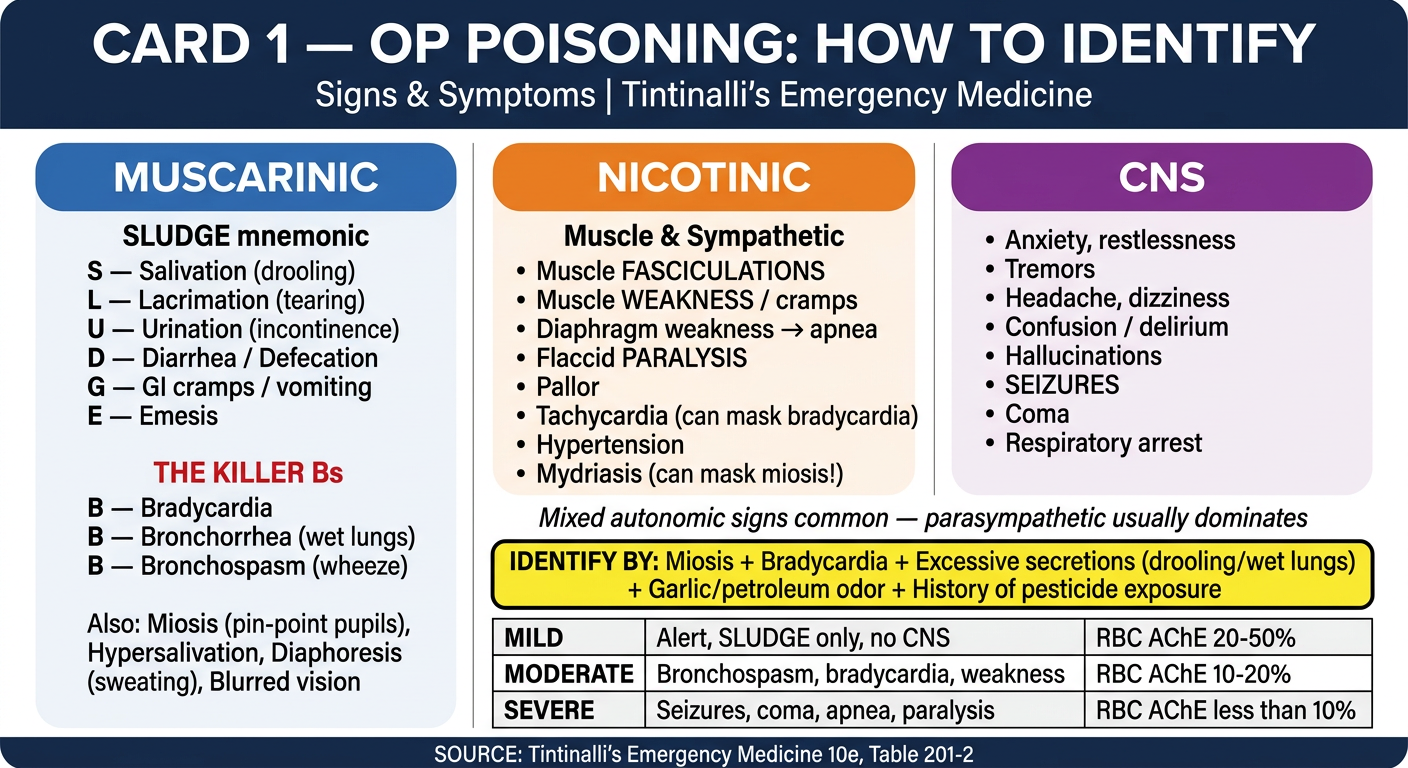
Clean professional medical flashcard. Dark navy blue header bar with bold white text: "CARD 1 — OP POISONING: HOW TO IDENTIFY" and smaller text below: "Signs & Symptoms | Tintinalli's Emergency Medicine" Three columns side by side on white background: LEFT COLUMN — header: MUSCARINIC (blue rounded box) Subheading: "SLUDGE mnemonic" S — Salivation (drooling) L — Lacrimation (tearing) U — Urination (incontinence) D — Diarrhea / Defecation G — GI cramps / vomiting E — Emesis Blank line Subheading: "THE KILLER Bs" in bold red B — Bradycardia B — Bronchorrhea (wet lungs) B — Bronchospasm (wheeze) Blank line Also: Miosis (pin-point pupils), Hypersalivation, Diaphoresis (sweating), Blurred vision MIDDLE COLUMN — header: NICOTINIC (orange rounded box) Subheading: "Muscle & Sympathetic" • Muscle FASCICULATIONS • Muscle WEAKNESS / cramps • Diaphragm weakness → apnea • Flaccid PARALYSIS • Pallor • Tachycardia (can mask bradycardia) • Hypertension • Mydriasis (can mask miosis!) Note in italic: "Mixed autonomic signs common — parasympathetic usually dominates" RIGHT COLUMN — header: CNS (purple rounded box) • Anxiety, restlessness • Tremors • Headache, dizziness • Confusion / delirium • Hallucinations • SEIZURES • Coma • Respiratory arrest Below all 3 columns, a full-width yellow warning box: "IDENTIFY BY: Miosis + Bradycardia + Excessive secretions (drooling/wet lungs) + Garlic/petroleum odor + History of pesticide exposure" Severity grading table at bottom (3 rows, 3 columns): MILD | Alert, SLUDGE only, no CNS | RBC AChE 20-50% MODERATE | Bronchospasm, bradycardia, weakness | RBC AChE 10-20% SEVERE | Seizures, coma, apnea, paralysis | RBC AChE less than 10% Bottom footer dark blue: "SOURCE: Tintinalli's Emergency Medicine 10e, Table 201-2" Clean, bold, high contrast, medical student study card style.
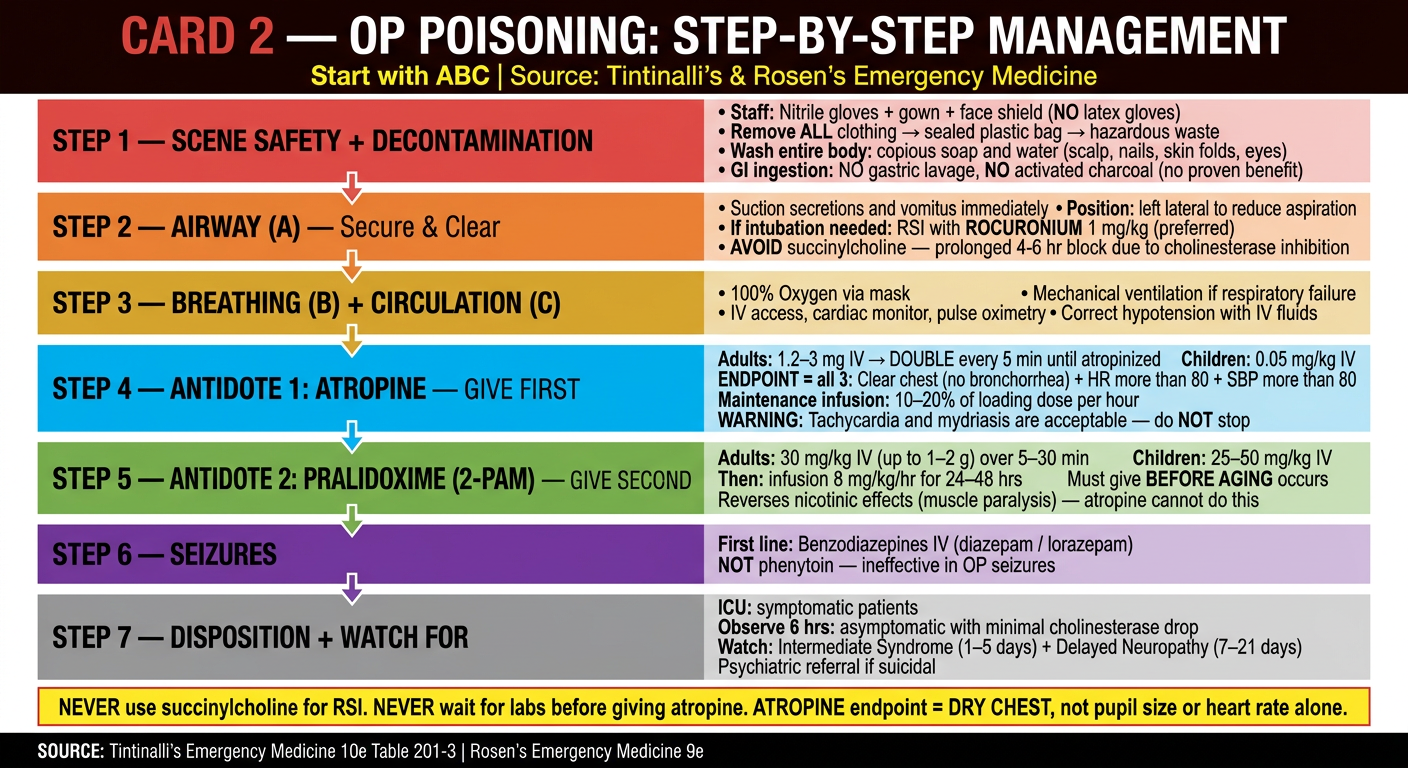
Clean professional medical flashcard on white background. Dark red header bar with bold white text: "CARD 2 — OP POISONING: STEP-BY-STEP MANAGEMENT" subtitle in yellow: "Start with ABC | Source: Tintinalli's & Rosen's Emergency Medicine" Show 7 numbered steps as horizontal colored bands stacked vertically with small downward arrows between them. Each step is a full-width colored rectangle with bold step number on left and content on right: STEP 1 — red band — "SCENE SAFETY + DECONTAMINATION" • Staff: Nitrile gloves + gown + face shield (NO latex gloves) • Remove ALL clothing → sealed plastic bag → hazardous waste • Wash entire body: copious soap and water (scalp, nails, skin folds, eyes) • GI ingestion: NO gastric lavage, NO activated charcoal (no proven benefit) STEP 2 — orange band — "AIRWAY (A) — Secure & Clear" • Suction secretions and vomitus immediately • Position: left lateral to reduce aspiration • If intubation needed: RSI with ROCURONIUM 1 mg/kg (preferred) • AVOID succinylcholine — prolonged 4-6 hr block due to cholinesterase inhibition STEP 3 — gold/yellow band — "BREATHING (B) + CIRCULATION (C)" • 100% Oxygen via mask • Mechanical ventilation if respiratory failure • IV access, cardiac monitor, pulse oximetry • Correct hypotension with IV fluids STEP 4 — bright blue band — "ANTIDOTE 1: ATROPINE — GIVE FIRST" Adults: 1.2–3 mg IV → DOUBLE every 5 min until atropinized Children: 0.05 mg/kg IV ENDPOINT = all 3: Clear chest (no bronchorrhea) + HR more than 80 + SBP more than 80 Maintenance infusion: 10–20% of loading dose per hour WARNING: Tachycardia and mydriasis are acceptable — do NOT stop STEP 5 — green band — "ANTIDOTE 2: PRALIDOXIME (2-PAM) — GIVE SECOND" Adults: 30 mg/kg IV (up to 1–2 g) over 5–30 min Children: 25–50 mg/kg IV Then: infusion 8 mg/kg/hr for 24–48 hrs Must give BEFORE AGING occurs Reverses nicotinic effects (muscle paralysis) — atropine cannot do this STEP 6 — purple band — "SEIZURES" First line: Benzodiazepines IV (diazepam / lorazepam) NOT phenytoin — ineffective in OP seizures STEP 7 — gray band — "DISPOSITION + WATCH FOR" ICU: symptomatic patients Observe 6 hrs: asymptomatic with minimal cholinesterase drop Watch: Intermediate Syndrome (1–5 days) + Delayed Neuropathy (7–21 days) Psychiatric referral if suicidal Full-width bottom alert box in yellow: "NEVER use succinylcholine for RSI. NEVER wait for labs before giving atropine. ATROPINE endpoint = DRY CHEST, not pupil size or heart rate alone." Bottom dark footer: "SOURCE: Tintinalli's Emergency Medicine 10e Table 201-3 | Rosen's Emergency Medicine 9e" Bold readable fonts, clean arrows, professional MBBS study card.
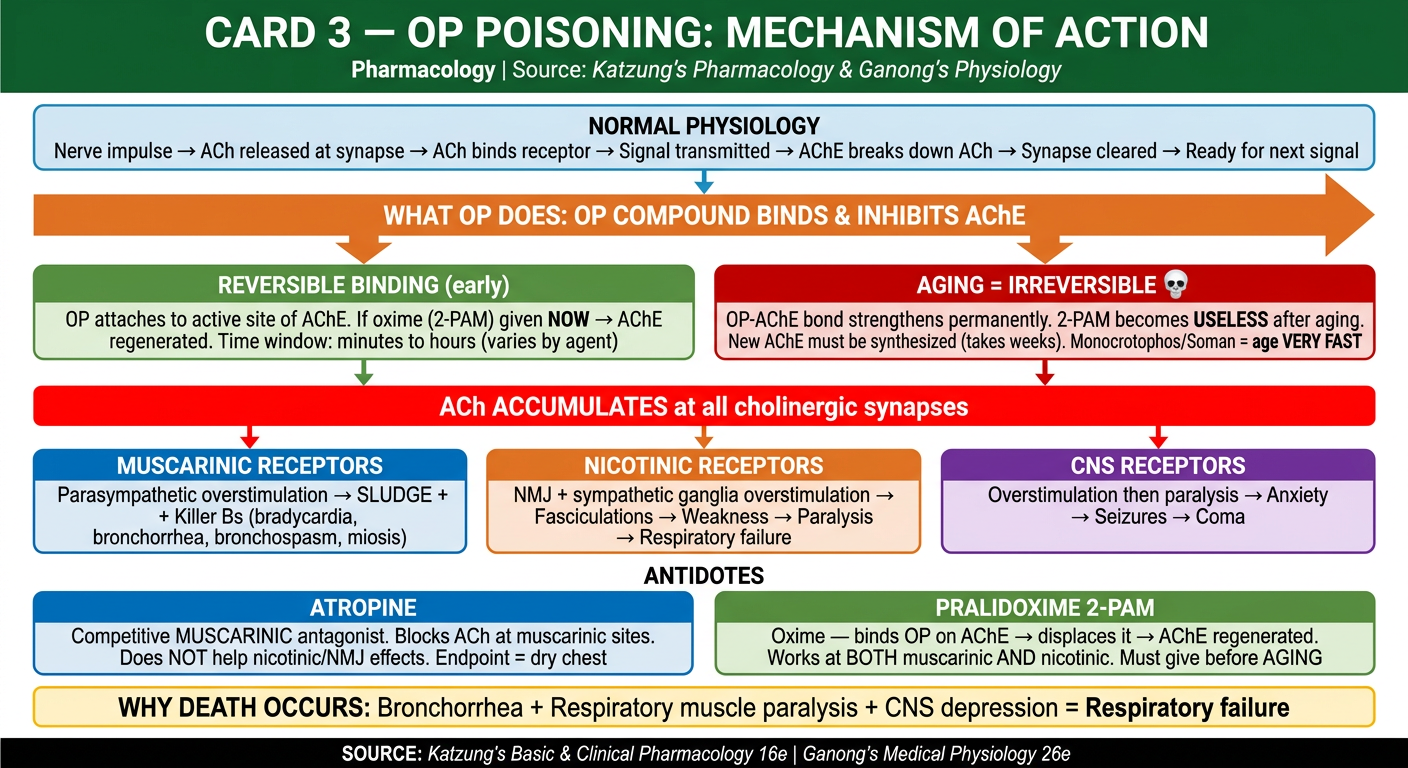
Clean professional medical flashcard on white background. Dark green header bar with bold white text: "CARD 3 — OP POISONING: MECHANISM OF ACTION" subtitle: "Pharmacology | Source: Katzung's Pharmacology & Ganong's Physiology" Show a clear visual pathway diagram from top to bottom: TOP SECTION — "NORMAL PHYSIOLOGY" box (light blue): Nerve impulse → ACh released at synapse → ACh binds receptor → Signal transmitted → AChE breaks down ACh → Synapse cleared → Ready for next signal MIDDLE SECTION — "WHAT OP DOES" in a large orange arrow pointing down with bold text inside: "OP COMPOUND BINDS & INHIBITS AChE" Below arrow, TWO side-by-side boxes: LEFT BOX — "REVERSIBLE BINDING (early)" green: OP attaches to active site of AChE If oxime (2-PAM) given NOW → AChE regenerated Time window: minutes to hours (varies by agent) RIGHT BOX — "AGING = IRREVERSIBLE" red with skull icon: OP-AChE bond strengthens permanently 2-PAM becomes USELESS after aging New AChE must be synthesized (takes weeks) Monocrotophos/Soman = age VERY FAST RESULT BOX — bright red wide banner: "ACh ACCUMULATES at all cholinergic synapses" Then branching into 3 boxes below: MUSCARINIC RECEPTORS (blue): Parasympathetic overstimulation → SLUDGE + Killer Bs (bradycardia, bronchorrhea, bronchospasm, miosis) NICOTINIC RECEPTORS (orange): NMJ + sympathetic ganglia overstimulation → Fasciculations → Weakness → Paralysis → Respiratory failure CNS RECEPTORS (purple): Overstimulation then paralysis → Anxiety → Seizures → Coma ANTIDOTES section at bottom — two boxes side by side: ATROPINE box (blue): Competitive MUSCARINIC antagonist. Blocks ACh at muscarinic sites. Does NOT help nicotinic/NMJ effects. Endpoint = dry chest. PRALIDOXIME 2-PAM box (green): Oxime — binds OP on AChE → displaces it → AChE regenerated. Works at BOTH muscarinic AND nicotinic. Must give before AGING. Bottom yellow box: "WHY DEATH OCCURS: Bronchorrhea + Respiratory muscle paralysis + CNS depression = Respiratory failure" Bottom dark footer: "SOURCE: Katzung's Basic & Clinical Pharmacology 16e | Ganong's Medical Physiology 26e" Clean diagram arrows, color coded, bold labels, professional MBBS study card quality.
🟦 CARD 1 — Signs & Symptoms: How to Identify OP Poisoning
🟥 CARD 2 — Step-by-Step Management (ABC first)
🟩 CARD 3 — Mechanism of Action
Quick Key Points to Remember
| Card | The One Line to Know |
|---|---|
| Signs | Miosis + Bradycardia + Wet lungs + Garlic odor = OP poisoning |
| Treatment | Decontaminate → ABC → Atropine (double every 5 min) → 2-PAM → Benzo for seizures. Use rocuronium, never succinylcholine |
| Mechanism | OP blocks AChE → ACh accumulates → Cholinergic crisis at M + N + CNS receptors. After aging, 2-PAM is useless |