
I want to visualize screening effect.
What context are you referring to for the screening effect? · What format do you want the visualization in?
Atomic screening effect (shielding effect) educational diagram. Show a nucleus in the center labeled with atomic number Z and positive charge. Around it, show inner shell electrons (core electrons) forming a shielding cloud between the nucleus and the outer valence electron. Use arrows to show: the full nuclear charge Z pointing outward, the shielding/screening by inner electrons reducing the effective nuclear charge (Zeff = Z - sigma), and the reduced force felt by the outer valence electron. Label: nucleus, inner electrons (shielding electrons), outer valence electron, effective nuclear charge (Zeff), shielding constant (sigma). Use a clean, textbook-style scientific illustration with color coding - nucleus in red, inner electrons in blue, outer electron in green, electric field lines in orange.
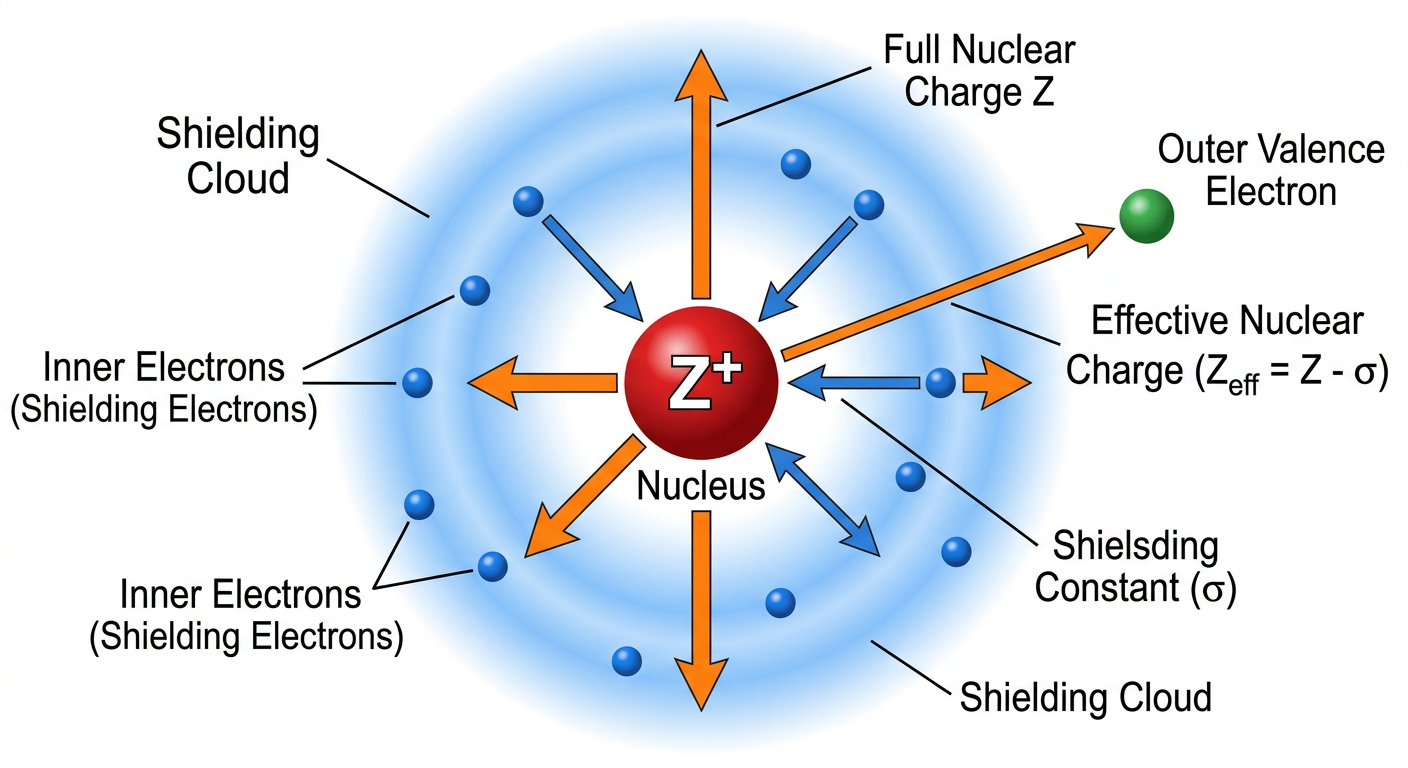
The Screening Effect (Shielding Effect)
Key Formula
Z_eff = Z - σ
| Symbol | Meaning |
|---|---|
| Z | Actual atomic number (total protons) |
| σ (sigma) | Shielding constant (contributed by inner electrons) |
| Z_eff | Effective nuclear charge felt by the valence electron |
How it works
- Inner electrons (closer to nucleus) repel outer electrons
- This repulsion partially cancels the nucleus's positive pull
- The more inner electrons, the higher σ, and the lower Z_eff
Example - Sodium (Na, Z = 11)
- Electron config: 1s² 2s² 2p⁶ 3s¹
- 10 inner electrons shield the outer 3s electron
- Using Slater's rules: σ ≈ 8.8, so Z_eff ≈ 2.2 (far less than 11)
Consequences
- Atomic radius increases down a group - each new shell is more shielded
- Ionization energy decreases down a group - easier to remove a well-shielded electron
- d-block contraction (lanthanide contraction) - poor shielding by d and f electrons keeps Z_eff high