
ARDS definition management updates special mention about prone ventilation
Reading File
Now let me run parallel searches across the library and PubMed simultaneously:
Finding Sources
Searching PubMed
"acute respiratory distress syndrome" AND "prone positioning"
Searching PubMed
"ARDS" AND "Berlin definition" AND "management"
Finding Sources
Finding Sources
Searching PubMed
"ARDS" AND "mechanical ventilation" AND "guidelines"
Now let me read the key textbook sections:
Reading File
Reading File
Reading File
Reading File
Reading File
Reading Article
PMID: 41199320
Reading File
Reading File
Searching the Web
ARDS 2023 2024 updated definition Global definition new criteria
Reading Web Page
https://litfl.com/acute-respiratory-distress-syndrome-defini…
Reading File
I now have comprehensive data. Let me also grab the ARDS CXR image and the management table from Fishman's:
Loading Image
Reading File
I now have all the information needed for a comprehensive answer. Let me compile it.
ARDS: Definition, Management, and Prone Ventilation
Chest Radiograph
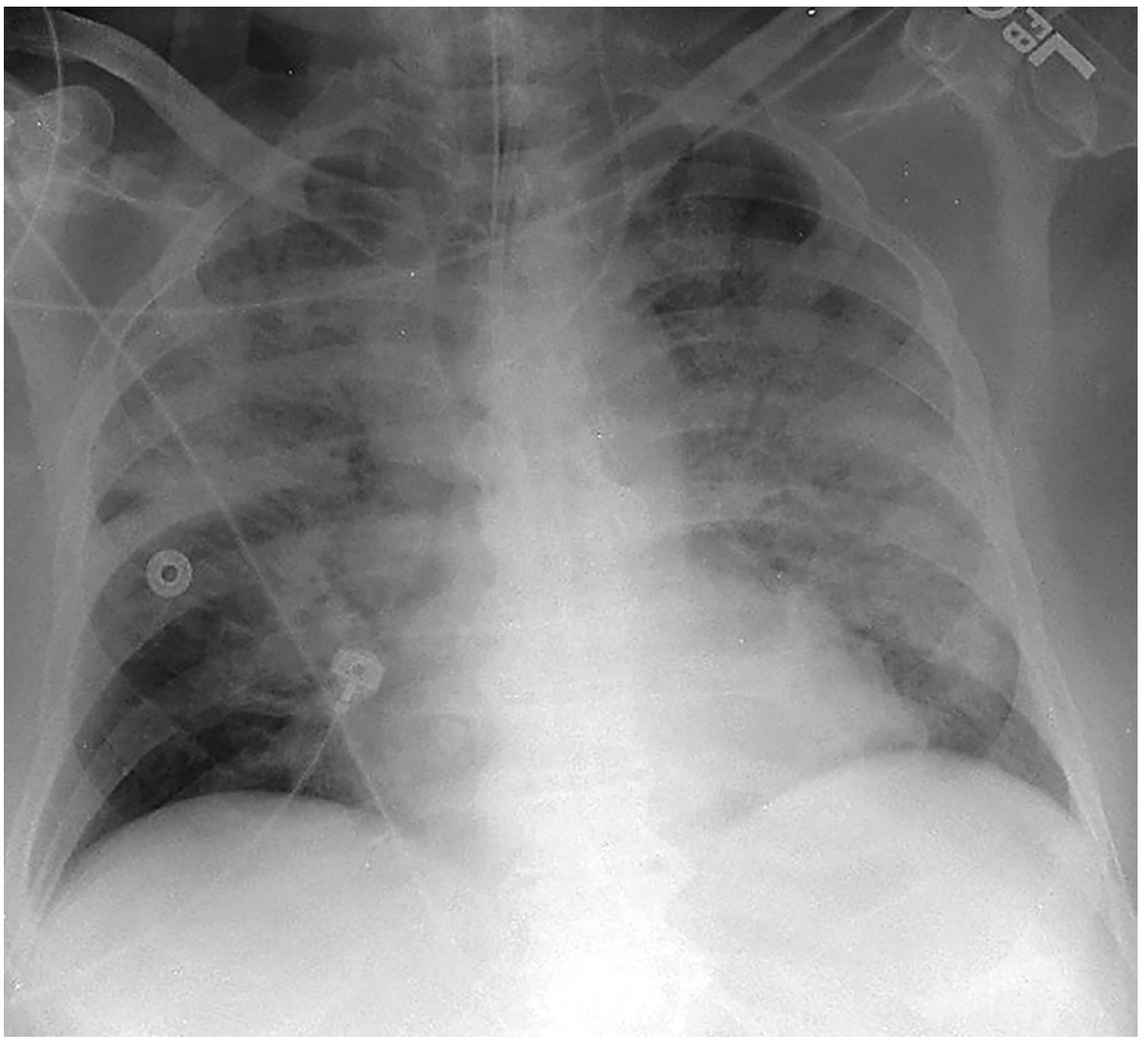
1. Evolution of ARDS Definitions
1967 — Ashbaugh (Original Description)
12 patients with acute respiratory distress, bilateral opacities on CXR, low compliance, and hypoxemia responding to PEEP. Initially called adult respiratory distress syndrome; later renamed acute to include children.
1988 — Murray Lung Injury Score
Three-part system: (1) acuity, (2) associated risk factors, (3) Lung Injury Score using hypoxemia + PEEP + compliance + CXR. Score >2.5 = ARDS. No exclusion of cardiogenic edema.
1994 — AECC Definition
| Variable | Acute Lung Injury (ALI) | ARDS |
|---|---|---|
| Onset | Acute | Acute |
| PaO₂/FiO₂ | ≤300 mmHg | ≤200 mmHg |
| CXR | Bilateral infiltrates | Bilateral infiltrates |
| Exclusion | PAWP ≤18 mmHg or no clinical LV failure | PAWP ≤18 mmHg or no clinical LV failure |
Limitations of AECC: no defined time frame for "acute"; CXR interpretation variability (kappa only 0.55); PaO₂/FiO₂ fluctuates with PEEP level; PAWP criterion problematic.
2012 — Berlin Definition (Current Standard)
Developed by an international expert panel to address AECC limitations. ARDS is defined by all four criteria:
- Timing: Onset within 1 week of a known clinical insult
- Imaging: Bilateral opacities on CXR/CT — not fully explained by effusions, atelectasis, or nodules
- Origin: Respiratory failure not fully explained by cardiac failure or fluid overload (echocardiography recommended if no ARDS risk factor)
- Oxygenation: PaO₂/FiO₂ ≤300 mmHg with PEEP or CPAP ≥5 cmH₂O
Berlin Severity Classification
| Severity | PaO₂/FiO₂ (with PEEP ≥5 cmH₂O) | Mortality |
|---|---|---|
| Mild | 200 < PaO₂/FiO₂ ≤ 300 | ~27% |
| Moderate | 100 < PaO₂/FiO₂ ≤ 200 | ~32% |
| Severe | PaO₂/FiO₂ ≤ 100 | ~45% |
The term ALI is now obsolete — those patients are reclassified as mild ARDS under Berlin.
Key improvements over AECC: time frame now explicit (1 week); PAWP criterion removed (PA catheters rarely used); PEEP requirement standardizes oxygenation assessment; recognizes concomitant ARDS + cardiogenic edema is possible.
Remaining limitations: Only marginally better mortality prediction than AECC; interobserver variability remains (κ ≈ 0.5, 67% due to CXR interpretation). — Fishman's Pulmonary Diseases, Murray & Nadel's
2023 — Global Definition of ARDS (Matthay et al.)
The most important update since Berlin. Three categories now exist:
Universal Criteria (apply to all)
- Acute onset within 1 week of insult
- Bilateral opacities not fully explained by effusions/collapse/nodules
- Hypoxemia not fully explained by cardiac failure/fluid overload
Category-Specific Criteria
| Category | Oxygenation Criterion | Setting |
|---|---|---|
| Non-intubated ARDS | PaO₂/FiO₂ ≤300 or SpO₂/FiO₂ ≤315 (if SpO₂ ≤97%) on HFNO ≥30 L/min or NIV/CPAP ≥5 cmH₂O | Standard |
| Intubated ARDS | Same Berlin P/F thresholds (mild/moderate/severe) or S/F equivalents | Standard |
| Resource-limited | SpO₂/FiO₂ ≤315 (SpO₂ ≤97%) — no PEEP requirement, no ABG, no CXR required; lung ultrasound accepted | LMICs |
Key changes from Berlin:
- HFNO patients now qualify (captures indolent presentations, e.g., COVID-19)
- SpO₂/FiO₂ (S/F ratio) accepted as substitute for PaO₂/FiO₂ — eliminates need for arterial blood gas
- Lung ultrasound (bilateral B-lines/consolidations) accepted as substitute for CXR in resource-limited settings
- Importantly: does not change management for severe ARDS — prone positioning, lung-protective ventilation, and ECMO remain the core interventions
2. Management of ARDS
Step 1 — Treat the Underlying Cause
Identify and treat the precipitating insult (sepsis, pneumonia, aspiration, trauma, pancreatitis, etc.). This is the most critical step.
Step 2 — Oxygenation Targets
- SpO₂ 88–95% acceptable (permissive hypoxemia to avoid O₂ toxicity)
- FiO₂ <0.7 preferred if achievable with PEEP
- High-flow nasal cannula (HFNO): reasonable first step in non-intubated mild/moderate ARDS (FLORALI trial: lower 90-day mortality vs. NIV face mask)
- NIV via helmet: shown to reduce intubation rate vs. face mask in a single-center RCT (n=83)
Step 3 — Lung-Protective Mechanical Ventilation (ARDSNet Protocol)
| Parameter | Target |
|---|---|
| Tidal volume (VT) | 6 mL/kg predicted body weight |
| Plateau pressure | ≤30 cmH₂O |
| PEEP | Titrated (higher PEEP strategy for moderate–severe) |
| FiO₂ | Minimize to <0.7 when possible |
| Driving pressure | Target <15 cmH₂O |
| Permissive hypercapnia | pH ≥7.20 acceptable |
The baby lung concept explains the rationale: ARDS lung is heterogeneous, and delivered VT is concentrated in small regions of aerated lung — conventional volumes cause volutrauma and atelectrauma (VILI).
Step 4 — Adjuncts to Mechanical Ventilation
Conservative Fluid Management
- Restrict fluids once haemodynamically stable (FACTT trial: conservative fluid strategy = more ventilator-free days, no mortality benefit)
Neuromuscular Blockade (NMB)
- ACURASYS trial (2010): Cisatracurium ×48h reduced 90-day mortality vs. placebo (31.6% vs. 40.7%) in heavily sedated patients with PaO₂/FiO₂ <150
- ROSE trial (2019, n=1006): NMB showed NO benefit over usual care with light sedation (42.5% vs. 42.8%)
- Current recommendation: Not routine for all moderate–severe ARDS; may be beneficial in severe ventilator dyssynchrony or to facilitate prone positioning
Corticosteroids
- Theoretical benefit: anti-inflammatory, antifibrotic
- No high-dose benefit early; LaSRS (2006) — moderate-dose methylprednisolone in persistent ARDS (days 7–21) showed no mortality benefit and increased re-intubation
- Initiating after day 14 was associated with increased mortality
- Growing evidence for use in overlapping conditions (severe CAP, septic shock)
- Not recommended routinely
ECMO (VV-ECMO)
- Increasingly used at specialized centres for most severe ARDS
- Prone positioning can still be performed in patients on VV-ECMO, though it requires additional expertise
3. ★ PRONE VENTILATION — Special Focus
Physiologic Rationale
Placing a patient prone improves ARDS outcomes through:
- V/Q matching — blood flow redistributes from dorsal (now non-dependent) regions; ventilation becomes more uniform
- Recruitment of dorsal alveoli — previously compressed by the heart and abdominal contents
- Reduced VILI — CT studies show more homogeneous ventilation prone vs. supine, reducing overdistension anteriorly and atelectasis posteriorly
- Heart repositioning — removes cardiac compression from posterior lungs, improving aeration and reducing airway closure
Key Trials
| Trial | Year | Population | Intervention | Result |
|---|---|---|---|---|
| Earlier trials | Pre-2013 | All ARDS | <12h prone/day | No mortality benefit |
| PROSEVA | 2013 | PaO₂/FiO₂ <150, ≤36h from MV | Prone ≥16h/day + lung-protective ventilation | 28-day mortality: 16% prone vs. 32.8% supine (p<0.001) |
| Meta-analysis (6 RCTs) | — | Prone + protective ventilation | ≥16h prone | RR of death 0.74 (95% CI 0.59–0.95); attenuated without protective ventilation |
PROSEVA Trial — Key Details
- 466 patients, PaO₂/FiO₂ <150 mmHg
- Enrolled within 36 hours of MV initiation
- All patients received low tidal volume ventilation
- Heavy sedation + NMB used in majority of both arms
- 28-day mortality: 16.0% vs. 32.8% — highly significant
- Approximately 4 additional ventilator-free days in prone group
Current Recommendations
Prone positioning is strongly recommended for PaO₂/FiO₂ <150 mmHg after application of adequate PEEP — minimum 16 hours per day — initiated early (within 36h). — Murray & Nadel's, Fishman's
Despite this strong evidence, real-world implementation remains poor: only 3–16% of eligible patients in recent trials received prone positioning, and even trials targeting very severe ARDS (P/F <80) used prone in only 60% before randomisation.
Practical Considerations
| Issue | Detail |
|---|---|
| Pressure injuries | Nose, face, ears — careful padding required |
| Airway security | ETT, CVCs, arterial lines must be secured before turning |
| Eye care | Pressure on eyes → retinal ischaemia, especially in hypotensive patients |
| Haemodynamic instability | Arrhythmias and haemodynamic shifts possible during turning |
| Cardiac output | Prone may reduce cardiac index up to 25% (especially jackknife position/IVC compression); prior MI or ischaemic heart disease increases risk |
| Contraindications (relative) | Unstable spine, open abdomen, raised ICP, haemodynamic instability |
Awake/Non-Intubated Prone Positioning
During COVID-19, awake prone positioning in spontaneously breathing HFNO patients was widely adopted. Systematic reviews (PMID 38597483, 37796372) showed improvement in oxygenation and reduced intubation rates in COVID-19 ARDS, though evidence in non-COVID ARDS remains limited.
Prolonged Prone Positioning (≥24h) — 2025 Update
A 2025 meta-analysis (PMID 41199320) of 9 studies (n=1,045) found no significant mortality benefit for sessions ≥24h vs. standard ≥16h (HR 0.72; 95% CI 0.41–1.25). Evidence was low certainty. PPP outside clinical trials is not currently supported.
Summary Table
| Feature | AECC 1994 | Berlin 2012 | Global 2023 |
|---|---|---|---|
| Time frame | Not defined | ≤1 week | ≤1 week |
| Imaging | CXR bilateral | CXR/CT | CXR/CT/lung USS |
| Oxygenation | P/F ≤300 or ≤200 | P/F with PEEP ≥5 | P/F or S/F; HFNO patients included |
| PEEP requirement | No | Yes (≥5 cmH₂O) | Yes (or HFNO ≥30 L/min; waived in RLS) |
| Cardiac exclusion | PAWP ≤18 | Echo if no risk factor | Echo if no risk factor |
| Non-intubated | Not included | Not included | Included (new) |
| Resource-limited | Not addressed | Not addressed | Addressed (new) |
| Severity | ALI vs ARDS | Mild/Moderate/Severe | Same (Berlin preserved) |
Sources: Fishman's Pulmonary Diseases and Disorders; Murray & Nadel's Textbook of Respiratory Medicine; Barash Clinical Anesthesia, 9e; Matthay et al. 2023 Global ARDS Definition; PROSEVA trial; ROSE trial; Jung et al. Critical Care 2025 [PMID 41199320]; Tasaka et al. ARDS CPG 2022 [PMID 35753956].
VAP, definition, treatment, prevention bundles. Write as a long answer to MD anaesthesia exam question
Finding Sources
Searching PubMed
"ventilator-associated pneumonia" AND "prevention" AND "bundle"
Searching PubMed
"ventilator-associated pneumonia" AND "diagnosis" AND "treatment"
Finding Sources
Finding Sources
Searching PubMed
"ventilator-associated pneumonia" AND prevention
Your credits are exhausted. Your daily credits reset tomorrow, or you can purchase a top-up for more.
This is a shared conversation. Sign in to Orris to start your own chat.