
Facial aesthetics from Cummings
Reading File
Finding Sources
Finding Sources
Finding Sources
Finding Sources
The main "Aesthetic Facial Analysis" section is in block4. Let me also check what other aesthetic/analysis headings are in that block, and fetch the full content.
Finding Sources
Reading File
Reading File
Reading File
I now have comprehensive content. Let me compile the full answer.
Loading Image
Loading Image
Here is a comprehensive summary of Aesthetic Facial Analysis from Cummings Otolaryngology Head and Neck Surgery (Chapter 16, Marc S. Zimbler):
Aesthetic Facial Analysis — Cummings Otolaryngology
Key Points
- A detailed understanding of aesthetic facial analysis is imperative for any cosmetic or reconstructive surgeon.
- Soft tissue and bony anatomic landmarks form the basic language of surgical communication.
- Nasal and nasofacial angles are the cornerstone of rhinoplasty analysis and planning.
- Aesthetic subunits and relaxed skin tension lines are critical for designing incisions and repairs.
Historical Background
The study of beauty as a formal discipline began with Greek philosophers — to Plato and Aristotle, beauty meant symmetry, harmony, and geometry. The Renaissance expanded this: Leonardo da Vinci formulated ideal facial proportions through anatomical study, dividing the profile into equal thirds (Vitruvian Man). Albrecht Dürer divided the facial profile into four equal parts and noted that the length of the nose equals that of the ear.
In the 20th century, anthropometrist Leslie Farkas challenged classical canons by measuring 200 women (including 50 models), concluding that some canons are artistic idealizations. Current surgical parameters are based predominantly on Powell and Humphreys (1984) — Proportions of the Aesthetic Face.
Anatomic Landmarks
Soft Tissue Reference Points (Box 16.1)
Key points include:
- Trichion – hairline midpoint
- Glabella – most prominent point of forehead
- Nasion – soft tissue depression at the nasal root
- Radix – root of the nose (deepest point)
- Rhinion – the osseocartilaginous junction (nasal tip)
- Subnasale – junction of columella and upper lip
- Labrale superius/inferius – vermilion borders
- Stomion – midpoint of mouth opening
- Menton – lowest point of chin
- Cervical point – innermost point between submental area and neck
Skeletal (Cephalometric) Reference Points (Box 16.2)
- Sella (S) – midpoint of hypophysial fossa
- Nasion (N) – frontonasal junction
- ANS/PNS – anterior/posterior nasal spine
- Point A (subspinale) – deepest concavity of premaxilla
- Pogonion (Pg) – most anterior bony chin point
- Gnathion (Gn) – between most anterior and inferior chin points
- Menton (Me) – lowest mandibular point
- Gonion (Go) – midpoint at mandibular angle
Frankfurt Horizontal Plane
Standard reference for patient positioning in photos and cephalometric X-rays — drawn from the superior external auditory canal to the inferior border of the infraorbital rim, with the patient's gaze parallel to the floor.
Facial Proportions
Facial Width — Rule of Fifths
The face is divided into five equal vertical fifths (Fig. 16.7). The width of one eye = one-fifth of total facial width = intercanthal distance = nasal base width.
Facial Height — Rule of Thirds
Two methods:
- Da Vinci method — three equal thirds: trichion → glabella → subnasale → menton
- Excluding hairline method — from nasion (not glabella): midface = 43% of facial height; lower face = 57%
Subunit Analysis
The face is divided into aesthetic units, each further subdivided:
| Unit | Subunits |
|---|---|
| Nose | Tip, dorsum, paired sidewalls, paired alar lobules, soft tissue triangles, columella |
| Lip | Philtrum, paired lateral upper lips, lower lip, chin-lip complex |
| Eyelids | Upper and lower lids (left and right) |
| Forehead | Forehead, temporal fossa (bilateral) |
| Cheeks | Bilateral |
| Ear | Bilateral |
Surgical principle: When >50% of a subunit is deficient, reconstruct the entire subunit (Burget and Menick principle) for optimal aesthetic result.
Relaxed Skin Tension Lines (RSTLs)
- Run perpendicular to the underlying muscle fiber direction
- Incisions placed within RSTLs heal with minimal scarring
- Contrasted with Langer's lines, which are cadaver-derived and less reliable for live tissue
Nasofacial Relationships (Powell & Humphreys)
Nasofrontal Angle
The angle at the nasal root between the forehead and nasal dorsum.
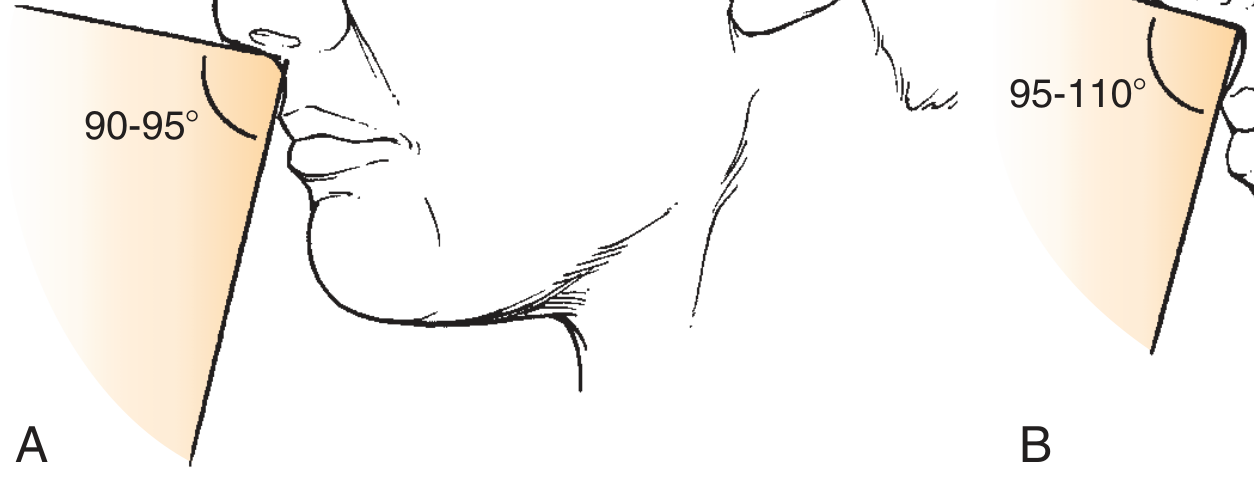
Nasolabial Angle
Angular inclination of the columella meeting the upper lip — formed between a line tangent to labrale superius/subnasale and a line tangent to subnasale/columella tip.
- Women: 95–110°
- Men: 90–95°
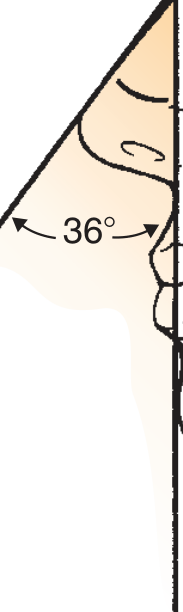
Nasofacial Angle
The incline of the nasal dorsum relative to the facial plane — angle from a vertical line (glabella–pogonion) intersecting a line from nasion through nasal tip.
- Ideal: 36° (range 30–40°)
Nasomental Angle
Formed by the nasion-to-tip line intersecting with the tip-to-pogonion line.
- Range: 120–132°
Nasal Rotation and Projection
Tip rotation occurs along an arc with radius based at the external auditory canal.
Projection methods:
- Simons' method: nasal projection ≈ upper lip length (ratio 1:1)
- Goode's method: vertical line from nasion to alar groove; ratio of perpendicular (alar groove → tip) to nasal length (nasion → tip) = 0.55–0.60; when achieved, nasofacial angle ≈ 36°
- Crumley-Lanser: 3-4-5 triangle — hypotenuse = nasal length, projection = smallest arm
Alar-Columellar Complex
On lateral view:
- Alar-to-tip/lobular ratio: optimal at 1:1
- Columellar show: 3–5 mm is acceptable
Chin Analysis
The chin is assessed in relation to the nose and lips. Ideal position:
- The chin (pogonion) should lie on or slightly posterior to the nasofacial vertical plane
- A microgenia (underprojected chin) worsens perceived nasal projection
- Chin evaluation is integral to rhinoplasty planning (nose-chin relationship)
Facial Symmetry
True facial symmetry is rare. Midline points (nasion, tip, philtrum, menton) should lie on the midsagittal axis. Subtle asymmetries are noted preoperatively and disclosed to the patient.
Source: Cummings Otolaryngology Head and Neck Surgery, 7th ed. — Chapter 16: Aesthetic Facial Analysis (Marc S. Zimbler), pp. 332–338
This is a shared conversation. Sign in to Orris to start your own chat.