
Acne vulgaris
"acne vulgaris"[MeSH Terms] AND "therapy"
acne vulgaris comedones papules pustules clinical photograph
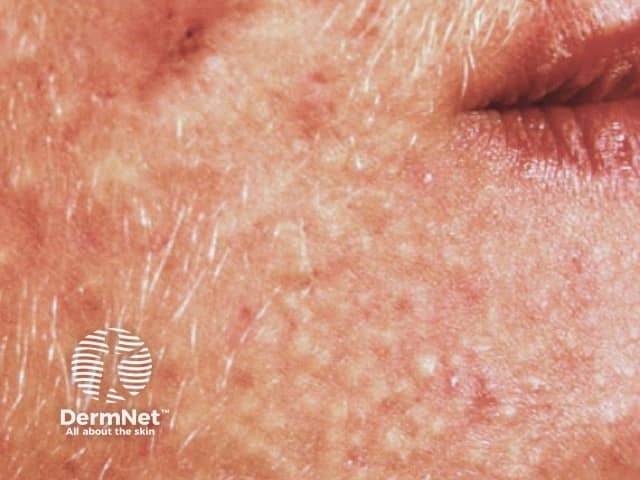
Clinical photograph of adult facial skin showing acne vulgaris. Modality: color digital photography; close-up frontal view of left cheek and perioral region. The skin shows numerous small inflammatory papules and closed comedones within erythematous background. Surface shows rough texture, post-inflammatory hyperpigmentation; no visible pustules or nodules beyond papules; sebaceous prominence; mild focal scarring. The distribution is predominantly in the central to lower cheek and perioral zones; symmetric involvement is suspected though lateralization not certain in this single frame. The visual features correspond to acne vulgaris, predominantly non-inflammatory comedones and mild inflammatory papules; differential includes rosacea (erythema with flushing and telangiectasia), folliculitis, perioral dermatitis. Clinically significant due to risk of scarring if untreated; management typically includes topical retinoids (tretinoin, adapalene), benzoyl peroxide, salicylic acid, topical/oral antibiotics, hormonal therapy in women; isotretinoin in severe cases. This image provides educational reference for adult-onset facial acne assessment, severity grading (milDer-type with comedones and papules), and therapy planning. Notable clinical context: identify pilosebaceous unit involvement, comedone formation, and post-inflammatory hyperpigmentation. Educational value includes recognizing lesion morphology, distinguishing acne from similar mimics, and selecting appropriate imaging-assisted documentation for follow-up, patient education, and clinical trials evaluating novel anti-acne therapies. This supports standardized severity assessment and treatment planning.
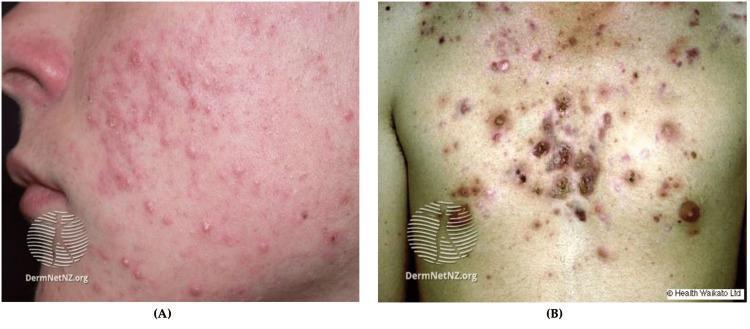
This clinical photograph set provides a comparative view of varying severities of acne. Image (A) displays Acne vulgaris on the facial region, specifically the cheek and jawline. It is characterized by a polymorphic eruption consisting of closed comedones (whiteheads), erythematous inflammatory papules, and small pustules distributed across a background of diffuse facial erythema. Image (B) demonstrates a more severe manifestation known as nodulocystic acne on the chest. This presentation features deeper, larger inflammatory lesions including firm nodules and fluctuant cysts. Significant post-inflammatory hyperpigmentation (PIH) and crusting are visible, with lesions often clustering to form larger inflammatory complexes. The comparison highlights the progression from superficial inflammatory acne to deep, scarring-prone nodulocystic disease. These images are intended for medical education regarding dermatological classification, lesion morphology identification, and clinical staging of acne severity.
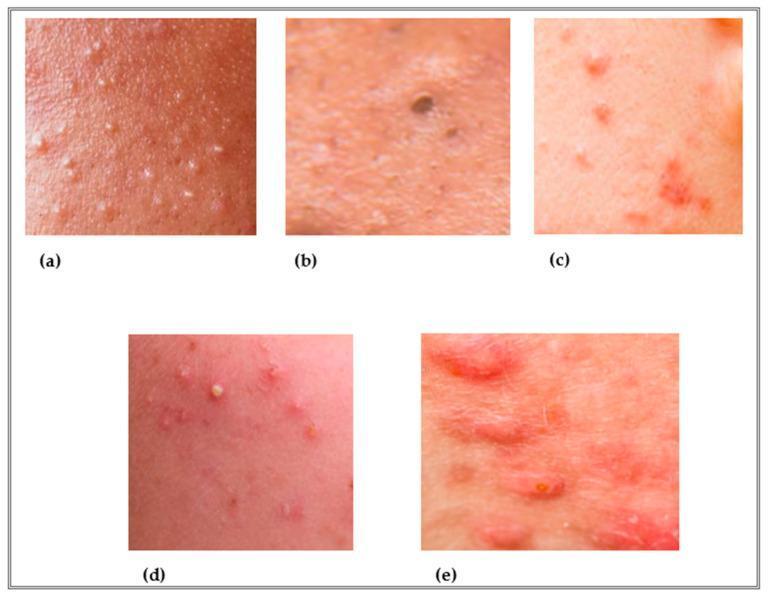
This composite clinical photograph illustrates the morphological spectrum of acne vulgaris, organized by lesion type and increasing severity. The images provide a comparative visualization of non-inflammatory and inflammatory dermatological findings: (a) Closed comedones (whiteheads) presenting as small, flesh-colored, non-inflammatory sub-epidermal bumps; (b) Open comedones (blackheads) characterized by dilated follicular orifices with dark oxidized keratinous material; (c) Erythematous papules representing early inflammatory lesions without visible suppuration; (d) Pustules demonstrating localized purulent material at the lesion apex surrounded by an inflammatory halo; and (e) Nodular acne featuring large, deep-seated, painful inflammatory lesions extending into the dermis. This sequence serves as an educational tool for clinical grading, transitioning from mild comedonal acne to moderate papulopustular and finally severe inflammatory nodular stages. The visual features highlighted include changes in lesion morphology, diameter, color (from flesh-toned to intense erythema), and the transition from non-inflammatory follicular plugging to deep dermal inflammation.
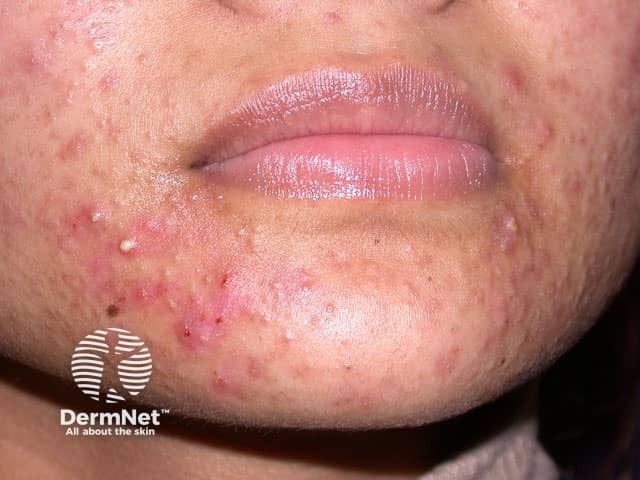
This is a high-resolution clinical photograph of facial skin focusing on the lower face (cheeks, chin) to document acne vulgaris. Modality is clinical photography with macro-detail of the pilosebaceous units. The image captures frontal view of the perioral and mandibular regions with even illumination and natural color balance. Visible findings include multiple erythematous inflammatory papules and pustules scattered across the lower cheeks and chin, with a few comedones (whiteheads) and subtle post-inflammatory hyperpigmentation. Skin surface shows mild textural irregularity, non-scars, and minimal edema around select lesions. The distribution is bilateral and facially symmetric in the lower face, consistent with acne distribution on the jawline and chin. The pattern suggests moderate severity, with inflamed lesions outnumbering comedones and without deep nodules in this field. In a clinical setting, this image would support diagnostic labeling of acne vulgaris, particularly moderate grade, and would be useful for treatment planning, patient education, and response monitoring during topical retinoid/benzoyl peroxide regimens, oral antibiotics, or hormonal therapies if appropriate. Differential considerations include rosacea, folliculitis, and perioral dermatitis, but the predominantly comedone and papulopustular features favor acne. This photograph serves as an educational reference for dermatology trainees and for trials documenting lesion counts and response to therapy.
acne vulgaris treatment guideline AAD topical retinoid benzoyl peroxide isotretinoin
Acne vulgaris
Overview
Pathogenesis
- Abnormal keratinization of the lower follicular infundibulum, forming a keratin plug that blocks sebum outflow.
- Androgen-driven sebaceous gland hypertrophy at puberty.
- Colonization by lipase-producing Cutibacterium (Propionibacterium) acnes, which converts sebum lipids into proinflammatory free fatty acids.
- Secondary follicular inflammation, ending in cyst rupture and a foreign-body reaction (Harrison's, p. 433).
- Friction or occlusion, such as helmet straps, headbands and heavy clothing.
- Comedogenic cosmetics and hair products.
- Industrial exposures: cutting oils, chlorinated hydrocarbons and coal tars.
- Drugs: topical or systemic glucocorticoids, ACTH, testosterone, gonadotropins, some contraceptives, iodides and bromides (Harrison's; Robbins).
Clinical features
- Non-inflammatory lesions:
- Closed comedones (whiteheads) are 1-2 mm pebbly white papules. They are the precursors of inflammatory lesions, and their contents are not easily expressed.
- Open comedones (blackheads) have a dilated follicular orifice. Their dark color is oxidized melanin pigment, not dirt. They rarely become inflamed (Harrison's; Robbins).
- Inflammatory lesions: papules, pustules, nodules and cysts.
- Distribution: earliest lesions are on the forehead. Typical inflammatory lesions then appear on the cheeks, nose and chin. The chest and back are commonly involved.
- Course: most disease is mild and does not scar. A minority develop large nodules and cysts that drain and scar, and early treatment of severe acne is essential (Harrison's).
Severity-based management
| Severity | First-line | Escalation |
|---|---|---|
| Mild (papules, pustules, comedones, no nodules) | Topical retinoid, or benzoyl peroxide (BPO) ± topical antibiotic, or retinoid + BPO. Alternatives: dapsone, clascoterone, azelaic acid. | Increase retinoid strength, switch from wash to leave-on BPO, or add or replace a topical agent. |
| Moderate (multiple papules and pustules, few nodules) | Topical retinoid + BPO ± topical antibiotic, oral antibiotic and/or hormonal therapy (females). | Add an oral antibiotic and/or hormonal therapy, or change to isotretinoin. |
| Severe (numerous lesions, multiple nodules) | Topical retinoid + BPO + oral antibiotic ± hormonal therapy, or isotretinoin. | Change to isotretinoin. |
| Very severe (acne fulminans, systemic symptoms) | Prednisone ± low-dose isotretinoin. | Isotretinoin with slow dose escalation. |
- Topical antibiotics: never use them as monotherapy because of resistance. When combining them with a retinoid, add BPO.
- Oral antibiotics: doxycycline, minocycline or sarecycline. Limit the course and always combine with BPO and a topical retinoid.
- Hormonal options for females: combined oral contraceptives or spironolactone.
- Isotretinoin:
- It works through strong antisebaceous action (Robbins).
- It is teratogenic. Pregnancy prevention and monitoring are required (iPLEDGE in the US).
- Typical monitoring covers lipids, liver enzymes and mood (my addition).
Current evidence
- Strong recommendations for BPO, topical retinoids (tretinoin, adapalene, tazarotene, trifarotene) and fixed-dose combinations such as retinoid + BPO.
- Strong recommendation for doxycycline.
- Conditional recommendations for minocycline and sarecycline.
- Multimodal therapy combining different mechanisms of action as a good practice statement.
- Reynolds et al., JAAD 2024, the guideline itself (PMID 38300170).
- Harper et al., network meta-analysis of moderate-to-severe acne, 2024 (PMID 38564399).
- A 2025 systematic review of procedural therapies such as lasers, peels and photodynamic therapy (PMID 40993442).
Trearment and management
PMID: 38300170
https://reference.medscape.com/cc2/p10/management-acne-vulga…
Acne vulgaris: treatment and management
1. Assessment before treating
- Grade severity by lesion type and count:
- Mild: comedones, a few papules and pustules, no nodules.
- Moderate: multiple papules and pustules, few nodules.
- Severe: numerous inflammatory lesions with nodules.
- Acne fulminans: severe acne with systemic symptoms.
- Treat as severe regardless of lesion count if there is scarring or significant psychosocial burden. The 2024 AAD guideline says these patients are candidates for isotretinoin (AAD summary).
- Look for triggers (Goldman-Cecil Medicine; Harrison's):
- Drugs: corticosteroids, androgens, phenytoin, phenobarbital, lithium, isoniazid.
- Oil-based cosmetics and hair products.
- Friction or occlusion.
- Endocrine disease such as PCOS or androgen-secreting tumors. Consider a work-up if there is hirsutism, irregular menses or abrupt severe onset.
- Counsel on expectations. Antibiotics take 6-8 weeks to show visible results and up to 3-6 months for maximum effect (Goodman & Gilman's). Retinoids often cause early irritation and a temporary flare.
2. Stepwise treatment (Dermatology 2-Volume Set 5e, Table 36.4)
| Severity | First-line | If inadequate |
|---|---|---|
| Mild | Topical retinoid, or BPO ± topical antibiotic, or retinoid + BPO. Alternatives: dapsone, clascoterone, azelaic acid. | Increase retinoid strength, change BPO wash to leave-on, or add or replace a topical. |
| Moderate | Retinoid + BPO ± topical antibiotic, oral antibiotic and/or hormonal therapy (females). | Add an oral antibiotic and/or hormonal therapy, or switch to isotretinoin. |
| Severe | Retinoid + BPO + oral antibiotic ± hormonal therapy, or isotretinoin. | Isotretinoin. |
| Very severe / fulminans | Prednisone ± low-dose isotretinoin. | Isotretinoin with slow dose escalation. |
3. Drug classes
Topical
- Benzoyl peroxide (BPO):
- It is bactericidal, does not induce resistance, and mildly comedolytic.
- Use it alongside any antibiotic to prevent resistance.
- Side effects are dryness, irritation, and bleaching of fabric.
- Topical retinoids:
- Tretinoin, adapalene, tazarotene and trifarotene all normalize follicular keratinization. No agent has been shown superior to the others.
- They are the key maintenance drug.
- Avoid in pregnancy. Tazarotene is the most teratogenic topical retinoid (Lippincott Illustrated Reviews: Pharmacology).
- Start low, apply at night, and use a moisturizer and sunscreen.
- Topical antibiotics (clindamycin, erythromycin):
- Never use as monotherapy. They act more slowly and promote resistance (Goodman & Gilman's).
- Use only as fixed-dose combinations with BPO, or with a retinoid plus BPO.
- Others:
- Azelaic acid, which is also useful for post-inflammatory hyperpigmentation.
- Salicylic acid.
- Dapsone.
- Clascoterone, a topical antiandrogen with high-certainty evidence but high cost.
Systemic antibiotics
- Choice of agent:
- Doxycycline is the strongest recommendation.
- Minocycline and sarecycline have conditional recommendations. Sarecycline is narrow-spectrum.
- Macrolides and trimethoprim-sulfamethoxazole are second-line alternatives.
- Rules:
- Combine with BPO and a topical retinoid.
- Keep the course as short as possible. Reassess at 3 months and taper once controlled. Do not use as monotherapy or for maintenance.
- Adverse effects (Harriet Lane Handbook, Table 8.3):
- Doxycycline: pill esophagitis (take with a large glass of water and stay upright for about an hour), photosensitivity, vaginal candidiasis.
- Minocycline: skin and mucosal hyperpigmentation, vestibular toxicity (dizziness in the first days), drug hypersensitivity syndrome, lupus-like syndrome, Stevens-Johnson syndrome. Extended-release forms have fewer vestibular effects.
- Tetracyclines should not be used in pregnancy or in children under 8 years because they stain developing teeth.
- Minocycline is a poor choice with pre-existing liver disease (Swanson's Family Medicine Review).
Hormonal therapy (females)
- Combined oral contraceptives:
- Examples are ethinyl estradiol with norgestimate or with drospirenone (Goldman-Cecil).
- They suit "hormonal" acne on the lower face, jawline and upper neck, and perimenstrual flares.
- The usual contraindications apply, such as VTE risk and migraine with aura.
- Spironolactone:
- It is an antiandrogen. It must not be used as monotherapy in pregnancy-capable patients without contraception, because of feminization of a male fetus.
- Routine potassium monitoring is not needed in healthy young patients. Check potassium if there are hyperkalemia risks such as older age, comorbidities, or interacting drugs (AAD 2024).
- Hormonal agents are not monotherapy. Use them with topicals (Harriet Lane).
Isotretinoin
- Indications:
- Severe nodular, cystic or scarring acne.
- Acne causing psychosocial burden.
- Failure of standard oral and topical therapy.
- Inability to wean off oral antibiotics.
- It should be managed by a dermatologist (Harriet Lane; AAD 2024).
- Mechanism: a strong antisebaceous action that shrinks sebaceous glands. It affects all major pathogenic factors.
- Dose and duration:
- Goldman-Cecil quotes 1.5 mg/kg for 5-6 months.
- Most patients clear in 16-20 weeks (Harriet Lane).
- Modern practice typically starts at 0.5 mg/kg/day, titrates up as tolerated, and aims for a cumulative dose of about 120-150 mg/kg. This comes from my own knowledge, not the retrieved sources.
- Teratogenicity:
- There is no safe dose in pregnancy (Goodman & Gilman's).
- In the US, prescribing requires enrollment in iPLEDGE.
- Females of childbearing potential need two forms of contraception and regular pregnancy tests.
- Monitoring:
- AAD 2024: consider LFTs and lipids. A CBC is not needed in healthy patients.
- Harriet Lane: check CBC, fasting lipids and LFTs at baseline, then at 4 and 8 weeks.
- Serum lipid elevation is the most common lab abnormality (Goodman & Gilman's).
- Population studies have not shown an increased risk of neuropsychiatric disease or inflammatory bowel disease, but ask about mood at each visit.
- Common effects:
- Cheilitis and dry skin and eyes.
- Photosensitivity.
- Myalgias.
- Transient flare early on.
- Avoid concurrent tetracyclines because of the risk of raised intracranial pressure (my addition).
Procedures
- Intralesional corticosteroid: triamcinolone injected into large nodules for quick relief (AAD good practice statement).
- Other procedures: chemical peels, lasers and photodynamic therapy have supportive but variable evidence, according to a 2025 systematic review. These are adjuncts rather than first-line.
- Scarring: treat early. Later options include resurfacing, microneedling, fillers and subcision (my addition).
4. Special situations
- Pregnancy: avoid oral retinoids, tetracyclines, spironolactone and topical retinoids. Reasonable options are topical BPO and azelaic acid. Topical clindamycin or erythromycin (with BPO) is also an option in pregnancy. Check local guidance.
- Pediatric / preadolescent: topical therapy comes first. Avoid tetracyclines under 8 years (Harriet Lane).
- Acne fulminans: prednisone first, then isotretinoin started at low dose.
- Transgender men on testosterone: acne is common, and isotretinoin has worked well. iPLEDGE rules still apply (Fitzpatrick's Dermatology).
5. Maintenance and follow-up
- Reassess every 8-12 weeks.
- After the acne is controlled, taper the oral antibiotic and continue a topical retinoid with or without BPO. This prevents relapse.
- Gentle cleansing, non-comedogenic products, and avoiding picking and aggravating drugs support treatment.
Evidence note
- Strong recommendations: BPO, topical retinoids, topical antibiotics (not as monotherapy), oral doxycycline, and isotretinoin for severe or failed disease.
- Conditional recommendations: clascoterone, salicylic acid, azelaic acid, minocycline, sarecycline, combined oral contraceptives and spironolactone.