
Difference Between Spermatogenesis And Oogenesis. 5 marks
Reading File
Finding Sources
Finding Sources
Reading File
Reading File
Reading File
Loading Image
Here is a comprehensive comparison for a 5-mark answer:
Differences Between Spermatogenesis and Oogenesis
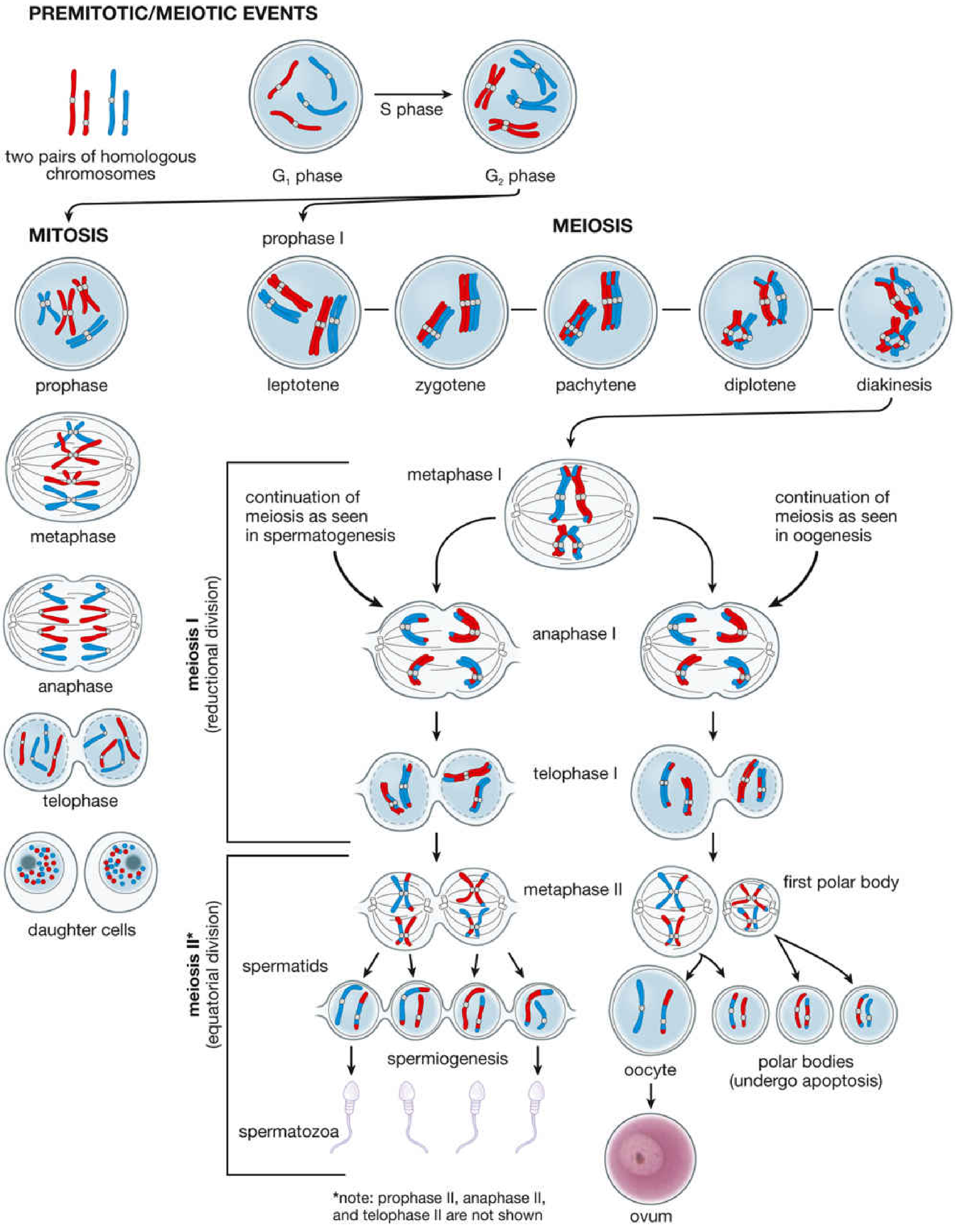
| Feature | Spermatogenesis | Oogenesis |
|---|---|---|
| Definition | Formation of mature spermatozoa (male gametes) in the testes | Formation of mature oocytes (female gametes) in the ovaries |
| Site | Seminiferous tubules of the testes | Ovarian follicles |
| Precursor cell | Spermatogonia | Oogonia |
| Onset | Begins at puberty and continues throughout adult life | Begins before birth (oogonia → primary oocytes in fetal life); resumes at puberty |
| Duration | Continuous and uninterrupted; ~64–74 days per cycle | Starts in fetal life, arrested at prophase I; completed only upon fertilization |
| Products per germ cell | 4 equal, functional spermatids (each becomes a spermatozoon) | 1 large, functional oocyte + 2–3 small, non-functional polar bodies that degenerate |
| Cytoplasm division | Equal (symmetric cytokinesis) — all 4 cells are similar in size | Unequal (asymmetric cytokinesis) — cytoplasm is conserved in the oocyte; polar bodies are tiny |
| Cell size of product | Small, highly motile spermatozoa | Large oocyte (~120 µm), rich in cytoplasm and nutrients |
| Meiotic arrest | No arrest; meiosis proceeds continuously | Arrested at prophase I (diplotene stage) for years/decades; re-arrested at metaphase II until fertilization |
| Spermiogenesis / equivalent | Spermatids undergo spermiogenesis (morphological transformation into spermatozoa — acrosome, flagellum, condensed nucleus) | No equivalent transformation; mature oocyte is released at ovulation already equipped with cytoplasmic stores |
| Number of gametes produced | Enormous numbers continuously (millions/day) | One oocyte per cycle; ~400 total in a lifetime (out of ~2 million primordial follicles) |
| Completion of meiosis II | Completes independently | Completes only after fertilization by a sperm |
| Polar bodies | None | 1st polar body released at ovulation; 2nd polar body released after fertilization |
| Hormonal control | FSH + testosterone (LH → Leydig cells → testosterone) | FSH + LH surge (LH surge triggers ovulation and meiosis resumption) |
Key Points to Memorise (for 5 marks)
- Number of functional gametes: Spermatogenesis → 4 sperms; Oogenesis → 1 oocyte + polar bodies.
- Timing: Spermatogenesis is continuous from puberty; oogenesis begins prenatally and involves long meiotic arrest.
- Cytokinesis: Equal in spermatogenesis; unequal in oogenesis (cytoplasm conserved for the oocyte).
- Meiotic arrest: Only oogenesis shows meiotic arrest (prophase I, then metaphase II); none in spermatogenesis.
- Final products: Spermatids require spermiogenesis to become spermatozoa; the oocyte requires fertilization to complete meiosis II.
"Four sperms form from one primary spermatocyte, whereas only one mature oocyte results from maturation of a primary oocyte. The cytoplasm is conserved during oogenesis to form one large cell, the mature oocyte." — The Developing Human: Clinically Oriented Embryology, p. 76
This is a shared conversation. Sign in to Orris to start your own chat.