
All about non gonococcal urethreits
"non-gonococcal urethritis"[MeSH Terms] AND treatment
non-gonococcal urethritis urethral discharge Chlamydia
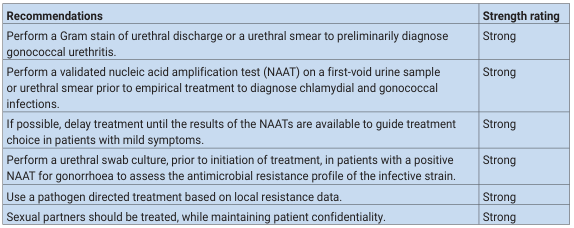
<table><thead><tr><th>Recommendations</th><th>Strength rating</th></tr></thead><tbody><tr><td>Perform a Gram stain of urethral discharge or a urethral smear to preliminarily diagnose gonococcal urethritis.</td><td>Strong</td></tr><tr><td>Perform a validated nucleic acid amplification test (NAAT) on a first-void urine sample or urethral smear prior to empirical treatment to diagnose chlamydial and gonococcal infections.</td><td>Strong</td></tr><tr><td>If possible, delay treatment until the results of the NAATs are available to guide treatment choice in patients with mild symptoms.</td><td>Strong</td></tr><tr><td>Perform a urethral swab culture, prior to initiation of treatment, in patients with a positive NAAT for gonorrhoea to assess the antimicrobial resistance profile of the infective strain.</td><td>Strong</td></tr><tr><td>Use a pathogen directed treatment based on local resistance data.</td><td>Strong</td></tr><tr><td>Sexual partners should be treated, while maintaining patient confidentiality.</td><td>Strong</td></tr></tbody></table>
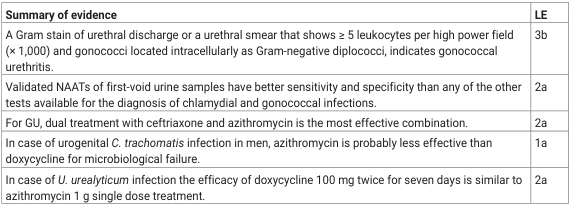
<table><thead><tr><th>Summary of evidence</th><th>LE</th></tr></thead><tbody><tr><td>A Gram stain of urethral discharge or a urethral smear that shows ≥ 5 leukocytes per high power field (× 1,000) and gonococci located intracellularly as Gram-negative diplococci, indicates gonococcal urethritis.</td><td>3b</td></tr><tr><td>Validated NAATs of first-void urine samples have better sensitivity and specificity than any of the other tests available for the diagnosis of chlamydial and gonococcal infections.</td><td>2a</td></tr><tr><td>For GU, dual treatment with ceftriaxone and azithromycin is the most effective combination.</td><td>2a</td></tr><tr><td>In case of urogenital <i>C. trachomatis</i> infection in men, azithromycin is probably less effective than doxycycline for microbiological failure.</td><td>1a</td></tr><tr><td>In case of <i>U. urealyticum</i> infection the efficacy of doxycycline 100 mg twice for seven days is similar to azithromycin 1 g single dose treatment.</td><td>2a</td></tr></tbody></table>
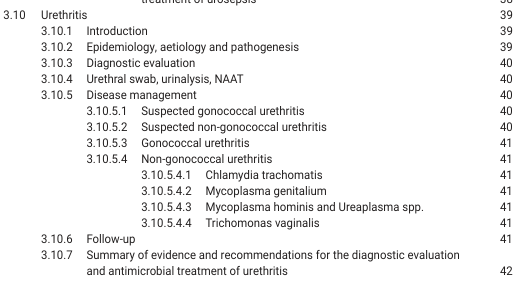
<table><tr><td>3.10</td><td>Urethritis</td><td>39</td></tr><tr><td>3.10.1</td><td>Introduction</td><td>39</td></tr><tr><td>3.10.2</td><td>Epidemiology, aetiology and pathogenesis</td><td>39</td></tr><tr><td>3.10.3</td><td>Diagnostic evaluation</td><td>40</td></tr><tr><td>3.10.4</td><td>Urethral swab, urinalysis, NAAT</td><td>40</td></tr><tr><td>3.10.5</td><td>Disease management</td><td>40</td></tr><tr><td>3.10.5.1</td><td>Suspected gonococcal urethritis</td><td>40</td></tr><tr><td>3.10.5.2</td><td>Suspected non-gonococcal urethritis</td><td>40</td></tr><tr><td>3.10.5.3</td><td>Gonococcal urethritis</td><td>41</td></tr><tr><td>3.10.5.4</td><td>Non-gonococcal urethritis</td><td>41</td></tr><tr><td>3.10.5.4.1</td><td>Chlamydia trachomatis</td><td>41</td></tr><tr><td>3.10.5.4.2</td><td>Mycoplasma genitalium</td><td>41</td></tr><tr><td>3.10.5.4.3</td><td>Mycoplasma hominis and Ureaplasma spp.</td><td>41</td></tr><tr><td>3.10.5.4.4</td><td>Trichomonas vaginalis</td><td>41</td></tr><tr><td>3.10.6</td><td>Follow-up</td><td>41</td></tr><tr><td>3.10.7</td><td>Summary of evidence and recommendations for the diagnostic evaluation and antimicrobial treatment of urethritis</td><td>42</td></tr></table>
Non-Gonococcal Urethritis (NGU)
Definition
Epidemiology
- An estimated 2.8 million cases of urethritis occur annually in the US; the majority are NGU.
- NGU is more common in younger, sexually active individuals (highest prevalence < 24 years).
- Coinfection with gonorrhea is common; up to 40-50% of NGU cases have no identifiable causative organism.
Etiology
| Organism | Proportion of NGU cases |
|---|---|
| Chlamydia trachomatis | 15-40% (most common cause) |
| Mycoplasma genitalium | 15-25% (2nd most common identifiable cause) |
| Ureaplasma urealyticum | Less common; associated with young men with few partners |
| Trichomonas vaginalis | Varies by geography/age; 2-13% |
| Herpes simplex virus (HSV-1, HSV-2) | Occasional |
| Adenovirus | Occasional |
| Unknown | Up to 50% of cases |
- C. trachomatis is more prevalent in younger men.
- M. genitalium has emerged as an increasingly recognized pathogen, with clinical significance comparable to chlamydia.
- Ureaplasma urealyticum should be considered when no other pathogen is found, particularly in young men with few sexual partners.
Pathophysiology
Clinical Features
- Often asymptomatic (symptoms are less prominent than in gonococcal urethritis)
- Dysuria (usual)
- White, mucopurulent or purulent urethral discharge (can appear 1-6 weeks after sexual contact)
- Urine may appear clear but contain "threads" or pus cells
- Urethral itching/stinging, penile tip irritation
- Usually asymptomatic
- Vaginal discharge or urethrotriginitis
- May present as cervicitis or ascend to cause pelvic inflammatory disease (PID)
Clinical features alone cannot reliably distinguish NGU from gonococcal urethritis; coinfection is common.
Diagnosis
Diagnostic Criteria (any one of the following):
- Mucoid, mucopurulent, or purulent discharge on examination
- Urethral Gram stain showing ≥2 WBCs per oil immersion field (current CDC threshold - older guideline used ≥5 WBCs/hpf, which missed significant cases)
- Positive leukocyte esterase on first-void urine
- >10 WBCs/hpf on first-void urine microscopy
Gram Stain Interpretation
- Gram-negative intracellular diplococci = N. gonorrhoeae (gonococcal)
- ≥2 WBCs per oil immersion field without intracellular diplococci = NGU
- Sensitivity of Gram stain is highly provider-dependent and collection-method dependent
Nucleic Acid Amplification Test (NAAT) - Gold Standard
- First-catch (first-void) urine is the preferred specimen in men for NAAT
- High sensitivity and specificity for C. trachomatis, N. gonorrhoeae, T. vaginalis, and M. genitalium
- Should be performed whenever Gram stain is unavailable, or when ≥2 WBCs are present without intracellular diplococci
- In women: urine, endocervical, or vaginal swabs can be used
Additional Testing
- Concurrent testing for gonorrhea, HIV, and syphilis is recommended with any NGU diagnosis
- NAAT for M. genitalium should be obtained in persistent or recurrent NGU
- Wet mount microscopy can identify trichomoniasis but is less sensitive than NAAT (~50-65%)
Treatment
First-Line Treatment for NGU
| Regimen | Dose |
|---|---|
| Doxycycline (preferred) | 100 mg orally twice daily for 7 days |
| Azithromycin | 1 g orally as a single dose |
Note: Doxycycline is now preferred over azithromycin for NGU because azithromycin's median cure rate has dropped from 85% historically to ~40% in recent studies, largely due to M. genitalium resistance.
Alternative Regimens (for C. trachomatis):
- Erythromycin base 500 mg PO four times daily for 7 days
- Erythromycin ethylsuccinate 800 mg PO four times daily for 7 days
- Levofloxacin 500 mg PO once daily for 7 days
- Ofloxacin 300 mg PO twice daily for 7 days
Treatment by Specific Organism
- Doxycycline 100 mg PO twice daily x 7 days (preferred)
- OR Azithromycin 1 g PO single dose
- Abstain from intercourse for 7 days after single-dose therapy or until 7-day course is complete
- 3-month retest recommended (not test-of-cure, but re-screening)
- Two-stage approach: Doxycycline 100 mg PO twice daily x 7 days followed by Moxifloxacin 400 mg PO once daily x 7 days
- If macrolide sensitivity confirmed on resistance testing: doxycycline x 7 days followed by azithromycin (1 g initial dose, then 500 mg once daily x 3 more days)
- Moxifloxacin has shown 100% cure rates in early reports
- Metronidazole 2 g PO single dose
- OR Tinidazole 2 g PO single dose
Persistent or Recurrent NGU
- Treatment failure (especially M. genitalium resistance to doxycycline or azithromycin)
- Non-compliance with initial treatment
- Re-exposure to an untreated sex partner
- Resistant M. genitalium or T. vaginalis infection
- Obtain urine NAAT for M. genitalium and T. vaginalis
- If M. genitalium confirmed: two-stage doxycycline + moxifloxacin regimen (see above)
- Consider chronic pelvic pain syndrome as an alternative diagnosis if pelvic pain is prominent
- Urologic evaluation rarely identifies a specific cause in persistent cases
Complications
- Epididymitis (common)
- Orchitis
- Prostatitis (prostate may also serve as a reservoir for relapse)
- Urethral stricture (potential late complication)
- Reiter syndrome (reactive arthritis, uveitis, urethritis) - associated with C. trachomatis
- Cervicitis
- Pelvic inflammatory disease (PID)
- Fallopian tube scarring
- Infertility
- Pelvic pain
- Neonatal conjunctivitis (ophthalmia neonatorum)
- Neonatal pneumonia (C. trachomatis)
Partner Management
- All sex partners with whom the patient had sexual contact in the preceding 60 days should be referred for evaluation, testing, and presumptive treatment.
- Treat both partners - reinfection is probable if the partner is not treated.
- Retesting of both partners at 3 months is recommended.
- Patients should abstain from intercourse until treatment is complete and symptoms resolve.
EAU Guideline Recommendations (Summary)
- Gram stain of urethral discharge for preliminary diagnosis
- NAAT on first-void urine (preferred) or urethral smear before empirical treatment
- Delay treatment until NAAT results available if symptoms are mild
- Urethral swab culture prior to treatment if NAAT is positive for gonorrhea (for resistance profiling)
- Pathogen-directed treatment based on local resistance data
- Always treat sexual partners
Key Points Summary
| Feature | Detail |
|---|---|
| Most common cause | Chlamydia trachomatis (15-40%) |
| 2nd most common | Mycoplasma genitalium (15-25%) |
| Gold standard test | NAAT on first-void urine |
| Diagnostic threshold | ≥2 WBCs/oil immersion field (current CDC) |
| First-line treatment | Doxycycline 100 mg BD x 7 days |
| Persistent NGU | Add moxifloxacin (for M. genitalium) |
| Partner treatment | Mandatory; 60-day contact tracing |
| Retest timing | 3 months after treatment |