
Tonsillitis instruments ent dhingra
Dhingra ENT tonsillitis tonsillectomy instruments list
https://www.theentresident.com/ent-notes-lectures/tonsillect…
Tonsillectomy Instruments (ENT - Dhingra)
1. Mouth Gag & Exposure
| Instrument | Description & Use |
|---|---|
| Boyle-Davis Mouth Gag | Spring-loaded gag with a tongue blade slot; keeps mouth open and depresses tongue. The most important starting instrument. Used in tonsillectomy, adenoidectomy, and pharyngeal surgeries. |
| Draffin's Bipod Rods + Magauran's Plate | Metallic bipod stands that attach to the Boyle-Davis gag; fixed to the Magauran's plate to suspend the gag and maintain Rose's position hands-free. |
| Doughty Tongue Blade | Blade that fits into the Boyle-Davis gag to depress the tongue; available in multiple sizes (3", 4", 4.5"). |
2. Holding & Grasping Forceps
| Instrument | Description & Use |
|---|---|
| Denis Browne Tonsil Holding Forceps | Ratcheted holding forceps; grasps and retracts the tonsil medially to create tension during dissection. |
| Waugh's Dissecting Forceps | Serrated-jaw forceps; used for incision of the anterior pillar mucosa and blunt dissection. Can also hold gauze swab for pressure. |
| Tonsil Seizing Forceps | Grips tonsil tissue during dissection. |
3. Dissectors & Retractors
| Instrument | Description & Use |
|---|---|
| Gwynne-Evans Tonsil Dissector & Anterior Pillar Retractor | Double-ended instrument - one end for dissection, other for retracting the anterior pillar. Used to blunt-dissect the tonsil from its peritonsillar space (capsule-pharyngeal muscle plane). |
| Mollison Tonsillar Dissector & Pillar Retractor | Double-ended instrument - rounded dissector end for blunt dissection; broad curved retractor end to retract the anterior pillar, check for bleeding points, and look for tonsillar tags or retained gauze. |
| Tonsil Knife / Scalpel (No. 15 or No. 12 blade on #7 handle) | Incises the mucosa of the anterior faucial pillar at the start of dissection. |
| Tonsillar Scissors (curved) | Curved, blunt-tipped scissors for dissecting the lower pole and dividing the mucosa. |
4. Snare
| Instrument | Description & Use |
|---|---|
| Eve's Tonsillar Snare | Long cylindrical instrument with a stainless steel wire loop and sliding mechanism. Passed around the lower pole of the tonsil to sever and remove it at the inferior pedicle. Twisting and tightening the wire loop avulses the lower pole. Used in the cold steel guillotine/snare technique. |
5. Haemostasis Instruments
| Instrument | Description & Use |
|---|---|
| Negus Tonsil Artery Forceps (curved) | Long, slender hemostatic forceps with curved, blunt, finely serrated jaws. Clamps bleeding vessels in the tonsillar fossa. The curved tip prevents the ligature from slipping. |
| Birkett Artery Forceps (straight) | Straight artery forceps for clamping vessels. |
| Negus Ligature Slipper & Knot Tier (Negus Knot Pusher) | Long rod-like instrument with a forked distal end/central groove. Used to guide and push the ligature (tie) over the tip of the Negus artery forceps during vessel ligation - essential for tying sutures deep in the tonsillar fossa. |
| Bipolar Diathermy Forceps | Used for haemostasis in diathermy tonsillectomy techniques. |
| Tonsil Compression / Haemostatic Forceps (Yorke's) | Used in post-tonsillectomy haemorrhage to compress the tonsillar fossa. |
6. Suction
| Instrument | Description & Use |
|---|---|
| Yankauer Suction Cannula | Curved metal tube with rounded atraumatic tip (one central + multiple side holes). Clears blood and secretions from the pharynx during and after surgery. Multiple holes prevent blockage. |
7. Adenoidectomy Instrument (often combined with tonsillectomy)
| Instrument | Description & Use |
|---|---|
| St. Clair Thompson Adenoid Curette | Available with cage (to catch adenoid tissue) or without. Held in dagger fashion, passed behind soft palate into nasopharynx to curette adenoid tissue. |
Key Viva Points (Dhingra-style)
- Position: Rose's position (Trendelenburg with neck extended, head slightly lower than feet) - allows blood to drain away from airway.
- Boyle-Davis gag is the single most important instrument to identify - it provides exposure for the entire operation.
- Eve's snare is used at the lower pole and works by mechanical strangulation/avulsion.
- Negus artery forceps have a curved tip specifically to prevent the ligature from slipping during ligation.
- Negus knot pusher is the companion instrument to the Negus forceps - necessary because the tonsillar fossa is deep and a knot cannot be tied with fingers alone.
- Mollison retractor is the last instrument used at the end - to inspect the fossa for bleeding points or retained gauze.
- Normal blood loss in tonsillectomy: approximately 50-100 mL.
- Cold steel dissection + ties has the lowest secondary haemorrhage rate compared to diathermy or coblation techniques (Scott-Brown's, NPTA data).
Create a visual reference poster of tonsillectomy instruments
A clean, professional medical reference poster titled "Tonsillectomy Instruments" for ENT surgery students. Dark navy blue background with white and gold text. The poster shows detailed illustrated drawings of the following surgical instruments, each clearly labeled with name and function: 1. Boyle-Davis Mouth Gag - spring-loaded gag with tongue blade, shown assembled 2. Draffin's Bipod Rods - metallic bipod stand with rings 3. Denis Browne Tonsil Holding Forceps - ratcheted holding forceps 4. Waugh's Dissecting Forceps - serrated jaw forceps 5. Gwynne-Evans Tonsil Dissector & Pillar Retractor - double-ended instrument 6. Mollison Tonsillar Dissector & Pillar Retractor - double-ended with curved retractor end 7. Eve's Tonsillar Snare - cylindrical with wire loop and sliding mechanism 8. Negus Tonsil Artery Forceps - long curved hemostatic forceps 9. Negus Knot Pusher / Ligature Slipper - long rod with forked distal end 10. Yankauer Suction Cannula - curved metal suction tube with rounded tip 11. St. Clair Thompson Adenoid Curette - with cage Each instrument is drawn in realistic silver/steel style with clean black outlines, arranged in a grid layout. Small annotation arrows point to key features. A color-coded legend groups instruments by function: Exposure (blue), Holding (green), Dissection (orange), Haemostasis (red), Suction (purple). Footer reads "ENT Surgery - Tonsillectomy Instruments Reference" in small text. Clean, textbook-quality medical illustration style.
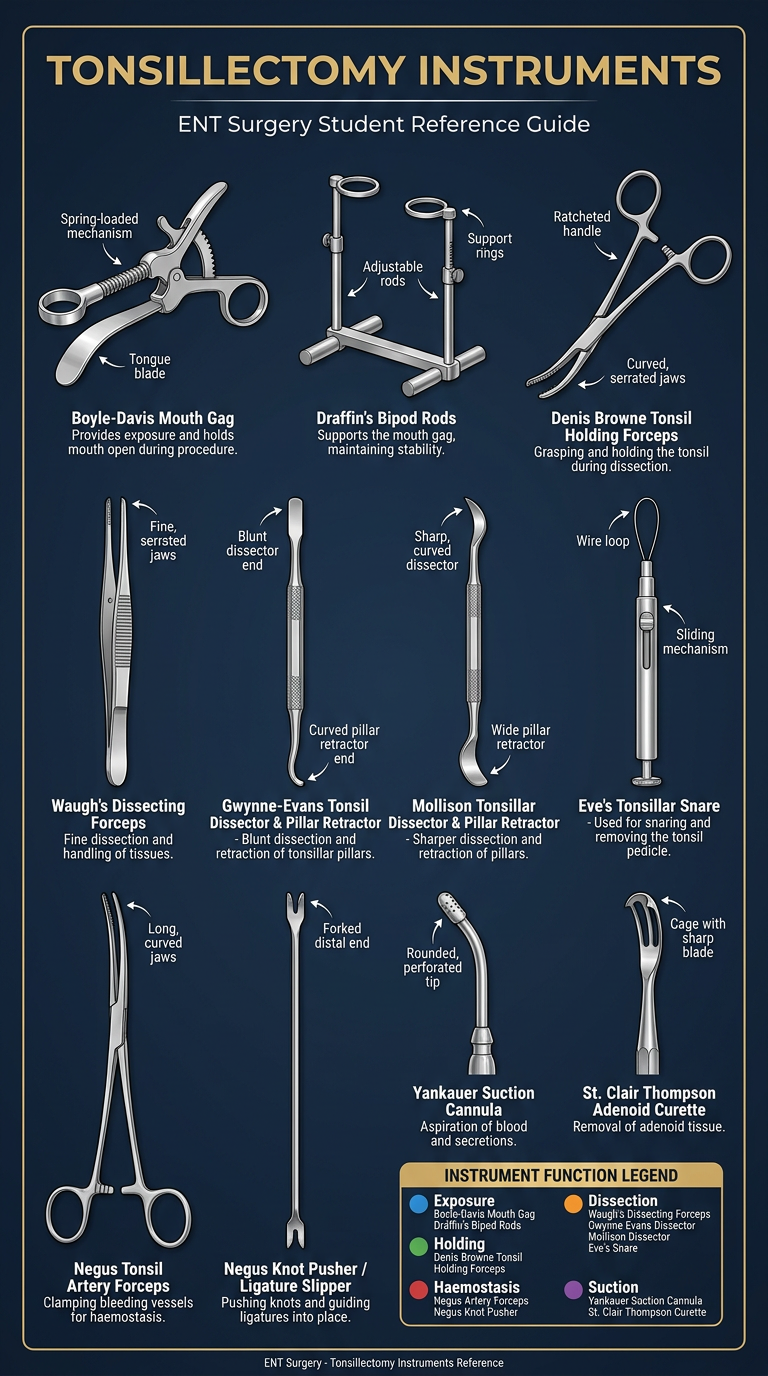
- Blue - Exposure: Boyle-Davis Mouth Gag, Draffin's Bipods
- Green - Holding/Grasping: Denis Browne Forceps, Waugh's Forceps
- Orange - Dissection: Gwynne-Evans Dissector, Mollison Dissector & Retractor
- Red - Haemostasis: Eve's Tonsillar Snare, Negus Artery Forceps, Negus Knot Pusher
- Purple - Suction/Other: Yankauer Cannula, St. Clair Thompson Curette