
Palmar aponeurosis
Reading File
Finding Sources
Finding Sources
Reading File
Reading File
Reading File
Reading File
Loading Image
Loading Image
Palmar aponeurosis is the thickened, central part of the deep fascia of the palm.
Key points
- Shape: triangular, fan-shaped fibrous sheet in the palm
- Proximal attachment (apex): continuous with palmaris longus tendon (if absent, anchored to the flexor retinaculum)
- Distal extension (base): sends longitudinal digital slips toward mainly the index, middle, ring, and little fingers
- Fiber types:
- longitudinal fibers (dominant)
- transverse fibers connecting longitudinal bundles
- Relations:
- superficial to deeper palmar structures
- deep to it lie digital vessels, nerves, and long flexor tendons
- distally connected to skin via fibrous septa, helping skin fixation and grip
Functions
- Protects deeper palmar neurovascular and tendon structures
- Helps maintain palmar architecture and compartmentalization
- Assists grip mechanics by stabilizing palmar skin and fascia
- Kept tense partly by palmaris longus and palmaris brevis actions
Clinical relevance
- Dupuytren contracture: progressive fibrotic thickening/shortening of palmar fascia (aponeurosis), often affecting ring and little fingers, causing fixed flexion deformity and reduced hand function.
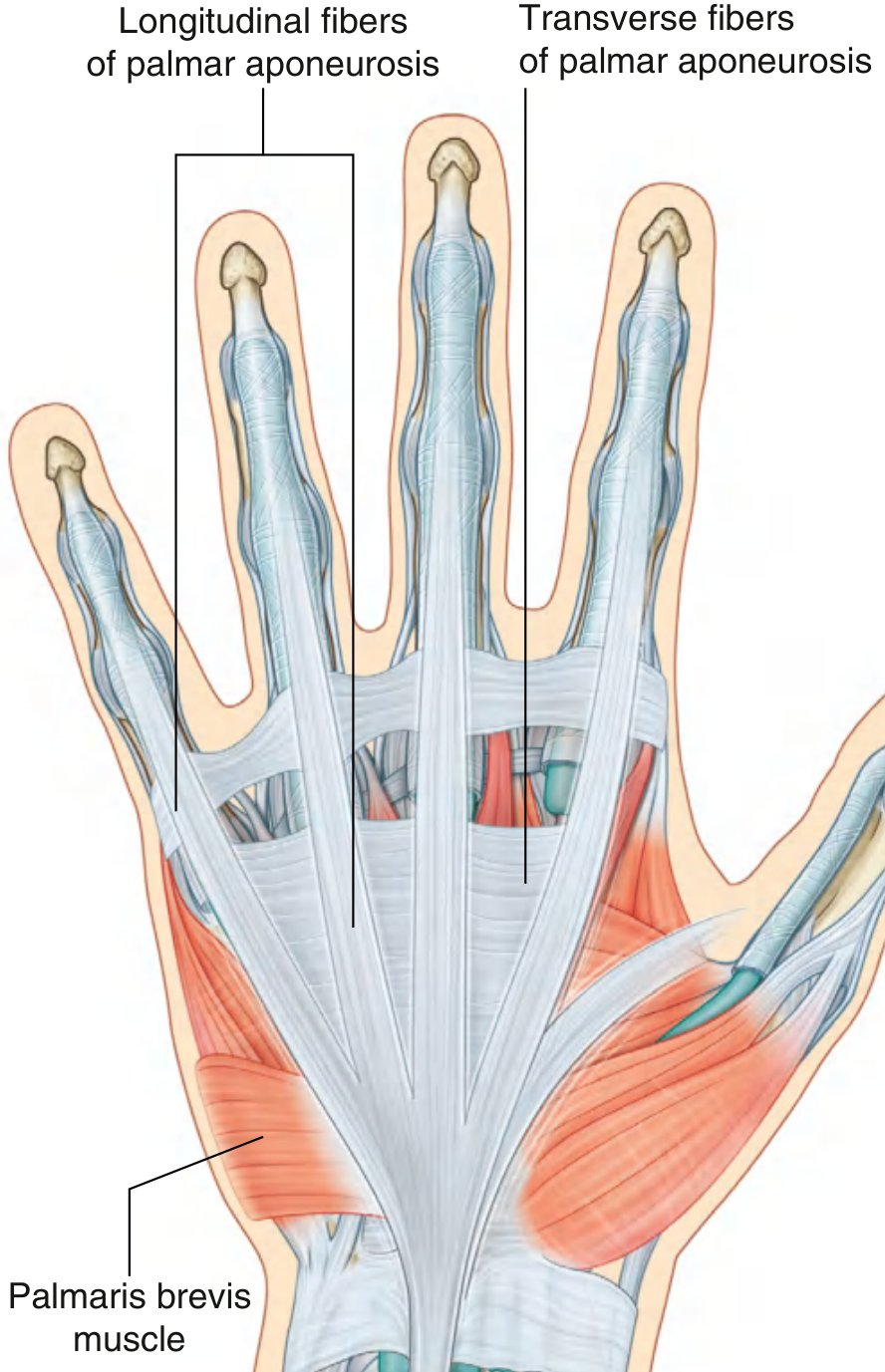
Source: Gray’s Anatomy for Students, p. 360
Additional atlas correlation: General Anatomy and Musculoskeletal System (THIEME Atlas), p. 369; Imaging Anatomy Text and Atlas Vol. 3, p. 618
Additional atlas correlation: General Anatomy and Musculoskeletal System (THIEME Atlas), p. 369; Imaging Anatomy Text and Atlas Vol. 3, p. 618
This is a shared conversation. Sign in to Orris to start your own chat.