
Stages of measles
Reading File
Searching sources...
Finding Sources
Finding Sources
The best sources are Park's (stages description), Andrews' Dermatology, and Medical Microbiology. Let me read the detailed content from the most relevant sources in parallel.
Reading File
Reading File
Reading File
Now let me read the detailed stages from Park's textbook and fetch the pathogenesis diagram:
Reading File
Loading Image
Loading Image
Now let me read the post-measles stage and complications from Park's textbook:
Reading File
I now have comprehensive information from the textbooks. Here is the full structured answer:
Stages of Measles
Measles (caused by an RNA paramyxovirus, a paramyxovirus with a single serotype) passes through three main clinical stages after an incubation period. - Park's Textbook of Preventive and Social Medicine
Incubation Period
- Duration: ~10 days from exposure to onset of fever; ~14 days to appearance of rash
- The virus implants in the upper respiratory tract, replicates in the mucosal epithelium, then spreads via viremia to lymphoid tissues, bone marrow, skin, and CNS.
- No symptoms are present, but the patient becomes infectious from ~4 days before the rash appears.
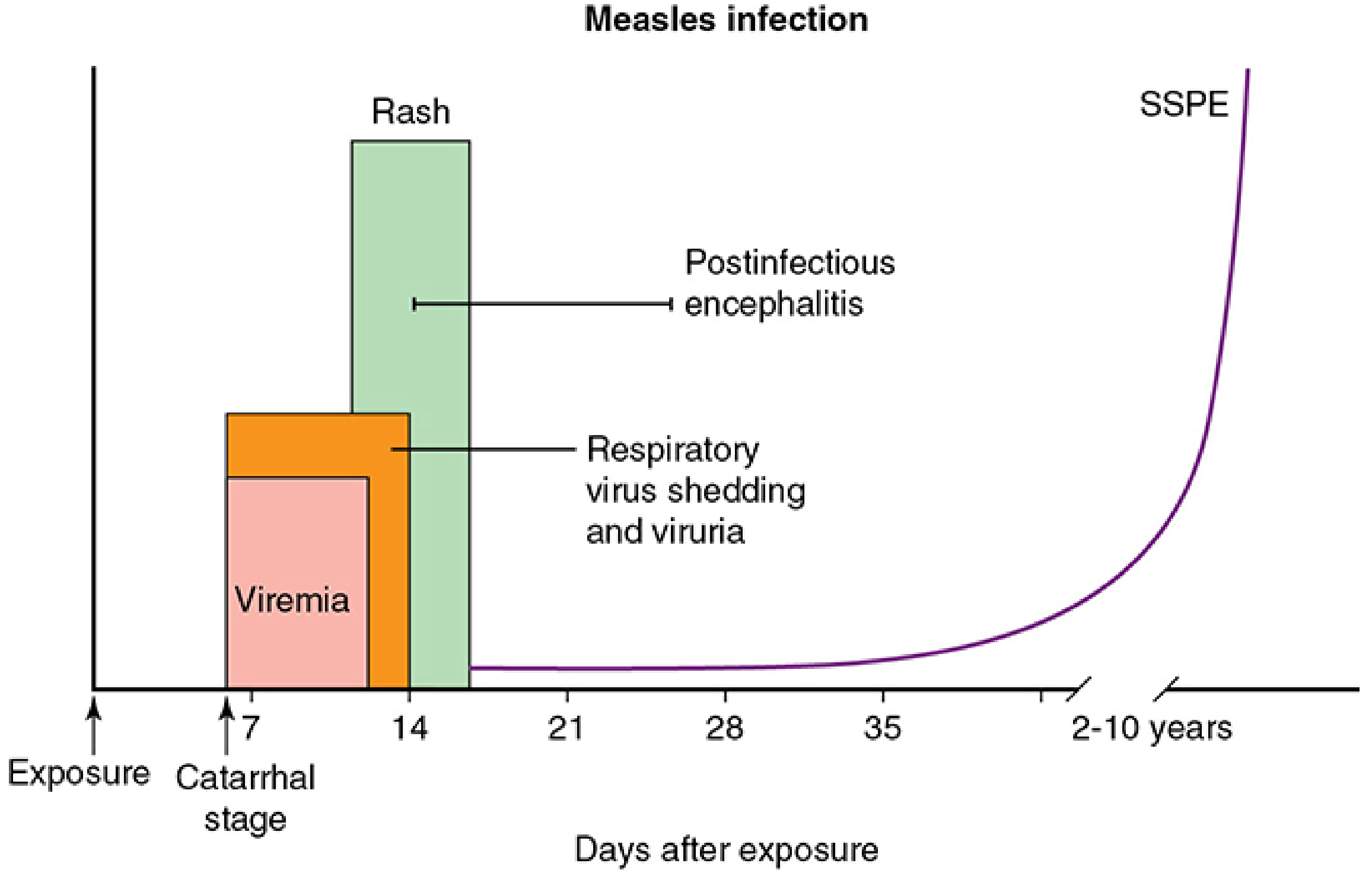
Stage 1: Prodromal (Pre-Eruptive) Stage
- Timing: Days 10-14 after infection (lasts 2-4 days before rash)
- Features:
- High fever
- Coryza - sneezing, nasal discharge
- Conjunctivitis (red eyes, lacrimation, photophobia)
- Prominent cough
- Vomiting or diarrhoea may occur
- Pathognomonic sign - Koplik's spots: Small, bluish-white spots on a red base (described as resembling table salt crystals) appearing on the buccal mucosa opposite the lower molars, 1-2 days before the rash. They may spread to other areas of the buccal mucosa and pharynx.
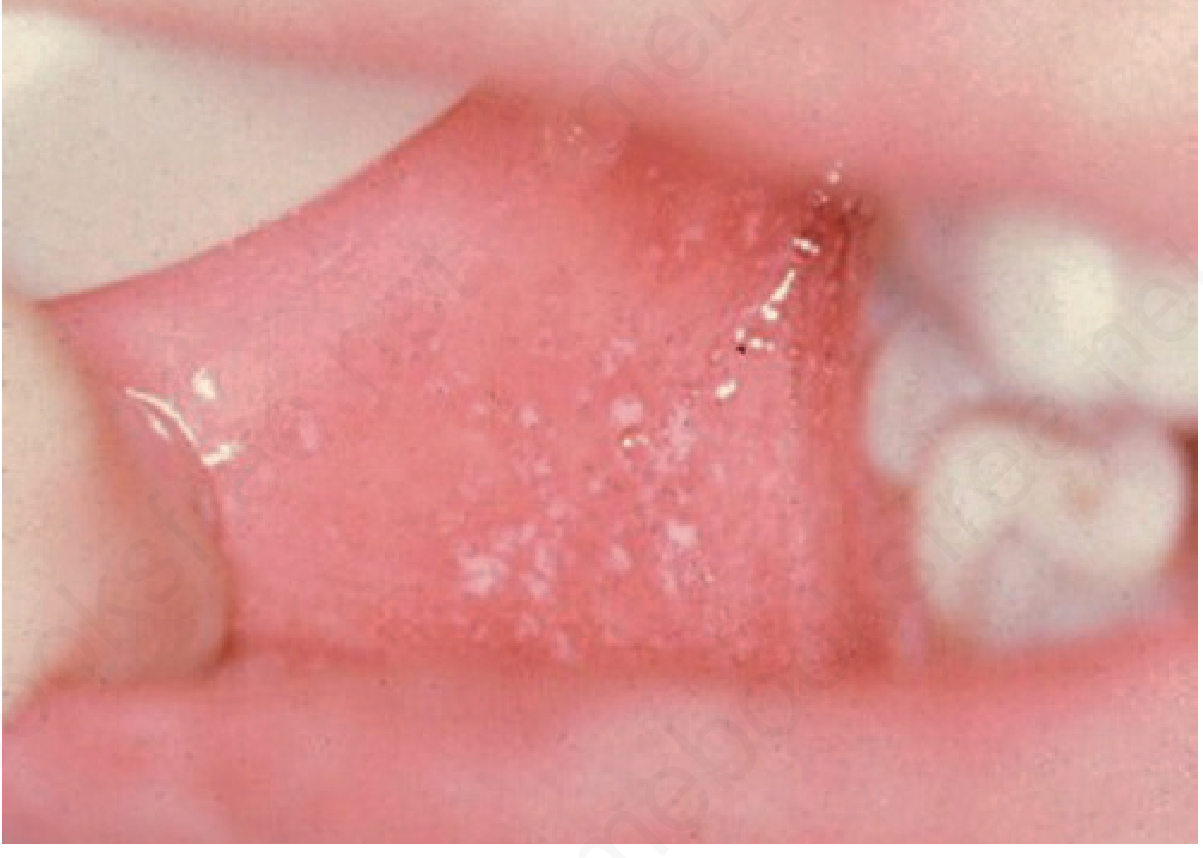
Koplik spots - pathognomonic of measles. (Andrews' Diseases of the Skin)
- Communicability: Maximum during this phase - virus is present in tears, nasal/throat secretions, urine, and blood.
Stage 2: Eruptive (Exanthematous) Stage
- Timing: ~Day 14 from exposure; rash lasts 6-7 days
- Rash characteristics:
- Dusky-red, macular or maculopapular (morbilliform) lesions
- Begins behind the ears and on the anterior scalp hairline
- Spreads rapidly over the face and neck within hours, then down the trunk, reaching the lower extremities by day 2-3 (unlike rubella, which spreads more rapidly)
- Lesions are most confluent in initially involved areas; may be more discrete on extremities
- Often becomes confluent and blotchy
- After 6-7 days the rash fades in the same craniocaudal order, leaving a brownish discolouration that may persist for 2 months or more
- Fever: Persists during the rash but falls as rash clears; leukopenia is common (pronounced leukopenia <2000 cells/mm³ is associated with poor prognosis)
- Pathophysiology of rash: The rash develops from interaction of immune T cells with virus-infected endothelial cells in small blood vessels. Patients with defective cell-mediated immunity do not develop a rash.
- As the maculopapular rash appears, circulating antibodies become detectable, viremia disappears, and fever falls.
Stage 3: Post-Measles Stage
- Timing: After rash resolution
- The child is weakened and has lost weight.
- Complications arising in this stage (occur in ~30% of cases):
- Respiratory: Pneumonia (1-6%), laryngotracheobronchitis (croup), otitis media (7-9%)
- GI: Diarrhoea (8%), protein-losing enteropathy (especially in developing countries)
- Neurological: Post-infectious encephalitis (~1-4 per 1,000-2,000 cases)
- Late neurological: Subacute sclerosing panencephalitis (SSPE) - develops 2-10 years after infection in ~1 per 10,000-100,000 cases
- Other: Cancrum oris, reactivation of pulmonary TB, pyogenic infections, candidiasis, growth retardation
- Immune suppression: Profound depression of cell-mediated immunity (due to IL-12 downregulation by measles virus in monocytes/macrophages) persists for several weeks after acute illness, greatly increasing susceptibility to bacterial superinfections.
Summary Table
| Stage | Timing | Key Features |
|---|---|---|
| Incubation | Days 0-10 | Asymptomatic; virus replicating and spreading |
| Prodromal | Days 10-14 | 3 Cs: Cough, Coryza, Conjunctivitis; Koplik's spots |
| Eruptive | Day 14 onward (~6-7 days) | Morbilliform rash spreading craniocaudally; high fever |
| Post-measles | After rash fades | Weakness, immune suppression, complications |
| SSPE (late) | 2-10 years later | Rare, fatal CNS complication |
Classic diagnostic tip: The diagnosis of measles is practically incorrect in any febrile exanthem where red eyes and cough are absent. - Park's Textbook of Preventive and Social Medicine
Sources: Park's Textbook of Preventive and Social Medicine | Andrews' Diseases of the Skin | Sherris & Ryan's Medical Microbiology, 8th Ed.
This is a shared conversation. Sign in to Orris to start your own chat.