
how does stomach react to water when we drink eat in empty stomach
When you drink water or eat on an empty stomach, the stomach responds in several coordinated ways. Gastric acid is already present at baseline, and the arrival of food/water triggers further secretion of HCl, pepsinogen, and gastric motility. Water passes through quickly (empties in ~20 minutes), while food stimulates more sustained responses including gastrin release, mucus production, and peristaltic mixing waves.
Searching sources...
Reading File
Searching the Web
stomach response to water food empty stomach gastric physiology
Now let me search the medical library for detailed gastric physiology content.
Finding Sources
Finding Sources
Excellent - found the key sources. Let me read the relevant sections from Guyton & Hall and Sleisenger & Fordtran simultaneously.
Reading File
Reading File
Let me get the key gastric secretion and stomach emptying sections from Guyton & Hall:
Finding Sources
Reading File
Reading File
Reading File
Reading File
I now have rich material from Guyton & Hall. Let me also fetch the phases diagram image for the user.
Loading Image
I now have everything needed for a thorough, well-cited answer. Here is the complete explanation:
How the Stomach Reacts When You Drink Water or Eat on an Empty Stomach
The response differs depending on whether you are drinking plain water or eating food. Both trigger a coordinated series of mechanical, secretory, and hormonal events, but the intensity, duration, and complexity differ greatly.
1. The Stomach at Baseline (Fasting State)
On an empty stomach, the stomach is not truly "off." It still produces a small basal level of gastric acid (HCl) and runs intermittent contractions called the migrating myoelectric complex (MMC) - housekeeping waves that sweep remaining contents toward the duodenum every ~90 minutes. The hormone ghrelin is elevated during fasting and stimulates the excitatory vagal motor circuit to hasten gastric emptying between meals. When the stomach is truly empty for 12-24 hours, hunger contractions begin - intense peristaltic waves felt as hunger pangs. These can reach their peak intensity after 3-4 days of starvation (Guyton and Hall, p. 791).
2. Drinking Water on an Empty Stomach
Mechanical response
The stomach accommodates liquid immediately. The fundus relaxes (receptive relaxation) via a vagal reflex mediated by nitric oxide, allowing the water to be distributed throughout the antrum and corpus without a major rise in intraluminal pressure. (Sleisenger & Fordtran, p. 851)
Gastric emptying
Water passes through the stomach very rapidly. The pyloric sphincter - which stays slightly contracted normally - remains open enough for water and fluids to empty easily without needing to be churned into a semi-solid (chyme). Strong antral peristaltic contractions (the "pyloric pump") can generate 50-70 cm H₂O pressure to push contents through. Plain water is typically emptied within 15-20 minutes (Guyton and Hall, p. 791).
Acid response
Plain water has a minimal stimulating effect on acid secretion because it lacks the protein and nutrient content that trigger gastrin release. The pH of the stomach rises briefly as water dilutes gastric acid, but this dilution itself can transiently stimulate parietal cells (via low pH feedback mechanisms).
Hunger contractions
Drinking water temporarily distends the stomach, which suppresses hunger contractions briefly - this is why drinking water before a meal can reduce appetite temporarily.
3. Eating Food on an Empty Stomach
Eating on an empty stomach triggers all three phases of gastric secretion, which together account for ~1,500 mL of gastric juice per day. (Guyton and Hall, p. 804)
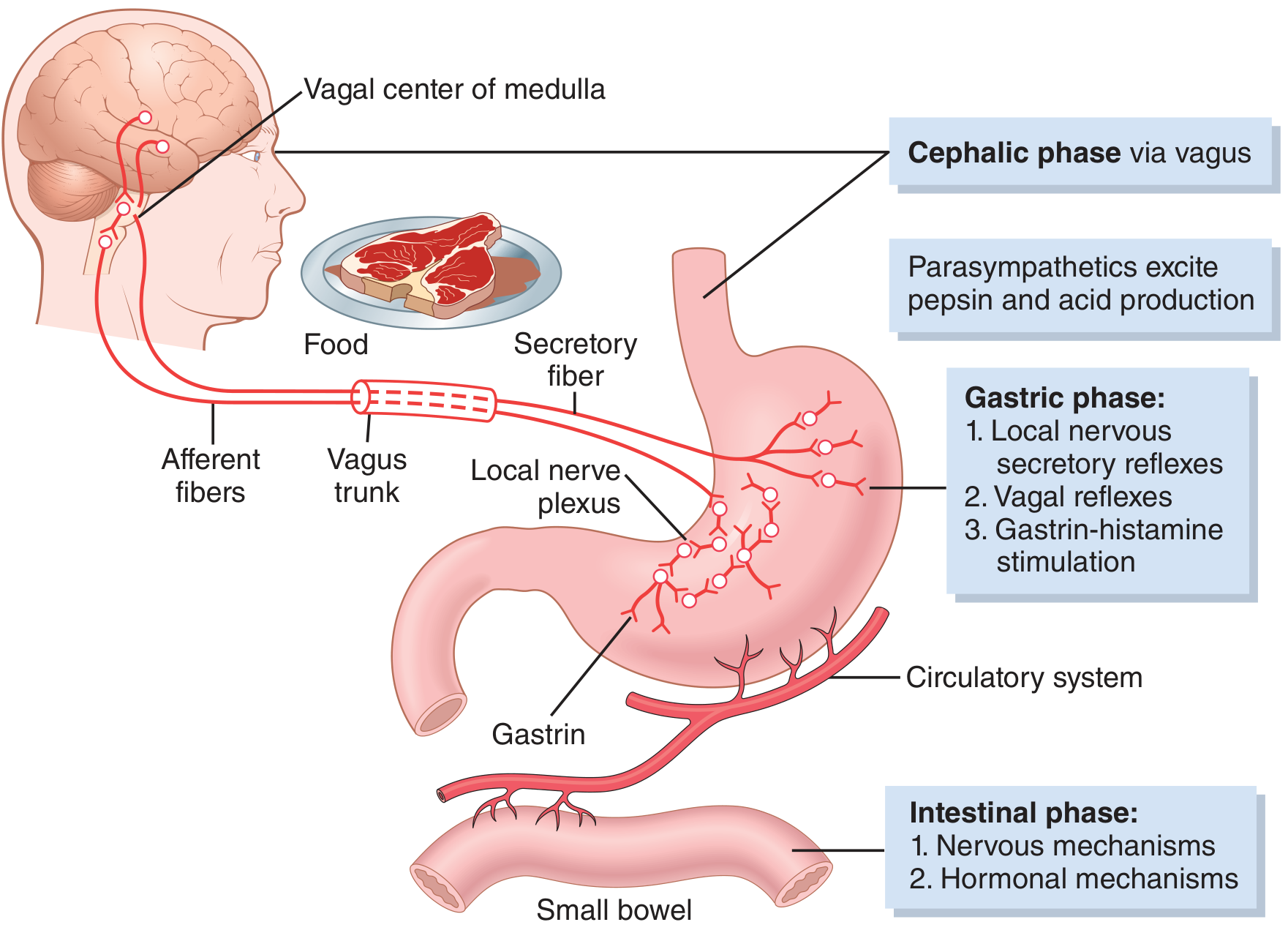
Phase 1 - Cephalic Phase (~30% of total secretion)
This starts before food even reaches the stomach - triggered by the sight, smell, thought, or taste of food. The cerebral cortex and hypothalamus send signals via the vagus nerve (dorsal motor nucleus) down to the stomach. This stimulates:
- Parietal cells → HCl secretion
- Peptic (chief) cells → Pepsinogen secretion
- ECL cells → Histamine release (which then amplifies parietal cell acid secretion)
The stronger your appetite, the more intense the cephalic phase response.
Phase 2 - Gastric Phase (~60% of total secretion)
Once food physically enters the stomach, three mechanisms fire simultaneously:
- Vagovagal reflexes - afferent vagal signals from the stomach wall travel to the brain stem and return as parasympathetic efferents
- Local enteric reflexes - the myenteric plexus within the stomach wall itself
- Gastrin-histamine mechanism - proteins in food stimulate G cells in the pyloric antrum to release gastrin into the blood. Gastrin travels to ECL cells in the oxyntic glands, stimulating histamine, which strongly drives parietal cells to pump out HCl (pH can drop to 0.8).
Pepsinogen secretion is driven by: vagal acetylcholine, gastric acid (via enteric reflexes), and secretin from the duodenum. Pepsinogen is activated to pepsin by the acidic environment and begins protein digestion.
The stomach also secretes thick alkaline mucus continuously from surface mucous cells, protecting the stomach wall from its own acid. Any food contact directly stimulates more mucus production.
Phase 3 - Intestinal Phase (~10% of total secretion)
As chyme enters the duodenum, small amounts of gastrin released by duodenal mucosa continue to stimulate gastric secretion briefly.
Mechanical mixing on an empty stomach
Once food arrives, the stomach performs two tasks:
- Mixing waves - weak rhythmic contractions that blend food with gastric secretions into semi-liquid chyme
- Pyloric pump - strong antral peristaltic contractions (active ~20% of the time food is present) that grind solids and push chyme through the pylorus in small spurts. The pylorus stays closed to particles until they are ground to near-fluid consistency.
4. Why an Empty Stomach Matters
| Situation | Effect |
|---|---|
| Water on empty stomach | Passes through in ~15-20 min, minimal acid response |
| Food on empty stomach | Full 3-phase response, faster gastric emptying than after a prior meal |
| Alcohol on empty stomach | Gastric emptying is fast, peak blood alcohol reached in ~30 min (vs. much slower with food) |
| Antacids on empty stomach | Less effective - food isn't present to slow gastric emptying, so antacid washes through before it can neutralize much acid |
5. Inhibitory Feedback (Enterogastric Reflex)
Once chyme fills the duodenum, the stomach slows itself down via:
- Reverse enterogastric reflex - distension, acid, protein breakdown products, or osmotic changes in the small intestine send inhibitory signals back to the stomach
- Hormonal inhibition - secretin, gastric inhibitory peptide (GIP), VIP, and somatostatin all reduce gastric acid and motility
This prevents the duodenum from being overwhelmed.
Sources: Guyton and Hall Textbook of Medical Physiology (pp. 791, 804); Sleisenger and Fordtran's Gastrointestinal and Liver Disease (p. 851)
This is a shared conversation. Sign in to Orris to start your own chat.