
A 2 month-old infant was brought to the OPD with mental retardation, blonde hair and fair skin. It is noticed he has a musty, mousy odour. On investigations, ferric chloride test and Guthrie test were positive. 1. What is the diagnosis? Justify. 2. Explain the biochemical basis of this condition in detail. 3. Why there is mousy order in this condition? Explain. 4. Why there is blonde hair and fair skin in this condition? 5. Give a detailed account of the management of this patient.
Reading File
Now I'll run parallel searches across the medical library for all aspects of this PKU case.
Finding Sources
Finding Sources
Finding Sources
Excellent results. Now let me read the most comprehensive sources in parallel - Robbins Pathologic Basis (most detailed PKU section) and Lippincott Biochemistry.
Reading File
Reading File
Reading File
Excellent content. Let me now get the rest of the Robbins PKU section (management, melanin pathway) and the Lippincott detailed PKU section, plus the PKU metabolites/mousy odor section.
Reading File
Finding Sources
Finding Sources
Now let me get the Lippincott detailed PKU section (including the mousy odor, melanin, and management content):
Reading File
Reading File
I now have comprehensive information from multiple authoritative sources. Let me also get the Lippincott management section and fetch the key metabolic pathway diagram:
Reading File
Loading Image
I now have all the information needed for a comprehensive, well-sourced answer. Let me compose the full response.
Diagnosis: Phenylketonuria (PKU) - Classic Type
1. Diagnosis and Justification
The diagnosis is Classic Phenylketonuria (PKU), an autosomal recessive inborn error of amino acid metabolism.
Justification - each finding maps directly to PKU:
| Clinical Feature | Explanation |
|---|---|
| Mental retardation | Hyperphenylalaninemia impairs brain development |
| Blonde hair, fair skin | Decreased melanin synthesis due to tyrosine deficiency |
| Musty/mousy odour | Accumulation of phenylpyruvate, phenylacetate, phenyllactate |
| Ferric chloride test positive | FeCl3 reacts with urinary phenylpyruvate (a phenylketone) to give a blue-green colour |
| Guthrie test positive | Bacterial inhibition assay detects elevated blood phenylalanine (uses Bacillus subtilis that requires phenylalanine for growth) |
| Age 2 months | Infant is normal at birth; hyperphenylalaninemia develops over weeks once exposed to dietary phenylalanine |
The Guthrie test (now largely replaced by tandem mass spectrometry) was originally known as the newborn bloodspot test and reliably identifies elevated phenylalanine, while the ferric chloride test detects urinary phenylpyruvate - both are classic screening tools for PKU. - Emery's Elements of Medical Genetics and Genomics; Harper's Illustrated Biochemistry, 32nd Ed
2. Biochemical Basis of PKU
The PAH Enzyme System:
PKU is caused by a severe deficiency (loss-of-function mutations) of the enzyme phenylalanine hydroxylase (PAH), located in the liver. This enzyme normally catalyzes the irreversible hydroxylation of phenylalanine to tyrosine, which is the first and rate-limiting step in phenylalanine catabolism.
Normal reaction:
Phenylalanine + O₂ + Tetrahydrobiopterin (BH4) → Tyrosine + H₂O + Dihydrobiopterin (BH2) BH2 is then recycled back to BH4 by dihydropteridine reductase (DHPR), using NADH.
The diagram below (from Robbins Pathology) illustrates this beautifully:
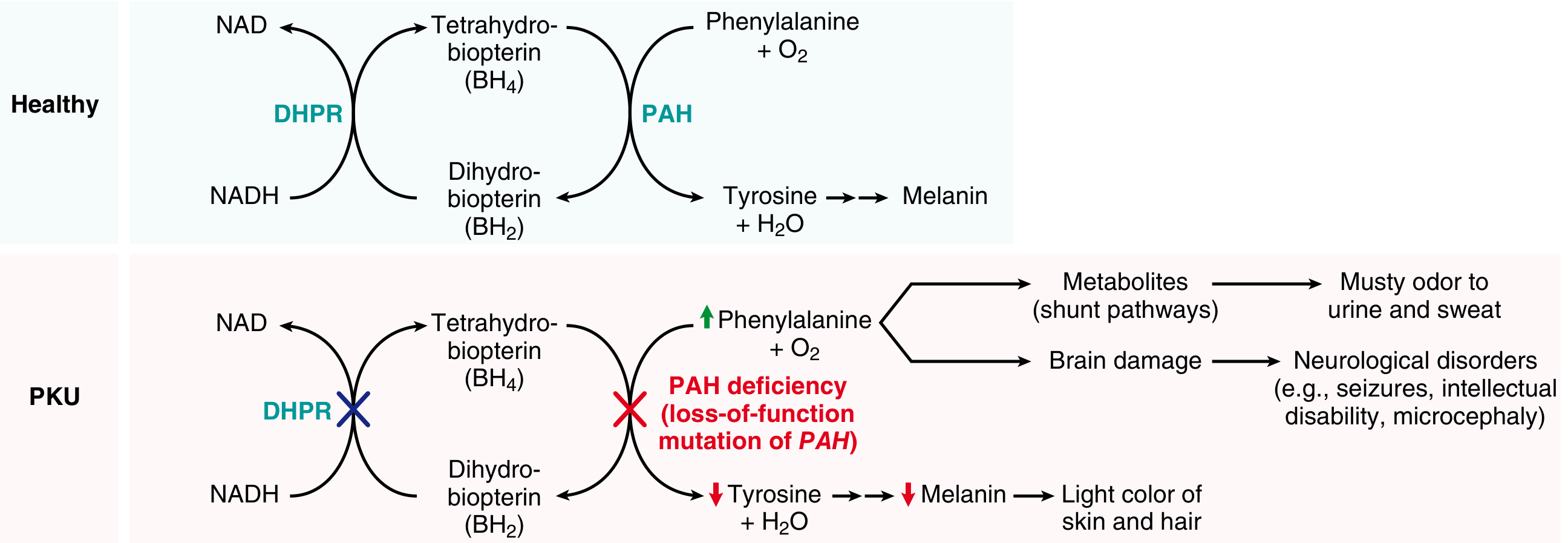
Fig. 10.14 from Robbins, Cotran & Kumar Pathologic Basis of Disease - PAH system in health (top) vs. PKU (bottom)
Consequences of PAH deficiency:
-
Phenylalanine accumulates in blood and tissues (hyperphenylalaninemia). Normal blood phenylalanine is ~60 µmol/L; in PKU it typically exceeds 1200 µmol/L (>5-fold above normal).
-
Tyrosine becomes deficient because the major route of phenylalanine disposal is blocked. Tyrosine, normally a non-essential amino acid, becomes conditionally essential and must be supplemented.
-
Shunt (minor) pathways are overloaded: In the absence of functional PAH, excess phenylalanine is diverted into minor metabolic pathways that are not normally significant:
- Transamination → Phenylpyruvate (the phenylketone that gives the disease its name and is detected by ferric chloride test)
- Reduction of phenylpyruvate → Phenyllactate
- Decarboxylation and oxidation → Phenylacetate (the main source of the mousy odour)
- Decarboxylation → Phenylethylamine
-
CNS damage mechanism: Excess phenylalanine (or its metabolites) is neurotoxic. It competitively inhibits the transport of other large neutral amino acids (e.g., tryptophan, tyrosine, leucine) across the blood-brain barrier, depriving the brain of substrates needed for neurotransmitter synthesis (serotonin from tryptophan, catecholamines from tyrosine) and protein synthesis. This leads to impaired myelination and progressive intellectual disability. - Robbins, Cotran & Kumar Pathologic Basis of Disease; Lippincott Biochemistry 8th Ed
Variant PKU (~2%): Deficiency of DHPR or defects in BH4 biosynthesis also cause hyperphenylalaninemia. These are more severe because BH4 is also a cofactor for tyrosine hydroxylase and tryptophan hydroxylase - so catecholamine and serotonin deficiencies compound the picture. These variants cannot be treated by dietary restriction alone. - Ganong's Review of Medical Physiology
Genetics: Autosomal recessive; PAH gene on chromosome 12q23.2. Nearly 1000 mutant alleles identified. Mutations in both alleles are required. Incidence is approximately 1 in 10,000 live births in Northern European populations. - Robbins, Cotran & Kumar
3. Why is There a Musty/Mousy Odour?
When PAH is non-functional, excess phenylalanine is shunted into minor metabolic pathways that produce abnormal metabolites in large quantities. These metabolites are excreted in urine and sweat and are responsible for the characteristic smell:
- Phenylacetate (from oxidative decarboxylation of phenylpyruvate, or via phenylacetyl-CoA) - this is the primary compound responsible for the musty/mousy smell
- Phenylpyruvate (from transamination of phenylalanine by aminotransferases)
- Phenyllactate (from reduction of phenylpyruvate)
These metabolites are not produced in significant amounts when PAH is functional, because phenylalanine is efficiently converted to tyrosine. When the main pathway is blocked, the shunt pathways become the dominant route of phenylalanine catabolism, and phenylacetate in particular imparts the characteristic musty or "mousy" odour to urine and sweat. - Lippincott Biochemistry 8th Ed, p. 762; Robbins, Cotran & Kumar
The ferric chloride test detects urinary phenylpyruvate (gives blue-green/grey-green colour), confirming overflow into this shunt pathway.
4. Why is There Blonde Hair and Fair Skin?
The hypopigmentation in PKU results from decreased melanin synthesis, which is a direct consequence of tyrosine deficiency:
Normal melanin synthesis pathway:
Tyrosine →(tyrosinase, copper-dependent)→ DOPA →→→ Melanin
In PKU:
- PAH deficiency blocks phenylalanine → tyrosine conversion
- Tyrosine levels fall significantly
- The enzyme tyrosinase (a copper-requiring enzyme) uses tyrosine as its substrate to begin melanin synthesis. With less tyrosine available, tyrosinase activity is reduced, producing less melanin
- Melanin is the pigment responsible for dark hair colour, skin tanning, and eye pigmentation
- Reduced melanin production leads to: fair/blonde hair, light skin, and blue eyes
This is why PKU patients have a characteristically lighter complexion than their unaffected siblings or parents. The degree of hypopigmentation correlates with the severity of the phenylalanine elevation. - Lippincott Biochemistry 8th Ed, p. 762; Robbins, Cotran & Kumar
Note: This is distinct from true albinism (where tyrosinase itself is deficient); in PKU the enzyme is functional but deprived of substrate.
5. Detailed Management of PKU
A. Newborn Screening (Prevention of Damage)
- All newborns should be screened by blood phenylalanine measurement (tandem mass spectrometry from heel-prick blood spot) ideally within the first 24-48 hours after commencing feeds
- The Guthrie test (bacterial inhibition assay) was the historical screening test
- Dietary treatment must begin within the first 7-10 days of life to prevent cognitive impairment - Lippincott Biochemistry 8th Ed
- Note: Blood phenylalanine is normal at birth (cleared by the mother's placenta), and rises only after 24-48 hours of protein feeding
B. Dietary Management (Cornerstone of Treatment)
- Phenylalanine-restricted diet: Since all natural proteins contain phenylalanine, a normal diet cannot satisfy protein requirements without exceeding the phenylalanine limit. Therefore:
- Synthetic amino acid formula free of phenylalanine provides the bulk of protein/nitrogen intake
- Low-phenylalanine natural foods are allowed in limited quantities (certain fruits, vegetables, specific cereals)
- High-protein foods are avoided: meat, fish, eggs, dairy, nuts, regular bread
- Target blood phenylalanine levels: 120-360 µmol/L. Treatment is indicated when levels exceed 360 µmol/L - Harrison's Principles of Internal Medicine 22E (2025)
- Phenylalanine is an essential amino acid - complete elimination causes deficiency states and growth failure. The diet must provide a small controlled amount.
- Tyrosine supplementation is mandatory: since tyrosine cannot be synthesized from phenylalanine, it becomes an essential amino acid in PKU and must be provided in the diet - Harrison's; Lippincott Biochemistry
- Aspartame (artificial sweetener) must be avoided - it is a dipeptide of phenylalanine and aspartate
- Dietary restriction is lifelong - discontinuation in childhood is associated with declining IQ scores; adults who discontinue the diet develop executive function deficits and psychiatric symptoms
C. Pharmacological Treatment
-
Sapropterin (BH4 analogue):
- Synthetic tetrahydrobiopterin (cofactor of PAH)
- Dose: 5-20 mg/kg/day orally
- Effective in patients with BH4-responsive mutations (about 25-50% of classic PKU patients)
- Used in conjunction with a low-protein diet
- Not effective for the ~2% of PKU due to DHPR deficiency (variant PKU) - Robbins, Cotran & Kumar; Harrison's
-
Pegvaliase (enzyme substitution therapy):
- Pegylated recombinant phenylalanine ammonia lyase (PAL) - a bacterial enzyme
- Converts excess phenylalanine to trans-cinnamic acid and ammonia (bypassing the PAH pathway)
- Injectable; can substantially reduce phenylalanine levels, potentially allowing a normal diet
- Limitation: bacterial origin can trigger immune reactions in some patients
- Approved for adults with uncontrolled PKU - Harrison's Principles of Internal Medicine 22E
-
Phenylalanine ammonia lyase (PAL) enzyme therapy (investigational/microbiome-based approaches also under study)
D. Monitoring
- Regular blood phenylalanine levels (weekly in infancy, monthly thereafter)
- Nutritional assessment: levels of tyrosine, essential amino acids, vitamins (especially B12, selenium, zinc - often deficient with restrictive diet)
- Neurodevelopmental assessment and IQ testing
- Ophthalmology follow-up (some patients develop cataracts with prolonged hyperphenylalaninemia)
E. Special Situations
-
Maternal PKU: Women with PKU who plan pregnancy must resume strict phenylalanine restriction at least 2 months before conception and maintain it throughout pregnancy. Uncontrolled maternal hyperphenylalaninemia is teratogenic - causing intellectual disability, microcephaly, and congenital heart defects in the offspring (even if the fetus is only heterozygous). 75-90% of children born to untreated PKU mothers have intellectual disability. - Robbins, Cotran & Kumar
-
Variant PKU (BH4 deficiency ~2%): Requires BH4 replacement plus neurotransmitter precursor supplementation (L-DOPA, 5-hydroxytryptophan) since DOPA and serotonin synthesis are also impaired. Dietary restriction alone is insufficient.
-
Gene therapy: Experimental approaches targeting PAH gene correction are under investigation.
Summary Table
| Feature | Mechanism |
|---|---|
| Mental retardation | Excess Phe/metabolites toxic to brain; inhibits neurotransmitter synthesis |
| Mousy odour | Phenylacetate (+ phenylpyruvate, phenyllactate) excreted in urine/sweat |
| Fair skin, blonde hair | Decreased tyrosine → decreased melanin |
| Ferric chloride (+) | Phenylpyruvate in urine → blue-green colour |
| Guthrie test (+) | Elevated blood phenylalanine detected |
| Treatment | Low-Phe diet + Tyr supplementation + sapropterin/pegvaliase |
Sources: Robbins, Cotran & Kumar Pathologic Basis of Disease (10th Ed), pp. 438-439 | Lippincott Illustrated Reviews Biochemistry 8th Ed, pp. 761-767 | Harrison's Principles of Internal Medicine 22E (2025), p. 3413 | Harper's Illustrated Biochemistry 32nd Ed | Emery's Elements of Medical Genetics and Genomics
This is a shared conversation. Sign in to Orris to start your own chat.