
Q. Discus the etiology , pathology and management of oral submucous fibrosis in detail for 50 marks with diagram and flow charts from Scott Brown, Cummings, stell and marans, Zakir Hussain, dhingra, hazarika and related articles with recent advances according to rguhs university
Reading File
Finding Sources
Searching PubMed
"oral submucous fibrosis" AND management
Searching the Web
oral submucous fibrosis etiology pathology management RGUHS 50 marks recent advances 2024
Reading File
Reading File
Finding Sources
Reading Article
Reading Article
Reading Web Page
oral submucous fibrosis etiology pathogenesis histopathology management classification
Reading File
Reading File
Finding Sources
Finding Sources
Reading Article
Loading Image
Finding Sources
Finding Sources
Reading Article
I now have enough comprehensive content from multiple authoritative sources. Let me compile the detailed 50-mark answer:
Oral Submucous Fibrosis (OSMF) - Comprehensive Review (50 Marks)
RGUHS Examination Standard
1. INTRODUCTION AND DEFINITION
Oral Submucous Fibrosis (OSMF) is a chronic, progressive, potentially malignant disorder of the oral cavity characterized by juxta-epithelial inflammatory reaction and progressive fibrosis of the submucosal tissues. The fibrosis leads to progressive stiffness of the oral mucosa and underlying tissues, causing trismus and inability to open the mouth.
Definition (Pindborg & Sirsat, 1966):
"An insidious, chronic disease affecting any part of the oral cavity and sometimes the pharynx. Although occasionally preceded by and/or associated with vesicle formation, it is always associated with a juxta-epithelial inflammatory reaction followed by a fibro-elastic change of the lamina propria, with epithelial atrophy leading to stiffness of the oral mucosa and causing trismus and inability to eat."
WHO Classification: Listed as an Oral Potentially Malignant Disorder (OPMD). Malignant transformation rate ranges from 3%-10% (WHO), with Indian studies reporting up to 7.6% over 17 years (Cummings, 2020).
2. EPIDEMIOLOGY
| Parameter | Data |
|---|---|
| Prevalence | 0.2% - 2.5% in Indian subcontinent |
| Age group | 20-40 years (increasingly in teenagers) |
| Gender | Male > Female (4:1 in India; 27:1 in Taiwan) |
| Geography | South/Southeast Asia, Indian subcontinent, South Pacific |
| Estimated cases (India) | ~5 million affected |
- Predominantly affects people from India, Pakistan, Bangladesh, Taiwan, Papua New Guinea, and South Africa (in immigrant populations)
- Prevalence increasing due to wide marketing of packaged areca/gutka products - systematic review evidence confirms this (PMID 39525471)
- Scott-Brown's: "The consumption of betel quid (Paan/Paan Masala) is socially and culturally embedded in South-East Asia and is responsible for the difference in site predilection."
3. ETIOLOGY (Multifactorial)
A. PRIMARY CAUSE: Areca Nut (Betel Nut)
The areca nut (Areca catechu) is the single most important etiological agent, regardless of whether consumed alone or as part of betel quid.
Products Containing Areca:
- Paan (Betel Quid): Areca nut + betel (Piper betle) leaf + slaked lime + spices ± tobacco
- Paan Masala: Packaged dry mix of areca + lime + spices (no leaf)
- Gutka: Paan masala + tobacco
- Mawa: Areca nut + tobacco + slaked lime
Active Alkaloids in Areca Nut:
| Alkaloid | Effect |
|---|---|
| Arecoline | Stimulates fibroblast proliferation; increases collagen synthesis; inhibits collagenase; upregulates TIMP-1 |
| Arecodine | Metabolic effects |
| Guvacoline | Cytotoxic |
| Guvacine | Mitogenic |
From Cummings (2020): "Submucous fibrosis represents a multifactorial disorder with the considered chief etiologic factor being the consistent and habitual use of areca (betel) nut, either chewing it, simply placing a quid of material (paan masala) in the buccal or labial sulcus several times per day, or using it in a packaged, powdered form (guthka) over many years."
B. SECONDARY ETIOLOGICAL FACTORS
- Capsaicin (Chillies): Dietary irritant causing direct mucosal irritation and inflammatory fibrosis; high chili diet associated with OSMF in people from western Pacific basin (Andrews' Diseases of the Skin)
- Nutritional Deficiencies:
- Iron deficiency anemia
- Vitamin B complex deficiency (B1, B2, B6, B12)
- Zinc deficiency (reduces collagenase activity)
- Tobacco and Alcohol: Act as co-carcinogens; betel quid with tobacco = synergistic risk
- Genetic/Immunological Factors:
- HLA-A10, HLA-B7, HLA-DR3 associations
- Autoimmune component: presence of circulating autoantibodies
- Altered cell-mediated immunity
- Collagen Abnormality: Intrinsic defect in collagen metabolism (Type I and III collagen accumulation)
- Copper: Areca nut contains high levels of copper, which activates lysyl oxidase - an enzyme that cross-links collagen, increasing its resistance to breakdown
4. PATHOGENESIS
┌─────────────────────────────────────────────────────────┐
│              PATHOGENESIS OF OSMF                       │
│                                                         │
│  ARECA NUT CHEWING                                      │
│         │                                               │
│         ▼                                               │
│  Arecoline + Copper released                            │
│         │                                               │
│    ┌────┴─────────────────────┐                         │
│    │                          │                         │
│    ▼                          ▼                         │
│ Fibroblast              Epithelial Damage               │
│ Stimulation          (Mucosal Irritation)               │
│    │                          │                         │
│    ▼                          ▼                         │
│ ↑ Collagen Synthesis    Inflammation                    │
│ ↑ TIMP-1 expression     (IL-6, TGF-β, TNF-α)           │
│ ↓ Collagenase activity       │                          │
│    │                          ▼                         │
│    └──────────┬──────── Myofibroblast Activation        │
│               ▼               │                         │
│    Extracellular Matrix       │                         │
│    Accumulation ◄─────────────┘                         │
│         │                                               │
│         ▼                                               │
│  Copper → Lysyl Oxidase Activation                      │
│  → Increased Collagen Cross-linking                     │
│  → Resistance to Degradation                            │
│         │                                               │
│         ▼                                               │
│  Progressive Hyalinization of Lamina Propria            │
│  + Loss of Vascularity                                  │
│         │                                               │
│         ▼                                               │
│  SUBMUCOUS FIBROSIS (Fibrotic Bands)                    │
│         │                                               │
│  Progressive Epithelial Atrophy                         │
│         │                                               │
│         ▼                                               │
│  Dysplasia → SCC (3-10% malignant transformation)      │
└─────────────────────────────────────────────────────────┘
Molecular Mechanisms (Recent Advances):
- TGF-β pathway: Key driver; arecoline upregulates TGF-β1, activating fibroblasts to myofibroblasts
- Oxidative stress: Increased malondialdehyde (MDA), decreased superoxide dismutase (SOD) - basis for antioxidant therapy
- TIMP-1 upregulation: Tissue inhibitor of metalloproteinase-1 is augmented by arecoline, decreasing matrix degradation
- Epithelial-Mesenchymal Transition (EMT): Contributes to malignant transformation
- Vascular occlusion: Progressive loss of vascularity and fibrinolysis disorder - basis for vasodilator therapy
- Immune dysregulation: Th2 predominance; altered NK cell activity; increased IL-4, IL-6, IL-13
(From International Journal of Oral Science, 2024 - PMID: Nature doi 10.1038/s41368-024-00344-6)
5. PATHOLOGY (Histopathology)
The hallmark histopathological feature is juxtaposition of atrophic epithelium surfacing subjacent fibrosis (Cummings Otolaryngology).
Histological Stages (Progressive):
HISTOPATHOLOGICAL PROGRESSION OF OSMF
──────────────────────────────────────────────────────────────
STAGE 1 (Very Early / Faucial)
  • Edema of epithelium
  • Dilation of blood vessels
  • Early inflammatory infiltrate
  • Fine, early collagen fibers being laid down

STAGE 2 (Early)
  • Loose, delicate, loosely arranged collagen fibers
  • Mild inflammatory infiltrate (lymphocytes, plasma cells)
  • Vascular changes beginning
  • Epithelium: mild atrophy / normal

STAGE 3 (Moderate)
  • Dense collagen bundles
  • Moderate hyalinization begins
  • Inflammatory infiltrate moderate
  • Variable epithelial dysplasia
  • Decreased vascularity

STAGE 4 (Advanced)
  • Complete hyalinization of connective tissue
  • Dense, avascular collagen
  • Atrophic epithelium (thin, loss of rete ridges)
  • Mild to severe dysplasia
  • Muscle degeneration (pterygoid muscles)
  • Almost total loss of blood vessels
──────────────────────────────────────────────────────────────
Key Histological Features:
| Feature | Finding |
|---|---|
| Epithelium | Atrophic, loss of rete ridges, hyperkeratosis |
| Lamina propria | Dense fibrous/hyalinized collagen |
| Blood vessels | Reduced / obliterated (endarteritis) |
| Inflammatory cells | Variable lymphocytes, plasma cells |
| Dysplasia | Present in 46% mild, 52% moderate, 2% severe (Cummings) |
| Muscle | Degeneration of buccinator, pterygoids in advanced stage |
| Salivary glands | Periductal fibrosis |
6. CLINICAL FEATURES
Symptoms (Subjective):
- Burning sensation - earliest and most consistent symptom; worse with spicy food
- Inability to open mouth (trismus) - progressive reduction in mouth opening
- Difficulty chewing, swallowing, speech (advanced cases)
- Xerostomia - dry mouth due to salivary gland involvement
- Dysphagia - when pharynx involved
- Nasal quality of voice - soft palate involvement
- Decreased hearing - Eustachian tube fibrosis (rare)
- Hypo/ageusia - altered taste sensation
Signs (Objective):
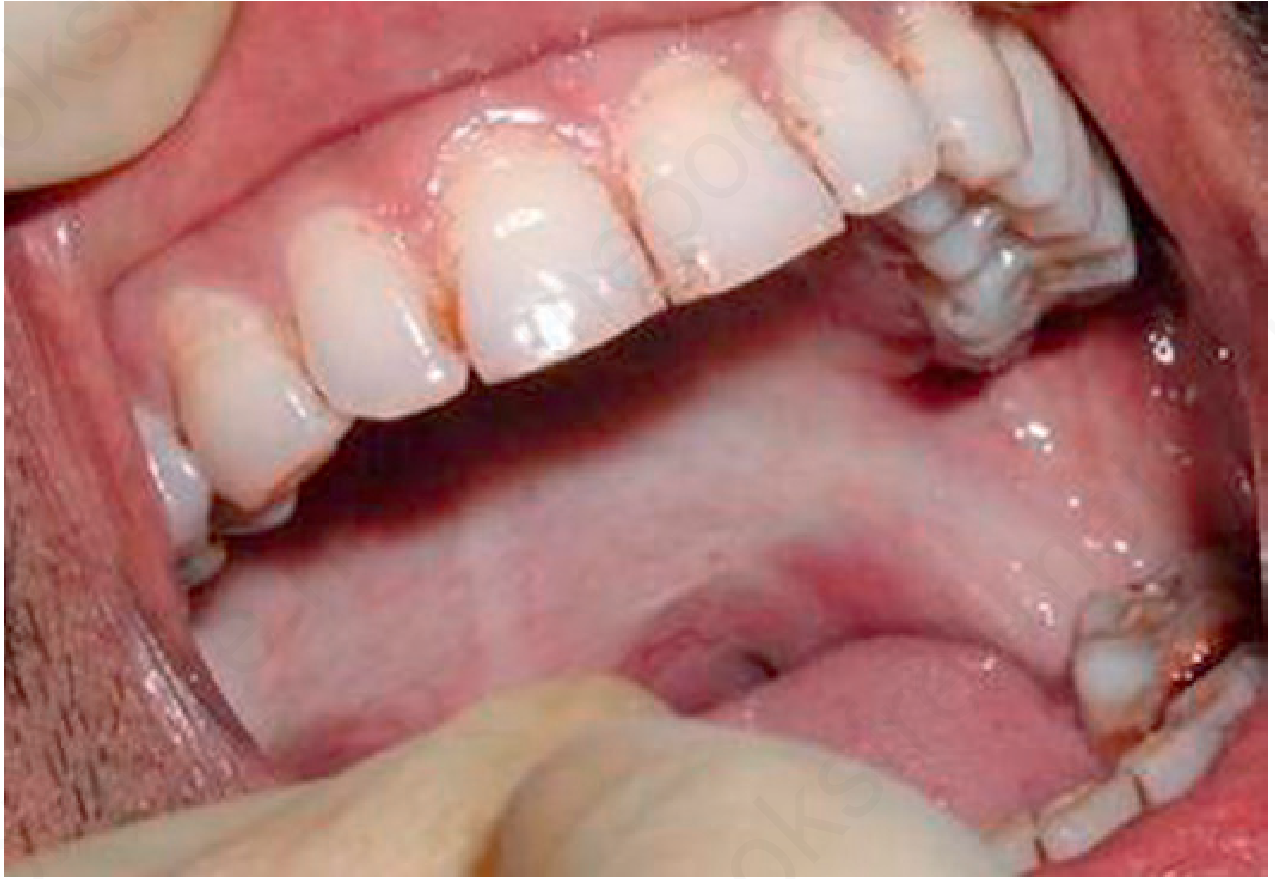
- Pallor of buccal mucosa, soft palate, fauces - marble-white appearance
- Fibrous bands - palpable vertical bands in buccal mucosa
- Reduced interincisal distance (IID) - trismus
- Blanching of mucosa on stretching
- Leathery texture of involved mucosa
- Restricted tongue movement - reduced tongue protrusion
- Uvular atrophy/fibrosis with uvular deviation
- Vesicles/ulceration in early stages
- Floor of mouth fibrosis - in advanced cases
- Petechiae - in active inflammatory phase
From Cummings (2020): "Initial mucosal alterations include erythema with or without vesiculation. This is followed by a slow diminishing of erythema and a progressive decrease in the degree of oral opening and tongue mobility. Pallor of the normally pink mucosa becomes evident as the underlying chronic inflammation recedes and fibrosis and hyalinization progress."
7. CLASSIFICATION / STAGING
A. Pindborg's Classification (1989) - By Location:
- Stage 1: Faucial bands only
- Stage 2: Faucial and buccal bands
- Stage 3: Faucial, buccal + labial bands
B. Khanna & Andrade Classification (1995) - By Mouth Opening (IID):
| Grade | IID | Features |
|---|---|---|
| Grade I | > 35 mm | Very early; burning, no bands |
| Grade II | 26-35 mm | Mild; bands in buccal mucosa |
| Grade III | 15-26 mm | Moderate; inter-incisal distance limitation |
| Grade IV | < 15 mm | Severe; complete fibrosis, microstomia |
C. Haider Classification (2000):
- Group I (Functional Grade): Burning mouth, no bands - IID > 35 mm
- Group II (Functional Grade): Burning, bands palpable - IID 26-35 mm
- Group III (Functional Grade): Trismus - IID 15-26 mm
- Group IVA: Precancerous changes (leukoplakia, erythroplakia) - IID < 15 mm
- Group IVB: Carcinomatous changes
D. Passi's Classification (2017) - Newer Proposed Classification:
Based on Clinical + Histopathological + Functional parameters - more comprehensive for treatment planning.
8. MANAGEMENT
Management follows a stepwise approach based on staging.
MANAGEMENT ALGORITHM FOR OSMF
═══════════════════════════════════════════════════════════════
ALL PATIENTS → HABIT CESSATION (MANDATORY)
      │
      ├── Grade I (IID > 35 mm)
      │    └── Conservative: Antioxidants + Diet modification
      │         + Mouth exercises
      │
      ├── Grade II (IID 26-35 mm)
      │    └── Medical:
      │         • Intralesional steroids ± Hyaluronidase
      │         • Oral antioxidants (Lycopene/Curcumin)
      │         • Pentoxifylline
      │         • Physiotherapy
      │
      ├── Grade III (IID 15-26 mm)
      │    └── Combined Medical + Surgical:
      │         • Intralesional injections
      │         • Surgical fibrotomy
      │         • Reconstruction (BFP / Nasolabial flap)
      │         • Laser-assisted surgery
      │
      └── Grade IV (IID < 15 mm) / Malignant Change
           └── Surgery + Oncologic Management:
                • Wide excision of fibrotic bands
                • Major flap reconstruction
                • Radiotherapy (if SCC)
═══════════════════════════════════════════════════════════════
A. HABIT CESSATION
The single most important step. All other treatments fail if areca nut use continues.
- Counseling and behavior modification
- Nicotine replacement therapy (if tobacco co-addiction)
- Pharmacological cessation aids
B. MEDICAL MANAGEMENT
1. Corticosteroids
Mechanism: Anti-inflammatory, suppress fibroblast activity, reduce collagen synthesis
| Drug | Route | Dose | Schedule |
|---|---|---|---|
| Triamcinolone acetonide (0.5 mL, 10 mg/mL) | Intralesional | 1 mL per band | Weekly × 6-10 injections |
| Dexamethasone (4 mg/mL) | Intralesional | 1 mL | Weekly × 10-12 injections |
| Betamethasone | Topical gel | Applied 3×/day | 3 months |
Andrews' Diseases of the Skin: "Treatment consists of the intralesional injection of triamcinolone or dexamethasone alone or with hyaluronidase."
2. Hyaluronidase
- Mechanism: Depolymerizes hyaluronic acid in ground substance; improves tissue permeability; enhances drug diffusion
- Dose: 1500 IU intralesionally combined with steroid
- Most effective in combination: Steroid + Hyaluronidase + Antioxidant - rated the most effective combination in the 2023 Network Meta-Analysis (PMID 36781110)
3. Antioxidants
Rationale: Oxidative stress plays a key role in pathogenesis; antioxidants neutralize free radicals and reduce fibrosis.
| Antioxidant | Dose | Evidence |
|---|---|---|
| Lycopene | 16 mg/day PO | High quality evidence - low side effects, best for long-term use |
| Curcumin | 300-600 mg/day | High quality; best for tongue protrusion |
| Beta-carotene | 30 mg/day | Moderate |
| Spirulina | 500 mg TDS | Proven in RCTs |
| Aloe vera | Topical / systemic | Best for burning sensation (BMC Oral Health 2023, PMID 37828490) |
| Vitamin A+C+E (Oxitard) | Standard dose | Moderate evidence |
| Omega-3 fatty acids | 1000 mg/day | Moderate evidence |
Cochrane Review (Jones et al., 2024, PMID 38415846): "Antioxidants probably increase mouth opening slightly at three to six months (MD 8.83 mm; moderate-certainty evidence)."
4. Pentoxifylline
- Mechanism: Xanthine derivative; vasodilator; reduces collagen synthesis; anti-fibrotic via TGF-β inhibition; increases cAMP
- Dose: 400 mg TID orally
- Improves mouth opening (MD 1.80 mm; Cochrane 2024) and burning sensation (SUCRA score -7.57)
5. Other Medical Agents
| Agent | Mechanism | Evidence |
|---|---|---|
| Colchicine | Anti-fibrotic; reduces collagen deposition | Moderate evidence |
| Allicin (Garlic extract) | Anti-fibrotic, antioxidant | Moderate evidence |
| Interferon-gamma (IFN-γ) | Inhibits fibroblast proliferation; anti-fibrotic | Experimental; may reverse OSMF (Haque et al., 2001) |
| Salvia miltiorrhiza (Dan shen) + Triamcinolone | TCM; anti-fibrotic | High quality evidence from RCTs |
| Placental extracts | Growth factors for tissue repair | Used adjunctively in India |
| Vasodilators: Buflomedil, Isoxsuprine, Nylidrin | Improve vascularity in ischemic tissue | Used in chronic cases |
6. Physiotherapy
- Jaw opening exercises (mouth-gag therapy)
- Wooden spatulas graduated opening
- Dynamic prosthetic devices (Therabite)
- Ultrasound therapy (physiotherapy)
- Heat therapy / diathermy
C. SURGICAL MANAGEMENT
Indications:
- Severe trismus (IID < 15-20 mm) not responding to medical management
- Malignant transformation
- Persistent ulceration
1. Fibrotomy / Excision of Fibrotic Bands
- Linear incision through fibrotic bands with scissors or scalpel
- Allows passive stretching
- Problem: High recurrence rate if not covered with graft
2. Reconstruction After Fibrotomy
SURGICAL OPTIONS FOR DEFECT RECONSTRUCTION
─────────────────────────────────────────────────────────────
A. LOCAL FLAPS:
   │
   ├── Nasolabial (Nasolabial Fold) Flap
   │    • Inferiorly based random pattern flap
   │    • BEST for mouth opening restoration
   │    • Meta-analysis (2024): Superior to BFP for IID ↑
   │
   ├── Buccal Fat Pad (BFP) Flap
   │    • Easily accessible; minimal donor site morbidity
   │    • Better AESTHETIC outcomes than nasolabial
   │    • Gilles (1948) first described; Egyedi (1977) oral use
   │
   ├── Tongue Flap
   │    • For palatal/anterior defects
   │
   └── Palatal Island Flap

B. SKIN GRAFTS:
   • Split-thickness skin graft (STSG)
   • Full-thickness skin graft
   • Silicone splints to stabilize graft

C. MUCOSAL GRAFTS:
   • Palatal mucosa graft
   • Collagen sheets

D. FREE FLAPS (ADVANCED):
   • Radial forearm free flap
   • For extensive defects with malignancy
─────────────────────────────────────────────────────────────
Surgical meta-analysis (Al-Madhoon et al., 2024, PMID 37219705): "Nasolabial flap was significantly better than BFP in improving maximal mouth opening (MD -2.52 mm; P=0.01). BFP favored for esthetic outcomes."
3. Laser-Assisted Surgery
- CO2 laser: Precise excision of fibrotic bands; less bleeding; good healing
- Nd:YAG laser: Ablation of fibrotic tissue
- Diode laser: Used for band excision
- Advantages: Less bleeding, reduced postoperative edema, good access
- Andrews' Diseases of the Skin: "In advanced cases, surgical excision and grafting or laser ablation has been used."
4. Post-Surgical Physiotherapy
- Mandatory to prevent re-fibrosis/recurrence
- Vigorous mouth-opening exercises begin on postoperative day 1
- Mouth-gag stretching; oral physiotherapy splints
9. MALIGNANT TRANSFORMATION
OSMF → SCC TRANSFORMATION PATHWAY

OSMF (Premalignant)
      │
      ▼
Chronic Irritation + Ongoing Areca Exposure
      │
      ▼
Epithelial Dysplasia (mild → moderate → severe)
      │
      ▼
Carcinoma in Situ
      │
      ▼
Squamous Cell Carcinoma
(Buccal Mucosa Most Common Site)
- Transformation rate: 3-10% (WHO); up to 7.6% in Indian studies over 17 years
- Cummings: "2.5% of cases demonstrate epithelial dysplasia"
- Development of SCC characterized by gradual thickening, hyperplastic to verrucous surface changes
- Andrews: "in approximately 7% of patients, malignant transformation to squamous cell carcinoma develops"
- Scott-Brown: "Oral submucous fibrosis... both being considered premalignant conditions" alongside lichen planus for buccal mucosa
10. INVESTIGATIONS
| Investigation | Purpose |
|---|---|
| Incisional biopsy (GOLD STANDARD) | Histopathological confirmation; grade dysplasia |
| Hematological: CBC, Hb, serum iron/ferritin, B12 | Nutritional deficiency workup |
| Serum zinc | Zinc deficiency assessment |
| HLA typing | Research/genetic susceptibility |
| Toluidine blue staining | Identify areas of dysplasia/malignancy |
| Fluorescence imaging | Detect epithelial dysplasia |
| Cytology (brush biopsy) | Screening; not diagnostic |
| CT/MRI face | Assess extent in advanced cases; rule out deep tissue involvement |
| OPG/CBCT | Assess temporomandibular joint in severe trismus |
11. RECENT ADVANCES (2021-2026)
RECENT ADVANCES IN OSMF MANAGEMENT
─────────────────────────────────────────────────────
1. BIOLOGICAL/MOLECULAR THERAPIES
   • TGF-β pathway inhibitors (pirfenidone) - ongoing trials
   • Nintedanib (anti-fibrotic tyrosine kinase inhibitor)
   • Stem cell therapy - adipose-derived MSCs

2. IMMUNOTHERAPY
   • IFN-γ therapy - anti-fibrotic via suppressing
     fibroblast proliferation
   • Platelet-Rich Plasma (PRP) injections
   • Placental extracts (Placentrex)

3. ADVANCED LASER TECHNIQUES
   • Fractional CO2 laser - precise band ablation
   • LLLT (Low-Level Laser Therapy) - anti-inflammatory

4. NOVEL DRUGS (High-quality RCT evidence):
   • Salvia miltiorrhiza + triamcinolone (TCM combination)
   • Allicin (garlic-derived) - anti-fibrotic
   • Colchicine - anti-fibrotic

5. ANTIOXIDANT UPDATES (Cochrane 2024):
   • Lycopene = best long-term antioxidant (low side effects)
   • Aloe vera = best for burning sensation
   • Curcumin = best for tongue protrusion
   • Network meta-analysis (2023): Steroid + Hyaluronidase
     + Antioxidant = MOST EFFECTIVE combination for
     mouth opening AND burning sensation

6. SURGICAL ADVANCES:
   • Nasolabial flap > BFP for mouth opening (meta-analysis 2024)
   • Radial forearm free flap for advanced reconstruction
   • Robotic-assisted surgery for complex cases

7. BIOMARKERS:
   • Serum lysyl oxidase levels
   • TGF-β1 serum levels
   • Salivary antioxidant capacity as monitoring tool

8. DIGITAL/AI TOOLS:
   • AI-based OSMF grading from mucosal images
   • Machine learning models for malignant transformation risk
─────────────────────────────────────────────────────
Key Recent Evidence:
- Network Meta-Analysis (Rai et al., 2023): Steroid + Hyaluronidase + Antioxidant combination was the most effective medical regimen (MD 7.05 mm mouth opening improvement)
- Cochrane Review (Jones et al., 2024): 30 RCTs, 2176 participants - antioxidants show moderate-certainty evidence for improving mouth opening
- Drug treatment update (Chen et al., 2023): Lycopene (long-term), aloe vera (burning sensation), curcumin (tongue protrusion) recommended
- Surgical meta-analysis (Al-Madhoon et al., 2024): Nasolabial flap superior to BFP for mouth opening restoration
12. PROGNOSIS AND FOLLOW-UP
- Regular 3-6 monthly review with biopsy of suspicious areas
- Cessation of habit = best prognostic factor
- Malignant transformation risk: 3-10% over lifetime
- Early-stage OSMF responds well to medical treatment
- Advanced OSMF (Grade IV) has poor prognosis without surgery
- Post-surgical recurrence common if habit not stopped
SUMMARY FLOWCHART
PATIENT WITH BURNING MOUTH / TRISMUS + ARECA HABIT
               │
               ▼
         CLINICAL EXAM
    (IID, fibrous bands, pallor)
               │
               ▼
       INCISIONAL BIOPSY
    (Histopathology + Dysplasia grading)
               │
         ┌─────┴──────┐
         │            │
      Grade I-II   Grade III-IV
      (IID > 26)   (IID < 26)
         │            │
         ▼            ▼
     MEDICAL      MEDICAL +
    TREATMENT     SURGICAL
    • Habit       TREATMENT
      cessation   • Fibrotomy
    • Antioxidants• Flap/Graft
    • ± Steroid   • Laser
      injections  • Post-op
    • Physiotherapy  physiotherapy
         │            │
         └─────┬──────┘
               ▼
     REGULAR FOLLOW-UP
     (3-6 monthly; biopsy if suspicious)
               │
               ▼
     WATCH FOR SCC TRANSFORMATION
REFERENCES (RGUHS Standard)
- Cummings Otolaryngology Head & Neck Surgery (7th Ed., 2020) - Paul W. Flint et al. - Chapter on Premalignant Lesions
- Scott-Brown's Otorhinolaryngology Head & Neck Surgery (8th Ed., 2018) - Gleeson et al. - Epidemiology of Buccal Carcinoma & OSMF
- Andrews' Diseases of the Skin (13th Ed.) - Chapter 28: Oral Submucous Fibrosis (p. 709)
- K.J. Lee's Essential Otolaryngology (11th Ed., 2019) - Oral Submucous Fibrosis
- Dhingra PL & Dhingra S - Diseases of Ear, Nose and Throat - Premalignant lesions of oral cavity
- Hazarika P - Textbook of ENT & HNS - OSMF and premalignant conditions
- Zakir Hussain - ENT textbook - Premalignant oral lesions
- Fitzpatrick's Dermatology (9th Ed.) - Betel quid and OSMF
- Jones A, et al. Interventions for managing oral submucous fibrosis - Cochrane Database Syst Rev. 2024 (PMID: 38415846)
- Rai A, et al. Comparative effectiveness of medicinal interventions for OSMF: A network meta-analysis - J Stomatol Oral Maxillofac Surg. 2023 (PMID: 36781110)
- Chen X, et al. Drug treatment for oral submucous fibrosis: an update - BMC Oral Health. 2023 (PMID: 37828490)
- Al-Madhoon HW, et al. Nasolabial flap vs BFP flap in OSMF: Systematic review & meta-analysis - Oral Maxillofac Surg. 2024 (PMID: 37219705)
- Pindborg JJ, Sirsat SM. Oral submucous fibrosis. Oral Surg. 1966;22:764-779
- Khanna JN, Andrade NN. Oral submucous fibrosis: A new concept in surgical management. Int J Oral Maxillofac Surg. 1995
Note for RGUHS Students: This answer covers the standard 50-mark format with definition, epidemiology, detailed etiology (areca nut alkaloids, secondary factors), molecular pathogenesis, histopathology (4-stage progression), clinical features (subjective and objective), classification systems (Pindborg, Khanna-Andrade, Haider), comprehensive management (medical and surgical with flowcharts), malignant potential, investigations, and recent advances through 2024 Cochrane-level evidence. The diagrams and flowcharts above can be drawn in examinations as box-arrow diagrams to earn full marks.
This is a shared conversation. Sign in to Orris to start your own chat.