
injection
I need a bit more context to give you a useful answer. What aspect of "injection" are you asking about?
Asking for Preferences
What aspect of injection are you asking about?
Asking for Preferences
What specifically would you like to know about medical injections?
The four main parenteral routes are intramuscular (IM), intravenous (IV), subcutaneous (SC), and intradermal (ID) - each differing in depth, site, needle angle, volume, and onset of action.
Searching sources...
Reading File
Finding Sources
Finding Sources
Finding Sources
Finding Sources
Reading File
Finding Sources
The Lippincott Pharmacology textbook has exactly what we need, including an illustration. Let me read that section and fetch the image.
Reading File
Loading Image
Finding Sources
Here is a thorough overview of the four main parenteral injection routes.
Routes of Injection (Parenteral Administration)
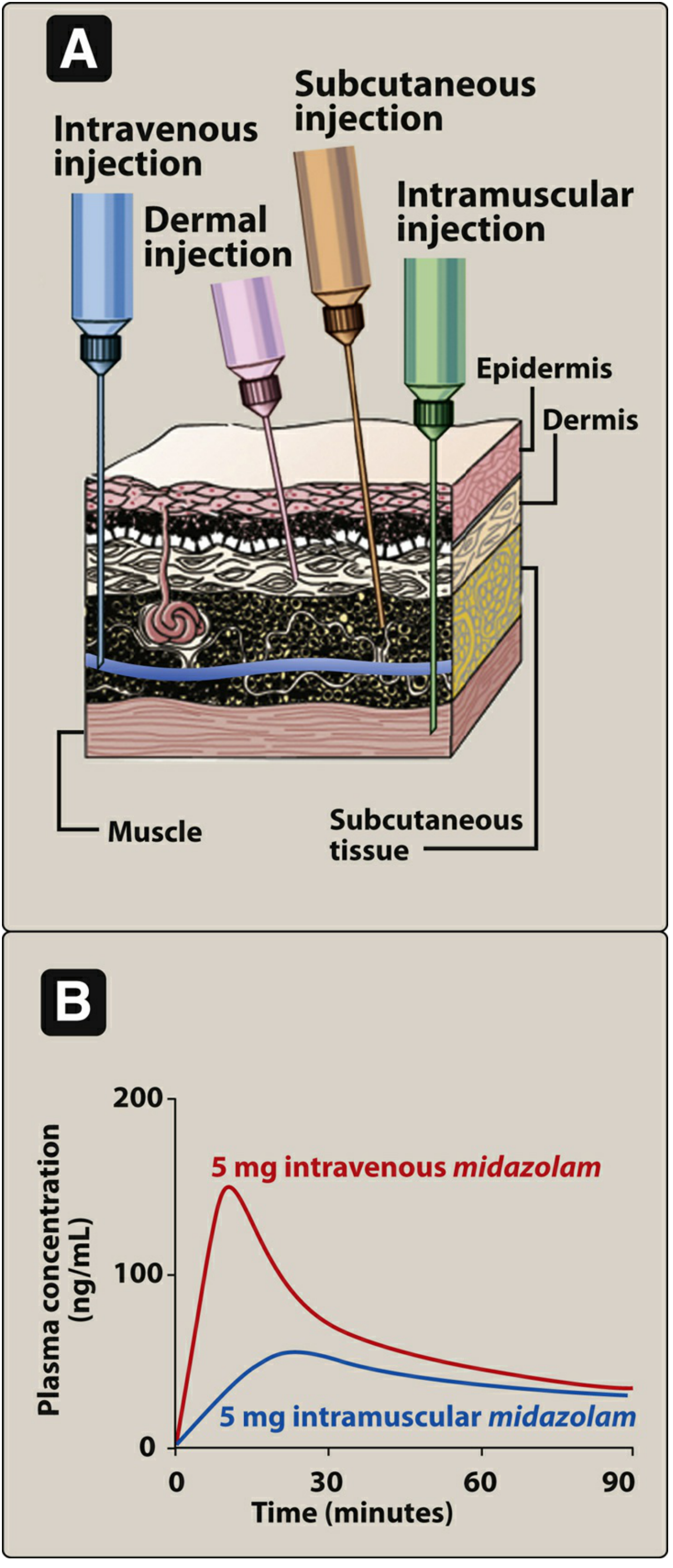
Fig. 1.3 - Lippincott Illustrated Reviews: Pharmacology. A: Cross-section showing depth of each injection route. B: Plasma concentration curves comparing IV vs. IM midazolam.
Why Use Parenteral Routes?
Parenteral routes bypass the GI tract entirely, which is useful when:
- A drug is poorly absorbed orally (e.g., heparin)
- A drug is unstable in the GI environment (e.g., insulin)
- The patient is unconscious or cannot swallow
- A rapid onset of action is needed
- Precise dose control is required
The trade-off: parenteral administration is irreversible, may cause pain, local tissue damage, and carries infection risk.
The Four Major Routes
1. Intravenous (IV)
- Depth: Directly into a vein (bypasses all tissue layers)
- Onset: Fastest of all routes - nearly immediate when given as a bolus
- Absorption: 100% bioavailability - no absorption step required
- Volume: Can accommodate large volumes
- Types:
- IV bolus - full dose delivered almost instantly
- IV infusion - drug delivered over time, giving lower peak concentrations and longer duration
- Examples: rocuronium, many antibiotics, emergency medications
- Risks: Hemolysis, thrombophlebitis, air embolism, infection
2. Intramuscular (IM)
- Depth: Into muscle tissue (below subcutaneous fat)
- Needle angle: 90 degrees
- Onset: Faster than SC, slower than IV
- Absorption: Via simple diffusion - rate depends on formulation
- Types of IM preparations:
- Aqueous solutions - absorbed rapidly
- Depot preparations - suspended in non-aqueous vehicles (e.g., polyethylene glycol, oil); the vehicle diffuses out, drug precipitates at the site, then dissolves slowly over days to weeks - ideal for long-acting formulations
- Common sites: Deltoid, vastus lateralis, ventrogluteal, dorsogluteal
- Max volume: ~3-5 mL in most sites
- Examples: vaccines, antipsychotics (depot), some antibiotics
3. Subcutaneous (SC)
- Depth: Into the subcutaneous (hypodermis) fat layer - below dermis, above muscle
- Needle angle: 45 degrees (can be 90° in obese patients with longer needles)
- Onset: Slower than IM due to lower vascularity of fat
- Absorption: Simple diffusion; provides slow, sustained, and constant drug release
- Advantages over IV: Minimizes risk of hemolysis or thrombosis
- Limitation: Should NOT be used for irritating drugs - risk of severe pain and necrosis
- Max volume: ~1-2 mL per site
- Examples: insulin, heparin, epinephrine auto-injectors
4. Intradermal (ID)
- Depth: Into the dermis (below epidermis, above subcutaneous tissue)
- Needle angle: 10-15 degrees (nearly flat to the skin)
- Onset: Slowest - minimal vascularity in dermis
- Primary uses:
- Allergy skin testing (diagnostic determination)
- Tuberculin (Mantoux) test (TB screening)
- Desensitization therapy
- Volume: Very small - typically 0.05-0.1 mL
- Expected result: A visible wheal (raised bleb) under the skin confirms correct placement
Quick Comparison Table
| Feature | IV | IM | SC | ID |
|---|---|---|---|---|
| Depth | Vein | Muscle | Fat | Dermis |
| Needle angle | 15-25° | 90° | 45-90° | 10-15° |
| Onset speed | Fastest | Fast | Moderate | Slowest |
| Bioavailability | 100% | High | High | Low |
| Max volume | Large | 3-5 mL | 1-2 mL | 0.1 mL |
| Typical uses | Emergency, large dose | Vaccines, depot drugs | Insulin, heparin | Allergy testing, TB test |
Speed of Absorption: IV > IM > SC > ID
The chart in the image illustrates this clearly - IV midazolam reaches a plasma concentration of ~150 ng/mL within ~15 minutes, while the same dose given IM peaks at roughly ~50 ng/mL over a longer, flatter curve.
- Lippincott Illustrated Reviews: Pharmacology, p. 25-26
This is a shared conversation. Sign in to Orris to start your own chat.