
Write a short note on pyoderma gangrenosum
Reading File
Now let me search the medical library and PubMed in parallel.
Finding Sources
Searching PubMed
pyoderma gangrenosum
Andrews' Diseases of the Skin has the most comprehensive section (11 paragraphs). Let me read that along with Rheumatology and Tintinalli's for clinical context, and also check for images.
Reading File
Reading File
Reading File
Let me fetch the clinical image and read more of the Andrews' section (treatment part).
Loading Image
Reading File
I now have comprehensive information. Let me compile the full note.
Pyoderma Gangrenosum (PG)
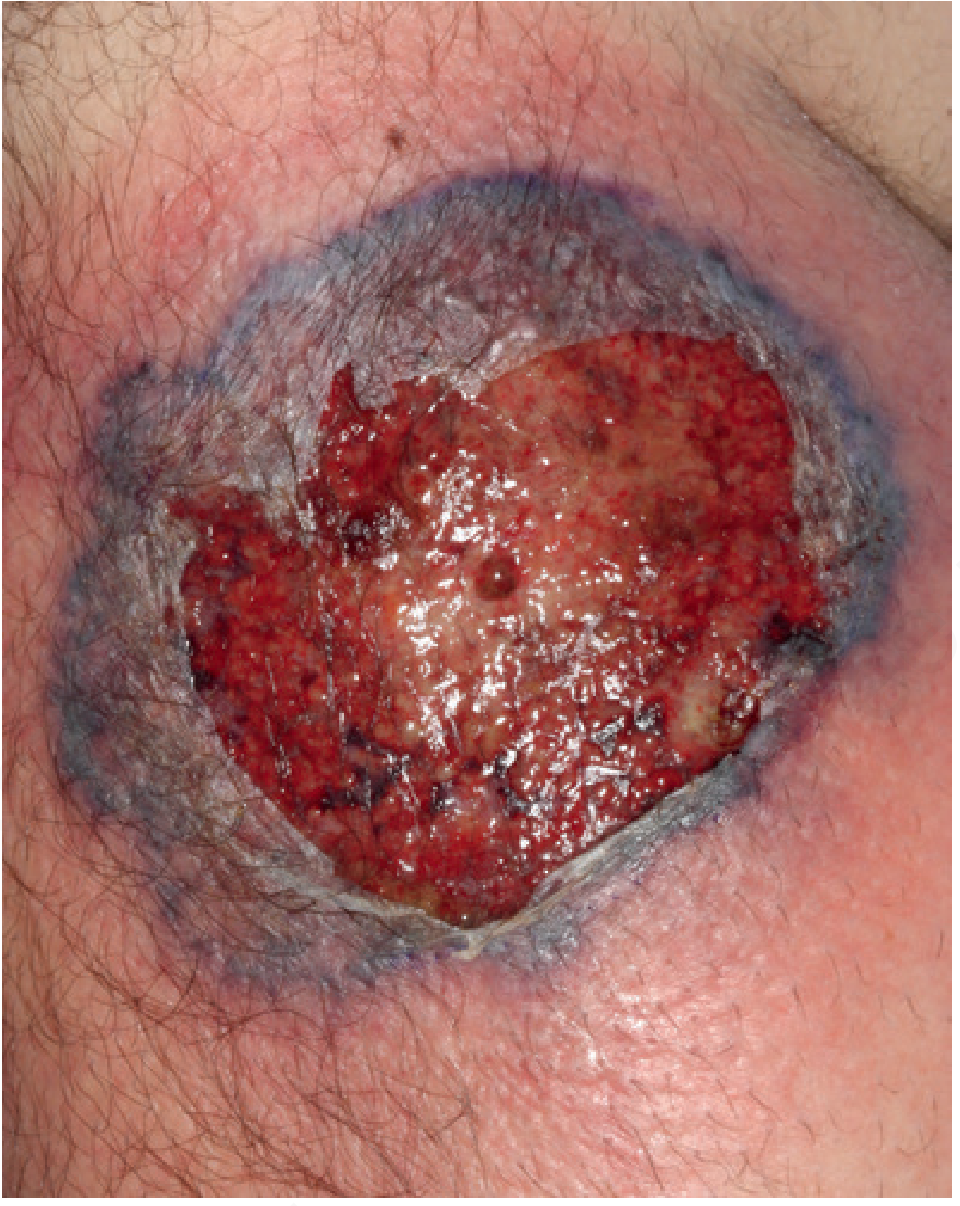
Definition
Pyoderma gangrenosum is a rare, recurrent, cutaneous necrotizing and non-infective ulceration of the skin. It belongs to the group of neutrophilic dermatoses - conditions characterized by sterile infiltration of the skin by neutrophils. Despite the name, it is neither pyogenic (bacterial) nor gangrenous in the classical sense.
- Andrews' Diseases of the Skin, p. 172
- Tintinalli's Emergency Medicine, p. 253
Epidemiology
- First described by Brunsting in 1930
- Affects all ages; most commonly in the 4th to 6th decades
- Female predominance
- Childhood cases are rare (>40% have underlying IBD; 18% have leukemia)
- Approximately 50% of patients have an associated systemic disease
Associated Conditions
| System | Conditions |
|---|---|
| Gastrointestinal | Inflammatory bowel disease (both Crohn disease and ulcerative colitis) - most common association; 1.5%-5% of IBD patients develop PG |
| Hematologic | Myelodysplastic syndrome, acute/chronic myelogenous leukemia, polycythemia vera, IgA paraproteinemia (up to 10%), myeloma |
| Rheumatologic | Rheumatoid arthritis, seronegative asymmetric arthritis (>1/3 of PG patients), PAPA syndrome, SLE |
| Others | Hepatitis C, HIV, pregnancy, hidradenitis suppurativa, Takayasu arteritis |
The two diseases (PG and IBD) may flare together or run an independent course. Notably, malignancies and hematologic disorders are more common in patients over 65.
Clinical Subtypes
1. Ulcerative (Classic) - Most Common
- Begins as an inflammatory pustule with surrounding halo that enlarges and ulcerates
- Fully developed lesion: painful ulcer with undermined, purple to gray (gun-metal gray) borders
- Pathergy (lesion development after minor trauma) in 20-30% of patients
- Satellite violaceous papules may appear at the periphery, coalesce ("cheese cloth" pattern)
- Lesions favour lower extremities and trunk
- Heals with characteristic thin, atrophic "cribriform" (crosslike) scars
2. Bullous PG
- More superficial and less destructive than ulcerative type
- Red plaques become dusky with superficial erosions
- Overlaps with bullous Sweet syndrome
- Typically seen with hematologic disorders (leukemia, myelodysplasia)
3. Pustular PG
- Pustules that generally do not progress to ulcerative lesions
- Most often seen in IBD patients
- Forme fruste (incomplete/atypical form) of PG
4. Vegetative PG
- Least aggressive form
- Chronic, superficial, cribriform ulcerations, usually on the trunk
- Enlarges slowly; elevated borders with clean bases
- Rarely painful; usually not associated with systemic disease
- Responds to conservative treatment
5. Peristomal PG
- Occurs in patients with intestinal stoma (ostomy)
- Clinically similar to classic PG but isolated to the abdomen near the stoma
Pathogenesis
PG is fundamentally a disorder of neutrophil dysfunction and dysregulation. The exact mechanism is not fully understood but involves:
- Abnormal neutrophil trafficking and function
- Dysregulated innate immunity
- Association with autoinflammatory syndromes (e.g., PAPA syndrome)
- Children with congenital LAD (leukocyte adhesion deficiency) develop PG-like lesions
Histology (non-diagnostic):
- Early: suppurative folliculitis with follicular rupture
- Evolving: suppurative inflammation in dermis and subcutaneous fat
- At the violaceous border: massive dermal edema and epidermal neutrophilic abscesses
- Must exclude infection on tissue culture
Diagnosis
PG is a diagnosis of exclusion - no pathognomonic serologic or histologic features exist. Clinical and pathologic correlation with extensive exclusion of alternatives is essential.
Workup includes:
- Skin biopsy (to exclude other diagnoses)
- Tissue culture (to exclude deep fungal, mycobacterial infections, syphilis, amebiasis)
- Evaluation for associated diseases: IBD, hematologic disorders, inflammatory arthritis
- Blood: CBC, metabolic panel, protein electrophoresis (IgA gammopathy)
Key differential diagnoses to exclude:
- Infections (mycobacteria, deep fungi, gummatous syphilis, synergistic gangrene)
- Vascular occlusive or chronic venous disease
- Vasculitis (granulomatosis with polyangiitis - "malignant pyoderma")
- Spider bite (for solitary extremity lesions)
- Factitial (self-induced) disease - the most difficult to exclude; histology may only show non-specific suppurative dermatitis
Treatment
Management is challenging. The goal is halting inflammation while healing a large wound. Appropriate response to therapy is itself a minor diagnostic criterion - failure to respond should prompt questioning of the diagnosis.
Local / Topical Treatment
- High-potency topical corticosteroids
- Intralesional corticosteroid injections
- Topical tacrolimus
- Proper wound care (avoid aggressive debridement, which can worsen due to pathergy)
Systemic Treatment
| Drug | Notes |
|---|---|
| Systemic corticosteroids | First-line; rapid control of inflammation |
| Cyclosporine | Effective in refractory cases |
| Dapsone | Useful for less severe disease |
| Anti-TNF agents (infliximab, adalimumab) | Particularly effective when associated with IBD; one study: 33/38 IBD-PG patients responded to infliximab or adalimumab; another: 29/31 healed |
| Other immunosuppressives | Azathioprine, mycophenolate mofetil, cyclophosphamide |
A 2025 meta-analysis (Kaur et al., Int Wound J, 2025) and a 2024 systematic review (Zaman et al., Arch Dermatol Res, 2024) confirm that biologic therapies - especially anti-TNF agents - are effective for refractory and IBD-associated PG.
- Treat the underlying disease (e.g., IBD, hematologic disorder) - bowel resection in IBD may lead to PG remission, but lesions can also persist or first appear post-surgery
Key Points Summary
| Feature | Detail |
|---|---|
| Type | Neutrophilic dermatosis |
| Hallmark lesion | Painful ulcer with undermined violaceous/gray borders |
| Pathergy | Present in 20-30% |
| Most common association | IBD (Crohn disease, ulcerative colitis) |
| Scar pattern | Cribriform (crosslike, atrophic) |
| Diagnosis | Exclusion; no pathognomonic feature |
| First-line systemic therapy | Systemic corticosteroids |
| Biologic option | Infliximab / adalimumab (especially IBD-associated) |
Name all dermatology books available in orris
Finding Sources
There are 4 dermatology books available in the Orris library:
| # | Title | ISBN |
|---|---|---|
| 1 | Andrews' Diseases of the Skin: Clinical Atlas, 2e | 9780323790130 |
| 2 | Andrews' Diseases of the Skin E-Book: Clinical Dermatology | 9780323547536 |
| 3 | Dermatology: 2-Volume Set, 5e | 9780702082252 |
| 4 | Fitzpatrick's Dermatology, Volumes 1 & 2 | 9780071837781 |
Iadvlrooks
I think you may be asking about IADVL (Indian Association of Dermatologists, Venereologists and Leprologists) books. Let me check if any are available in the library.
Finding Sources
No IADVL books are currently available in the Orris library. The dermatology collection consists of the 4 international titles mentioned earlier (Andrews' x2, Dermatology 2-Volume Set 5e, and Fitzpatrick's).
If you're looking for specific IADVL textbook content (such as the IADVL Textbook of Dermatology), it is not part of the current library.
This is a shared conversation. Sign in to Orris to start your own chat.