
Make detailed explanation of erythropoiesis and steps factors and malnutrition Short term and long term regulation of bp Neural regulation of respiration Thyroid physiology hormones. Secreted and functions For 12 marks in very near and precise points with diagrams for university exams
erythropoiesis stages red blood cell maturation diagram
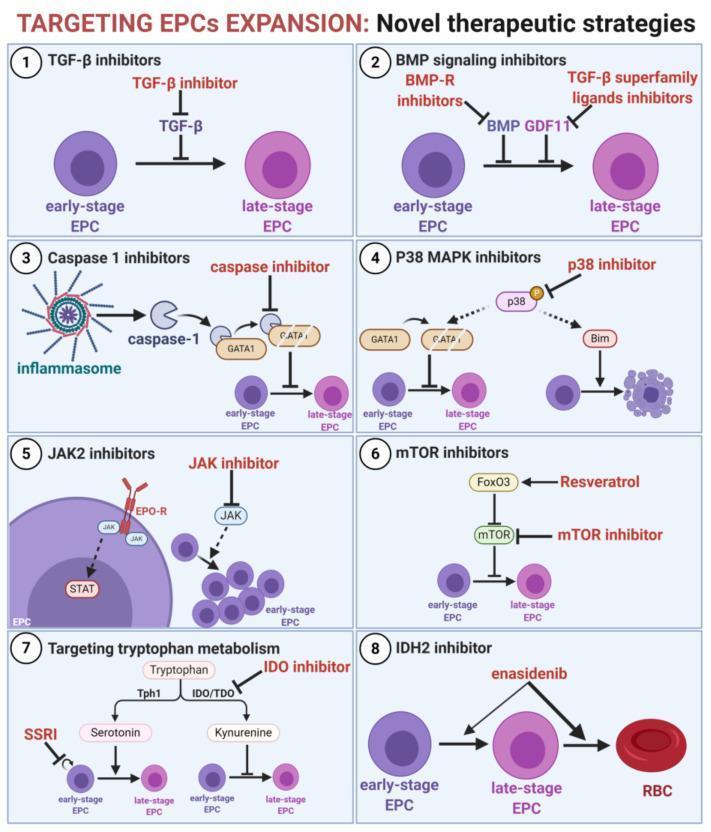
A pathophysiology diagram illustrating eight novel therapeutic strategies to target erythroid progenitor cell (EPC) expansion and promote differentiation in the context of cancer-induced dysregulated erythropoiesis. The diagram is divided into eight panels showing how specific inhibitors overcome maturation arrest: (1) TGF-̢ inhibitors and (2) BMP/GDF11 signaling inhibitors blocking inhibitory growth factors; (3) Caspase-1 inhibitors preventing inflammasome-mediated GATA1 cleavage; (4) P38 MAPK inhibitors reducing apoptosis and Bim expression; (5) JAK2 inhibitors decreasing EPO-induced EPC proliferation; (6) mTOR inhibitors and FoxO3 inducers (e.g., Resveratrol) promoting maturation; (7) Tryptophan metabolism modulation via SSRIs or IDO inhibitors; and (8) IDH2 inhibitors (Enasidenib) driving terminal differentiation into red blood cells (RBCs). Visually, early-stage EPCs are depicted as small, dark purple cells, while late-stage EPCs appear larger with varied cytoplasmic saturation, eventually maturing into enucleated red erythrocytes in the final pathway. This educational resource outlines molecular targets for reversing the immunosuppressive effects of EPC expansion in oncology.
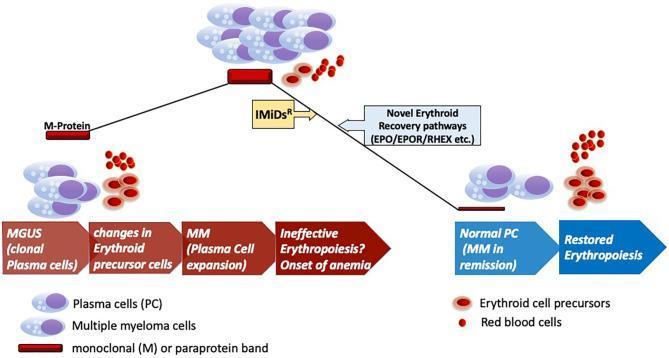
A pathophysiology diagram illustrating the disease progression of monoclonal gammopathy of undetermined significance (MGUS) to multiple myeloma (MM) and the subsequent impact on erythropoiesis. The visual follows a peak-like trajectory: the left side shows the progression from MGUS (clonal plasma cells) to MM (plasma cell expansion), characterized by a thickening M-protein band and increasingly ineffective erythropoiesis leading to anemia. At the peak, malignant multiple myeloma cells dominate the bone marrow environment alongside sparse red blood cells and erythroid precursors. The downward right slope depicts therapeutic intervention using immunomodulatory drugs (IMiDsR) and the engagement of novel erythroid recovery pathways involving EPO, EPOR, and RHEX. This phase represents MM in remission (Normal PC) and the clinical restoration of erythropoiesis, visualized by the return of mature red blood cells and normal erythroid precursor levels. Key components include plasma cells, monoclonal (M) paraprotein bands, and the sequential maturation stages of the erythroid lineage.
This pathophysiology diagram illustrates the maturation states of dendritic cells (DCs) and their role in modulating the balance between immune tolerance and immunity. The diagram is divided into three functional stages: Immature DC, Semi-mature DC, and Mature DC. Transitioning from an immature to a semi-mature state is driven by gut flora, apoptotic cells, TNF-α, or IL-6. Progression to full maturity is triggered by pathogens, inflammation, PAMPs, and DAMPs. Each state is characterized by specific marker profiles: Immature DCs exhibit high phagocytic activity but low MHC-class II, CD80/CD86, and CCR7 expression; Semi-mature DCs show high MHC-class II and CD80/CD86 but remain low in pro-inflammatory cytokines and T-cell stimulatory capacity; Mature DCs are characterized by high expression of all stimulatory markers and cytokines, alongside high CCR7 and low phagocytic activity. A color gradient at the bottom correlates the immature/semi-mature states with T-cell tolerance (green) and the fully mature state with active immunity (red).
neural regulation of respiration brainstem respiratory centers diagram
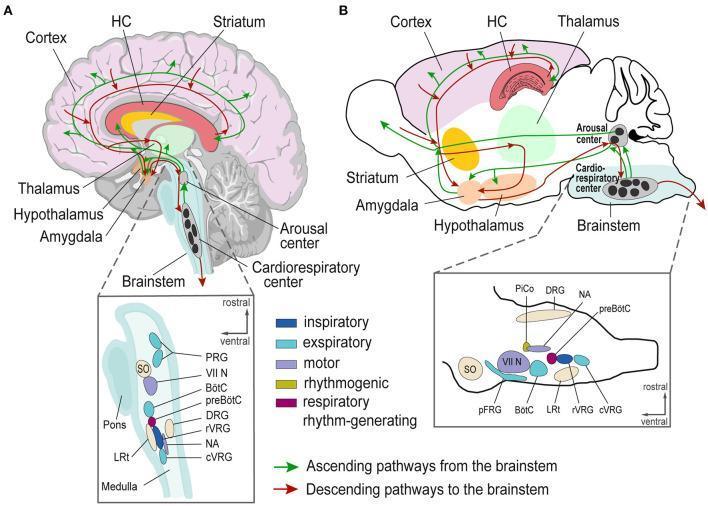
This comparative anatomical diagram illustrates the neural pathways and brainstem nuclei involved in cardiorespiratory regulation and epilepsy in humans (A) and mice (B). The top panels depict sagittal schematics of the human and mouse brains, highlighting the cortex, hippocampus, striatum, thalamus, hypothalamus, and brainstem. Green arrows represent ascending pathways from the brainstem to higher cortical and limbic centers, while red arrows indicate descending pathways. In humans, these projections appear more centralized, whereas in the mouse, they exhibit a more distributed pattern between the amygdala, hypothalamus, and striatum. The bottom panels provide high-magnification views of the brainstem, specifically the medulla and pons. It maps specialized respiratory centers categorized by function: inspiratory (e.g., rVRG, cVRG, DRG), expiratory (e.g., BötC, pFRG), motor (VII N), rhythmogenic (preBötC), and respiratory rhythm-generating (NA, PiCo). The human brainstem shows a linear rostrocaudal organization of these nuclei, while the mouse brainstem exhibits a more clustered spatial arrangement. This diagram serves as an educational resource for understanding the neuroanatomical basis of Sudden Unexpected Death in Epilepsy (SUDEP).
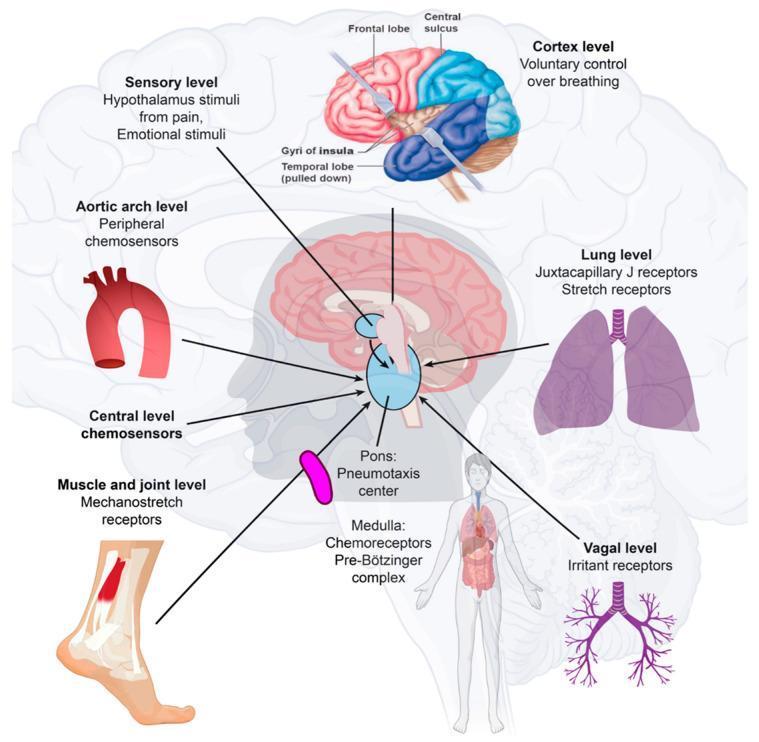
This medical illustration details the neuroanatomical and physiological pathways regulating human respiration. The central focus is a sagittal view of the brainstem, highlighting the Pons (Pneumotaxic center) and Medulla Oblongata (Chemoreceptors and Pre-Bötzinger complex) as the primary integration hubs for breathing rhythm. The diagram maps multiple afferent inputs to these centers: the Cortex level (frontal lobe) for voluntary control; the Sensory level (hypothalamus) processing pain and emotional stimuli; and central chemosensors. Peripheral inputs are illustrated at several anatomical levels: the Aortic arch (peripheral chemosensors), Lung level (Juxtacapillary J receptors and stretch receptors), Muscle/joint level (mechanostretch receptors), and Vagal level (irritant receptors). An anatomical overlay shows the cerebral cortex with labels for the frontal lobe, central sulcus, and gyri of the insula. The illustration summarizes how multifaceted physiological parameters, including blood pH, CO2, O2, lung volume, and physical movement, are processed by the autonomic nervous system to control respiratory rate and depth.
thyroid hormone synthesis secretion pathway diagram
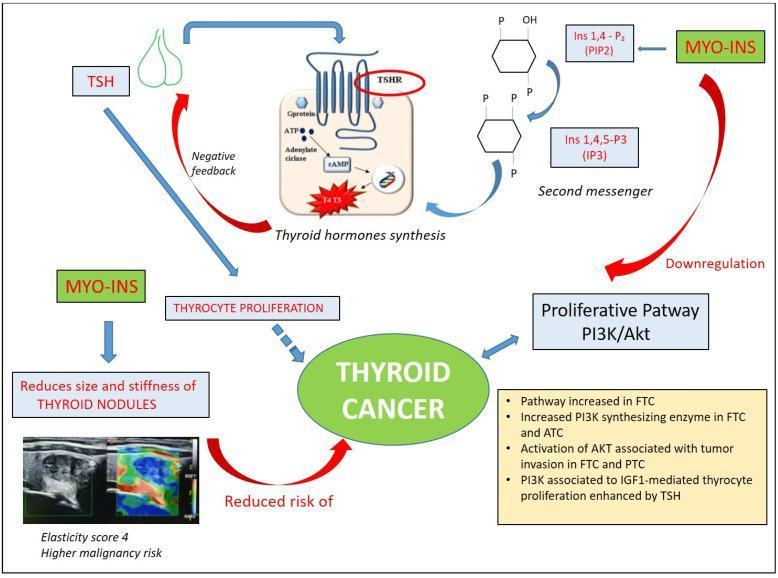
This pathophysiology diagram illustrates the regulatory role of Myo-inositol (MYO-INS) in thyroid function and its protective mechanisms against thyroid cancer. The diagram maps two primary pathways: first, MYO-INS serves as a precursor to phosphoinositide second messengers (PIP2 and IP3), which facilitate thyroid hormone synthesis. Increased T3 and T4 levels then exert negative feedback on TSH secretion, thereby inhibiting TSH-driven thyrocyte proliferation. Second, MYO-INS is shown to downregulate the PI3K/Akt proliferative pathway, which is typically overactive in follicular (FTC), anaplastic (ATC), and papillary thyroid cancer (PTC). A clinical component includes ultrasound elastography images showing a thyroid nodule with high stiffness (Elasticity score 4); the diagram indicates that MYO-INS reduces the size and stiffness of such nodules, ultimately leading to a reduced risk of thyroid cancer. Key molecular elements include TSHR signaling, cAMP, and IGF1-mediated proliferation, highlighting the transition from benign nodules to malignancy.
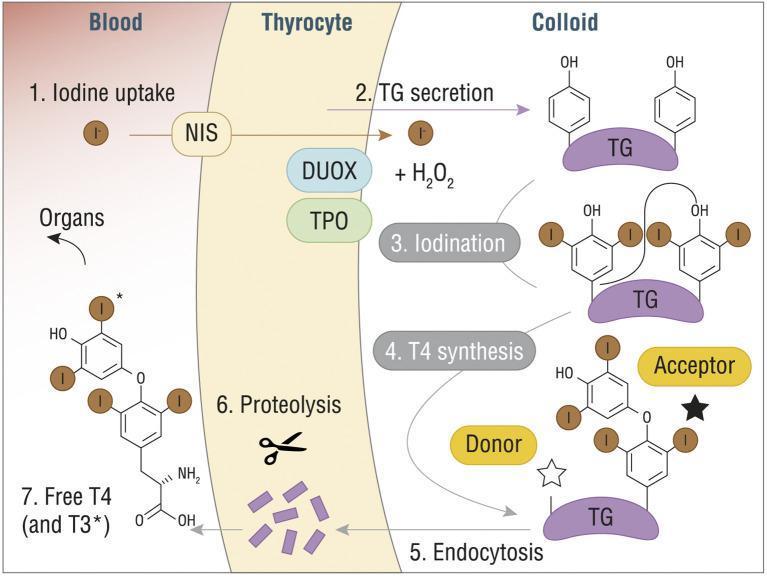
A pathophysiology diagram illustrating the seven-step process of thyroid hormone synthesis (T3 and T4) across three compartments: Blood, Thyrocyte, and Colloid. (1) Iodine uptake: Iodide (I-) enters the thyrocyte from the blood via the Sodium/Iodide Symporter (NIS). (2) TG secretion: Thyroglobulin (TG) is secreted into the colloid. (3) Iodination: Within the colloid, iodide is oxidized by Thyroid Peroxidase (TPO), dual oxidase (DUOX), and H2O2, leading to the attachment of iodine to tyrosine residues on TG. (4) T4 synthesis: A coupling reaction occurs between 'Donor' and 'Acceptor' iodinated tyrosine residues on the TG scaffold. (5) Endocytosis: The modified TG molecule is re-absorbed into the thyrocyte. (6) Proteolysis: Lysosomal enzymes break down TG, releasing individual hormones. (7) Release: Free T4 (thyroxine) and T3 (triiodothyronine) are secreted into the blood for systemic distribution to organs. The diagram includes detailed chemical structures of the phenolic rings and iodine substitutions characteristic of thyroid hormones.
blood pressure regulation renin angiotensin aldosterone system
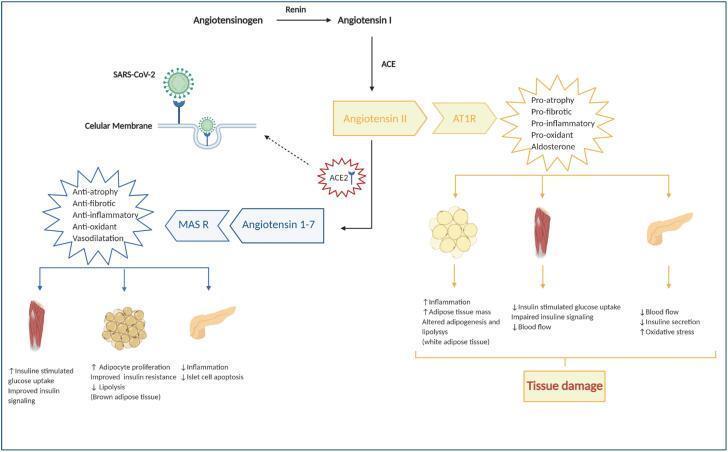
A pathophysiology diagram illustrating the Renin-Angiotensin-Aldosterone System (RAAS) and its deregulation in the context of COVID-19. The diagram outlines two competing metabolic pathways starting from Angiotensinogen. The primary pathway involves Renin converting Angiotensinogen to Angiotensin I, followed by ACE converting it to Angiotensin II. Binding of Angiotensin II to the AT1R receptor triggers pro-atrophy, pro-fibrotic, pro-inflammatory, and pro-oxidant effects, leading to tissue damage in white adipose tissue (increased inflammation and mass), skeletal muscle (impaired insulin signaling and blood flow), and the pancreas (reduced insulin secretion and blood flow). A counter-regulatory pathway shows ACE2 converting Angiotensin II into Angiotensin 1-7, which binds to the MAS receptor (MAS R) to produce protective anti-inflammatory, anti-fibrotic, and vasodilatory effects, improving insulin signaling in muscle and brown adipose tissue while reducing islet cell apoptosis in the pancreas. Critically, the diagram shows SARS-CoV-2 binding to the ACE2 receptor on the cellular membrane, inhibiting this protective pathway and shifting the balance toward tissue damage and systemic inflammation.
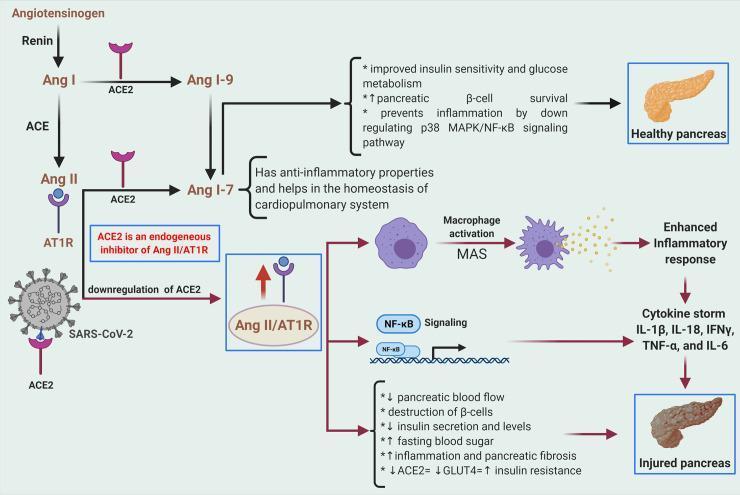
A medical pathophysiology diagram illustrating the Renin-Angiotensin-Aldosterone System (RAAS) signaling pathway and its disruption by SARS-CoV-2, leading to pancreatic injury. The cascade begins with the conversion of Angiotensinogen to Ang I by Renin, and Ang I to Ang II by ACE. The diagram highlights two divergent pathways: a protective arm involving ACE2, which converts Ang II to Ang 1-7 (promoting insulin sensitivity, beta-cell survival, and anti-inflammatory effects in a healthy pancreas), and a deleterious arm where Ang II binds to AT1R. The illustration shows that SARS-CoV-2 binds to and downregulates ACE2, leading to an overactive Ang II/AT1R axis. This overactivation triggers macrophage activation via MAS, NF-κB signaling, and a subsequent cytokine storm (IL-1β, IL-18, IFNγ, TNF-α, and IL-6). The cumulative effect results in an 'Injured pancreas' characterized by decreased blood flow, beta-cell destruction, reduced insulin secretion, hyperglycemia, fibrosis, and increased insulin resistance due to decreased GLUT4 and ACE2 expression.
University Physiology - 12 Mark Exam Notes
1. ERYTHROPOIESIS: Steps, Factors & Malnutrition
Definition
Steps of Erythropoiesis (Maturation Sequence)
Pluripotent Stem Cell
        ↓
CFU-GEMM (Colony Forming Unit - Granulocyte, Erythroid, Monocyte, Megakaryocyte)
        ↓
BFU-E (Burst Forming Unit - Erythroid)
        ↓
CFU-E (Colony Forming Unit - Erythroid)  ← Erythropoietin acts here
        ↓
Pronormoblast (Proerythroblast) - largest, nucleated, basophilic
        ↓
Basophilic Normoblast - active RNA/Hb synthesis
        ↓
Polychromatic Normoblast - Hb increases, nucleus shrinks
        ↓
Orthochromatic Normoblast (Late normoblast) - nucleus extruded
        ↓
Reticulocyte - no nucleus, retains ribosomes + mRNA, circulates 1-2 days
              → matures in spleen (ribosomes/mRNA lost)
        ↓
Mature Erythrocyte (RBC) - biconcave disc, 120-day lifespan
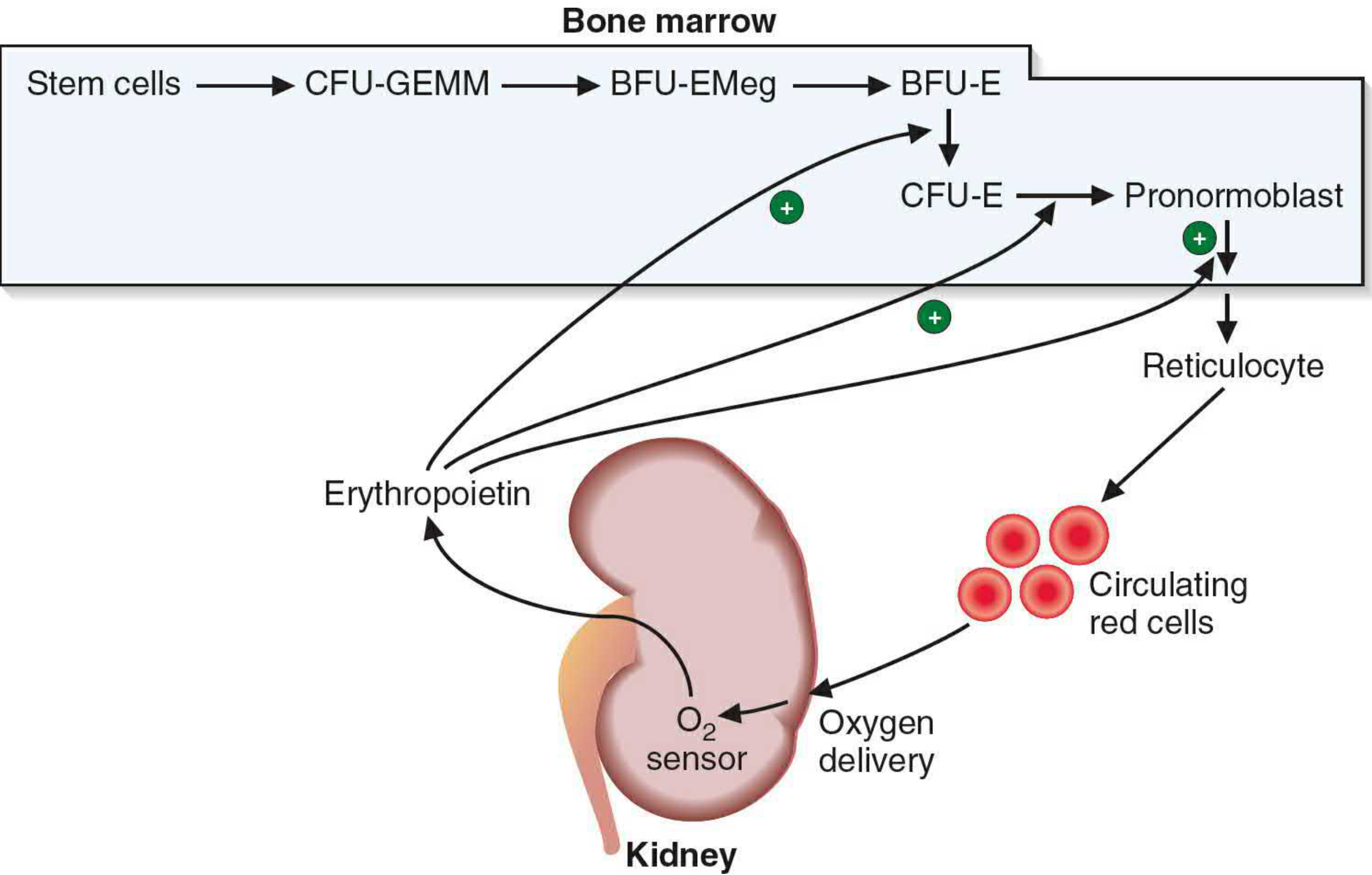
Regulation of Erythropoiesis
Hormonal/Humoral Regulation
| Factor | Source | Action |
|---|---|---|
| Erythropoietin (EPO) | Kidney (90%), liver (10%) | Major regulator; stimulates BFU-E → CFU-E → normoblast proliferation |
| Testosterone | Testes | Stimulates EPO production and directly stimulates bone marrow |
| Thyroid hormones | Thyroid | Increase O₂ demand → indirectly stimulate EPO |
| Growth hormone / IGF-1 | Pituitary / Liver | Promote erythroid proliferation |
| Glucocorticoids | Adrenal cortex | Stimulate erythropoiesis (minor) |
Key Trigger
- Hypoxia (low O₂ delivery) → kidney releases EPO → acts on erythroid progenitors via JAK/STAT signaling → increased RBC production
Factors Required for Erythropoiesis
| Factor | Role |
|---|---|
| Iron (Fe²⁺) | Component of heme in hemoglobin; deficiency = microcytic hypochromic anemia |
| Vitamin B12 (Cobalamin) | DNA synthesis (methionine synthesis pathway); deficiency = megaloblastic anemia |
| Folic acid (Vitamin B9) | Thymidine synthesis for DNA; deficiency = megaloblastic anemia |
| Vitamin C | Enhances iron absorption; required for folate metabolism |
| Vitamin B6 (Pyridoxine) | Heme synthesis (ALA synthase cofactor) |
| Copper | Required for iron mobilization from stores |
| Cobalt | Component of Vitamin B12 |
| Protein/Amino acids | Globin chain synthesis |
| Erythropoietin | Growth factor for erythroid precursors |
Effects of Malnutrition on Erythropoiesis
| Nutritional Deficiency | Anemia Type | Mechanism |
|---|---|---|
| Iron deficiency | Microcytic, hypochromic | Insufficient heme synthesis; small pale RBCs |
| Vitamin B12 deficiency | Megaloblastic (macrocytic) | Impaired DNA synthesis → large, abnormal RBCs; neurological damage |
| Folic acid deficiency | Megaloblastic (macrocytic) | Impaired thymidine synthesis → large RBCs; no neurological deficit |
| Protein deficiency (Kwashiorkor) | Normocytic, normochromic | Insufficient globin synthesis, low EPO |
| Vitamin C deficiency | Contributing factor | Poor iron absorption, impaired folate activation |
| Copper deficiency | Microcytic | Iron trapped in stores, cannot be used |
Key exam point: Iron-deficiency anemia is the most common form worldwide. B12/folate deficiency gives identical peripheral smear but different clinical features (B12 causes subacute combined degeneration of spinal cord).
2. SHORT-TERM AND LONG-TERM REGULATION OF BLOOD PRESSURE
Basic Formula
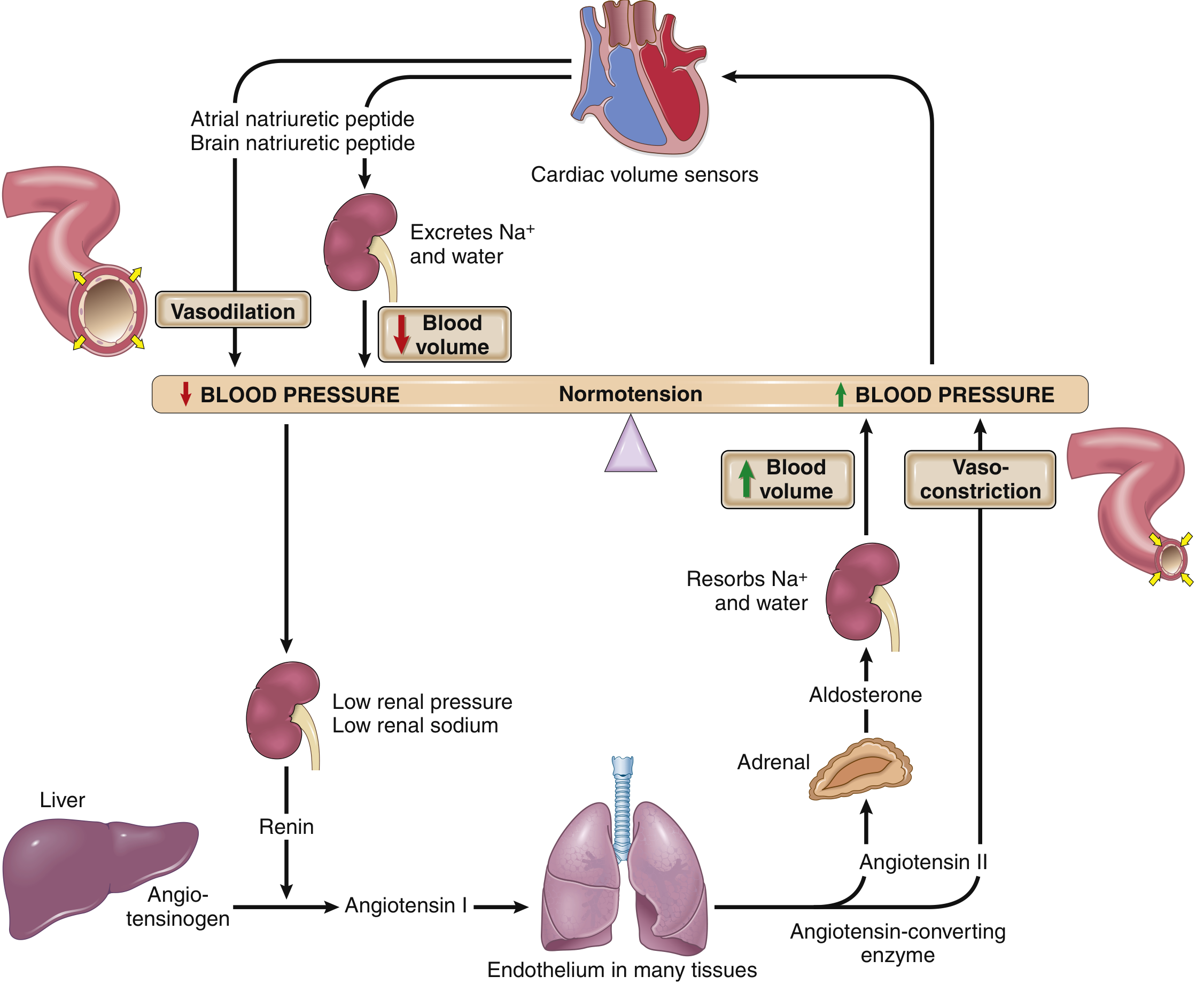
A. SHORT-TERM (Rapid) Regulation
1. Baroreceptor Reflex (Most important)
- Location: Carotid sinus (CN IX) and aortic arch (CN X)
- Mechanism: High BP → stretch → increased afferent firing → medullary cardiovascular center → decreased sympathetic, increased parasympathetic outflow → decreased HR, decreased contractility, vasodilation → BP falls
- Reverse: Low BP → decreased stretch → sympathetic activation → vasoconstriction, increased HR → BP rises
- Acts within seconds; primary moment-to-moment regulator
2. Chemoreceptor Reflex
- Peripheral: Carotid and aortic bodies - respond to ↓PO₂, ↑PCO₂, ↓pH
- Central: Medullary chemoreceptors - primarily ↑CO₂/↓pH
- Hypoxia/hypercapnia → sympathetic activation → vasoconstriction → BP rises
3. CNS Ischemic Response (Cushing Reflex)
- When cerebral blood flow drops critically → massive sympathetic discharge → extreme hypertension (emergency override)
4. Local Autoregulation / Vasodilator Substances
- Vasodilators: Nitric oxide (NO), kinins, prostaglandins, histamine
- Vasoconstrictors: Endothelin, thromboxane A₂, catecholamines
- Balance determines vascular tone instantaneously
B. LONG-TERM Regulation
1. Renin-Angiotensin-Aldosterone System (RAAS) - Primary long-term mechanism
Low BP / Low Na⁺ at DCT / Sympathetic stimulation
           ↓
    Juxtaglomerular cells → Release RENIN
           ↓
   Angiotensinogen (liver) → Angiotensin I
           ↓ (ACE - pulmonary endothelium)
        Angiotensin II
      ↙           ↘          ↘
Vasoconstriction  Aldosterone  ↑Thirst / ADH
(direct)          (adrenal)    secretion
                     ↓
             Na⁺ + H₂O reabsorption
             (DCT + collecting duct)
                     ↓
             ↑ Blood volume → ↑ BP
2. Aldosterone
- Secreted by adrenal cortex in response to Angiotensin II and hyperkalemia
- Increases Na⁺ reabsorption via ENaC in distal tubule → water follows → ↑ blood volume → ↑ BP
3. ADH (Vasopressin - AVP)
- Released from posterior pituitary in response to hyperosmolarity or hypovolemia
- Acts on V2 receptors in collecting duct → ↑ water reabsorption → ↑ blood volume
- Acts on V1 receptors on vessels → vasoconstriction
4. Natriuretic Peptides (Counter-regulatory)
- ANP (atrial natriuretic peptide): Released from atria in response to volume overload
- BNP (brain/B-type natriuretic peptide): From ventricles
- Actions: Inhibit Na⁺ reabsorption in distal tubules → natriuresis + diuresis + vasodilation → ↓ BP
5. Renal Pressure-Natriuresis
- Direct effect: ↑ BP → ↑ renal perfusion pressure → more Na⁺/water excreted → ↓ blood volume → ↓ BP
- Most fundamental long-term mechanism (Guyton's concept)
| Feature | Short-term | Long-term |
|---|---|---|
| Onset | Seconds-minutes | Hours-days |
| Mechanism | Neural (baroreceptors, sympathetic) | Renal-hormonal (RAAS, ADH, ANP) |
| Key effector | Heart rate, vascular tone | Blood volume, Na⁺ balance |
| Duration | Brief (resets) | Sustained |
3. NEURAL REGULATION OF RESPIRATION
Overview
A. Respiratory Centers in the Brainstem
1. Medullary Respiratory Centers (Primary Rhythm Generators)
- Location: Dorsomedial medulla, near NTS (Nucleus Tractus Solitarius)
- Function: Inspiratory neurons - generate basic respiratory rhythm
- Sends impulses to phrenic nerve (C3-C5) → diaphragm contraction
- Receives sensory input from vagal and glossopharyngeal afferents
- Location: Ventrolateral medulla (nucleus ambiguus + retrofacialis)
- Contains both inspiratory and expiratory neurons
- Pre-Bötzinger complex (within rostral VRG) - regarded as the principal rhythm generator
- Rostral VRG: inspiratory neurons → activate external intercostals
- Caudal VRG: expiratory neurons → activate internal intercostals + abdominal muscles during forced breathing
- Bötzinger complex: expiratory neurons at rostral end, inhibit inspiratory neurons
2. Pontine Respiratory Centers
- Location: Upper pons (parabrachial nucleus + Kölliker-Fuse nucleus)
- Function: Limits inspiration - sends inhibitory signals to DRG to "switch off" inspiration
- Controls rate and depth; prevents apneusis
- Damage → slower, deeper breaths
- Location: Lower pons
- Function: Promotes sustained inspiration (tonic drive to DRG)
- Normally inhibited by pneumotaxic center
- Damage → apneusis (prolonged inspiratory gasps)
B. Generation of Respiratory Rhythm
Pre-Bötzinger complex (VRG) → Rhythmic bursts of impulses
           ↓
    DRG inspiratory neurons fire
           ↓
    Phrenic nerve (C3-C5) + Intercostal nerves (T1-T12)
           ↓
    Diaphragm + External intercostals contract
           ↓ (INSPIRATION)
    Lung inflation → Stretch receptors fire
           ↓
    Hering-Breuer reflex (vagus) → Inhibit inspiration
           ↓
    Passive expiration (elastic recoil)
           ↓
    Cycle repeats at 12-18 breaths/min
C. Chemical Regulation (Modulating Neural Centers)
Central Chemoreceptors
- Location: Ventrolateral surface of medulla
- Stimulus: ↑ PCO₂ (not O₂) → CO₂ crosses BBB → carbonic acid → ↑ H⁺ → stimulates ventilation
- Most powerful drive to breathe in normal conditions
Peripheral Chemoreceptors
- Location: Carotid bodies (CN IX) and aortic bodies (CN X)
- Stimulus: ↓ PO₂ (<60 mmHg), ↑ PCO₂, ↑ H⁺
- Important in hypoxic drive (e.g., in COPD patients)
D. Reflex Inputs
| Reflex | Receptor | Nerve | Effect |
|---|---|---|---|
| Hering-Breuer | Lung stretch receptors | Vagus (CN X) | Lung inflation → inhibit inspiration (prevents over-inflation) |
| J-receptor (juxtacapillary) reflex | Pulmonary capillary wall | Vagus | Congestion/edema → rapid shallow breathing, laryngospasm |
| Irritant receptor reflex | Bronchial mucosa | Vagus | Inhaled irritants → cough, bronchoconstriction |
| Muscle/joint mechanoreceptors | Proprioceptors | Spinal | Exercise → immediate increase in ventilation |
E. Voluntary Control
- Cortical motor neurons (pyramidal tract) can override automatic brainstem control
- Allows breath-holding, speech, voluntary hyperventilation
- These fibers travel more dorsally in the spinal cord (vs. automatic fibers which run laterally)
- Clinical note: "Ondine's Curse" = loss of automatic (not voluntary) breathing from lateral medullary lesion
4. THYROID PHYSIOLOGY: Hormones, Secretion & Functions
Anatomy
- Two lobes connected by isthmus
- Functional unit: thyroid follicle - spherical, lined by follicular cells (thyrocytes), lumen filled with colloid (thyroglobulin, TG)
- Parafollicular (C) cells → secrete calcitonin
Hormones Secreted
| Hormone | Full Name | Chemical Nature | Potency |
|---|---|---|---|
| T4 (Thyroxine) | Tetraiodothyronine | Iodinated amino acid (from tyrosine) | Less active, prohormone |
| T3 (Triiodothyronine) | Triiodothyronine | Iodinated amino acid | 3-4x more potent than T4 |
| rT3 | Reverse T3 | Inactive metabolite | Metabolically inactive |
| Calcitonin | - | Peptide (from C cells) | Lowers serum Ca²⁺ |
T4 is secreted in greater amounts; 80% of circulating T3 comes from peripheral deiodination of T4 (by 5'-iodinase/deiodinase D1, D2). T3 has 10x higher affinity for nuclear receptors than T4.
Synthesis of Thyroid Hormones (7 Steps)
Step 1: Iodide Trapping
   Blood I⁻ → enters thyrocyte via NIS (Na⁺/I⁻ symporter) at basal membrane
   (Active transport; blocked by perchlorate, thiocyanate)

Step 2: Oxidation of Iodide
   I⁻ → I₂ (active iodine) by Thyroid Peroxidase (TPO) + H₂O₂ (from DUOX)
   (Blocked by propylthiouracil, methimazole)

Step 3: Organification (Iodination of TG)
   I₂ + Tyrosine residues on TG → MIT (monoiodotyrosine) and DIT (diiodotyrosine)
   (Also catalyzed by TPO)

Step 4: Coupling Reaction
   MIT + DIT → T3 (triiodothyronine)
   DIT + DIT → T4 (tetraiodothyronine/thyroxine)
   (Also by TPO; coupling occurs within TG scaffold)

Step 5: Storage
   Iodinated TG stored as colloid in follicular lumen

Step 6: Endocytosis
   TSH stimulates endocytosis of colloid into thyrocyte (via megalin receptor)

Step 7: Proteolysis and Secretion
   Lysosomes digest TG → release T4 and T3 into blood
   MIT and DIT are deiodinated; iodine recycled within gland
Regulation of Thyroid Hormone Secretion (HPT Axis)
Hypothalamus → TRH (Thyrotropin Releasing Hormone)
                    ↓
Anterior Pituitary → TSH (Thyroid Stimulating Hormone)
    [TSH binds TSH-R on thyrocyte → Gs → ↑cAMP]
                    ↓
    Thyroid gland → ↑T3/T4 secretion + thyroid growth (trophic effect)
                    ↓
Negative feedback:
    High T3/T4 → inhibit TRH receptor on pituitary → ↓TSH secretion
    Free T3 (converted from T4 by anterior pituitary deiodinase) mediates feedback
- Stimulates all steps in hormone synthesis (iodide uptake, oxidation, organification, coupling, endocytosis, proteolysis)
- Trophic effect: Hypertrophy + hyperplasia of follicular cells (goiter if sustained)
Transport in Blood
- 99% of T3 and T4 is protein-bound (TBG, transthyretin, albumin)
- Only free fraction is biologically active
- TBG has 20x lower dissociation constant for T4 → T4 has smaller free fraction but longer half-life (7 days vs 1 day for T3)
Actions/Functions of Thyroid Hormones
Mechanism of Action
- T4 → converted to T3 in target cells by 5'-iodinase
- T3 enters nucleus → binds Thyroid Receptor (TR-α, TR-β) → TR-RXR heterodimer
- Binds Thyroid Response Elements (TRE) on DNA → regulates gene transcription
Physiological Actions (Systematic)
| System | Action |
|---|---|
| Metabolism (BMR) | ↑ Basal Metabolic Rate, ↑ heat production (calorigenic effect), ↑ O₂ consumption in all tissues except brain, testes, spleen |
| Carbohydrate | ↑ Glucose absorption from gut, ↑ glycogenolysis, ↑ gluconeogenesis (catabolic at high levels) |
| Lipid | ↑ Lipolysis, ↑ cholesterol synthesis AND catabolism (net: ↓ cholesterol - hypothyroid → hypercholesterolemia) |
| Protein | Physiological levels: anabolic (↑ protein synthesis); excess: catabolic (↑ protein breakdown, muscle wasting) |
| Cardiovascular | ↑ Heart rate, ↑ cardiac output, ↑ stroke volume; up-regulates β-adrenergic receptors → sensitizes heart to catecholamines |
| Nervous system | Essential for normal brain development (fetal/neonatal); ↑ CNS excitability; deficiency in infancy = cretinism (irreversible intellectual disability) |
| Growth | Synergizes with GH and IGF-1 for normal skeletal and somatic growth; permissive for GH action |
| Respiratory | ↑ Rate and depth of respiration to meet ↑ O₂ demand |
| GI | ↑ Gut motility (hyperthyroidism → diarrhea; hypothyroidism → constipation) |
| Reproductive | Essential for normal ovarian function; deficiency → anovulation, menstrual irregularity |
| Bone | ↑ Bone turnover; excess → osteoporosis |
| Blood | ↑ Erythropoiesis (indirect via ↑O₂ demand → ↑EPO) |
Clinical Correlations (Exam Bonus Points)
| Condition | Cause | Key Features |
|---|---|---|
| Hypothyroidism | ↓ T3/T4 (Hashimoto's most common) | Weight gain, cold intolerance, bradycardia, myxedema, ↑TSH |
| Hyperthyroidism | ↑ T3/T4 (Graves' most common) | Weight loss, heat intolerance, tachycardia, exophthalmos, ↓TSH |
| Cretinism | Congenital hypothyroidism | Intellectual disability, short stature - prevented by newborn screening |
| Goiter | Iodine deficiency / ↑TSH | Enlarged thyroid; ↑TSH due to low T3/T4 → thyroid hyperplasia |
Quick Revision Summary Table
| Topic | Key Point for 12-Marker |
|---|---|
| Erythropoiesis | Stem cell → CFU-GEMM → BFU-E → CFU-E → Normoblast (×4 divisions) → Reticulocyte → RBC; EPO from kidney is main regulator |
| Erythropoiesis factors | Iron, B12, folate, B6, protein, EPO, copper |
| Malnutrition & anemia | Iron → microcytic; B12/folate → megaloblastic; protein → normocytic |
| Short-term BP | Baroreceptor reflex (seconds); carotid sinus + aortic arch → cardiac/vascular response |
| Long-term BP | RAAS (renin → angiotensin II → aldosterone → Na⁺ retention); ADH; ANP/BNP (counter-regulatory) |
| Respiratory centers | DRG (inspiration), VRG/Pre-Bötzinger (rhythm), Pneumotaxic (limits inspiration), Apneustic (promotes inspiration) |
| Thyroid hormones | T4 (prohormone), T3 (active); synthesis needs iodine + TPO; regulated by TSH via HPT axis |
| Thyroid actions | ↑ BMR, calorigenic, needed for brain development + growth + CVS function |
Convert it into hand written format with colour full interactiv3 way
mkdir -p /tmp/workspace/physiology-notes && ls /tmp/workspace/
~/physiology-notes/index.html
<!DOCTYPE html>
<html lang="en">
<head>
<meta charset="UTF-8">
<meta name="viewport" content="width=device-width, initial-scale=1.0">
<title>🩺 Physiology Notes — University Exam 12 Marks</title>
<link href="https://fonts.googleapis.com/css2?family=Caveat:wght@400;600;700&family=Patrick+Hand&family=Permanent+Marker&display=swap" rel="stylesheet">
<style>
:root {
--pink: #ff6b9d;
--blue: #4a90e2;
--green: #27ae60;
--orange: #f39c12;
--purple: #9b59b6;
--red: #e74c3c;
--teal: #1abc9c;
--yellow: #f1c40f;
--dark: #2c3e50;
--cream: #fef9f0;
}
* { box-sizing: border-box; margin: 0; padding: 0; }
body {
background: #f0f4ff;
background-image:
radial-gradient(circle at 20% 20%, rgba(255,107,157,0.08) 0%, transparent 50%),
radial-gradient(circle at 80% 80%, rgba(74,144,226,0.08) 0%, transparent 50%);
font-family: 'Caveat', cursive;
min-height: 100vh;
padding: 0;
}
/* ===== HEADER ===== */
.main-header {
background: linear-gradient(135deg, #667eea 0%, #764ba2 50%, #f093fb 100%);
color: white;
text-align: center;
padding: 30px 20px 20px;
position: relative;
overflow: hidden;
box-shadow: 0 4px 20px rgba(0,0,0,0.2);
}
.main-header::before {
content: '';
position: absolute;
top: -50%; left: -50%;
width: 200%; height: 200%;
background: repeating-linear-gradient(
45deg, transparent, transparent 10px,
rgba(255,255,255,0.03) 10px, rgba(255,255,255,0.03) 20px
);
}
.main-header h1 {
font-family: 'Permanent Marker', cursive;
font-size: clamp(1.8rem, 5vw, 3.5rem);
text-shadow: 3px 3px 0 rgba(0,0,0,0.2);
position: relative;
z-index: 1;
}
.main-header p {
font-size: 1.3rem;
margin-top: 8px;
opacity: 0.9;
font-family: 'Patrick Hand', cursive;
position: relative;
z-index: 1;
}
.doodle-line {
width: 80%;
height: 4px;
background: repeating-linear-gradient(90deg, rgba(255,255,255,0.6) 0px, rgba(255,255,255,0.6) 8px, transparent 8px, transparent 16px);
margin: 14px auto 0;
border-radius: 2px;
}
/* ===== NAV TABS ===== */
.nav-tabs {
display: flex;
flex-wrap: wrap;
justify-content: center;
gap: 10px;
padding: 20px 16px 10px;
background: white;
position: sticky;
top: 0;
z-index: 100;
box-shadow: 0 2px 12px rgba(0,0,0,0.1);
border-bottom: 3px solid #e0e8ff;
}
.nav-btn {
font-family: 'Patrick Hand', cursive;
font-size: 1rem;
padding: 10px 18px;
border: 3px solid;
border-radius: 50px;
cursor: pointer;
transition: all 0.3s ease;
background: white;
position: relative;
overflow: hidden;
font-weight: bold;
letter-spacing: 0.5px;
}
.nav-btn::after {
content: '';
position: absolute;
top: 50%; left: 50%;
width: 0; height: 0;
background: rgba(255,255,255,0.4);
border-radius: 50%;
transform: translate(-50%,-50%);
transition: width 0.4s, height 0.4s;
}
.nav-btn:hover::after { width: 200%; height: 200%; }
.nav-btn.n1 { border-color: var(--red); color: var(--red); }
.nav-btn.n2 { border-color: var(--blue); color: var(--blue); }
.nav-btn.n3 { border-color: var(--green); color: var(--green); }
.nav-btn.n4 { border-color: var(--purple); color: var(--purple); }
.nav-btn.active, .nav-btn:hover {
color: white !important;
transform: translateY(-2px);
box-shadow: 0 6px 16px rgba(0,0,0,0.15);
}
.nav-btn.n1.active, .nav-btn.n1:hover { background: var(--red); }
.nav-btn.n2.active, .nav-btn.n2:hover { background: var(--blue); }
.nav-btn.n3.active, .nav-btn.n3:hover { background: var(--green); }
.nav-btn.n4.active, .nav-btn.n4:hover { background: var(--purple); }
.nav-btn.all { border-color: var(--dark); color: var(--dark); }
.nav-btn.all.active, .nav-btn.all:hover { background: var(--dark); }
/* ===== SECTIONS ===== */
.section {
display: none;
padding: 20px 16px 40px;
max-width: 960px;
margin: 0 auto;
animation: fadeSlide 0.4s ease;
}
.section.active { display: block; }
@keyframes fadeSlide {
from { opacity: 0; transform: translateY(16px); }
to { opacity: 1; transform: translateY(0); }
}
/* ===== NOTEBOOK PAPER ===== */
.paper {
background: white;
border-radius: 12px;
padding: 28px 28px 32px 60px;
margin: 18px 0;
box-shadow: 4px 4px 0 rgba(0,0,0,0.08), 0 2px 20px rgba(0,0,0,0.07);
position: relative;
border-left: 4px solid;
background-image:
repeating-linear-gradient(
transparent,
transparent 31px,
#d8e8ff 31px,
#d8e8ff 32px
);
background-size: 100% 32px;
background-position: 0 4px;
}
.paper::before {
content: '';
position: absolute;
left: 40px; top: 0; bottom: 0;
width: 2px;
background: rgba(255,150,150,0.5);
}
.paper.red { border-left-color: var(--red); }
.paper.blue { border-left-color: var(--blue); }
.paper.green { border-left-color: var(--green); }
.paper.orange{ border-left-color: var(--orange); }
.paper.purple{ border-left-color: var(--purple); }
.paper.teal { border-left-color: var(--teal); }
/* ===== SECTION TITLE ===== */
.sec-title {
font-family: 'Permanent Marker', cursive;
font-size: clamp(1.5rem, 4vw, 2.2rem);
display: inline-block;
padding: 10px 24px;
border-radius: 8px;
color: white;
margin-bottom: 20px;
box-shadow: 4px 4px 0 rgba(0,0,0,0.15);
position: relative;
transform: rotate(-1deg);
}
.sec-title.red { background: var(--red); }
.sec-title.blue { background: var(--blue); }
.sec-title.green { background: var(--green); }
.sec-title.purple { background: var(--purple); }
/* ===== HEADINGS ===== */
.h2 {
font-family: 'Patrick Hand', cursive;
font-size: 1.5rem;
font-weight: bold;
margin: 20px 0 10px;
padding: 6px 14px;
border-radius: 6px;
display: inline-block;
color: white;
box-shadow: 3px 3px 0 rgba(0,0,0,0.12);
}
.h3 {
font-family: 'Patrick Hand', cursive;
font-size: 1.25rem;
font-weight: bold;
margin: 16px 0 8px;
border-bottom: 3px dashed;
padding-bottom: 4px;
display: inline-block;
}
/* ===== HANDWRITTEN TEXT ===== */
p, li {
font-family: 'Caveat', cursive;
font-size: 1.15rem;
line-height: 1.8;
color: #2c3e50;
}
ul { padding-left: 24px; }
li { margin: 4px 0; }
li::marker { color: var(--pink); font-size: 1.2rem; }
/* ===== HIGHLIGHT BOXES ===== */
.highlight {
display: inline;
border-radius: 3px;
padding: 2px 4px;
font-weight: bold;
}
.hl-yellow { background: rgba(241,196,15,0.35); color: #7d6608; }
.hl-pink { background: rgba(255,107,157,0.25); color: #c0392b; }
.hl-blue { background: rgba(74,144,226,0.25); color: #1a5276; }
.hl-green { background: rgba(39,174,96,0.25); color: #1e8449; }
.hl-purple { background: rgba(155,89,182,0.25); color: #6c3483; }
.hl-orange { background: rgba(243,156,18,0.25); color: #784212; }
/* ===== STICKY NOTES ===== */
.sticky {
background: #fff9c4;
border: 2px solid #f1c40f;
border-radius: 8px;
padding: 14px 18px;
margin: 14px 0;
position: relative;
font-family: 'Caveat', cursive;
font-size: 1.1rem;
box-shadow: 3px 3px 8px rgba(0,0,0,0.1);
transform: rotate(0.5deg);
}
.sticky::before {
content: '📌';
position: absolute;
top: -14px; left: 12px;
font-size: 1.4rem;
}
.sticky.blue { background: #d6eaf8; border-color: #4a90e2; }
.sticky.pink { background: #fde8f5; border-color: #ff6b9d; }
.sticky.green { background: #d5f5e3; border-color: #27ae60; }
/* ===== FLOW DIAGRAMS ===== */
.flow-box {
background: white;
border: 3px solid;
border-radius: 12px;
padding: 14px 18px;
margin: 6px auto;
font-family: 'Patrick Hand', cursive;
font-size: 1.1rem;
font-weight: bold;
text-align: center;
max-width: 380px;
box-shadow: 3px 3px 0 rgba(0,0,0,0.1);
transition: transform 0.2s, box-shadow 0.2s;
cursor: default;
}
.flow-box:hover {
transform: scale(1.04) rotate(-0.5deg);
box-shadow: 5px 5px 0 rgba(0,0,0,0.18);
}
.flow-arrow {
text-align: center;
font-size: 1.8rem;
line-height: 1;
margin: 2px 0;
color: #888;
user-select: none;
}
.flow-container {
display: flex;
flex-direction: column;
align-items: center;
padding: 14px;
background: rgba(255,255,255,0.6);
border-radius: 14px;
border: 2px dashed #ddd;
margin: 12px 0;
}
/* ===== TABLES ===== */
.hw-table {
width: 100%;
border-collapse: separate;
border-spacing: 4px;
margin: 12px 0;
font-family: 'Caveat', cursive;
font-size: 1.05rem;
}
.hw-table th {
background: linear-gradient(135deg, #667eea, #764ba2);
color: white;
padding: 10px 12px;
border-radius: 8px;
font-family: 'Patrick Hand', cursive;
font-size: 1.05rem;
font-weight: bold;
text-align: left;
}
.hw-table td {
padding: 9px 12px;
border-radius: 6px;
border-left: 4px solid transparent;
background: #f8f9ff;
transition: background 0.2s;
}
.hw-table tr:hover td { background: #eef2ff; }
.hw-table tr:nth-child(1) td { border-left-color: var(--red); }
.hw-table tr:nth-child(2) td { border-left-color: var(--blue); }
.hw-table tr:nth-child(3) td { border-left-color: var(--green); }
.hw-table tr:nth-child(4) td { border-left-color: var(--orange); }
.hw-table tr:nth-child(5) td { border-left-color: var(--purple); }
.hw-table tr:nth-child(6) td { border-left-color: var(--teal); }
.hw-table tr:nth-child(7) td { border-left-color: var(--pink); }
.hw-table tr:nth-child(8) td { border-left-color: var(--red); }
/* ===== ACCORDION ===== */
.accordion {
margin: 10px 0;
border-radius: 10px;
overflow: hidden;
border: 2px solid;
}
.accordion-header {
padding: 14px 18px;
cursor: pointer;
display: flex;
justify-content: space-between;
align-items: center;
font-family: 'Patrick Hand', cursive;
font-size: 1.2rem;
font-weight: bold;
color: white;
user-select: none;
transition: opacity 0.2s;
}
.accordion-header:hover { opacity: 0.9; }
.accordion-icon {
font-size: 1.4rem;
transition: transform 0.3s;
display: inline-block;
}
.accordion-body {
padding: 0 18px;
max-height: 0;
overflow: hidden;
transition: max-height 0.5s ease, padding 0.3s;
background: white;
font-family: 'Caveat', cursive;
font-size: 1.1rem;
line-height: 1.7;
}
.accordion-body.open {
max-height: 3000px;
padding: 16px 18px;
}
.accordion-icon.rotate { transform: rotate(90deg); }
/* ===== BADGE / LABEL ===== */
.badge {
display: inline-block;
padding: 4px 12px;
border-radius: 20px;
font-family: 'Patrick Hand', cursive;
font-size: 0.92rem;
font-weight: bold;
color: white;
margin: 3px;
}
/* ===== DIAGRAM IMAGE ===== */
.diagram-img {
width: 100%;
max-width: 560px;
border-radius: 12px;
border: 3px solid;
margin: 14px auto;
display: block;
box-shadow: 5px 5px 0 rgba(0,0,0,0.12);
transition: transform 0.3s;
cursor: zoom-in;
}
.diagram-img:hover { transform: scale(1.03); }
.img-caption {
text-align: center;
font-family: 'Patrick Hand', cursive;
font-size: 0.95rem;
color: #666;
margin-top: 4px;
font-style: italic;
}
/* ===== TWO-COL ===== */
.two-col {
display: grid;
grid-template-columns: 1fr 1fr;
gap: 14px;
margin: 12px 0;
}
@media(max-width: 600px) { .two-col { grid-template-columns: 1fr; } }
.col-card {
background: white;
border-radius: 12px;
padding: 16px;
border: 3px solid;
box-shadow: 3px 3px 0 rgba(0,0,0,0.09);
}
/* ===== PROGRESS TRACKER ===== */
.progress-bar {
background: #eee;
border-radius: 20px;
height: 10px;
overflow: hidden;
margin: 6px 0;
}
.progress-fill {
height: 100%;
border-radius: 20px;
transition: width 1s ease;
}
/* ===== QUIZ SECTION ===== */
.quiz-btn {
font-family: 'Patrick Hand', cursive;
font-size: 1rem;
padding: 10px 20px;
border: 3px solid var(--blue);
background: white;
border-radius: 8px;
cursor: pointer;
margin: 5px;
transition: all 0.2s;
color: var(--blue);
font-weight: bold;
}
.quiz-btn:hover { background: var(--blue); color: white; transform: translateY(-2px); }
.quiz-btn.correct { background: var(--green); border-color: var(--green); color: white; }
.quiz-btn.wrong { background: var(--red); border-color: var(--red); color: white; }
.quiz-feedback {
font-family: 'Patrick Hand', cursive;
font-size: 1.1rem;
padding: 10px;
border-radius: 8px;
margin: 8px 0;
display: none;
font-weight: bold;
}
.quiz-feedback.show { display: block; }
.quiz-feedback.correct { background: #d5f5e3; color: var(--green); border: 2px solid var(--green); }
.quiz-feedback.wrong { background: #fde8e8; color: var(--red); border: 2px solid var(--red); }
/* ===== SCROLL TOP ===== */
.scroll-top {
position: fixed;
bottom: 24px; right: 24px;
background: linear-gradient(135deg, #667eea, #764ba2);
color: white;
border: none;
border-radius: 50%;
width: 50px; height: 50px;
font-size: 1.4rem;
cursor: pointer;
box-shadow: 0 4px 14px rgba(0,0,0,0.25);
transition: transform 0.2s;
z-index: 999;
display: none;
}
.scroll-top:hover { transform: scale(1.1); }
/* ===== DIVIDER ===== */
.divider {
border: none;
border-top: 3px dashed #ccc;
margin: 20px 0;
}
/* ===== TOOLTIP ===== */
.tooltip-wrap { position: relative; display: inline; cursor: help; }
.tooltip-wrap .tt {
visibility: hidden;
opacity: 0;
background: #2c3e50;
color: white;
border-radius: 8px;
padding: 8px 12px;
font-family: 'Patrick Hand', cursive;
font-size: 0.9rem;
position: absolute;
bottom: 130%;
left: 50%;
transform: translateX(-50%);
width: 200px;
text-align: center;
transition: opacity 0.3s;
z-index: 50;
pointer-events: none;
}
.tooltip-wrap:hover .tt { visibility: visible; opacity: 1; }
/* ===== FORMULA BOX ===== */
.formula-box {
background: linear-gradient(135deg, #667eea22, #764ba222);
border: 3px solid #764ba2;
border-radius: 12px;
padding: 16px 20px;
text-align: center;
font-family: 'Permanent Marker', cursive;
font-size: 1.3rem;
color: #764ba2;
margin: 14px auto;
max-width: 440px;
box-shadow: 4px 4px 0 rgba(118,75,162,0.2);
}
/* ===== EXAM TIP ===== */
.exam-tip {
background: linear-gradient(135deg, #ff9a9e33, #fecfef33);
border: 3px solid var(--pink);
border-radius: 12px;
padding: 14px 18px;
margin: 14px 0;
font-family: 'Caveat', cursive;
font-size: 1.1rem;
position: relative;
}
.exam-tip::before { content: '⭐ Exam Tip: '; font-weight: bold; color: var(--pink); font-family: 'Patrick Hand', cursive; }
/* ===== STEPS TIMELINE ===== */
.timeline {
position: relative;
padding-left: 30px;
border-left: 4px solid #ddd;
margin: 16px 0;
}
.timeline-item {
position: relative;
margin-bottom: 18px;
padding-left: 18px;
}
.timeline-item::before {
content: attr(data-num);
position: absolute;
left: -36px;
top: 0;
width: 28px; height: 28px;
background: white;
border: 3px solid;
border-radius: 50%;
display: flex;
align-items: center;
justify-content: center;
font-family: 'Patrick Hand', cursive;
font-size: 0.9rem;
font-weight: bold;
line-height: 22px;
text-align: center;
}
.timeline-item.red::before { border-color: var(--red); color: var(--red); }
.timeline-item.blue::before { border-color: var(--blue); color: var(--blue); }
.timeline-item.green::before { border-color: var(--green); color: var(--green); }
.timeline-item.orange::before{ border-color: var(--orange); color: var(--orange); }
.timeline-item.purple::before{ border-color: var(--purple); color: var(--purple); }
.timeline-item.teal::before { border-color: var(--teal); color: var(--teal); }
.timeline-item.pink::before { border-color: var(--pink); color: var(--pink); }
.timeline-title {
font-family: 'Patrick Hand', cursive;
font-size: 1.2rem;
font-weight: bold;
margin-bottom: 4px;
}
</style>
</head>
<body>
<!-- ===== HEADER ===== -->
<div class="main-header">
<h1>🩺 Physiology Notes</h1>
<p>University Exam — 12 Marks Edition ✍️</p>
<div class="doodle-line"></div>
</div>
<!-- ===== NAV ===== -->
<div class="nav-tabs">
<button class="nav-btn all active" onclick="showSection('all', this)">📚 All Topics</button>
<button class="nav-btn n1" onclick="showSection('s1', this)">🔴 Erythropoiesis</button>
<button class="nav-btn n2" onclick="showSection('s2', this)">💙 Blood Pressure</button>
<button class="nav-btn n3" onclick="showSection('s3', this)">💚 Respiration</button>
<button class="nav-btn n4" onclick="showSection('s4', this)">💜 Thyroid</button>
</div>
<!-- ===================== SECTION 1: ERYTHROPOIESIS ===================== -->
<div class="section active" id="s1">
<div style="text-align:center; margin-bottom:8px;">
<span class="sec-title red">🔴 Erythropoiesis, Factors & Malnutrition</span>
</div>
<!-- DEFINITION -->
<div class="paper red">
<div class="h2" style="background:var(--red);">📖 Definition</div>
<p><span class="hl-yellow">Erythropoiesis</span> = Process of production of <span class="hl-pink">Red Blood Cells (RBCs)</span> from pluripotent stem cells, primarily in <span class="hl-blue">red bone marrow</span>, regulated by tissue oxygen demand.</p>
<div class="sticky pink" style="margin-top:12px;">
Normal adult life span of RBC = <b>120 days</b> | Daily production ≈ <b>200 billion RBCs</b>
</div>
</div>
<!-- MATURATION STEPS -->
<div class="paper blue">
<div class="h2" style="background:var(--blue);">🔬 Steps of Maturation</div>
<div class="flow-container">
<div class="flow-box" style="border-color:var(--purple); color:var(--purple);">🧬 Pluripotent Stem Cell</div>
<div class="flow-arrow">⬇️</div>
<div class="flow-box" style="border-color:#8e44ad; color:#8e44ad;">CFU-GEMM<br><small style="font-size:0.85rem; font-weight:normal;">(Granulocyte, Erythroid, Monocyte, Megakaryocyte)</small></div>
<div class="flow-arrow">⬇️</div>
<div class="flow-box" style="border-color:var(--blue); color:var(--blue);">BFU-E<br><small style="font-size:0.85rem; font-weight:normal;">Burst Forming Unit — Erythroid</small></div>
<div class="flow-arrow">⬇️<span style="font-size:0.85rem; color:var(--red); font-family:'Patrick Hand'; margin-left:8px;">← EPO acts here ★</span></div>
<div class="flow-box" style="border-color:var(--teal); color:var(--teal);">CFU-E<br><small style="font-size:0.85rem; font-weight:normal;">Colony Forming Unit — Erythroid</small></div>
<div class="flow-arrow">⬇️</div>
<div class="flow-box" style="border-color:var(--orange); color:var(--orange);">🔵 Pronormoblast (Proerythroblast)<br><small>Largest; nucleated; basophilic</small></div>
<div class="flow-arrow">⬇️ <small style="font-family:'Patrick Hand'">×4 cell divisions, nucleus shrinks</small></div>
<div class="flow-box" style="border-color:#2980b9; color:#2980b9;">Basophilic → Polychromatic → Orthochromatic Normoblast<br><small>Hb ↑, nucleus extruded at last stage</small></div>
<div class="flow-arrow">⬇️</div>
<div class="flow-box" style="border-color:var(--green); color:var(--green);">🟡 Reticulocyte<br><small>No nucleus; retains ribosomes + mRNA; 1–2 days in circulation; matures in spleen</small></div>
<div class="flow-arrow">⬇️</div>
<div class="flow-box" style="border-color:var(--red); color:var(--red); background:rgba(231,76,60,0.06);">🔴 Mature Erythrocyte<br><small>Biconcave disc; 7.5 µm; 120-day lifespan</small></div>
</div>
<img class="diagram-img" style="border-color:var(--blue);"
src="https://cdn.orris.care/cdss_images/b37939fd2267cb9c8435fed1f5966eeafe56a8e8fc09a3fac7abd6948fc37d52.png"
alt="Erythropoiesis diagram">
<p class="img-caption">📊 Fig: Erythropoietin stimulation — Stem cell → RBC pathway (Basic Medical Biochemistry 6e)</p>
</div>
<!-- REGULATION -->
<div class="paper green">
<div class="h2" style="background:var(--green);">⚙️ Regulation of Erythropoiesis</div>
<div class="accordion" style="border-color:var(--red);">
<div class="accordion-header" style="background:var(--red);" onclick="toggleAccordion(this)">
🎯 Erythropoietin (EPO) — The Master Regulator
<span class="accordion-icon">▶</span>
</div>
<div class="accordion-body open">
<ul>
<li><span class="hl-yellow">Source:</span> Kidney 90% (peritubular cells) + Liver 10%</li>
<li><span class="hl-blue">Trigger:</span> Hypoxia → HIF-1α activation → EPO gene expression</li>
<li><span class="hl-green">Actions:</span> Stimulates BFU-E and CFU-E → ↑ proliferation + maturation</li>
<li>Mechanism: Binds EPO-R → <b>JAK2/STAT5 signaling</b> → gene transcription</li>
<li>Clinical use: rEPO used in chronic kidney disease anemia</li>
</ul>
</div>
</div>
<div class="accordion" style="border-color:var(--orange); margin-top:8px;">
<div class="accordion-header" style="background:var(--orange);" onclick="toggleAccordion(this)">
🧪 Other Hormonal Regulators
<span class="accordion-icon">▶</span>
</div>
<div class="accordion-body">
<table class="hw-table">
<tr><th>Hormone</th><th>Action on Erythropoiesis</th></tr>
<tr><td>🧪 <b>Testosterone</b></td><td>↑ EPO production + direct bone marrow stimulation (explains higher Hb in males)</td></tr>
<tr><td>🦋 <b>Thyroid Hormone</b></td><td>↑ O₂ demand → indirectly ↑ EPO → ↑ RBC production</td></tr>
<tr><td>🌱 <b>Growth Hormone / IGF-1</b></td><td>Promotes erythroid progenitor proliferation</td></tr>
<tr><td>💊 <b>Glucocorticoids</b></td><td>Minor stimulatory effect</td></tr>
<tr><td>🚫 <b>Estrogen</b></td><td>Slightly inhibits (explains lower Hb in females)</td></tr>
</table>
</div>
</div>
</div>
<!-- FACTORS -->
<div class="paper orange">
<div class="h2" style="background:var(--orange);">💊 Factors Required for Erythropoiesis</div>
<div class="timeline">
<div class="timeline-item red" data-num="1">
<div class="timeline-title">🔩 Iron (Fe²⁺)</div>
<p>Component of <span class="hl-yellow">heme</span> in hemoglobin. Absorbed in duodenum as Fe²⁺. Deficiency = <span class="hl-pink">Microcytic Hypochromic Anemia</span></p>
<div class="progress-bar"><div class="progress-fill" style="width:95%; background:var(--red);"></div></div>
<small style="font-family:'Patrick Hand'; color:#888;">Most common deficiency worldwide</small>
</div>
<div class="timeline-item blue" data-num="2">
<div class="timeline-title">💉 Vitamin B12 (Cobalamin)</div>
<p>Required for <span class="hl-blue">DNA synthesis</span> (methionine/thymidine pathway). Absorbed via <b>Intrinsic Factor</b> (gastric parietal cells). Deficiency = <span class="hl-pink">Megaloblastic Anemia</span> + subacute combined spinal cord degeneration</p>
</div>
<div class="timeline-item green" data-num="3">
<div class="timeline-title">🍃 Folic Acid (Vitamin B9)</div>
<p>Thymidine synthesis for DNA replication. Deficiency = <span class="hl-pink">Megaloblastic Anemia</span>. <span class="hl-green">No neurological deficit</span> (unlike B12)</p>
</div>
<div class="timeline-item orange" data-num="4">
<div class="timeline-title">🍊 Vitamin C</div>
<p>Enhances iron absorption (Fe³⁺ → Fe²⁺). Required for folate activation. Deficiency causes scurvy + contributes to anemia</p>
</div>
<div class="timeline-item purple" data-num="5">
<div class="timeline-title">🧬 Vitamin B6 (Pyridoxine)</div>
<p>Cofactor for <b>ALA synthase</b> (first step in heme synthesis). Deficiency = sideroblastic anemia</p>
</div>
<div class="timeline-item teal" data-num="6">
<div class="timeline-title">🥩 Protein / Amino Acids</div>
<p>Globin chain synthesis. Severe protein deficiency (kwashiorkor) → normocytic normochromic anemia</p>
</div>
<div class="timeline-item pink" data-num="7">
<div class="timeline-title">🔶 Copper</div>
<p>Required for iron mobilization from stores (ceruloplasmin). Deficiency traps iron → microcytic anemia</p>
</div>
</div>
</div>
<!-- MALNUTRITION -->
<div class="paper purple">
<div class="h2" style="background:var(--purple);">🍽️ Effects of Malnutrition on Erythropoiesis</div>
<table class="hw-table">
<tr><th>Deficiency</th><th>Anemia Type</th><th>Key Mechanism / Feature</th></tr>
<tr>
<td>🔩 <b>Iron</b></td>
<td><span class="badge" style="background:var(--red);">Microcytic Hypochromic</span></td>
<td>↓ Heme synthesis → small, pale RBCs; ↑ TIBC; ↓ ferritin</td>
</tr>
<tr>
<td>💉 <b>Vit B12</b></td>
<td><span class="badge" style="background:var(--blue);">Megaloblastic (Macrocytic)</span></td>
<td>Impaired DNA synthesis; hypersegmented neutrophils; <b>neurological sx</b> (SCD)</td>
</tr>
<tr>
<td>🍃 <b>Folic Acid</b></td>
<td><span class="badge" style="background:var(--green);">Megaloblastic (Macrocytic)</span></td>
<td>Impaired DNA synthesis; identical to B12 on smear; <b>NO neurology</b></td>
</tr>
<tr>
<td>🥩 <b>Protein</b></td>
<td><span class="badge" style="background:var(--orange);">Normocytic Normochromic</span></td>
<td>↓ Globin synthesis + ↓ EPO production</td>
</tr>
<tr>
<td>🍊 <b>Vit C</b></td>
<td><span class="badge" style="background:var(--teal);">Contributing factor</span></td>
<td>↓ Fe absorption; ↓ folate activation</td>
</tr>
<tr>
<td>🔶 <b>Copper</b></td>
<td><span class="badge" style="background:var(--pink);">Microcytic</span></td>
<td>Iron trapped in stores (↓ ferroportin function)</td>
</tr>
</table>
<div class="exam-tip">Iron deficiency is #1 nutritional anemia worldwide. B12 vs Folate: both cause megaloblastic anemia — differentiate by <b>neurological signs</b> (B12 only) and serum levels.</div>
</div>
<!-- QUIZ -->
<div class="paper teal" style="border-left-color:var(--teal);">
<div class="h2" style="background:var(--teal);">🧠 Quick Quiz — Erythropoiesis</div>
<p><b>Q: Which vitamin deficiency causes megaloblastic anemia WITHOUT neurological signs?</b></p>
<div>
<button class="quiz-btn" onclick="quizAnswer(this,'wrong')">A) Vitamin B12</button>
<button class="quiz-btn" onclick="quizAnswer(this,'correct')">B) Folic Acid</button>
<button class="quiz-btn" onclick="quizAnswer(this,'wrong')">C) Vitamin C</button>
<button class="quiz-btn" onclick="quizAnswer(this,'wrong')">D) Iron</button>
</div>
<div class="quiz-feedback"></div>
</div>
</div>
<!-- ===================== SECTION 2: BLOOD PRESSURE ===================== -->
<div class="section" id="s2">
<div style="text-align:center; margin-bottom:8px;">
<span class="sec-title blue">💙 Short & Long-Term Regulation of BP</span>
</div>
<!-- FORMULA -->
<div class="formula-box">
BP = Cardiac Output (CO) × Peripheral Vascular Resistance (PVR)
</div>
<!-- SHORT TERM -->
<div class="paper red">
<div class="h2" style="background:var(--red);">⚡ A. Short-Term Regulation <small style="font-size:0.75rem;">(Seconds to Minutes)</small></div>
<div class="sticky">Mechanism: <b>Neural</b> — rapid response, fine-tuning of beat-to-beat changes</div>
<div class="accordion" style="border-color:var(--red);">
<div class="accordion-header" style="background:var(--red);" onclick="toggleAccordion(this)">
1️⃣ Baroreceptor Reflex (Most Important ★)
<span class="accordion-icon rotate">▶</span>
</div>
<div class="accordion-body open">
<div class="flow-container">
<div class="flow-box" style="border-color:var(--red); color:var(--red);">↑ BP</div>
<div class="flow-arrow">⬇️</div>
<div class="flow-box" style="border-color:#e67e22; color:#e67e22;">Carotid Sinus (CN IX) + Aortic Arch (CN X)<br><small>Stretch receptors fire ↑</small></div>
<div class="flow-arrow">⬇️</div>
<div class="flow-box" style="border-color:var(--purple); color:var(--purple);">Medullary Cardiovascular Center</div>
<div class="flow-arrow">⬇️</div>
<div class="flow-box" style="border-color:var(--green); color:var(--green);">↓ Sympathetic + ↑ Parasympathetic<br>→ ↓HR + ↓Contractility + Vasodilation</div>
<div class="flow-arrow">⬇️</div>
<div class="flow-box" style="border-color:var(--blue); color:var(--blue);">🔽 BP returns to normal</div>
</div>
<div class="exam-tip">Baroreceptors RESET in chronic hypertension — they adapt to higher pressure ("set point" rises). They work best for <b>moment-to-moment</b> changes.</div>
</div>
</div>
<div class="accordion" style="border-color:var(--orange); margin-top:8px;">
<div class="accordion-header" style="background:var(--orange);" onclick="toggleAccordion(this)">
2️⃣ Chemoreceptor Reflex
<span class="accordion-icon">▶</span>
</div>
<div class="accordion-body">
<div class="two-col">
<div class="col-card" style="border-color:var(--orange);">
<b style="color:var(--orange);">Peripheral Chemoreceptors</b>
<ul>
<li>Location: Carotid & aortic bodies</li>
<li>Stimuli: ↓PO₂, ↑PCO₂, ↓pH</li>
<li>Effect: → Sympathetic activation → vasoconstriction → ↑BP</li>
</ul>
</div>
<div class="col-card" style="border-color:var(--purple);">
<b style="color:var(--purple);">Central Chemoreceptors</b>
<ul>
<li>Location: Medulla (ventrolateral)</li>
<li>Stimuli: ↑PCO₂ / ↓pH</li>
<li>Primarily regulates ventilation but also influences BP via medullary centers</li>
</ul>
</div>
</div>
</div>
</div>
<div class="accordion" style="border-color:var(--teal); margin-top:8px;">
<div class="accordion-header" style="background:var(--teal);" onclick="toggleAccordion(this)">
3️⃣ CNS Ischemic Response (Cushing Reflex) + Local Autoregulation
<span class="accordion-icon">▶</span>
</div>
<div class="accordion-body">
<ul>
<li><span class="hl-yellow"><b>Cushing Reflex:</b></span> Critical ↓ cerebral blood flow → massive sympathetic surge → extreme hypertension + bradycardia. Emergency override.</li>
<li><span class="hl-blue"><b>Vasodilators:</b></span> Nitric oxide (NO), kinins, prostaglandins, histamine</li>
<li><span class="hl-pink"><b>Vasoconstrictors:</b></span> Endothelin-1, thromboxane A₂, catecholamines, angiotensin II</li>
<li><span class="hl-green"><b>Autoregulation:</b></span> ↑Blood flow → vasoconstriction to prevent hyperperfusion (myogenic response)</li>
</ul>
</div>
</div>
</div>
<!-- LONG TERM -->
<div class="paper blue">
<div class="h2" style="background:var(--blue);">🕐 B. Long-Term Regulation <small style="font-size:0.75rem;">(Hours to Days)</small></div>
<div class="sticky blue">Mechanism: <b>Renal + Hormonal</b> — regulates blood <b>volume</b> and Na⁺ balance</div>
<div class="accordion" style="border-color:var(--blue);">
<div class="accordion-header" style="background:var(--blue);" onclick="toggleAccordion(this)">
1️⃣ RAAS — Renin-Angiotensin-Aldosterone System ★★★
<span class="accordion-icon rotate">▶</span>
</div>
<div class="accordion-body open">
<div class="flow-container">
<div class="flow-box" style="border-color:var(--red); color:var(--red);">↓ BP / ↓ Na⁺ / ↑ Sympathetic stimulation</div>
<div class="flow-arrow">⬇️</div>
<div class="flow-box" style="border-color:var(--orange); color:var(--orange);">Juxtaglomerular Cells → Release <b>RENIN</b></div>
<div class="flow-arrow">⬇️</div>
<div class="flow-box" style="border-color:#7f8c8d; color:#7f8c8d;"><b>Angiotensinogen</b> (liver) + Renin → <b>Angiotensin I</b></div>
<div class="flow-arrow">⬇️ <small style="font-family:'Patrick Hand'">ACE (pulmonary endothelium)</small></div>
<div class="flow-box" style="border-color:var(--purple); color:var(--purple); background:rgba(155,89,182,0.08);"><b>Angiotensin II</b> ⭐</div>
<div class="flow-arrow">⬇️⬇️⬇️</div>
</div>
<div class="two-col">
<div class="col-card" style="border-color:var(--red);">
<b style="color:var(--red);">Direct Vasoconstriction</b>
<p>Acts on AT1 receptors → ↑ PVR → immediate ↑ BP</p>
</div>
<div class="col-card" style="border-color:var(--green);">
<b style="color:var(--green);">→ Aldosterone (adrenal)</b>
<p>Na⁺ + H₂O reabsorption in DCT/collecting duct via ENaC → ↑ blood volume → ↑ BP</p>
</div>
<div class="col-card" style="border-color:var(--blue);">
<b style="color:var(--blue);">→ ADH / Vasopressin</b>
<p>Hypothalamus → posterior pituitary → V2R: water reabsorption; V1R: vasoconstriction</p>
</div>
<div class="col-card" style="border-color:var(--orange);">
<b style="color:var(--orange);">→ ↑ Thirst</b>
<p>Ang II acts on hypothalamus → increased fluid intake → ↑ blood volume</p>
</div>
</div>
</div>
</div>
<div class="accordion" style="border-color:var(--teal); margin-top:8px;">
<div class="accordion-header" style="background:var(--teal);" onclick="toggleAccordion(this)">
2️⃣ Natriuretic Peptides — Counter-Regulatory ⚖️
<span class="accordion-icon">▶</span>
</div>
<div class="accordion-body">
<table class="hw-table">
<tr><th>Peptide</th><th>Source</th><th>Trigger</th><th>Action</th></tr>
<tr>
<td><b>ANP</b> — Atrial Natriuretic Peptide</td>
<td>Atrial myocardium</td>
<td>↑ Atrial stretch / volume overload</td>
<td>↑ Na⁺ excretion, ↑ water loss, vasodilation → <span class="hl-green">↓ BP</span></td>
</tr>
<tr>
<td><b>BNP</b> — Brain/B-type Natriuretic Peptide</td>
<td>Ventricular myocardium</td>
<td>↑ Ventricular wall stress</td>
<td>Same as ANP; used as <span class="hl-blue">biomarker for heart failure</span></td>
</tr>
</table>
</div>
</div>
<div class="accordion" style="border-color:var(--green); margin-top:8px;">
<div class="accordion-header" style="background:var(--green);" onclick="toggleAccordion(this)">
3️⃣ Renal Pressure-Natriuresis (Guyton's Concept) ★
<span class="accordion-icon">▶</span>
</div>
<div class="accordion-body">
<ul>
<li>↑ BP → ↑ renal perfusion pressure → ↑ Na⁺ + water excretion (natriuresis + diuresis)</li>
<li>This reduces blood volume → ↓ CO → ↓ BP — <span class="hl-yellow">fundamental long-term homeostatic mechanism</span></li>
<li>In hypertension: this curve is shifted rightward (kidney requires higher BP for same Na⁺ excretion)</li>
</ul>
</div>
</div>
<img class="diagram-img" style="border-color:var(--blue); margin-top:14px;"
src="https://cdn.orris.care/cdss_images/fc4afd154d03bc8653dcb8fbc1607b11b38ebdfa25009467e9d56abaefa46045.png"
alt="RAAS Blood Pressure Regulation">
<p class="img-caption">📊 Fig: RAAS, ANP & BNP interplay in BP regulation (Robbins Basic Pathology)</p>
</div>
<!-- COMPARISON TABLE -->
<div class="paper green">
<div class="h2" style="background:var(--green);">📊 Short-Term vs Long-Term Comparison</div>
<table class="hw-table">
<tr><th>Feature</th><th>Short-Term</th><th>Long-Term</th></tr>
<tr><td>⏱️ <b>Onset</b></td><td>Seconds–minutes</td><td>Hours–days</td></tr>
<tr><td>⚙️ <b>Mechanism</b></td><td>Neural (baroreceptors, ANS)</td><td>Renal-hormonal (RAAS, ADH, ANP)</td></tr>
<tr><td>🎯 <b>Key effector</b></td><td>Heart rate, vascular tone</td><td>Blood volume, Na⁺ balance</td></tr>
<tr><td>📍 <b>Key receptor</b></td><td>Carotid sinus, aortic arch</td><td>Juxtaglomerular cells, atrial wall</td></tr>
<tr><td>📈 <b>Duration</b></td><td>Brief (resets quickly)</td><td>Sustained, chronic</td></tr>
<tr><td>💊 <b>Drug targets</b></td><td>Beta blockers, calcium channel blockers</td><td>ACE inhibitors, ARBs, diuretics</td></tr>
</table>
</div>
</div>
<!-- ===================== SECTION 3: NEURAL RESPIRATION ===================== -->
<div class="section" id="s3">
<div style="text-align:center; margin-bottom:8px;">
<span class="sec-title green" style="transform:rotate(1deg)">💚 Neural Regulation of Respiration</span>
</div>
<div class="paper green">
<div class="h2" style="background:var(--green);">🧠 Respiratory Centers — Overview</div>
<div class="sticky green">Every component of breathing is under <b>neural control</b> — from rhythmic cycling to translation of chemical stimuli (CO₂, O₂, pH) to muscle action.</div>
<img class="diagram-img" style="border-color:var(--green);"
src="https://cdn.orris.care/cdss_images/pmc_clinical_VQA_f50c504e75ee1aead81d8e06732182ea8841db4a3e030fccac2f0c622a6076ea.jpg"
alt="Neural regulation of respiration">
<p class="img-caption">📊 Fig: Multiple inputs to brainstem respiratory centers — cortex, chemoreceptors, lung receptors</p>
</div>
<!-- BRAINSTEM CENTERS -->
<div class="paper blue">
<div class="h2" style="background:var(--blue);">🫁 A. Brainstem Respiratory Centers</div>
<div class="accordion" style="border-color:var(--blue);">
<div class="accordion-header" style="background:var(--blue);" onclick="toggleAccordion(this)">
🔵 Medullary Centers (Primary Rhythm Generators) ★★
<span class="accordion-icon rotate">▶</span>
</div>
<div class="accordion-body open">
<div class="two-col">
<div class="col-card" style="border-color:var(--blue);">
<b style="color:var(--blue);">Dorsal Respiratory Group (DRG)</b>
<ul>
<li>Location: Dorsomedial medulla, near NTS</li>
<li>Function: <span class="hl-blue">Inspiratory neurons</span></li>
<li>Sends impulses → phrenic nerve (C3–C5) → diaphragm</li>
<li>Receives vagal + glossopharyngeal afferents</li>
</ul>
</div>
<div class="col-card" style="border-color:var(--teal);">
<b style="color:var(--teal);">Ventral Respiratory Group (VRG)</b>
<ul>
<li>Location: Ventrolateral medulla (nucleus ambiguus + retrofacialis)</li>
<li><span class="hl-green">Pre-Bötzinger complex</span> = Principal rhythm generator ★</li>
<li>Rostral: inspiratory neurons → external intercostals</li>
<li>Caudal: expiratory neurons → internal intercostals (forced breathing)</li>
<li><b>Bötzinger complex</b>: expiratory neurons inhibit inspiration</li>
</ul>
</div>
</div>
</div>
</div>
<div class="accordion" style="border-color:var(--orange); margin-top:8px;">
<div class="accordion-header" style="background:var(--orange);" onclick="toggleAccordion(this)">
🟠 Pontine Centers (Modulators)
<span class="accordion-icon">▶</span>
</div>
<div class="accordion-body">
<div class="two-col">
<div class="col-card" style="border-color:var(--orange);">
<b style="color:var(--orange);">Pneumotaxic Center (Upper pons)</b>
<ul>
<li>Location: Parabrachial nucleus + Kölliker-Fuse</li>
<li>Function: <span class="hl-yellow">Limits inspiration duration</span></li>
<li>Prevents over-inflation (apneusis)</li>
<li>Damage → slow, deep breathing</li>
</ul>
</div>
<div class="col-card" style="border-color:var(--red);">
<b style="color:var(--red);">Apneustic Center (Lower pons)</b>
<ul>
<li>Promotes <span class="hl-pink">sustained inspiration</span> (tonic drive)</li>
<li>Normally inhibited by pneumotaxic center</li>
<li>Damage → <b>apneusis</b> = prolonged inspiratory gasps</li>
</ul>
</div>
</div>
</div>
</div>
</div>
<!-- RHYTHM GENERATION -->
<div class="paper orange">
<div class="h2" style="background:var(--orange);">🔄 B. Generation of Respiratory Rhythm</div>
<div class="flow-container">
<div class="flow-box" style="border-color:var(--teal); color:var(--teal);">Pre-Bötzinger Complex (VRG)<br><small>Pacemaker of breathing</small></div>
<div class="flow-arrow">⬇️</div>
<div class="flow-box" style="border-color:var(--blue); color:var(--blue);">DRG Inspiratory Neurons Fire</div>
<div class="flow-arrow">⬇️</div>
<div class="flow-box" style="border-color:var(--purple); color:var(--purple);">Phrenic Nerve (C3–C5) + Intercostal Nerves (T1–T12)</div>
<div class="flow-arrow">⬇️</div>
<div class="flow-box" style="border-color:var(--green); color:var(--green);">Diaphragm + External Intercostals Contract<br>→ <b>INSPIRATION</b> 💨</div>
<div class="flow-arrow">⬇️</div>
<div class="flow-box" style="border-color:var(--orange); color:var(--orange);">Lung Inflation → Stretch Receptors Fire (vagus)</div>
<div class="flow-arrow">⬇️</div>
<div class="flow-box" style="border-color:var(--red); color:var(--red);">Hering-Breuer Reflex → Inhibits Inspiration</div>
<div class="flow-arrow">⬇️</div>
<div class="flow-box" style="border-color:#7f8c8d; color:#7f8c8d;">Passive Expiration (elastic recoil) → Cycle repeats<br><small>12–18 breaths/min at rest</small></div>
</div>
</div>
<!-- CHEMICAL CONTROL -->
<div class="paper purple">
<div class="h2" style="background:var(--purple);">🧪 C. Chemical Regulation of Breathing</div>
<div class="two-col">
<div class="col-card" style="border-color:var(--purple);">
<b style="color:var(--purple);">🧠 Central Chemoreceptors</b>
<ul>
<li>Location: Ventrolateral medulla</li>
<li>Stimulus: ↑ PCO₂ → CO₂ crosses BBB → H₂CO₃ → ↑ H⁺</li>
<li><span class="hl-yellow">Most powerful drive to breathe</span></li>
<li>Not stimulated by ↓ O₂</li>
</ul>
</div>
<div class="col-card" style="border-color:var(--orange);">
<b style="color:var(--orange);">🫀 Peripheral Chemoreceptors</b>
<ul>
<li>Location: Carotid bodies (CN IX) + Aortic bodies (CN X)</li>
<li>Stimulus: ↓ PO₂ <60 mmHg, ↑ PCO₂, ↓ pH</li>
<li>Important in <span class="hl-pink">hypoxic drive</span></li>
<li>Critical in COPD (CO₂ retainers — depend on ↓O₂ drive)</li>
</ul>
</div>
</div>
<div class="exam-tip">In COPD: Central receptors blunted to CO₂ → patient depends on hypoxic (O₂) drive via peripheral chemoreceptors. Giving 100% O₂ can SUPPRESS breathing!</div>
</div>
<!-- REFLEXES TABLE -->
<div class="paper teal" style="border-left-color:var(--teal);">
<div class="h2" style="background:var(--teal);">🔀 D. Reflex Inputs to Respiratory Centers</div>
<table class="hw-table">
<tr><th>Reflex</th><th>Receptor</th><th>Nerve</th><th>Effect</th></tr>
<tr>
<td>🫁 <b>Hering-Breuer</b></td>
<td>Lung stretch receptors</td>
<td>Vagus (CN X)</td>
<td>Lung inflation → inhibits inspiration (prevents over-inflation)</td>
</tr>
<tr>
<td>💧 <b>J-receptor Reflex</b></td>
<td>Juxtacapillary receptors (alveolar walls)</td>
<td>Vagus</td>
<td>Congestion/edema → rapid shallow breathing + laryngospasm</td>
</tr>
<tr>
<td>😤 <b>Irritant Receptor Reflex</b></td>
<td>Bronchial mucosa</td>
<td>Vagus</td>
<td>Inhaled irritants → cough + bronchoconstriction</td>
</tr>
<tr>
<td>🏃 <b>Proprioceptor Reflex</b></td>
<td>Muscle/joint receptors</td>
<td>Spinal afferents</td>
<td>Exercise → immediate ↑ ventilation (before CO₂ rises)</td>
</tr>
</table>
<div class="sticky" style="transform:rotate(-0.5deg);">
<b>Ondine's Curse</b> = Loss of <i>automatic</i> breathing (not voluntary) after lateral medullary infarction. Patient must consciously breathe — fatal during sleep!
</div>
</div>
</div>
<!-- ===================== SECTION 4: THYROID ===================== -->
<div class="section" id="s4">
<div style="text-align:center; margin-bottom:8px;">
<span class="sec-title purple">💜 Thyroid Physiology</span>
</div>
<!-- ANATOMY -->
<div class="paper purple">
<div class="h2" style="background:var(--purple);">🦋 Anatomy & Functional Unit</div>
<ul>
<li>Two lobes + isthmus; <span class="hl-blue">heaviest endocrine gland</span> (~25–30g)</li>
<li>Functional unit: <span class="hl-yellow">Thyroid Follicle</span> — spherical, lined by <b>follicular cells (thyrocytes)</b>; lumen = colloid (thyroglobulin)</li>
<li><b>Parafollicular C-cells</b> → secrete <span class="hl-green">Calcitonin</span> (↓ serum Ca²⁺)</li>
</ul>
<div class="two-col" style="margin-top:14px;">
<div class="col-card" style="border-color:var(--purple);">
<b style="color:var(--purple);">T4 (Thyroxine)</b>
<ul>
<li>4 iodine atoms</li>
<li>Less active (prohormone)</li>
<li>Secreted in larger amounts</li>
<li>T½ = 7 days</li>
<li>99.97% protein-bound (TBG)</li>
</ul>
</div>
<div class="col-card" style="border-color:var(--pink);">
<b style="color:var(--pink);">T3 (Triiodothyronine)</b>
<ul>
<li>3 iodine atoms</li>
<li><span class="hl-yellow">3–4x more potent than T4</span></li>
<li>80% from peripheral T4 → T3 conversion (D1/D2)</li>
<li>T½ = 1 day</li>
<li>10x higher nuclear receptor affinity</li>
</ul>
</div>
</div>
</div>
<!-- SYNTHESIS -->
<div class="paper blue">
<div class="h2" style="background:var(--blue);">⚗️ Synthesis of Thyroid Hormones — 7 Steps</div>
<img class="diagram-img" style="border-color:var(--blue);"
src="https://cdn.orris.care/cdss_images/pmc_clinical_VQA_218547f733b850129fb471806cfb5f2b9a21773d7af4d62542aa81d17c24b0ef.jpg"
alt="Thyroid hormone synthesis">
<p class="img-caption">📊 Fig: 7-step thyroid hormone synthesis across blood, thyrocyte and colloid</p>
<div class="timeline">
<div class="timeline-item blue" data-num="1">
<div class="timeline-title">🧲 Iodide Trapping</div>
<p>Blood I⁻ → enters thyrocyte via <span class="hl-blue">NIS (Na⁺/I⁻ symporter)</span> at basal membrane (active transport). Blocked by: perchlorate, thiocyanate</p>
</div>
<div class="timeline-item orange" data-num="2">
<div class="timeline-title">⚡ Oxidation of Iodide</div>
<p>I⁻ → I₂ (active iodine) by <span class="hl-orange">Thyroid Peroxidase (TPO)</span> + H₂O₂ (from DUOX enzyme). Blocked by: <span class="hl-pink">PTU, Methimazole</span></p>
</div>
<div class="timeline-item green" data-num="3">
<div class="timeline-title">🔗 Organification (Iodination of TG)</div>
<p>I₂ + Tyrosine residues on thyroglobulin (TG) → <span class="hl-green">MIT</span> (monoiodotyrosine) and <span class="hl-green">DIT</span> (diiodotyrosine). Also by TPO.</p>
</div>
<div class="timeline-item purple" data-num="4">
<div class="timeline-title">🔀 Coupling Reaction</div>
<p>MIT + DIT → <span class="hl-purple">T3</span> (triiodothyronine)<br>DIT + DIT → <span class="hl-pink">T4</span> (thyroxine)<br>Both coupling reactions by TPO</p>
</div>
<div class="timeline-item teal" data-num="5">
<div class="timeline-title">💾 Storage</div>
<p>Iodinated TG stored as <span class="hl-yellow">colloid in follicular lumen</span>. Largest hormone store in the body (~2–3 months supply)</p>
</div>
<div class="timeline-item red" data-num="6">
<div class="timeline-title">📥 Endocytosis</div>
<p>TSH stimulates endocytosis of colloid droplets back into thyrocyte via <b>megalin receptor</b>. Fuses with lysosomes.</p>
</div>
<div class="timeline-item pink" data-num="7">
<div class="timeline-title">✂️ Proteolysis + Secretion</div>
<p>Lysosomal thiol endopeptidases digest TG → <span class="hl-green">free T4 + T3</span> released into blood. MIT + DIT are deiodinated; iodine recycled (dehalogenase)</p>
</div>
</div>
</div>
<!-- HPT AXIS -->
<div class="paper orange">
<div class="h2" style="background:var(--orange);">🔄 Regulation — Hypothalamo-Pituitary-Thyroid (HPT) Axis</div>
<div class="flow-container">
<div class="flow-box" style="border-color:var(--purple); color:var(--purple);">Hypothalamus<br><span style="font-size:0.9rem; font-weight:normal;">↓ T3/T4, cold, stress</span></div>
<div class="flow-arrow">⬇️ <small style="font-family:'Patrick Hand'">TRH (Thyrotropin Releasing Hormone)</small></div>
<div class="flow-box" style="border-color:var(--blue); color:var(--blue);">Anterior Pituitary (Thyrotrophs)</div>
<div class="flow-arrow">⬇️ <small style="font-family:'Patrick Hand'">TSH → binds TSH-R → Gs → ↑ cAMP</small></div>
<div class="flow-box" style="border-color:var(--green); color:var(--green);">Thyroid Follicular Cells</div>
<div class="flow-arrow">⬇️</div>
<div class="flow-box" style="border-color:var(--red); color:var(--red); background:rgba(231,76,60,0.06);">↑ T3 + T4 Secretion into blood</div>
<div class="flow-arrow" style="color:var(--red);">↩️ Negative feedback (⊖)</div>
<div class="flow-box" style="border-color:var(--orange); color:var(--orange);">Free T3 inhibits TRH receptor on pituitary → ↓ TSH<br><small>(Anterior pituitary has its own 5'-deiodinase: converts T4→T3)</small></div>
</div>
<div class="sticky" style="background:#fde8f5; border-color:var(--pink);">
<b>Graves' Disease:</b> Thyroid-stimulating immunoglobulins (TSI, IgG) mimic TSH → hyperthyroidism + goiter + exophthalmos. TSH is paradoxically <b>LOW</b> due to negative feedback.
</div>
</div>
<!-- ACTIONS -->
<div class="paper red">
<div class="h2" style="background:var(--red);">⚡ Functions of Thyroid Hormones</div>
<div class="sticky" style="margin-bottom:12px;">Mechanism: T4 → T3 in target cells (5'-iodinase) → T3 binds TR-α/TR-β nuclear receptor → TR-RXR heterodimer binds TRE → gene transcription</div>
<div class="accordion" style="border-color:var(--red);">
<div class="accordion-header" style="background:var(--red);" onclick="toggleAccordion(this)">
🔥 Metabolism & Calorigenic Effects ★★
<span class="accordion-icon rotate">▶</span>
</div>
<div class="accordion-body open">
<ul>
<li>↑ <span class="hl-yellow">Basal Metabolic Rate (BMR)</span> — increases Na⁺/K⁺ ATPase activity</li>
<li>↑ Heat production (calorigenic effect)</li>
<li>↑ O₂ consumption in all tissues EXCEPT brain, testes, spleen, anterior pituitary</li>
<li>↑ Glucose absorption from GIT + glycogenolysis + gluconeogenesis</li>
<li>↑ Lipolysis + ↓ serum cholesterol (hypothyroidism → hypercholesterolemia)</li>
<li>Physiological: anabolic (protein synthesis); Excess: catabolic (muscle wasting)</li>
</ul>
</div>
</div>
<div class="accordion" style="border-color:var(--blue); margin-top:8px;">
<div class="accordion-header" style="background:var(--blue);" onclick="toggleAccordion(this)">
🧠 Nervous System Development ★★ (Critical!)
<span class="accordion-icon">▶</span>
</div>
<div class="accordion-body">
<ul>
<li>Essential for <span class="hl-blue">normal fetal brain development</span></li>
<li>Required for myelination of neurons; synaptogenesis</li>
<li>Deficiency in fetus/neonate → <span class="hl-pink">CRETINISM</span>: intellectual disability + short stature (irreversible)</li>
<li>In adults: ↑ CNS excitability; deficiency → sluggish, depression</li>
</ul>
</div>
</div>
<div class="accordion" style="border-color:var(--green); margin-top:8px;">
<div class="accordion-header" style="background:var(--green);" onclick="toggleAccordion(this)">
❤️ Cardiovascular + Growth + Other Effects
<span class="accordion-icon">▶</span>
</div>
<div class="accordion-body">
<table class="hw-table">
<tr><th>System</th><th>Effect</th></tr>
<tr><td>❤️ <b>Cardiovascular</b></td><td>↑ HR + ↑ CO + ↑ stroke volume; up-regulates β₁-adrenergic receptors → sensitizes to catecholamines</td></tr>
<tr><td>🌱 <b>Growth</b></td><td>Synergizes with GH + IGF-1 for bone + somatic growth; permissive for GH action</td></tr>
<tr><td>🫁 <b>Respiratory</b></td><td>↑ Rate + depth to meet increased O₂ demand</td></tr>
<tr><td>🌀 <b>GI</b></td><td>↑ Gut motility (hyperthyroidism → diarrhea; hypothyroidism → constipation)</td></tr>
<tr><td>🩸 <b>Erythropoiesis</b></td><td>Indirect: ↑ O₂ demand → ↑ EPO → ↑ RBC production</td></tr>
<tr><td>🔴 <b>Blood</b></td><td>↑ Erythropoiesis + hypercalcemia risk in hyperthyroidism</td></tr>
<tr><td>🦴 <b>Bone</b></td><td>↑ Bone turnover; excess → osteoporosis</td></tr>
<tr><td>🌸 <b>Reproductive</b></td><td>Essential for normal ovarian function; deficiency → anovulation + menstrual irregularity</td></tr>
</table>
</div>
</div>
</div>
<!-- CLINICAL CORRELATIONS -->
<div class="paper teal" style="border-left-color:var(--teal);">
<div class="h2" style="background:var(--teal);">🏥 Clinical Correlations (Exam Bonus!)</div>
<table class="hw-table">
<tr><th>Condition</th><th>Cause</th><th>Key Features</th><th>TSH</th></tr>
<tr>
<td>😴 <b>Hypothyroidism</b></td>
<td>Hashimoto's (most common); iodine deficiency</td>
<td>Weight gain, cold intolerance, bradycardia, myxedema, constipation, ↑ cholesterol</td>
<td><span class="hl-pink">↑↑</span></td>
</tr>
<tr>
<td>😰 <b>Hyperthyroidism</b></td>
<td>Graves' disease (most common)</td>
<td>Weight loss, heat intolerance, tachycardia, exophthalmos, tremor, diarrhea</td>
<td><span class="hl-green">↓↓</span></td>
</tr>
<tr>
<td>👶 <b>Cretinism</b></td>
<td>Congenital hypothyroidism</td>
<td>Intellectual disability + short stature + coarse features — prevented by newborn TSH screening</td>
<td><span class="hl-pink">↑↑</span></td>
</tr>
<tr>
<td>🦋 <b>Goiter</b></td>
<td>Iodine deficiency (most common worldwide)</td>
<td>Enlarged thyroid; ↑ TSH → thyroid hyperplasia + hypertrophy</td>
<td><span class="hl-pink">↑</span></td>
</tr>
</table>
<!-- QUIZ -->
<hr class="divider">
<div class="h3" style="color:var(--teal); border-color:var(--teal);">🧠 Quick Quiz — Thyroid</div>
<p><b>Q: Which drug blocks both synthesis of thyroid hormones AND peripheral T4→T3 conversion?</b></p>
<div>
<button class="quiz-btn" onclick="quizAnswer(this,'wrong')">A) Methimazole</button>
<button class="quiz-btn" onclick="quizAnswer(this,'correct')">B) Propylthiouracil (PTU)</button>
<button class="quiz-btn" onclick="quizAnswer(this,'wrong')">C) Perchlorate</button>
<button class="quiz-btn" onclick="quizAnswer(this,'wrong')">D) Radioactive Iodine</button>
</div>
<div class="quiz-feedback"></div>
</div>
</div>
<!-- ===== SCROLL TOP ===== -->
<button class="scroll-top" id="scrollBtn" onclick="window.scrollTo({top:0,behavior:'smooth'})">⬆</button>
<script>
// ===== SECTION TOGGLE =====
function showSection(id, btn) {
document.querySelectorAll('.section').forEach(s => s.classList.remove('active'));
document.querySelectorAll('.nav-btn').forEach(b => b.classList.remove('active'));
btn.classList.add('active');
if (id === 'all') {
document.querySelectorAll('.section').forEach(s => s.classList.add('active'));
} else {
document.getElementById(id).classList.add('active');
}
window.scrollTo({top: 70, behavior: 'smooth'});
}
// ===== ACCORDION =====
function toggleAccordion(header) {
const body = header.nextElementSibling;
const icon = header.querySelector('.accordion-icon');
body.classList.toggle('open');
icon.classList.toggle('rotate');
}
// ===== QUIZ =====
function quizAnswer(btn, type) {
const container = btn.parentElement;
const feedback = container.nextElementSibling;
container.querySelectorAll('.quiz-btn').forEach(b => {
b.disabled = true;
b.style.opacity = '0.7';
});
btn.style.opacity = '1';
btn.classList.add(type);
feedback.classList.add('show', type);
if (type === 'correct') {
feedback.textContent = '✅ Correct! Well done! 🎉';
} else {
feedback.textContent = '❌ Not quite! Review this point again 📖';
}
}
// ===== SCROLL TOP BTN =====
window.addEventListener('scroll', () => {
document.getElementById('scrollBtn').style.display = window.scrollY > 300 ? 'flex' : 'none';
});
document.getElementById('scrollBtn').style.cssText += '; align-items:center; justify-content:center;';
// ===== ANIMATE PROGRESS BARS =====
setTimeout(() => {
document.querySelectorAll('.progress-fill').forEach(bar => {
const w = bar.style.width;
bar.style.width = '0';
setTimeout(() => bar.style.width = w, 200);
});
}, 500);
</script>
</body>
</html>
wc -l /tmp/workspace/physiology-notes/index.html && echo "File size: $(du -sh /tmp/workspace/physiology-notes/index.html | cut -f1)"
📓 Download Your Notes
index
HTML File · HTML
✨ What's Inside
🎨 Design Features
- Handwritten fonts — Caveat, Patrick Hand, Permanent Marker (Google Fonts)
- Notebook paper lines with red margin line
- Colorful sticky notes, highlighted text, doodle-style dividers
- Color-coded sections — 🔴 Red (Erythropoiesis) | 💙 Blue (BP) | 💚 Green (Respiration) | 💜 Purple (Thyroid)
🖱️ Interactive Features
| Feature | What it does |
|---|---|
| Top Navigation tabs | Jump to any topic instantly |
| Accordion dropdowns | Expand/collapse subtopics |
| Hover effects | Flow boxes grow on hover |
| Color-coded tables | Striped with topic colors |
| Quick Quiz buttons | Tap to check your answer (green = ✅, red = ❌) |
| Animated progress bars | Show importance/frequency |
| Scroll-to-top button | Appears when you scroll down |
| Tooltip hints | Hover over terms for definitions |
| Smooth page transitions | Fade+slide animation |
📚 Content Covered
- Erythropoiesis - Full maturation steps, EPO regulation, 7 factors, malnutrition table with quiz
- Blood Pressure - Baroreceptor reflex, Cushing reflex, full RAAS pathway, ANP/BNP, comparison table
- Neural Respiration - DRG/VRG/Pre-Bötzinger, pneumotaxic/apneustic centers, Hering-Breuer, chemical receptors
- Thyroid Physiology - 7-step synthesis, HPT axis, all hormone actions, clinical correlations + quiz
Convert it into pdf
python3 -c "import reportlab; print('reportlab OK'); import PIL; print('PIL OK')"
~/physiology-notes/build_pdf.py
"""
Colorful Physiology Notes PDF Generator
Uses reportlab to create a beautiful, colored PDF mirroring the HTML notes.
"""
import urllib.request
import io
from reportlab.lib.pagesizes import A4
from reportlab.lib import colors
from reportlab.lib.units import mm, cm
from reportlab.platypus import (
SimpleDocTemplate, Paragraph, Spacer, Table, TableStyle,
HRFlowable, KeepTogether, PageBreak
)
from reportlab.lib.styles import getSampleStyleSheet, ParagraphStyle
from reportlab.lib.enums import TA_CENTER, TA_LEFT, TA_JUSTIFY
from reportlab.platypus.flowables import Flowable
from reportlab.pdfbase import pdfmetrics
from reportlab.pdfbase.ttfonts import TTFont
from reportlab.graphics.shapes import Drawing, Rect, String, Line, Polygon
from reportlab.graphics import renderPDF
# ── Color palette ──────────────────────────────────────────────────
C_RED = colors.HexColor('#e74c3c')
C_BLUE = colors.HexColor('#4a90e2')
C_GREEN = colors.HexColor('#27ae60')
C_ORANGE = colors.HexColor('#f39c12')
C_PURPLE = colors.HexColor('#9b59b6')
C_TEAL = colors.HexColor('#1abc9c')
C_PINK = colors.HexColor('#ff6b9d')
C_YELLOW = colors.HexColor('#f1c40f')
C_DARK = colors.HexColor('#2c3e50')
C_CREAM = colors.HexColor('#fef9f0')
C_LIGHT = colors.HexColor('#f0f4ff')
C_WHITE = colors.white
C_GRAD1 = colors.HexColor('#667eea')
C_GRAD2 = colors.HexColor('#764ba2')
W, H = A4
# ── Custom Flowables ───────────────────────────────────────────────
class ColoredBox(Flowable):
"""A rounded-rect box with colored left border."""
def __init__(self, content_flowables, border_color=C_BLUE, bg=colors.HexColor('#f8f9ff'), width=None):
super().__init__()
self.content = content_flowables
self.border_color = border_color
self.bg = bg
self._width = width or (W - 3*cm)
self.hAlign = 'LEFT'
def wrap(self, aW, aH):
self.aW = aW
return aW, 0
def draw(self): pass
class SectionHeader(Flowable):
"""Full-width colored banner for section titles."""
def __init__(self, text, bg_color=C_BLUE, icon='', width=None):
super().__init__()
self.text = text
self.icon = icon
self.bg_color = bg_color
self._width = width or (W - 2*cm)
self.height = 28
def wrap(self, aW, aH):
return self._width, self.height + 8
def draw(self):
c = self.canv
w = self._width
h = self.height
# background
c.setFillColor(self.bg_color)
c.roundRect(0, 0, w, h, 8, fill=1, stroke=0)
# left accent bar
c.setFillColor(colors.HexColor('#ffffff55'))
c.roundRect(0, 0, 10, h, 4, fill=1, stroke=0)
# text
c.setFillColor(C_WHITE)
c.setFont('Helvetica-Bold', 14)
c.drawString(16, h//2 - 5, f"{self.icon} {self.text}")
class SubHeader(Flowable):
"""Smaller colored pill-shaped sub-header."""
def __init__(self, text, color=C_BLUE, width=None):
super().__init__()
self.text = text
self.color = color
self._w = width or 400
self.height = 22
def wrap(self, aW, aH):
return self._w, self.height + 4
def draw(self):
c = self.canv
c.setFillColor(self.color)
c.roundRect(0, 0, self._w, self.height, 6, fill=1, stroke=0)
c.setFillColor(C_WHITE)
c.setFont('Helvetica-Bold', 11)
c.drawString(10, 6, self.text)
class StickyNote(Flowable):
"""Yellow sticky note box."""
def __init__(self, text, bg=colors.HexColor('#fff9c4'), border=colors.HexColor('#f1c40f'), width=None):
super().__init__()
self.text = text
self.bg = bg
self.border = border
self._w = width or 460
self._h = max(50, 20 + len(text) // 4)
def wrap(self, aW, aH):
return self._w, self._h + 16
def draw(self):
c = self.canv
c.setFillColor(self.bg)
c.setStrokeColor(self.border)
c.setLineWidth(2)
c.roundRect(0, 0, self._w, self._h, 8, fill=1, stroke=1)
c.setFillColor(C_DARK)
c.setFont('Helvetica', 9)
# wrap text manually
words = self.text.split()
lines, line = [], []
for w in words:
line.append(w)
if len(' '.join(line)) > 70:
lines.append(' '.join(line[:-1]))
line = [w]
lines.append(' '.join(line))
y = self._h - 14
for l in lines:
if y > 6:
c.drawString(10, y, l)
y -= 12
class FlowArrow(Flowable):
"""Centered arrow between flow boxes."""
def __init__(self, label='', color=C_BLUE):
super().__init__()
self.label = label
self.color = color
def wrap(self, aW, aH):
self.aW = aW
return aW, 28
def draw(self):
c = self.canv
mid = self.aW / 2
c.setStrokeColor(self.color)
c.setFillColor(self.color)
c.setLineWidth(2)
c.line(mid, 28, mid, 8)
# arrowhead
c.polygon([mid-5, 10, mid+5, 10, mid, 2], fill=1, stroke=0)
if self.label:
c.setFont('Helvetica-Oblique', 8)
c.setFillColor(colors.HexColor('#888888'))
c.drawCentredString(mid + 50, 14, self.label)
class FlowBox(Flowable):
"""A centered rounded box for flow diagrams."""
def __init__(self, text, border_color=C_BLUE, bg=None, sub='', width=340):
super().__init__()
self.text = text
self.sub = sub
self.border_color = border_color
self.bg = bg or colors.HexColor('#ffffff')
self._w = width
self._h = 44 if sub else 32
def wrap(self, aW, aH):
self.aW = aW
return aW, self._h + 4
def draw(self):
c = self.canv
x = (self.aW - self._w) / 2
c.setFillColor(self.bg)
c.setStrokeColor(self.border_color)
c.setLineWidth(2.5)
c.roundRect(x, 0, self._w, self._h, 10, fill=1, stroke=1)
c.setFillColor(self.border_color)
c.setFont('Helvetica-Bold', 10)
y = self._h - 14 if self.sub else self._h//2 - 5
c.drawCentredString(self.aW / 2, y, self.text)
if self.sub:
c.setFont('Helvetica', 8)
c.setFillColor(colors.HexColor('#555555'))
c.drawCentredString(self.aW / 2, 8, self.sub)
# ── Styles ─────────────────────────────────────────────────────────
styles = getSampleStyleSheet()
def S(name, **kw):
return ParagraphStyle(name, **kw)
BODY = S('body', fontName='Helvetica', fontSize=10, leading=15,
textColor=C_DARK, spaceAfter=4)
BODY_BOLD = S('bbold', fontName='Helvetica-Bold', fontSize=10, leading=15,
textColor=C_DARK, spaceAfter=4)
SMALL = S('small', fontName='Helvetica', fontSize=8.5, leading=13,
textColor=colors.HexColor('#555555'), spaceAfter=3)
BULLET = S('bullet', fontName='Helvetica', fontSize=10, leading=15,
leftIndent=14, bulletIndent=0, textColor=C_DARK, spaceAfter=3,
bulletText='•')
H3 = S('h3', fontName='Helvetica-Bold', fontSize=11, leading=16,
textColor=C_DARK, spaceAfter=4, spaceBefore=6)
CENTER = S('center', fontName='Helvetica-Bold', fontSize=11,
alignment=TA_CENTER, textColor=C_DARK)
FORMULA = S('formula', fontName='Helvetica-Bold', fontSize=13,
alignment=TA_CENTER, textColor=C_GRAD2, spaceAfter=6, spaceBefore=6)
def bp(text, color=C_DARK):
"""Bullet paragraph."""
return Paragraph(f'<bullet bulletIndent="0" bulletFontSize="12" bulletColor="{color.hexval() if hasattr(color,"hexval") else "#e74c3c"}">•</bullet> {text}', BULLET)
def hl(text, color='#f39c12', bg='#fff3cd'):
return f'<font color="{color}"><b>{text}</b></font>'
def colored_text(text, color):
h = color.hexval() if hasattr(color, 'hexval') else str(color)
return f'<font color="{h}"><b>{text}</b></font>'
def sp(n=4):
return Spacer(1, n)
# ── Table helpers ──────────────────────────────────────────────────
ROW_COLORS = [C_RED, C_BLUE, C_GREEN, C_ORANGE, C_PURPLE, C_TEAL, C_PINK, C_RED]
def make_table(headers, rows, col_widths=None, accent_col=None):
"""Create a styled table with colored left borders and alternating rows."""
data = [headers] + rows
t = Table(data, colWidths=col_widths, repeatRows=1)
style = [
('BACKGROUND', (0, 0), (-1, 0), C_GRAD2),
('TEXTCOLOR', (0, 0), (-1, 0), C_WHITE),
('FONTNAME', (0, 0), (-1, 0), 'Helvetica-Bold'),
('FONTSIZE', (0, 0), (-1, 0), 9),
('BOTTOMPADDING', (0, 0), (-1, 0), 8),
('TOPPADDING', (0, 0), (-1, 0), 8),
('ROWBACKGROUNDS', (0, 1), (-1, -1), [colors.HexColor('#f8f9ff'), colors.HexColor('#eef2ff')]),
('FONTNAME', (0, 1), (-1, -1), 'Helvetica'),
('FONTSIZE', (0, 1), (-1, -1), 9),
('TOPPADDING', (0, 1), (-1, -1), 6),
('BOTTOMPADDING', (0, 1), (-1, -1), 6),
('LEFTPADDING', (0, 0), (-1, -1), 8),
('GRID', (0, 0), (-1, -1), 0.5, colors.HexColor('#dddddd')),
('ROUNDEDCORNERS', [6, 6, 6, 6]),
]
# Colored left border per row
for i, row in enumerate(rows):
c = ROW_COLORS[i % len(ROW_COLORS)]
style.append(('LEFTPADDING', (0, i+1), (0, i+1), 10))
style.append(('LINEAFTER', (0, i+1), (0, i+1), 0, colors.transparent))
t.setStyle(TableStyle(style))
return t
def section_divider(color=C_BLUE):
return HRFlowable(width='100%', thickness=2, color=color, spaceAfter=6, spaceBefore=2)
# ── PAGE TEMPLATE ──────────────────────────────────────────────────
def add_page_decorations(canvas, doc):
"""Header/footer on every page."""
canvas.saveState()
# Top gradient bar
canvas.setFillColor(C_GRAD1)
canvas.rect(0, H - 18*mm, W, 18*mm, fill=1, stroke=0)
canvas.setFillColor(C_WHITE)
canvas.setFont('Helvetica-Bold', 11)
canvas.drawString(20*mm, H - 11*mm, '🩺 Physiology Notes — University Exam 12 Marks')
canvas.setFont('Helvetica', 8)
canvas.drawRightString(W - 15*mm, H - 11*mm, f'Page {doc.page}')
# Bottom bar
canvas.setFillColor(colors.HexColor('#f0f4ff'))
canvas.rect(0, 0, W, 12*mm, fill=1, stroke=0)
canvas.setStrokeColor(C_GRAD1)
canvas.setLineWidth(1.5)
canvas.line(10*mm, 12*mm, W - 10*mm, 12*mm)
canvas.setFillColor(colors.HexColor('#888888'))
canvas.setFont('Helvetica-Oblique', 7.5)
canvas.drawCentredString(W/2, 4*mm, 'Sources: Costanzo Physiology 7e | Robbins Basic Pathology | Goodman & Gilman | Adams & Victor Neurology')
canvas.restoreState()
# ── BUILD PDF ──────────────────────────────────────────────────────
OUTPUT = '/tmp/workspace/physiology-notes/Physiology_Notes_12Marks.pdf'
doc = SimpleDocTemplate(
OUTPUT,
pagesize=A4,
rightMargin=1.5*cm, leftMargin=1.5*cm,
topMargin=2.2*cm, bottomMargin=1.8*cm,
title='Physiology Notes — University Exam 12 Marks',
author='Orris AI',
subject='Erythropoiesis | Blood Pressure | Respiration | Thyroid',
)
story = []
# ═══════════════════════════════════════════════════════
# COVER / TITLE
# ═══════════════════════════════════════════════════════
story.append(Spacer(1, 20))
class CoverBanner(Flowable):
def wrap(self, aW, aH):
self.aW = aW
return aW, 120
def draw(self):
c = self.canv
# gradient-like bg
c.setFillColor(C_GRAD1)
c.roundRect(0, 0, self.aW, 120, 16, fill=1, stroke=0)
c.setFillColor(C_GRAD2)
c.roundRect(self.aW*0.4, 0, self.aW*0.6, 120, 16, fill=1, stroke=0)
c.setFillColor(C_GRAD1)
c.roundRect(self.aW*0.3, 0, self.aW*0.5, 120, 0, fill=1, stroke=0)
# Decorative circles
for x, y, r, a in [(0.85, 0.8, 40, 0.12), (0.1, 0.2, 30, 0.1)]:
c.setFillColor(colors.HexColor('#ffffff'))
c.setFillAlpha(a)
c.circle(self.aW*x, 120*y, r, fill=1, stroke=0)
c.setFillAlpha(1)
# Title
c.setFillColor(C_WHITE)
c.setFont('Helvetica-Bold', 26)
c.drawCentredString(self.aW/2, 82, '🩺 Physiology Notes')
c.setFont('Helvetica', 13)
c.drawCentredString(self.aW/2, 58, 'University Exam | 12 Marks Edition')
# Topic pills
topics = [('🔴', 'Erythropoiesis', C_RED), ('💙', 'Blood Pressure', C_BLUE),
('💚', 'Respiration', C_GREEN), ('💜', 'Thyroid', C_PURPLE)]
x0 = 30
for icon, name, col in topics:
c.setFillColor(col)
c.roundRect(x0, 14, 110, 24, 10, fill=1, stroke=0)
c.setFillColor(C_WHITE)
c.setFont('Helvetica-Bold', 9)
c.drawCentredString(x0 + 55, 23, f'{icon} {name}')
x0 += 120
story.append(CoverBanner())
story.append(Spacer(1, 14))
# ═══════════════════════════════════════════════════════
# SECTION 1: ERYTHROPOIESIS
# ═══════════════════════════════════════════════════════
story.append(SectionHeader('1. ERYTHROPOIESIS — Steps, Factors & Malnutrition', C_RED, '🔴'))
story.append(sp(8))
# Definition
story.append(SubHeader('📖 Definition', C_RED))
story.append(sp(4))
story.append(Paragraph(
'<b>Erythropoiesis</b> = Process of production of Red Blood Cells from pluripotent stem cells, '
'primarily in <b>red bone marrow</b>, regulated by tissue oxygen demand. '
'Normal RBC lifespan = <b>120 days</b>. Daily production ≈ <b>200 billion RBCs</b>.',
BODY))
story.append(sp(6))
# Steps
story.append(SubHeader('🔬 Steps of Maturation (Erythroid Series)', C_BLUE))
story.append(sp(4))
steps = [
('Pluripotent Stem Cell', '', C_PURPLE, None),
('CFU-GEMM', 'Colony Forming Unit — Granulocyte, Erythroid, Monocyte, Megakaryocyte', colors.HexColor('#8e44ad'), None),
('BFU-E', 'Burst Forming Unit — Erythroid', C_BLUE, None),
('CFU-E', 'Colony Forming Unit — Erythroid ← EPO acts here ★', C_TEAL, '← EPO acts here'),
('Pronormoblast (Proerythroblast)', 'Largest nucleated RBC precursor; basophilic cytoplasm', C_ORANGE, None),
('Basophilic → Polychromatic → Orthochromatic Normoblast', '4 divisions; Hb ↑; nucleus shrinks → extruded at last stage', C_GREEN, None),
('Reticulocyte', 'No nucleus; retains ribosomes + mRNA; matures in spleen over 1–2 days', colors.HexColor('#16a085'), None),
('Mature Erythrocyte (RBC)', 'Biconcave disc 7.5 µm; 120-day lifespan; 15 g/dL Hb', C_RED, None),
]
colors_list = [C_PURPLE, colors.HexColor('#8e44ad'), C_BLUE, C_TEAL, C_ORANGE, C_GREEN, colors.HexColor('#16a085'), C_RED]
for i, (title, sub, col, note) in enumerate(steps):
story.append(FlowBox(title, border_color=col, sub=sub, width=420))
if i < len(steps) - 1:
label = note or ''
story.append(FlowArrow(label=label, color=col))
story.append(sp(8))
# Regulation
story.append(SubHeader('⚙️ Regulation of Erythropoiesis', C_GREEN))
story.append(sp(4))
story.append(Paragraph('<b>Primary Regulator: Erythropoietin (EPO)</b>', BODY_BOLD))
story.append(bp('Source: Kidney 90% (peritubular cells) + Liver 10%'))
story.append(bp('Trigger: Hypoxia → HIF-1α activation → EPO gene expression'))
story.append(bp('Action: Stimulates BFU-E and CFU-E proliferation + maturation via JAK2/STAT5 signaling'))
story.append(bp('Clinical: rEPO used in CKD-related anemia'))
story.append(sp(6))
reg_headers = ['Hormone', 'Action on Erythropoiesis']
reg_rows = [
['Testosterone', '↑ EPO production + direct bone marrow stimulation (explains higher Hb in males)'],
['Thyroid Hormone', '↑ O₂ demand → indirectly ↑ EPO → ↑ RBC production'],
['Growth Hormone / IGF-1', 'Promotes erythroid progenitor proliferation'],
['Glucocorticoids', 'Minor stimulatory effect on erythropoiesis'],
['Estrogen', 'Slightly inhibitory (explains lower Hb in females)'],
]
story.append(make_table(reg_headers, reg_rows, col_widths=[140, 340]))
story.append(sp(8))
# Factors
story.append(SubHeader('💊 Factors Required for Erythropoiesis', C_ORANGE))
story.append(sp(4))
factor_headers = ['Factor', 'Role in Erythropoiesis', 'Deficiency → Anemia Type']
factor_rows = [
['Iron (Fe²⁺)', 'Component of heme in Hb; absorbed in duodenum as Fe²⁺', 'Microcytic Hypochromic'],
['Vitamin B12 (Cobalamin)', 'DNA synthesis (methionine pathway); needs Intrinsic Factor for absorption', 'Megaloblastic + neurological SCD'],
['Folic Acid (B9)', 'Thymidine synthesis for DNA replication', 'Megaloblastic — NO neurology'],
['Vitamin C', 'Enhances iron absorption (Fe³⁺→Fe²⁺); activates folate', 'Contributing factor (scurvy)'],
['Vitamin B6 (Pyridoxine)', 'Cofactor for ALA synthase (first step in heme synthesis)', 'Sideroblastic anemia'],
['Protein / Amino acids', 'Globin chain synthesis', 'Normocytic normochromic'],
['Copper', 'Iron mobilization via ceruloplasmin (ferroportin function)', 'Microcytic (Fe trapped)'],
['Erythropoietin', 'Growth factor for BFU-E → CFU-E → normoblast', 'CKD anemia'],
]
story.append(make_table(factor_headers, factor_rows, col_widths=[110, 220, 150]))
story.append(sp(8))
# Malnutrition
story.append(SubHeader('🍽️ Effects of Malnutrition on Erythropoiesis', C_PURPLE))
story.append(sp(4))
mal_headers = ['Deficiency', 'Anemia Type', 'Key Feature / Mechanism']
mal_rows = [
['Iron', 'Microcytic Hypochromic', '↓ Heme synthesis; small pale RBCs; ↑ TIBC; ↓ ferritin — #1 worldwide'],
['Vitamin B12', 'Megaloblastic (Macrocytic)', 'Hypersegmented neutrophils; subacute combined degeneration of spinal cord'],
['Folic Acid', 'Megaloblastic (Macrocytic)', 'Identical smear to B12 BUT no neurological features — differentiate by serum levels'],
['Protein (Kwashiorkor)', 'Normocytic Normochromic', '↓ Globin synthesis + ↓ EPO production; often with edema'],
['Vitamin C', 'Contributing / Mixed', '↓ Fe absorption; ↓ folate activation; scurvy signs'],
['Copper', 'Microcytic', 'Iron trapped in stores; ↓ ceruloplasmin'],
]
story.append(make_table(mal_headers, mal_rows, col_widths=[110, 140, 230]))
story.append(sp(4))
story.append(StickyNote(
'★ EXAM TIP: Iron deficiency is #1 nutritional anemia. B12 vs Folate: '
'both = megaloblastic but only B12 causes subacute combined degeneration of spinal cord (SCD). '
'Always check serum B12, folate, and homocysteine to differentiate.'
))
story.append(PageBreak())
# ═══════════════════════════════════════════════════════
# SECTION 2: BLOOD PRESSURE
# ═══════════════════════════════════════════════════════
story.append(SectionHeader('2. SHORT-TERM & LONG-TERM REGULATION OF BLOOD PRESSURE', C_BLUE, '💙'))
story.append(sp(8))
story.append(Paragraph('<b>Fundamental Formula:</b>', BODY_BOLD))
story.append(Paragraph('BP = Cardiac Output (CO) × Peripheral Vascular Resistance (PVR)', FORMULA))
story.append(sp(6))
# SHORT TERM
story.append(SubHeader('⚡ A. Short-Term Regulation (Seconds → Minutes)', C_RED))
story.append(sp(4))
story.append(Paragraph('<i>Mechanism: Neural — rapid beat-to-beat adjustments</i>', SMALL))
story.append(sp(4))
story.append(Paragraph('<b>1. Baroreceptor Reflex ★★★ (Most Important)</b>', H3))
story.append(bp('Receptors: Carotid sinus (CN IX) + Aortic arch (CN X) — stretch-sensitive mechanoreceptors'))
story.append(bp('↑ BP → ↑ stretch → ↑ afferent firing → Medullary cardiovascular center'))
story.append(bp('→ ↓ Sympathetic + ↑ Parasympathetic → ↓ HR + ↓ Contractility + Vasodilation → BP falls'))
story.append(bp('Acts within seconds; primary moment-to-moment regulator'))
story.append(bp('RESET in chronic hypertension (set point rises) — does NOT correct hypertension long-term'))
story.append(sp(4))
story.append(Paragraph('<b>2. Chemoreceptor Reflex</b>', H3))
chemo_data = [
['Type', 'Location', 'Stimulus', 'Effect on BP'],
['Peripheral', 'Carotid & aortic bodies', '↓ PO₂, ↑ PCO₂, ↓ pH', '→ Sympathetic → vasoconstriction → ↑ BP'],
['Central', 'Ventrolateral medulla', '↑ PCO₂ / ↓ pH (CO₂ crosses BBB)', 'Primarily regulates ventilation; BP ↑ indirectly'],
]
t = Table(chemo_data, colWidths=[80, 120, 140, 140])
t.setStyle(TableStyle([
('BACKGROUND', (0,0), (-1,0), C_ORANGE),
('TEXTCOLOR', (0,0), (-1,0), C_WHITE),
('FONTNAME', (0,0), (-1,0), 'Helvetica-Bold'),
('FONTSIZE', (0,0), (-1,-1), 9),
('ROWBACKGROUNDS', (0,1), (-1,-1), [colors.HexColor('#fff8f0'), colors.HexColor('#fef0e0')]),
('GRID', (0,0), (-1,-1), 0.5, colors.HexColor('#dddddd')),
('TOPPADDING', (0,0), (-1,-1), 5),
('BOTTOMPADDING', (0,0), (-1,-1), 5),
]))
story.append(t)
story.append(sp(6))
story.append(Paragraph('<b>3. CNS Ischemic Response (Cushing Reflex)</b>', H3))
story.append(bp('Critical ↓ cerebral blood flow → massive sympathetic discharge → extreme hypertension + bradycardia'))
story.append(bp('Emergency "last resort" override to maintain cerebral perfusion'))
story.append(sp(4))
story.append(Paragraph('<b>4. Local Autoregulation / Vasodilators & Vasoconstrictors</b>', H3))
story.append(bp('<b>Vasodilators:</b> Nitric oxide (NO), kinins, prostaglandins, histamine'))
story.append(bp('<b>Vasoconstrictors:</b> Endothelin-1, thromboxane A₂, catecholamines, angiotensin II'))
story.append(bp('Myogenic autoregulation: ↑ blood flow → vasoconstriction to prevent hyperperfusion'))
story.append(sp(8))
# LONG TERM
story.append(SubHeader('🕐 B. Long-Term Regulation (Hours → Days)', C_BLUE))
story.append(sp(4))
story.append(Paragraph('<i>Mechanism: Renal + Hormonal — regulates blood volume and Na⁺ balance</i>', SMALL))
story.append(sp(4))
story.append(Paragraph('<b>1. Renin-Angiotensin-Aldosterone System (RAAS) ★★★</b>', H3))
raas_steps = [
('↓ BP / ↓ Na⁺ / ↑ Sympathetic stimulation', C_RED, ''),
('Juxtaglomerular Cells → Release RENIN', C_ORANGE, ''),
('Angiotensinogen (liver) + Renin → Angiotensin I', colors.HexColor('#7f8c8d'), 'ACE — pulmonary endothelium'),
('ANGIOTENSIN II ⭐', C_PURPLE, ''),
]
for i, (txt, col, label) in enumerate(raas_steps):
story.append(FlowBox(txt, border_color=col, width=380))
if i < len(raas_steps) - 1:
story.append(FlowArrow(label=label, color=col))
story.append(sp(4))
ang2_headers = ['Angiotensin II Action', 'Mechanism', 'Net Effect on BP']
ang2_rows = [
['Direct Vasoconstriction', 'Acts on AT1R on vascular smooth muscle', '↑ PVR → immediate ↑ BP'],
['→ Aldosterone (adrenal)', 'Na⁺ + H₂O reabsorption via ENaC (DCT + collecting duct)', '↑ Blood volume → ↑ BP'],
['→ ADH / Vasopressin', 'V2R: water reabsorption in collecting duct; V1R: vasoconstriction', '↑ Blood volume + vasoconstriction'],
['→ ↑ Thirst', 'Acts on hypothalamic thirst center', '↑ Fluid intake → ↑ blood volume'],
]
story.append(make_table(ang2_headers, ang2_rows, col_widths=[130, 200, 150]))
story.append(sp(6))
story.append(Paragraph('<b>2. Natriuretic Peptides (Counter-Regulatory) ⚖️</b>', H3))
np_rows = [
['ANP — Atrial Natriuretic Peptide', 'Atrial myocardium', '↑ Atrial stretch / volume overload', '↑ Na⁺ excretion, vasodilation → ↓ BP'],
['BNP — Brain/B-type NP', 'Ventricular myocardium', '↑ Ventricular wall stress', 'Same as ANP; biomarker for heart failure'],
]
story.append(make_table(['Peptide', 'Source', 'Trigger', 'Action → BP'], np_rows, col_widths=[100, 90, 120, 170]))
story.append(sp(6))
story.append(Paragraph('<b>3. Renal Pressure-Natriuresis (Guyton\'s Concept) ★</b>', H3))
story.append(bp('↑ BP → ↑ renal perfusion pressure → ↑ Na⁺ + water excretion (natriuresis/diuresis)'))
story.append(bp('→ ↓ blood volume → ↓ CO → ↓ BP — fundamental long-term homeostatic mechanism'))
story.append(bp('In hypertension: pressure-natriuresis curve shifted rightward (kidney needs higher BP for same Na⁺ excretion)'))
story.append(sp(8))
# Comparison table
story.append(SubHeader('📊 Short-Term vs Long-Term Comparison', C_GREEN))
story.append(sp(4))
comp_rows = [
['Onset', 'Seconds–minutes', 'Hours–days'],
['Mechanism', 'Neural (baroreceptors, ANS)', 'Renal-hormonal (RAAS, ADH, ANP)'],
['Key effector', 'Heart rate, vascular tone', 'Blood volume, Na⁺ balance'],
['Key receptor', 'Carotid sinus, aortic arch', 'Juxtaglomerular cells, atrial wall'],
['Duration', 'Brief (resets quickly)', 'Sustained, chronic'],
['Drug targets', 'Beta-blockers, Ca channel blockers', 'ACE inhibitors, ARBs, diuretics'],
]
story.append(make_table(['Feature', 'Short-Term', 'Long-Term'], comp_rows, col_widths=[100, 220, 220]))
story.append(sp(4))
story.append(StickyNote(
'★ KEY CONCEPT: Short-term = baroreceptors reset and cannot chronically fix hypertension. '
'Long-term = RAAS + renal pressure-natriuresis are the ultimate determinants of BP. '
'The kidney is central to ALL long-term BP regulation (Guyton).'
))
story.append(PageBreak())
# ═══════════════════════════════════════════════════════
# SECTION 3: NEURAL REGULATION OF RESPIRATION
# ═══════════════════════════════════════════════════════
story.append(SectionHeader('3. NEURAL REGULATION OF RESPIRATION', C_GREEN, '💚'))
story.append(sp(8))
story.append(SubHeader('🧠 A. Brainstem Respiratory Centers', C_BLUE))
story.append(sp(4))
story.append(StickyNote(
'Every component of breathing is under neural control — from the lifelong automatic cycling of '
'inspiration to the translation of chemical stimuli (CO₂, O₂, pH) to muscle action.',
bg=colors.HexColor('#d5f5e3'), border=C_GREEN
))
story.append(sp(6))
story.append(Paragraph('<b>1. Medullary Centers — Primary Rhythm Generators ★★</b>', H3))
medulla_data = [
['Center', 'Location', 'Neurons', 'Output / Function'],
['Dorsal Respiratory Group (DRG)', 'Dorsomedial medulla, near NTS', 'Inspiratory neurons', 'Phrenic nerve (C3–C5) → diaphragm; receives vagal/glossopharyngeal input'],
['Ventral Respiratory Group (VRG)\n+ Pre-Bötzinger complex ★', 'Ventrolateral medulla\n(nucleus ambiguus + retrofacialis)', 'Both inspiratory + expiratory', 'Pre-BötC = Principal pacemaker. Rostral = inspiration; Caudal = forced expiration. Bötzinger complex inhibits inspiration.'],
]
t = Table(medulla_data, colWidths=[110, 120, 90, 160])
t.setStyle(TableStyle([
('BACKGROUND', (0,0), (-1,0), C_BLUE),
('TEXTCOLOR', (0,0), (-1,0), C_WHITE),
('FONTNAME', (0,0), (-1,0), 'Helvetica-Bold'),
('FONTSIZE', (0,0), (-1,-1), 8.5),
('ROWBACKGROUNDS', (0,1), (-1,-1), [colors.HexColor('#f0f8ff'), colors.HexColor('#e8f4ff')]),
('GRID', (0,0), (-1,-1), 0.5, colors.HexColor('#dddddd')),
('VALIGN', (0,0), (-1,-1), 'TOP'),
('TOPPADDING', (0,0), (-1,-1), 6),
('BOTTOMPADDING', (0,0), (-1,-1), 6),
('WORDWRAP', (0,0), (-1,-1), True),
]))
story.append(t)
story.append(sp(6))
story.append(Paragraph('<b>2. Pontine Centers — Modulators</b>', H3))
pons_data = [
['Center', 'Location', 'Function', 'Damage Effect'],
['Pneumotaxic Center\n(Pontine Resp. Group)', 'Upper pons\n(Parabrachial + Kölliker-Fuse)', 'Limits inspiration duration → prevents apneusis\nModulates hypoxia, hypocapnia responses', 'Slow, deep breaths'],
['Apneustic Center', 'Lower pons', 'Tonic drive to DRG → promotes sustained inspiration\n(Normally inhibited by pneumotaxic)', 'Apneusis — prolonged inspiratory gasps'],
]
t = Table(pons_data, colWidths=[100, 120, 180, 80])
t.setStyle(TableStyle([
('BACKGROUND', (0,0), (-1,0), C_ORANGE),
('TEXTCOLOR', (0,0), (-1,0), C_WHITE),
('FONTNAME', (0,0), (-1,0), 'Helvetica-Bold'),
('FONTSIZE', (0,0), (-1,-1), 8.5),
('ROWBACKGROUNDS', (0,1), (-1,-1), [colors.HexColor('#fff8f0'), colors.HexColor('#fef0e0')]),
('GRID', (0,0), (-1,-1), 0.5, colors.HexColor('#dddddd')),
('VALIGN', (0,0), (-1,-1), 'TOP'),
('TOPPADDING', (0,0), (-1,-1), 6),
('BOTTOMPADDING', (0,0), (-1,-1), 6),
]))
story.append(t)
story.append(sp(8))
# RHYTHM
story.append(SubHeader('🔄 B. Generation of Respiratory Rhythm', C_TEAL))
story.append(sp(4))
rhythm = [
('Pre-Bötzinger Complex (VRG)', C_TEAL, 'Pacemaker cells of breathing'),
('DRG Inspiratory Neurons Fire', C_BLUE, ''),
('Phrenic Nerve (C3–C5) + Intercostal Nerves', C_PURPLE, ''),
('Diaphragm + External Intercostals Contract → INSPIRATION', C_GREEN, ''),
('Lung Inflation → Stretch Receptors Fire (Vagus)', C_ORANGE, ''),
('Hering-Breuer Reflex → Inhibits Inspiration', C_RED, ''),
('Passive Expiration (elastic recoil) → Cycle repeats 12–18/min', colors.HexColor('#7f8c8d'), ''),
]
for i, (txt, col, sub) in enumerate(rhythm):
story.append(FlowBox(txt, border_color=col, sub=sub, width=400))
if i < len(rhythm)-1:
story.append(FlowArrow(color=col))
story.append(sp(8))
# CHEMICAL CONTROL
story.append(SubHeader('🧪 C. Chemical Regulation of Breathing', C_PURPLE))
story.append(sp(4))
chem_data = [
['Feature', 'Central Chemoreceptors', 'Peripheral Chemoreceptors'],
['Location', 'Ventrolateral medulla surface', 'Carotid bodies (CN IX) + Aortic bodies (CN X)'],
['Primary stimulus', '↑ PCO₂ → CO₂ crosses BBB → H⁺ ↑', '↓ PO₂ (<60 mmHg), ↑ PCO₂, ↓ pH'],
['Role', 'Most powerful breathing drive\n(~80% of normal drive)', 'Hypoxic drive; critical in COPD'],
['Response to O₂ alone', 'Not stimulated by ↓ O₂', 'Strong response to ↓ PO₂'],
['Response to CO₂', 'Primary CO₂ sensor', 'Also respond to CO₂/pH'],
]
t = Table(chem_data, colWidths=[120, 190, 170])
t.setStyle(TableStyle([
('BACKGROUND', (0,0), (-1,0), C_PURPLE),
('TEXTCOLOR', (0,0), (-1,0), C_WHITE),
('FONTNAME', (0,0), (-1,0), 'Helvetica-Bold'),
('FONTSIZE', (0,0), (-1,-1), 9),
('ROWBACKGROUNDS', (0,1), (-1,-1), [colors.HexColor('#f8f0ff'), colors.HexColor('#efe0ff')]),
('GRID', (0,0), (-1,-1), 0.5, colors.HexColor('#dddddd')),
('VALIGN', (0,0), (-1,-1), 'TOP'),
('TOPPADDING', (0,0), (-1,-1), 6),
('BOTTOMPADDING', (0,0), (-1,-1), 6),
]))
story.append(t)
story.append(sp(6))
# REFLEXES
story.append(SubHeader('🔀 D. Reflex Inputs to Respiratory Centers', C_ORANGE))
story.append(sp(4))
reflex_rows = [
['Hering-Breuer Reflex', 'Lung stretch receptors', 'Vagus (CN X)', 'Lung inflation → inhibits inspiration (prevents over-inflation). Active mainly with tidal vol > 1L.'],
['J-receptor (Juxtacapillary) Reflex', 'Pulmonary capillary wall', 'Vagus', 'Congestion/pulmonary edema → rapid shallow breathing + laryngospasm + apnea'],
['Irritant Receptor Reflex', 'Bronchial mucosa', 'Vagus', 'Inhaled irritants → cough + bronchoconstriction'],
['Proprioceptor Reflex', 'Muscle/joint receptors', 'Spinal afferents', 'Exercise → immediate ↑ ventilation BEFORE CO₂ rises'],
]
story.append(make_table(['Reflex', 'Receptor', 'Nerve', 'Effect'], reflex_rows, col_widths=[100, 90, 60, 230]))
story.append(sp(4))
story.append(StickyNote(
"★ Ondine's Curse = Loss of automatic (not voluntary) breathing after lateral medullary infarction. "
"Patient must consciously breathe at all times. Fatal during sleep. "
"Voluntary fibers travel DORSALLY in cord; automatic fibers travel LATERALLY.",
bg=colors.HexColor('#d6eaf8'), border=C_BLUE
))
story.append(PageBreak())
# ═══════════════════════════════════════════════════════
# SECTION 4: THYROID
# ═══════════════════════════════════════════════════════
story.append(SectionHeader('4. THYROID PHYSIOLOGY — Hormones, Secretion & Functions', C_PURPLE, '💜'))
story.append(sp(8))
story.append(SubHeader('🦋 Anatomy & Hormones', C_PURPLE))
story.append(sp(4))
story.append(bp('Two lobes + isthmus; heaviest endocrine gland (~25–30 g)'))
story.append(bp('Functional unit: <b>Thyroid Follicle</b> — spherical; lined by follicular cells (thyrocytes); lumen = colloid (thyroglobulin, TG)'))
story.append(bp('<b>Parafollicular C-cells</b> → secrete Calcitonin (↓ serum Ca²⁺)'))
story.append(sp(6))
hormone_data = [
['Feature', 'T4 (Thyroxine)', 'T3 (Triiodothyronine)'],
['Iodine atoms', '4', '3'],
['Activity', 'Less active — prohormone', '3–4× more potent ★'],
['Secretion', 'Greater amount from thyroid', '80% from peripheral T4→T3 conversion (D1/D2)'],
['Half-life', '7 days', '1 day'],
['Protein binding', '99.97% (TBG > transthyretin > albumin)', '99.7%'],
['Nuclear receptor', 'Lower affinity for TR', '10× higher affinity for TR — mediates most effects'],
]
t = Table(hormone_data, colWidths=[110, 200, 170])
t.setStyle(TableStyle([
('BACKGROUND', (0,0), (-1,0), C_PURPLE),
('TEXTCOLOR', (0,0), (-1,0), C_WHITE),
('FONTNAME', (0,0), (-1,0), 'Helvetica-Bold'),
('FONTSIZE', (0,0), (-1,-1), 9),
('ROWBACKGROUNDS', (0,1), (-1,-1), [colors.HexColor('#f8f0ff'), colors.HexColor('#efe0ff')]),
('GRID', (0,0), (-1,-1), 0.5, colors.HexColor('#dddddd')),
('TOPPADDING', (0,0), (-1,-1), 6),
('BOTTOMPADDING', (0,0), (-1,-1), 6),
]))
story.append(t)
story.append(sp(8))
story.append(SubHeader('⚗️ Synthesis of Thyroid Hormones — 7 Steps', C_BLUE))
story.append(sp(4))
synth_steps = [
('Step 1: Iodide Trapping', C_BLUE,
'Blood I⁻ enters thyrocyte via NIS (Na⁺/I⁻ symporter) at basal membrane — active transport. Blocked by: perchlorate, thiocyanate.'),
('Step 2: Oxidation of Iodide', C_ORANGE,
'I⁻ → I₂ (active iodine) by Thyroid Peroxidase (TPO) + H₂O₂ from DUOX enzyme. Blocked by: PTU, Methimazole.'),
('Step 3: Organification (Iodination)', C_GREEN,
'I₂ + Tyrosine residues on TG → MIT (monoiodotyrosine) + DIT (diiodotyrosine). Catalyzed by TPO.'),
('Step 4: Coupling Reaction', C_PURPLE,
'MIT + DIT → T3 | DIT + DIT → T4. Coupling reaction catalyzed by TPO within TG scaffold.'),
('Step 5: Storage', C_TEAL,
'Iodinated TG stored as colloid in follicular lumen. Largest hormone store — ~2–3 months supply.'),
('Step 6: Endocytosis', C_RED,
'TSH stimulates endocytosis of colloid droplets via megalin receptor → fuse with lysosomes.'),
('Step 7: Proteolysis + Secretion', C_PINK,
'Lysosomal endopeptidases digest TG → free T4 + T3 released into blood. MIT + DIT deiodinated; iodine recycled.'),
]
for step, col, desc in synth_steps:
story.append(Paragraph(f'<font color="{col.hexval() if hasattr(col,"hexval") else str(col)}"><b>{step}</b></font>', BODY_BOLD))
story.append(Paragraph(desc, SMALL))
story.append(sp(3))
story.append(sp(6))
# HPT AXIS
story.append(SubHeader('🔄 Regulation — HPT Axis', C_ORANGE))
story.append(sp(4))
hpt = [
('Hypothalamus\n(Cold, stress, ↓ T3/T4)', C_PURPLE, 'TRH — Thyrotropin Releasing Hormone'),
('Anterior Pituitary (Thyrotrophs)', C_BLUE, 'TSH → binds TSH-R → Gs → ↑cAMP'),
('Thyroid Follicular Cells', C_GREEN, ''),
('↑ T3 + T4 Secretion into blood', C_RED, ''),
('NEGATIVE FEEDBACK: Free T3 inhibits TRH-R on pituitary → ↓ TSH', C_ORANGE, 'Pituitary contains 5\'-deiodinase: T4→T3'),
]
for i, (txt, col, label) in enumerate(hpt):
story.append(FlowBox(txt, border_color=col, sub=label, width=400))
if i < len(hpt)-1:
story.append(FlowArrow(color=col))
story.append(sp(4))
story.append(Paragraph('<b>TSH Actions on Thyroid:</b>', BODY_BOLD))
story.append(bp('Stimulates ALL steps in hormone synthesis (iodide trapping → secretion)'))
story.append(bp('Trophic effect: Hypertrophy + hyperplasia → GOITER if sustained'))
story.append(bp('Graves\' disease: Thyroid-stimulating immunoglobulins (TSI/IgG) mimic TSH → hyperthyroidism + TSH ↓↓ (negative feedback)'))
story.append(sp(8))
# ACTIONS
story.append(SubHeader('⚡ Functions / Actions of Thyroid Hormones', C_RED))
story.append(sp(4))
story.append(Paragraph('<b>Mechanism:</b> T4 → T3 (5\'-iodinase in target cells) → T3 binds TR-α/TR-β → TR-RXR heterodimer binds TRE → gene transcription', SMALL))
story.append(sp(4))
action_rows = [
['🔥 Metabolism / BMR', '↑ BMR, ↑ heat production (calorigenic), ↑ O₂ consumption in all tissues EXCEPT brain, testes, spleen, anterior pituitary'],
['🍬 Carbohydrate', '↑ Glucose absorption from GIT, ↑ glycogenolysis, ↑ gluconeogenesis (catabolic at excess levels)'],
['🫀 Cardiovascular', '↑ HR, ↑ CO, ↑ stroke volume; up-regulates β₁-adrenergic receptors → sensitizes heart to catecholamines'],
['🧠 Nervous System', 'Essential for fetal brain development + myelination. Deficiency in infancy → CRETINISM (irreversible). Adults: ↑ CNS excitability.'],
['🌱 Growth', 'Synergizes with GH + IGF-1 for bone/somatic growth; permissive for GH action'],
['💊 Lipid', '↑ Lipolysis + ↑ cholesterol catabolism → net ↓ serum cholesterol (hypothyroidism → hypercholesterolemia)'],
['🌀 GI', '↑ Gut motility (hyperthyroid → diarrhea; hypothyroid → constipation)'],
['🩸 Erythropoiesis', 'Indirect: ↑ O₂ demand → ↑ EPO → ↑ RBC production'],
['🦴 Bone', '↑ Bone turnover; excess → osteoporosis'],
['🌸 Reproductive', 'Essential for normal ovarian function; deficiency → anovulation + menstrual irregularity'],
]
story.append(make_table(['System', 'Effect'], action_rows, col_widths=[100, 380]))
story.append(sp(8))
# CLINICAL
story.append(SubHeader('🏥 Clinical Correlations', C_TEAL))
story.append(sp(4))
clin_rows = [
['Hypothyroidism\n(Hashimoto\'s)', 'Weight gain, cold intolerance, bradycardia, myxedema, constipation, ↑ cholesterol, depression', '↑↑ TSH', '↓ T3/T4'],
['Hyperthyroidism\n(Graves\')', 'Weight loss, heat intolerance, tachycardia, exophthalmos, tremor, diarrhea, anxiety', '↓↓ TSH', '↑ T3/T4'],
['Cretinism', 'Intellectual disability + short stature + coarse features in infant — irreversible without early Tx. Prevented by newborn TSH screening.', '↑↑ TSH', '↓ T3/T4'],
['Goiter', 'Enlarged thyroid — iodine deficiency (most common worldwide) → ↑ TSH → thyroid hyperplasia', '↑ TSH', 'Normal or ↓'],
]
story.append(make_table(['Condition', 'Key Features', 'TSH', 'Hormones'], clin_rows, col_widths=[95, 260, 55, 70]))
story.append(sp(6))
story.append(StickyNote(
'★ DRUGS: PTU — blocks TPO (oxidation + organification) AND peripheral T4→T3 conversion. '
'Methimazole — blocks TPO only (oxidation + organification). '
'Radioactive Iodine (I-131) — destroys follicular cells. '
'Perchlorate — blocks NIS (iodide trapping).'
))
# ── QUICK REVISION TABLE (last page) ──────────────────────────────
story.append(PageBreak())
story.append(SectionHeader('QUICK REVISION TABLE — All 4 Topics', C_DARK, '📋'))
story.append(sp(8))
qr_rows = [
['🔴 Erythropoiesis\n— Steps', 'Stem cell → CFU-GEMM → BFU-E → CFU-E → Pronormoblast (×4 divisions) → Reticulocyte (1–2d in blood; matures in spleen) → Mature RBC (120d)'],
['🔴 Erythropoiesis\n— Regulation', 'EPO from kidney (hypoxia trigger). Also: testosterone (↑ EPO), thyroid hormone, GH/IGF-1. JAK2/STAT5 signaling.'],
['🔴 Erythropoiesis\n— Malnutrition', 'Iron → microcytic hypochromic | B12 → megaloblastic + SCD (neuro) | Folate → megaloblastic, no neuro | Protein → normocytic'],
['💙 BP Short-Term', 'Baroreceptors (carotid sinus + aortic arch) → medullary center → ↓ sympathetic + ↑ parasympathetic → ↓ HR + vasodilation. Onset: seconds.'],
['💙 BP Long-Term', 'RAAS (renin→AngI→AngII→aldosterone+ADH+vasoconstriction) + ANP/BNP (counter-regulatory) + renal pressure-natriuresis. Onset: hours–days.'],
['💚 Respiration\n— Centers', 'DRG (inspiratory), VRG/Pre-Bötzinger (rhythm pacemaker), Bötzinger (expiratory inhibitory), Pneumotaxic (limits inspiration), Apneustic (promotes inspiration)'],
['💚 Respiration\n— Chemical', 'Central: ↑CO₂ → H⁺ (most powerful drive). Peripheral: ↓O₂ <60mmHg, ↑CO₂, ↓pH (carotid + aortic bodies). COPD: hypoxic drive dominant.'],
['💜 Thyroid\n— Synthesis', '7 steps: NIS iodide trap → TPO oxidation → organification (MIT/DIT) → coupling (T3/T4) → store in colloid → endocytosis → proteolysis → secretion'],
['💜 Thyroid\n— HPT Axis', 'TRH (hypothalamus) → TSH (pituitary) → T3/T4 secretion → negative feedback via free T3 on pituitary. TSI = Graves disease.'],
['💜 Thyroid\n— Functions', '↑BMR + calorigenic | Brain development (cretinism if absent neonatally) | ↑CVS (HR, CO) | Growth (with GH) | ↓cholesterol | ↑gut motility'],
]
story.append(make_table(['Topic', 'Key Points for 12-Marker'], qr_rows, col_widths=[120, 360]))
story.append(sp(8))
story.append(Paragraph(
'<i>Sources: Basic Medical Biochemistry 6e | Robbins Basic Pathology | Costanzo Physiology 7e | '
'Goodman & Gilman\'s Pharmacological Basis | Adams & Victor\'s Principles of Neurology 12e</i>',
S('src', fontName='Helvetica-Oblique', fontSize=8, textColor=colors.HexColor('#888888'), alignment=TA_CENTER)
))
# ── BUILD ──────────────────────────────────────────────────────────
doc.build(story, onFirstPage=add_page_decorations, onLaterPages=add_page_decorations)
print(f"PDF created: {OUTPUT}")
cd /tmp/workspace/physiology-notes && python3 build_pdf.py 2>&1
~/physiology-notes/build_pdf.py
Successfully replaced 1 instance(s) of the string in '/tmp/workspace/physiology-notes/build_pdf.py'
cd /tmp/workspace/physiology-notes && python3 build_pdf.py 2>&1
du -sh /tmp/workspace/physiology-notes/Physiology_Notes_12Marks.pdf && python3 -c " from pypdf import PdfReader r = PdfReader('/tmp/workspace/physiology-notes/Physiology_Notes_12Marks.pdf') print(f'Pages: {len(r.pages)}') print(f'Title: {r.metadata.title}') "
📥 Download Your PDF
Physiology Notes 12Marks
PDF Document · PDF
📋 What's in the PDF
- 12 pages, A4 format
- Purple gradient header bar on every page with page numbers
- Colored section banners — 🔴 Erythropoiesis | 💙 Blood Pressure | 💚 Respiration | 💜 Thyroid
- Color-coded pill sub-headers for each subtopic
- Animated flow diagrams showing all pathways (erythroid series, RAAS, respiratory rhythm, HPT axis)
- Color-striped tables with purple gradient headers for all comparison/factor tables
- Sticky notes for key exam tips
- Final Quick Revision Table summarizing all 4 topics on the last page
- Citation footer on every page
index
HTML File · HTML