
altitude sickness
Reading File
Now let me search the medical library and web in parallel.
Finding Sources
Finding Sources
Searching PubMed
"altitude sickness" OR "acute mountain sickness"
Searching Images
altitude sickness acute mountain sickness HACE HAPE pathophysiology
I found excellent sources. Let me now read the key sections from Harrison's (most comprehensive) and Goldman-Cecil (for medication table), plus Guyton for physiology.
Reading File
Reading File
Reading File
Let me read more of the Harrison's section on HAPE and treatment, and also fetch the MRI image mentioned.
Reading File
I now have comprehensive information. Let me fetch the chest X-ray image showing HAPE and compose the full answer.
Loading Image
Here is a comprehensive overview of altitude sickness, drawn from Harrison's Principles of Internal Medicine (2025), Guyton & Hall Medical Physiology, and Goldman-Cecil Medicine.
Altitude Sickness (High-Altitude Illness)
Altitude sickness is a spectrum of syndromes caused by hypobaric hypoxia - the reduced oxygen partial pressure at high altitude. It ranges from the mild and self-limiting acute mountain sickness (AMS) to life-threatening high-altitude cerebral edema (HACE) and high-altitude pulmonary edema (HAPE).
The Three Syndromes
1. Acute Mountain Sickness (AMS)
AMS is a neurologic syndrome characterized by nonspecific symptoms developing 6-12 hours after ascent to high altitude (typically above ~2500 m / 8000-9000 ft). It is a clinical diagnosis.
Symptoms:
- Headache (hallmark symptom)
- Nausea and vomiting
- Fatigue
- Dizziness
- Sleep disturbance
AMS must be distinguished from exhaustion, dehydration, hypothermia, alcoholic hangover, and hyponatremia.
Diagnosis: The Lake Louise Scoring System (created at the 1991 International Hypoxia Symposium) is used for research standardization. A score ≥3 with headache and at least one other symptom after recent ascent establishes AMS.
2. High-Altitude Cerebral Edema (HACE)
HACE represents the severe end of the AMS-HACE continuum. It is an encephalopathy - not just nonspecific symptoms.
Hallmarks:
- Ataxia (truncal, gait instability)
- Altered consciousness (confusion, disorientation, coma)
- Diffuse cerebral involvement without focal deficits
- Papilledema and retinal hemorrhages (retinal hemorrhages occur frequently at ≥5000 m even without clinical symptoms)
- Progression can be rapid and fatal
MRI findings: Vasogenic (interstitial) edema in the white matter, especially the splenium of the corpus callosum - considered a footprint of HACE. Vasogenic edema can progress to cytotoxic (intracellular) edema in severe cases.
Mediators involved: histamine, arachidonic acid, and VEGF - all promoting blood-brain barrier permeability and capillary leakage.
3. High-Altitude Pulmonary Edema (HAPE)
Unlike HACE, HAPE is primarily a pulmonary problem and is not necessarily preceded by AMS.
Timing: Develops within 2-4 days after arrival at high altitude; rarely occurs after >4-5 days at the same altitude (because pulmonary vascular remodeling reduces susceptibility).
Symptoms and signs (progression):
- Reduced exercise tolerance (earliest sign)
- Dry, persistent cough, then blood-tinged sputum
- Tachypnea and tachycardia at rest (important markers)
- Crackles on auscultation
- Cyanosis in severe cases
- May be accompanied by HACE signs
Chest X-ray: Patchy or localized opacities - can mimic pneumonia. Kerley B lines or bat-wing pattern are NOT seen (unlike cardiogenic edema).
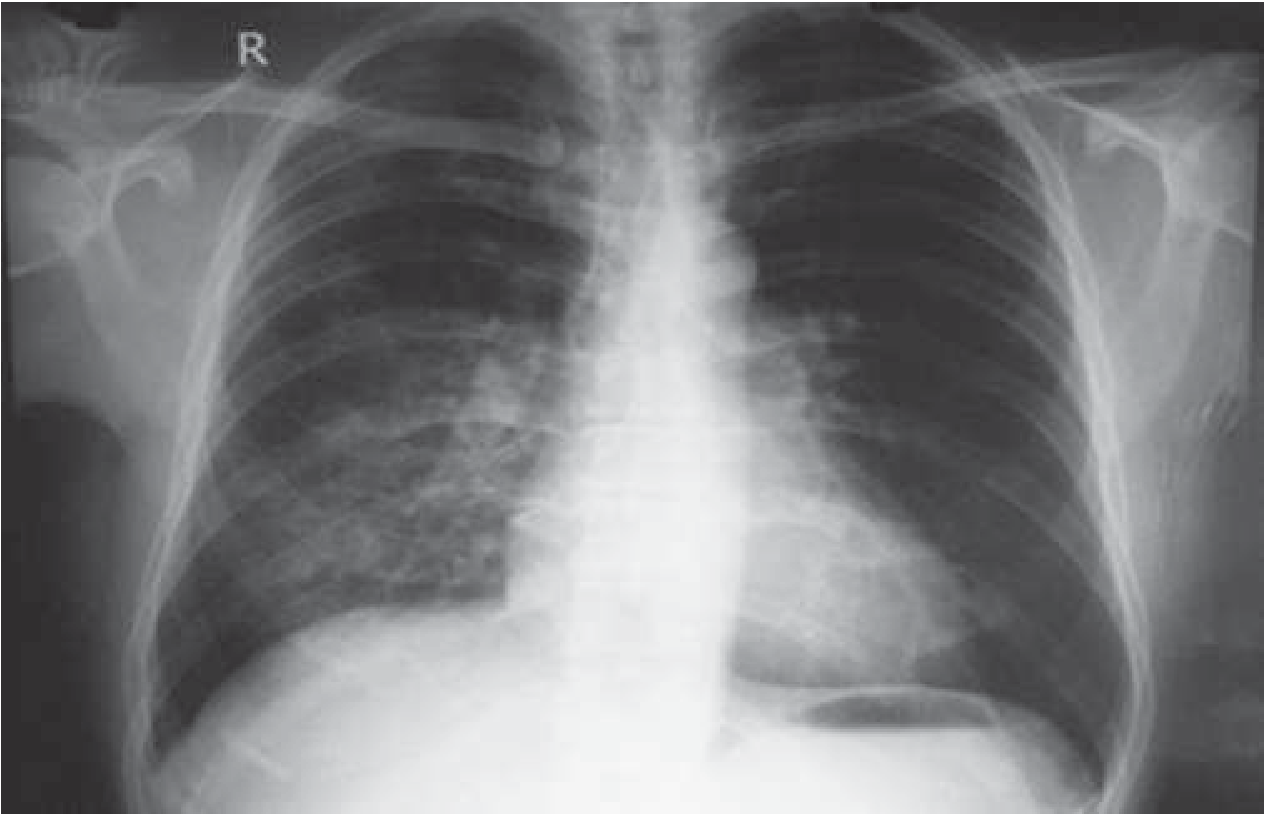
Mechanism (Guyton & Hall): Severe hypoxia causes pulmonary arteriolar constriction that is uneven across the lung. Blood is forced through fewer unconstricted vessels, raising capillary pressure focally, causing edema that spreads progressively. VEGF and inflammatory cytokines also increase pulmonary endothelial permeability.
ECG: May show right ventricular strain or hypertrophy. ABG: Hypoxemia + respiratory alkalosis (unless on acetazolamide, which may cause metabolic acidosis).
Risk Factors
| Factor | Notes |
|---|---|
| Rate of ascent | Most important risk factor |
| Prior history of altitude illness | Strong predictor for HAPE and HACE |
| Exertion | Risk factor - but lack of physical fitness is NOT |
| Age | Children and adults equally affected; >50 years may be somewhat protected |
| Sex | No gender difference in AMS; men more susceptible to HAPE |
| Sleep desaturation | Associated with AMS |
| Respiratory infections | Predispose to HAPE |
| Cardiopulmonary disease | Mitral stenosis, pulmonary hypertension increase HAPE risk |
| Patent foramen ovale | 4x more common in HAPE-susceptible individuals |
| Carotid body damage | Neck irradiation/surgery reduces hypoxic ventilatory response |
High oxygen desaturation and low ventilatory response to hypoxia during exercise are independent predictors of severe altitude illness.
Pathophysiology Summary
The root cause is hypobaric hypoxia. This triggers:
- Cerebral vasodilation → increased cerebral blood flow → raised intracranial pressure
- Increased blood-brain barrier permeability (via VEGF, histamine, arachidonic acid) → vasogenic cerebral edema (HACE)
- Uneven pulmonary vasoconstriction → focal high capillary pressure → non-cardiogenic pulmonary edema (HAPE)
- Sympathetic activation, fluid retention, relative hypoventilation in established AMS
Prevention and Treatment
(from Goldman-Cecil Medicine)
| Drug | Indication | Route | Dose |
|---|---|---|---|
| Acetazolamide | Prevention of AMS, HACE | Oral | 62.5-125 mg twice daily (peds: 2.5 mg/kg q12h) |
| Acetazolamide | Treatment of AMS | Oral | 250 mg twice daily |
| Dexamethasone | Prevention of AMS, HACE | Oral | 2 mg q6h or 4 mg q12h (not for pediatric prophylaxis) |
| Dexamethasone | Treatment of AMS | Oral/IV/IM | 4 mg q6h |
| Dexamethasone | Treatment of HACE | Oral/IV/IM | 8 mg once, then 4 mg q6h |
| Nifedipine | Prevention + Treatment of HAPE | Oral | 30 mg SR q12h or 20 mg SR q8h |
| Tadalafil | Prevention of HAPE | Oral | 10 mg twice daily |
| Salmeterol | Prevention of HAPE | Inhaled | 125 μg twice daily |
Key management principles:
- Descent is the definitive treatment for all forms - symptoms respond rapidly
- Supplemental oxygen reverses HAPE within hours
- Portable hyperbaric chambers (Gamow bag) "buy time" when descent is impossible - equivalent to descending several hundred meters
- Nifedipine and phosphodiesterase-5 inhibitors (tadalafil) have no role in AMS or HACE treatment
- Dexamethasone remains the primary treatment for HACE; acetazolamide can be used as an adjunct
- Short-term oxygen from portable canisters ("oxygen bars") is not helpful for AMS prevention
Chronic Mountain Sickness (Monge's Disease)
Occurs in long-term high-altitude residents. Features include: (Guyton & Hall)
- Marked polycythemia and elevated hematocrit
- Pulmonary hypertension (more severe than acclimatization alone)
- Right heart enlargement and eventual failure
- Falling systemic blood pressure
- Progressive congestive heart failure and death if altitude is not reduced
Acclimatization vs. Illness
Normal acclimatization responses (increased ventilation, erythropoiesis, 2,3-DPG rise, rightward oxygen-hemoglobin curve shift) are adaptive. Altitude illness occurs when these mechanisms are overwhelmed or delayed - particularly in people who ascend too rapidly.
Practical rule: "Climb high, sleep low" - ascend to higher altitude during the day but descend to sleep, allowing gradual acclimatization while limiting continuous hypoxic exposure.
Sources: Harrison's Principles of Internal Medicine 22E (2025), Guyton and Hall Textbook of Medical Physiology, Goldman-Cecil Medicine International Edition
This is a shared conversation. Sign in to Orris to start your own chat.