

photo-1783833048952.jpg
answer the question
Reading File
The question asks about: (1) components of the limbic system with a diagram, (2) vegetative functions of the hypothalamus, and (3) roles of the hypothalamus in reward and punishment. Let me search the medical library for all three parts simultaneously.
Finding Sources
Finding Sources
Finding Sources
Now let me read all three key sections simultaneously - Guyton's limbic system, Guyton's vegetative hypothalamus functions, and search for reward/punishment:
Reading File
Reading File
Finding Sources
Excellent! Now let me read the reward/punishment section and the remaining vegetative functions section:
Reading File
Reading File
I now have all the information needed. Let me also fetch the key limbic system diagram from Guyton:
Loading Image
Loading Image
I now have everything needed for a complete, detailed answer. Here is the full response:
GROUP A - Long Answer: Limbic System, Hypothalamus & Reward/Punishment
PART 1: Components of the Limbic System [3 marks]
The word "limbic" means border. The limbic system refers to the entire neuronal circuitry that controls emotional behavior and motivational drives.
Diagram of the Limbic System
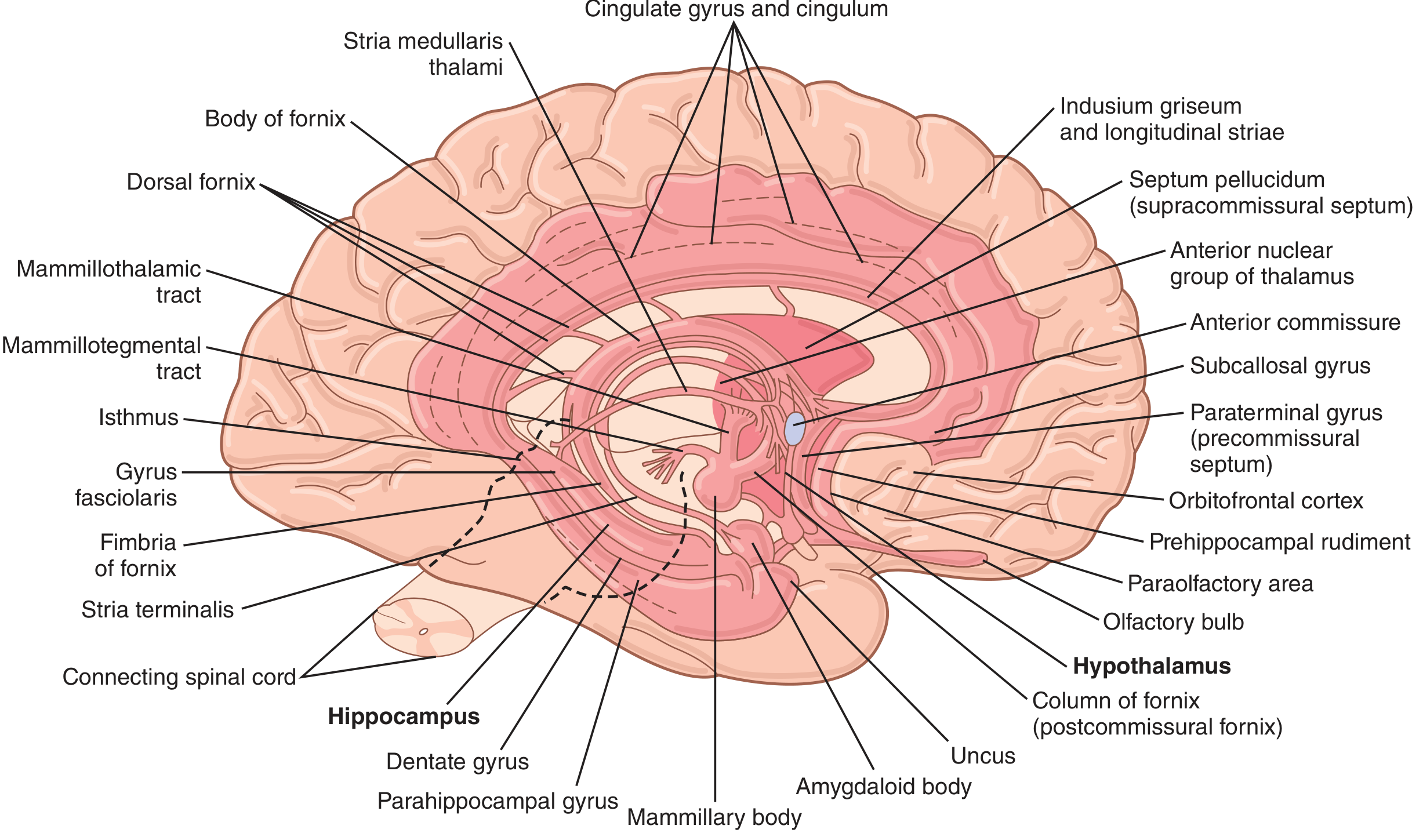
Figure: Anatomy of the limbic system (shaded area). - Guyton and Hall Textbook of Medical Physiology
Subcortical Limbic Structures (Inner Ring)
- Hypothalamus - the central/key structure
- Septum (septal nuclei)
- Paraolfactory area
- Anterior nucleus of the thalamus
- Portions of the basal ganglia
- Hippocampus (with dentate gyrus and parahippocampal gyrus)
- Amygdala (amygdaloid body)
- Mammillary bodies
Limbic Cortex (Outer Ring)
A ring of paleocortex on each side of the brain forming the outer border:
- Begins in the orbitofrontal area (ventral surface of frontal lobe)
- Extends upward into the subcallosal gyrus
- Continues over the corpus callosum into the cingulate gyrus
- Passes behind the corpus callosum and downward into the parahippocampal gyrus and uncus
This ring of limbic cortex serves as a two-way communication/association linkage between the neocortex and the deeper limbic structures.
PART 2: Vegetative Functions of the Hypothalamus [5 marks]
The hypothalamus is the central element of the limbic system. Its internal regulatory functions are collectively called vegetative functions.
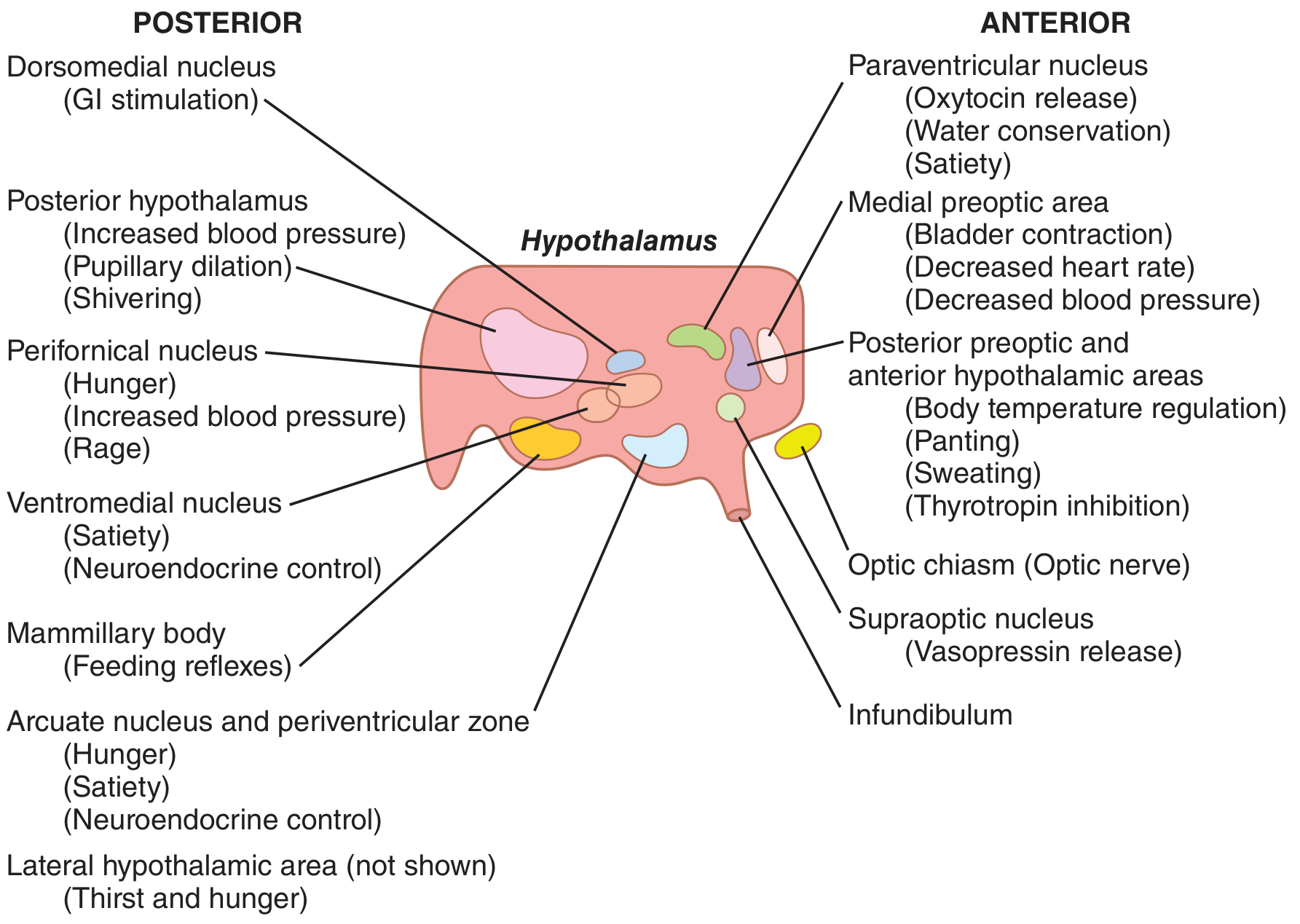
Figure: Control centers of the hypothalamus - Guyton and Hall Textbook of Medical Physiology
1. Cardiovascular Regulation
- Posterior and lateral hypothalamus stimulation → increases arterial pressure and heart rate
- Preoptic area stimulation → decreases heart rate and arterial pressure
- Effects transmitted via cardiovascular centers in the reticular regions of the pons and medulla
2. Body Temperature Regulation
- Anterior hypothalamus / preoptic area is the thermostat
- Increased blood temperature → increased neuron activity → heat dissipation responses
- Decreased blood temperature → mechanisms to raise temperature (shivering, vasoconstriction)
3. Body Water Regulation
Two mechanisms:
- Thirst center (lateral hypothalamus): when body fluids become too concentrated, the thirst sensation is generated, driving the person to drink
- Supraoptic nuclei: secrete ADH (vasopressin) via the posterior pituitary → acts on kidney collecting ducts to increase water reabsorption, thus regulating urinary water loss
4. Uterine Contractility and Milk Ejection
- Paraventricular nuclei secrete oxytocin → promotes uterine contractions during labor and milk ejection from breast alveoli when the baby suckles
5. Gastrointestinal and Feeding Regulation
- Lateral hypothalamic area (perifornical nucleus): contains the hunger center - stimulation causes extreme hunger and food-seeking behavior; bilateral destruction causes starvation
- Ventromedial nuclei: the satiety center - stimulation stops eating; bilateral destruction leads to voracious appetite and obesity
- Arcuate nucleus: contains neurons that increase or decrease appetite
- Mammillary bodies: control feeding reflexes such as licking and swallowing
6. Hypothalamic Control of Anterior Pituitary (Endocrine Control)
- Hypothalamic nuclei secrete releasing and inhibitory hormones (e.g., TRH, CRH, GnRH, GHRH, somatostatin) into the hypothalamo-hypophyseal portal blood
- These act on the anterior pituitary to control release of TSH, ACTH, LH, FSH, GH, and prolactin
7. Circadian Rhythm Control
- The suprachiasmatic nucleus (SCN), located above the optic chiasm, contains ~20,000 neurons
- Functions as the body's master biological clock, regulating sleep-wake cycles and other circadian rhythms
PART 3: Role of the Hypothalamus in Reward and Punishment [4 marks]
The limbic system determines whether sensory experiences are pleasant or unpleasant - these affective qualities are called reward (satisfaction) or punishment (aversion).
Reward Centers
- The major reward centers run along the medial forebrain bundle, especially in the:
- Lateral hypothalamic nucleus
- Ventromedial nucleus of the hypothalamus
- Secondary (less potent) reward areas include: septum, amygdala, certain thalamic and basal ganglia areas, and the basal tegmentum of the mesencephalon
- Note: the lateral nucleus can produce reward with weak stimulation but rage with strong stimulation
Punishment Centers
- The most potent punishment areas are in the central gray area surrounding the aqueduct of Sylvius (mesencephalon), extending upward into:
- Periventricular zones of the hypothalamus
- Periventricular zones of the thalamus
- Less potent punishment areas exist in the amygdala and hippocampus
- Stimulation of punishment centers can completely inhibit the reward centers - punishment and fear take precedence over pleasure
Rage - Association With Punishment Centers
Strong stimulation of punishment centers (periventricular zone of the hypothalamus, lateral hypothalamus) produces the rage pattern:
- Defense posture, extending claws, hissing, growling
- Piloerection, wide-open eyes, dilated pupils
- Immediate savage attack at slightest provocation
Normally held in check by inhibitory signals from the ventromedial nuclei and from portions of the hippocampus and anterior limbic cortex (cingulate and subcallosal gyri).
Importance of Reward/Punishment on Behavior
- If an action is rewarding, behavior is continued; if punishing, behavior is discontinued
- These centers control our drives, aversions, and motivations
- They also strongly influence learning and memory - the brain tends to store information associated with strong reward or punishment signals, discarding most neutral stimuli
Source: Guyton and Hall Textbook of Medical Physiology, Chapter 59
This is a shared conversation. Sign in to Orris to start your own chat.