


IMG_6695.jpeg
IMG_6694.jpeg
Analyse
I can see these are images of a big toe (hallux) with significant nail changes. Let me analyse them in detail.
Searching sources...
Reading File
Finding Sources
Searching PubMed
onychomycosis toenail diagnosis treatment
Searching the Web
toenail onychomycosis nail dystrophy white chalky discoloration differential diagnosis 2024
Finding Sources
Finding Sources
Reading File
Reading File
Now let me fetch the textbook image of white superficial onychomycosis for comparison:
Loading Image
Here is a thorough clinical analysis of the images:
Clinical Analysis - Right Hallux Nail
What the images show
Both photos depict the great toenail (hallux) with the following findings:
| Feature | Observation |
|---|---|
| Colour | White-chalky to yellow-brown discolouration occupying the central and distal nail plate |
| Surface texture | Rough, crumbly, friable - the nail surface has a powdery, eroded appearance |
| Nail plate integrity | Partial destruction/crumbling of the nail plate surface, with fissuring visible centrally |
| Periungual skin | Intact nail folds, no significant erythema or swelling (no active paronychia) |
| Onycholysis | Possible partial separation from the nail bed distally |
| Proximal nail | A strip of relatively normal-appearing nail visible at the proximal portion, suggesting the disease started distally or centrally |
| Subungual debris | Dark-coloured debris visible at the central fissure/crack |
Most Likely Diagnosis: Onychomycosis (Tinea Unguium)
The combination of white-chalky friable discolouration + crumbling nail surface + toenail involvement is highly characteristic of fungal nail infection.
Subtype considerations:
-
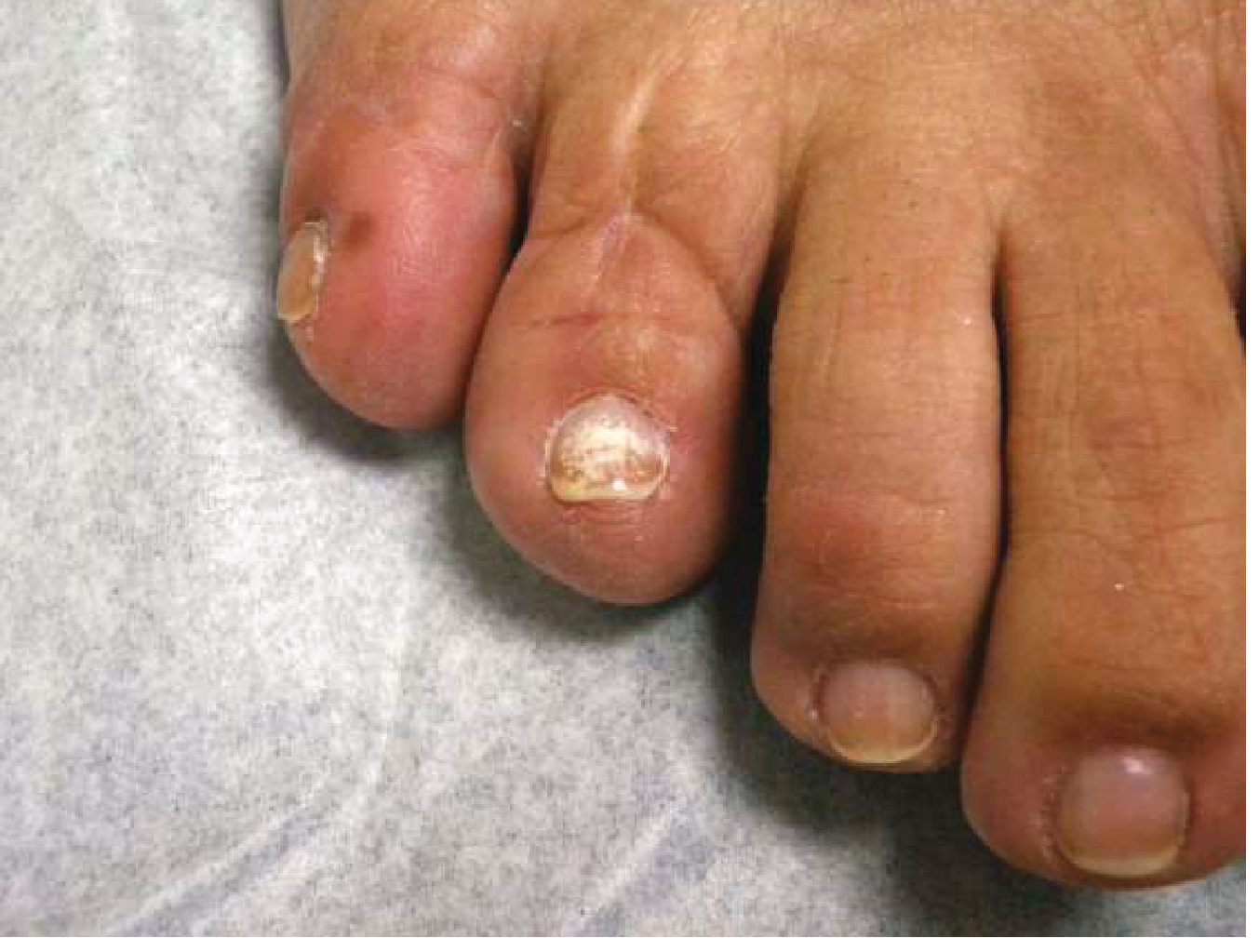
White Superficial Onychomycosis (WSO) - most fitting for one of the images (chalky white, powdery surface, surface-level erosion). In WSO, fungi (often Trichophyton mentagrophytes) colonise only the nail plate surface, producing white friable patches that can be scraped away. It only affects toenails.
-
Distal Lateral Subungual Onychomycosis (DLSO) - the darker, more central debris and evidence of partial onycholysis in the second image suggests a possible DLSO component, where T. rubrum invades from the hyponychium and nail bed, causing subungual hyperkeratosis and yellow-brown streaks.
The pattern here may represent mixed/co-existing WSO + early DLSO, which is not uncommon.
Textbook reference image for comparison (White Superficial Onychomycosis, Goldman-Cecil Medicine):
Differential Diagnoses to Consider
| Condition | Distinguishing Features |
|---|---|
| Nail psoriasis | Pits (thimble-like), oil-drop sign, salmon patches, usually accompanied by skin psoriasis elsewhere; pits are regular in psoriasis, irregular in onychomycosis |
| Traumatic nail dystrophy | History of repetitive trauma (tight shoes); transverse onycholysis pattern on dermoscopy rather than longitudinal striae |
| Lichen planus of nail | Pterygium formation, dorsal nail thinning, scarring; uncommon |
| Pachyonychia congenita | Genetic; symmetric thickening from birth |
The absence of regular pitting and the predominantly white-chalky crumbly surface make onychomycosis considerably more likely than psoriasis here.
Important Caveat
A 2024 retrospective study of 96,293 nail specimens found that only ~59% of clinically diagnosed onychomycosis cases were mycologically confirmed - and a similar positivity rate was seen in non-fungal nail dystrophies. This means clinical appearance alone is insufficient for a definitive diagnosis.
Recommended Next Steps
-
Mycological confirmation before treatment - nail clippings + subungual debris sent for:
- KOH microscopy (fastest)
- Fungal culture (identifies species, ~3-6 weeks)
- PCR (most sensitive, faster than culture)
- Periodic acid-Schiff (PAS) histopathology if others negative
-
If confirmed fungal:
- First-line: Oral terbinafine 250 mg/day for 3 months (most effective for toenail dermatophytes per network meta-analysis [PMID 37253047])
- Mild/superficial cases: topical efinaconazole or tavaborole daily for 6 months (FDA approved, less effective than oral)
- For WSO specifically, superficial filing + topical antifungal may be sufficient if limited
-
Predisposing factors to address: hyperhidrosis, footwear, athlete's foot (tinea pedis often co-exists and is the source)
Disclaimer: This is an educational image analysis only and does not constitute a medical diagnosis. Mycological confirmation is required before initiating antifungal therapy. Please consult a dermatologist or podiatrist for formal evaluation and management.
This is a shared conversation. Sign in to Orris to start your own chat.