
nalxone hydrochloride dihydrate
Reading File
Now let me search the medical library and web simultaneously for naloxone hydrochloride dihydrate.
Finding Sources
Searching the Web
naloxone hydrochloride dihydrate pharmacology mechanism dose clinical use
Searching PubMed
"naloxone" AND "opioid overdose"
Now let me read the key textbook sections in parallel for deeper detail.
Reading File
Reading File
Reading File
I now have rich information from multiple authoritative textbooks. Let me also fetch the naloxone administration flowchart image, and look up pharmacokinetic details.
Loading Image
Finding Sources
I now have comprehensive information from multiple authoritative sources. Here is the full answer:
Naloxone Hydrochloride Dihydrate
Chemical Identity
Naloxone hydrochloride dihydrate is the pharmaceutical salt form of naloxone used in most injectable formulations. Its full chemical name is 4,5α-epoxy-3,14-dihydroxy-17-(prop-2-enyl)morphinan-6-one hydrochloride dihydrate.
| Property | Value |
|---|---|
| Molecular formula | C₁₉H₂₁NO₄ · HCl · 2H₂O |
| Molecular weight | 399.9 g/mol (anhydrous HCl salt: 363.84 g/mol) |
| Appearance | White to off-white crystalline powder |
| Solubility | Freely soluble in water and dilute acids; slightly soluble in alcohol; practically insoluble in ether and chloroform |
| pH of injection | 3.1 - 4.5 |
| Structure class | Synthetic congener of oxymorphone (phenanthrene morphinan) |
The "dihydrate" refers to two molecules of water of crystallization included in the salt. In parenteral formulations, a dose is expressed as the HCl salt equivalent - e.g., 400 micrograms/mL solution contains 400 mcg of naloxone hydrochloride as the dihydrate form. The key structural difference from oxymorphone is replacement of the N-methyl group with an N-allyl (prop-2-enyl) group, which confers antagonist rather than agonist activity.
Mechanism of Action
Naloxone is a pure competitive opioid receptor antagonist. It competes with opioids for the same receptor binding sites - with highest affinity for the μ (mu) receptor, and also binding κ (kappa) and σ (sigma) receptors. By occupying these receptors without activating them, it fully reverses all opioid-mediated effects:
- Respiratory depression
- Sedation / CNS depression
- Hypotension
- Miosis
- Nausea, vomiting, pruritus, urinary retention, biliary spasm
- Psychotomimetic and dysphoric effects of partial agonist-antagonists (e.g., pentazocine, butorphanol, nalbuphine)
Importantly, naloxone has no intrinsic agonist activity at standard doses - when given to an opioid-naive patient, it produces no significant pharmacological effect. This distinguishes it from earlier antagonists like nalorphine and levallorphan, which had unacceptable partial agonist side effects.
Paradoxical low-dose effect: At very low doses (<25 mcg IV), naloxone may paradoxically enhance analgesia by blocking presynaptic autoinhibition and promoting endogenous opioid release. This has been exploited in low-dose naloxone infusions (0.25 mcg/kg/hr) to reduce opioid consumption without reversing analgesia. At doses above this threshold, antagonism predominates. - Miller's Anesthesia, 10e
Pharmacokinetics
| Parameter | Detail |
|---|---|
| Onset (IV) | 1-2 minutes |
| Onset (IM/SC) | 5-6 minutes |
| Onset (IN) | 6-8 minutes |
| Half-life | ~60-90 minutes |
| Duration of action | 20-90 minutes (shorter when a large opioid load is present) |
| Oral bioavailability | Very poor (extensive first-pass hepatic metabolism) |
| Metabolism | Liver - primarily glucuronide conjugation (naloxone-3-glucuronide) |
| Excretion | Urine |
The short duration of action is the most clinically important pharmacokinetic feature: naloxone may wear off before the opioid does, causing "renarcotization." Patients must be closely monitored after treatment. This is especially relevant for long-acting opioids (methadone, sustained-release morphine) and high-potency synthetic opioids (fentanyl, nitazenes, buprenorphine). - Tintinalli's Emergency Medicine and Miller's Anesthesia, 10e
Intranasal naloxone provides a pharmacokinetic profile similar to IM/SC and is widely used in bystander programs due to ease of administration. - Tintinalli's Emergency Medicine
Indications
- Opioid overdose - complete or partial reversal of respiratory depression, sedation, hypotension from natural and synthetic opioids (morphine, heroin, fentanyl, methadone, oxycodone, hydromorphone, propoxyphene, buprenorphine, pentazocine, butorphanol, nalbuphine, cyclazocine)
- Postoperative opioid reversal - reversal of residual opioid anesthesia
- Diagnosis of suspected acute opioid overdose
- Adjunctive therapy in septic shock - may help increase blood pressure in refractory cases
- Take-home naloxone programs for opioid-dependent patients and their carers
Dosing (Adults)
| Route | Indication | Dose |
|---|---|---|
| IV | Opioid-dependent, modest respiratory depression | 0.04 mg (start low to avoid precipitating withdrawal) |
| IV | Opioid-naive, modest depression | 0.4 mg |
| IV | Apnea / cyanosis / severe depression | 2 mg - repeat every 3 min up to 10 mg |
| IM or SC | Any | 2 mg |
| Intranasal | Any | 2 mg (1 mg per nostril) |
| Nebulized (inhaled) | Any | 2 mg in 3 mL normal saline |
| Postoperative (IV) | Titrated reversal | 0.005-0.01 mg increments every 2-3 min |
Repeat doses every 2-3 minutes as needed. Duration depends on opioid load present. - Tintinalli's Emergency Medicine, Table 186-3
Pediatric: Initial IV dose 0.01 mg/kg; if inadequate, escalate to 0.1 mg/kg.
Buprenorphine/high-affinity opioids: Larger doses and/or continuous IV infusion of naloxone may be required because buprenorphine's high receptor affinity and slow dissociation limit reversal. Respiratory depression from buprenorphine can outlast naloxone boluses. - Miller's Anesthesia, 10e
Opioid Overdose Response Protocol
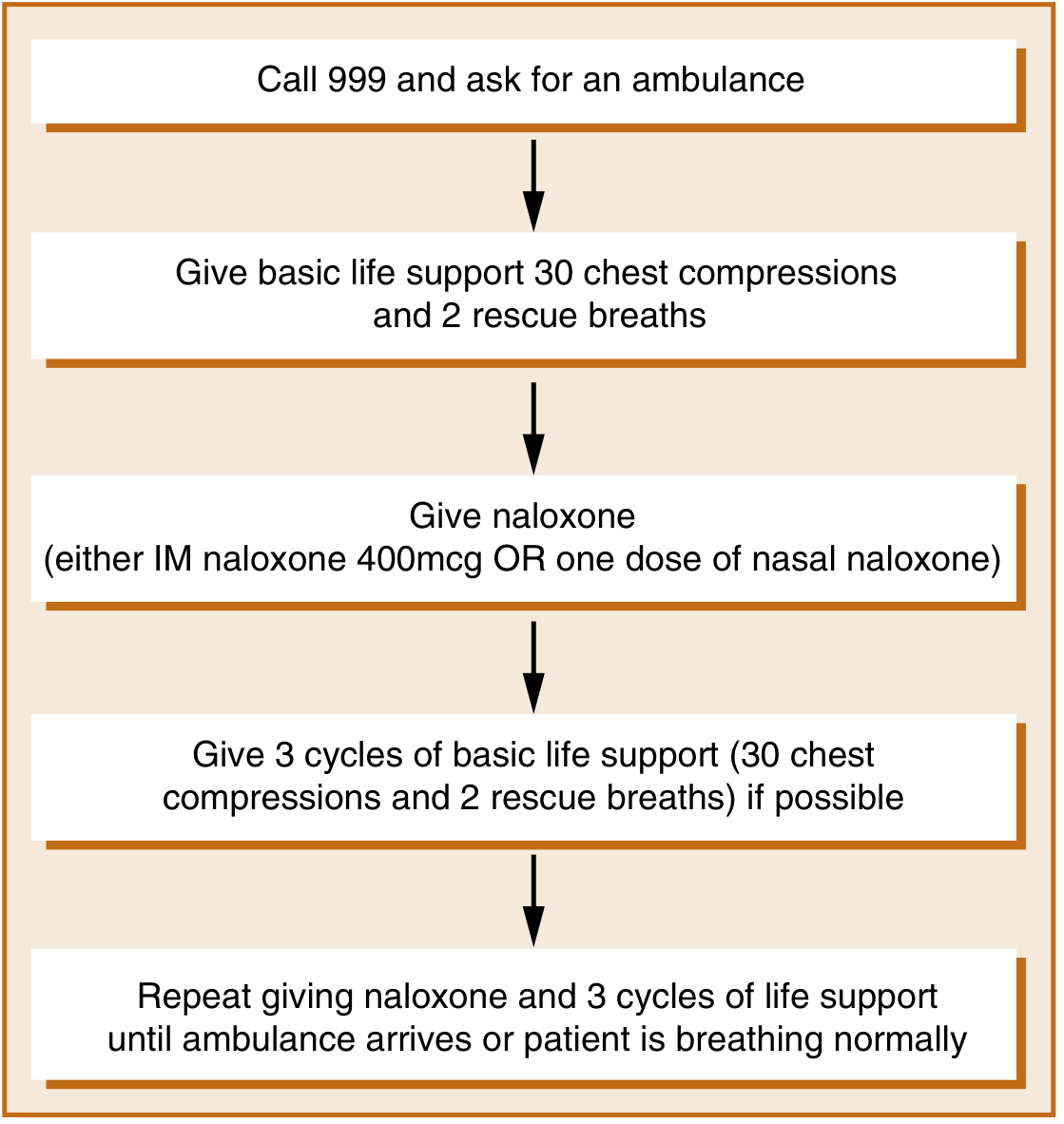
Figure: WHO protocol for lay naloxone use - Maudsley Prescribing Guidelines, 15e
Adverse Effects and Cautions
- Acute opioid withdrawal - the main risk; presents as agitation, tachycardia, hypertension, sweating, vomiting, pulmonary edema. Use low starting doses in opioid-dependent patients.
- Cardiovascular stimulation - increases in heart rate and blood pressure post-reversal due to pain, rapid awakening, sympathetic activation, and hypercapnia-driven sympathetics. Most dangerous in patients with underlying coronary artery disease.
- Pulmonary edema - rare but serious complication.
- Re-narcotization - occurs when naloxone wears off before the opioid; mandates monitoring for at least 2-3 hours (longer for sustained-release preparations or methadone).
- Physical dependence - naloxone produces no tolerance or dependence itself, but in physically dependent patients will precipitate withdrawal.
- Not effective against non-opioid respiratory depressants (benzodiazepines, barbiturates, alcohol).
Formulations Available
- Injection (standard): 0.4 mg/mL in 1 mL ampoules (most common)
- High-dose injection: 10 mg/0.4 mL auto-injector (for high-potency fentanyl analogue exposure, approved for ages ≥12 years)
- Intranasal spray: 2 mg/0.1 mL (Narcan nasal spray) - first generic approved by FDA
- Combination product: buprenorphine/naloxone sublingual (Suboxone) - naloxone included to deter injection misuse
Recent Evidence
A 2025 systematic review and meta-analysis (PMID 40133970) confirmed that community naloxone distribution programs significantly reduce opioid overdose deaths among people who use drugs - supporting broad take-home naloxone access policies. A 2024 systematic review (PMID 38563492) explored healthcare professionals' perceptions of take-home naloxone in acute care settings.
Sources: Miller's Anesthesia 10e | Tintinalli's Emergency Medicine | Maudsley Prescribing Guidelines 15e | FDA prescribing information | Health Canada product monograph
what is it used for?
Based on the detailed information already in our conversation, here is a focused summary of what naloxone hydrochloride dihydrate is used for:
What Naloxone Hydrochloride Dihydrate Is Used For
1. Opioid Overdose Reversal (Primary Use)
The main use is emergency reversal of opioid overdose. It rapidly reverses:
- Respiratory depression (the main killer in overdose)
- Sedation / loss of consciousness
- Hypotension
- Miosis (pinpoint pupils)
It works against all opioids - morphine, heroin, fentanyl, methadone, oxycodone, hydromorphone, buprenorphine, codeine, tramadol, and synthetic opioids.
2. Postoperative Opioid Reversal
Used in the recovery room to reverse residual opioid anesthesia after surgery - titrated carefully in small IV increments (0.005-0.01 mg) to restore breathing without completely abolishing pain relief.
3. Diagnosis of Suspected Opioid Overdose
If a patient is unconscious and opioid overdose is suspected, giving naloxone is both therapeutic and diagnostic - if the patient wakes up and breathing improves, opioids were the cause.
4. Take-Home / Community Overdose Programs
Dispensed to opioid-dependent patients, their family members, carers, and first responders as a life-saving kit for use before emergency services arrive. Available as nasal spray or pre-filled syringe for lay use.
5. Reversal of Mixed Agonist-Antagonists
Also reverses psychotomimetic and dysphoric effects of partial opioid agonists such as pentazocine, butorphanol, and nalbuphine.
6. Adjunct in Septic Shock
Used off-label as an adjunctive agent to raise blood pressure in refractory septic shock - the mechanism is thought to involve reversal of endogenous opioid-mediated vasodilation.
7. Component of Buprenorphine/Naloxone (Suboxone)
Naloxone is included in sublingual buprenorphine tablets not for its therapeutic effect (it has negligible sublingual absorption), but to deter injection misuse - if injected, the naloxone component would precipitate immediate withdrawal.
What It Does NOT Treat
- Overdose from benzodiazepines, alcohol, or barbiturates - naloxone has no effect on non-opioid CNS depressants
- Pain - it has no analgesic properties of its own
The single most important clinical point is its short duration of action (20-90 minutes), which is often shorter than the opioid it reverses. Patients must be monitored closely for re-narcotization (the opioid effect returning as the naloxone wears off).
This is a shared conversation. Sign in to Orris to start your own chat.