
Serotonin pharmacology
Reading File
Now I'll run parallel searches across the library and PubMed simultaneously.
Finding Sources
Finding Sources
Searching PubMed
serotonin pharmacology receptors
The main source is Katzung's "BASIC PHARMACOLOGY OF SEROTONIN" section. Let me read it now along with a related section.
Reading File
Excellent - I got a very rich section. Let me read the Clinical Pharmacology section too.
Reading File
I now have a comprehensive body of content. Let me compile the full answer.
Serotonin Pharmacology
Sources: Katzung's Basic and Clinical Pharmacology, 16th Edition (pp. 446-455)
1. History & Background
Serotonin was first identified as a vasoconstrictor released from blood clots (hence "sero-tonin," from serum). A parallel discovery in intestinal mucosa called the substance "enteramine." The synthesis of 5-hydroxytryptamine (5-HT) in 1951 unified both discoveries. It is now known to be a neurotransmitter, a local gut hormone, a platelet constituent, and a mediator in migraine and carcinoid syndrome.
2. Chemistry & Synthesis
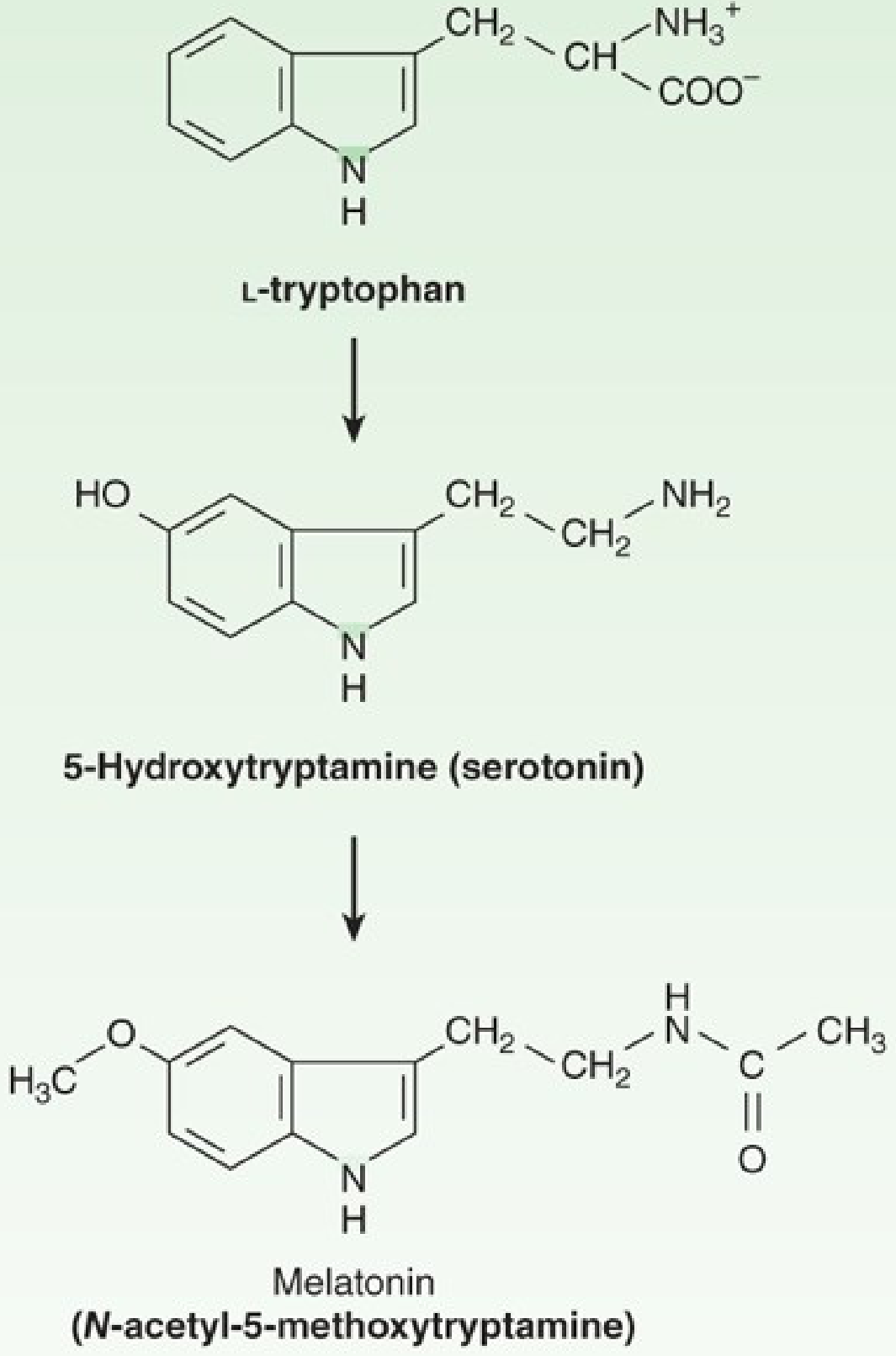
Serotonin is an indolealkylamine derived from the essential amino acid L-tryptophan:
- Tryptophan hydroxylase-1 hydroxylates the indole ring at C5 (rate-limiting step) - blocked by p-chlorophenylalanine (PCPA/fenclonine) and p-chloroamphetamine
- Aromatic L-amino acid decarboxylase removes the carboxyl group to yield 5-HT
In the pineal gland, 5-HT is acetylated and then methylated to form melatonin.
3. Distribution & Pharmacokinetics
| Location | % of body 5-HT | Notes |
|---|---|---|
| Enterochromaffin (GI) cells | >90% | Primary source; released into portal blood |
| Platelets | ~8% | Concentrated via SERT transporter |
| CNS raphe nuclei | <2% | Serotonergic neuron cell bodies |
Uptake: Serotonin enters platelets and nerve terminals via the serotonin transporter (SERT), then concentrated in vesicles by a vesicular amine transporter (VAT) - blocked by reserpine.
Metabolism: Primarily by monoamine oxidase (MAO) to 5-hydroxyindoleacetaldehyde, then to 5-HIAA (5-hydroxyindoleacetic acid) by aldehyde dehydrogenase. 5-HIAA is excreted in urine and is a useful marker for carcinoid tumors (elevated in carcinoid syndrome).
4. Receptor Subtypes & Their Pharmacology
There are at least seven receptor families (5-HT1 through 5-HT7) with multiple subtypes.
5-HT1 Family (Gi/Go coupled - inhibitory)
| Subtype | Location | Key effects | Drugs |
|---|---|---|---|
| 5-HT1A | Raphe neurons, hippocampus, limbic areas | Inhibits neuronal firing; reduces anxiety | Buspirone (partial agonist - anxiolytic) |
| 5-HT1B/1D | Presynaptic terminals; cerebral/meningeal vessels | Vasoconstriction; inhibits 5-HT/neuropeptide release | Triptans (sumatriptan, etc. - migraine) |
| 5-HT1F | Neurons | Inhibits neuropeptide release | Lasmiditan (migraine, non-vasoconstrictor) |
5-HT2 Family (Gq/G11 coupled - excitatory/complex)
| Subtype | Location | Key effects | Drugs |
|---|---|---|---|
| 5-HT2A | Smooth muscle, platelets, CNS cortex | Vasoconstriction, platelet aggregation, hallucinations | Antagonism by atypical antipsychotics (clozapine, quetiapine), ketanserin |
| 5-HT2B | Fundus of stomach, heart valves | Excitation; associated with cardiac valvulopathy | Avoided (ergotamine long-term use) |
| 5-HT2C | CNS (especially hypothalamus) | Appetite suppression, mood | Lorcaserin (withdrawn); some antipsychotics |
5-HT3 (Ligand-gated ion channel - unique among 5-HT receptors)
- Location: CNS (area postrema/chemoreceptor trigger zone), peripheral sensory/autonomic neurons, GI tract
- Effect: Rapid depolarization; mediates nausea/vomiting, pain, GI motility
- Drugs: Ondansetron, granisetron, dolasetron (5-HT3 antagonists) - highly effective antiemetics especially for chemotherapy-induced nausea
5-HT4 (Gs coupled - excitatory)
- Location: GI tract neurons, heart, CNS
- Effect: Increases cAMP; enhances gut motility (prokinetic); positive chronotropy in atria
- Drugs: Metoclopramide (partial agonist); tegaserod (partial agonist, approved for IBS-C); cisapride (withdrawn due to QT prolongation)
5-HT5, 5-HT6, 5-HT7
- Less well characterized clinically
- 5-HT6/5-HT7: High affinity for several atypical antipsychotics and antidepressants; role in cognition and circadian rhythm (5-HT7)
5. Physiological Effects by Organ System
Cardiovascular
- Arteries/veins: 5-HT directly constricts most vessels (5-HT2A), but can relax vessels with healthy endothelium via NO release; net effect depends on vascular bed and endothelial integrity
- Heart: Positive inotropy and chronotropy at 5-HT4; bradycardia via Bezold-Jarisch reflex (5-HT3 on vagal afferents)
- Platelets: 5-HT released from activated platelets amplifies aggregation and vasoconstriction
GI Tract
- Stimulates smooth muscle contraction (peristalsis) via 5-HT3 and 5-HT4 on enteric neurons
- Enterochromaffin cells release 5-HT in response to luminal pressure/chemicals - drives the peristaltic reflex
- Diarrhea is a hallmark of carcinoid syndrome (excess 5-HT)
CNS
- Broad modulatory role: mood, sleep (promotes NREM sleep onset), appetite, cognition, impulse control
- Raphe nuclei project to the entire forebrain
- Low serotonergic tone associated with depression, anxiety, impulsivity
Platelet Function
- 5-HT is stored and released from dense granules; amplifies platelet aggregation and potentiates ADP/thromboxane effects
6. Clinical Pharmacology - Key Drug Classes
Serotonin Synthesis Inhibitors
- Telotristat ethyl - oral tryptophan hydroxylase-1 inhibitor, approved for carcinoid syndrome diarrhea
- PCPA/fenclonine - research tools only (too toxic)
5-HT1A Agonists
- Buspirone - partial agonist at 5-HT1A (also D2 antagonist); anxiolytic without sedation/dependence; slow onset (1-3 weeks)
Triptans (5-HT1B/1D Agonists)
- Sumatriptan, zolmitriptan, rizatriptan, eletriptan, naratriptan, almotriptan, frovatriptan
- Acute migraine treatment: constrict dilated meningeal/cerebral vessels; inhibit trigeminal neuropeptide release
- Contraindicated in coronary artery disease, uncontrolled hypertension, prior stroke (risk of vasospasm)
- Lasmiditan (5-HT1F agonist) - newer "dittan"; lacks vasoconstrictor effect; can be used when triptans are contraindicated
5-HT2A Antagonists
- Ketanserin - antihypertensive; blocks vascular 5-HT2A
- Cyproheptadine - antihistamine + 5-HT2 antagonist; used for carcinoid flushing, appetite stimulation, serotonin syndrome
- Methysergide - historical prophylaxis for migraine/cluster headache; now largely abandoned due to retroperitoneal fibrosis risk
5-HT3 Antagonists (Setrons)
- Ondansetron, granisetron, dolasetron, palonosetron
- Prevent chemotherapy-induced, radiation-induced, and post-operative nausea/vomiting
- Act on vagal afferents and area postrema
Serotonin Reuptake Inhibitors (SERT Blockers)
- SSRIs (fluoxetine, sertraline, paroxetine, escitalopram): block SERT on neurons; increase synaptic 5-HT; first-line for depression/anxiety
- SNRIs (venlafaxine, duloxetine): block both SERT and NET
- TCAs (amitriptyline, clomipramine): also block SERT (plus NET, muscarinic, H1)
- Tramadol: weak SERT inhibitor + mu-opioid agonist
- MDMA ("ecstasy"): massive 5-HT release via reversal of SERT
Ergot Alkaloids (Mixed 5-HT Agonist/Antagonist)
- Ergotamine, dihydroergotamine (DHE): partial agonists at 5-HT1B/1D; also affect adrenergic and dopaminergic receptors; used in migraine
- Ergotism (from prolonged ergot exposure): intense vasoconstriction, limb ischemia, CNS effects
7. Serotonin Syndrome
A potentially life-threatening drug toxicity caused by excess serotonergic activity.
Classic triad:
- Neuromuscular abnormalities - tremor, myoclonus, hyperreflexia, clonus (especially lower extremity)
- Autonomic instability - hyperthermia, diaphoresis, tachycardia, hypertension, diarrhea
- Altered mental status - agitation, confusion
Common precipitants: Combination of SSRIs + MAOIs (most dangerous), SSRIs + tramadol, linezolid + SSRIs, triptans + SSRIs (debated)
Treatment: Discontinue offending agents; cyproheptadine (5-HT2A antagonist) as antidote; supportive care; benzodiazepines for agitation; severe cases may need cooling, intubation
8. Carcinoid Syndrome
Enterochromaffin cell tumors secrete excess 5-HT (and other mediators). Manifestations include:
- Flushing, diarrhea, bronchoconstriction, right-sided cardiac valve lesions (tricuspid/pulmonary thickening from 5-HT2B stimulation)
- 5-HIAA elevated in 24-hour urine
- Treatment: Somatostatin analogs (octreotide, lanreotide) as primary therapy; telotristat ethyl for diarrhea; cyproheptadine or ketanserin for symptomatic relief
Summary Table: Receptor-Drug Pairs
| Receptor | Coupling | Clinical Use | Example Drugs |
|---|---|---|---|
| 5-HT1A | Gi | Anxiety | Buspirone |
| 5-HT1B/1D | Gi | Migraine (acute) | Sumatriptan, triptans |
| 5-HT1F | Gi | Migraine (CV risk) | Lasmiditan |
| 5-HT2A (antagonist) | Gq | HTN, carcinoid, antipsychotic | Ketanserin, cyproheptadine |
| 5-HT2C (agonist) | Gq | Obesity (withdrawn) | Lorcaserin |
| 5-HT3 (antagonist) | Ion channel | Antiemetic | Ondansetron |
| 5-HT4 (agonist) | Gs | Prokinetic, IBS-C | Tegaserod, metoclopramide |
| SERT (inhibitor) | - | Depression, anxiety, OCD | SSRIs, SNRIs |
- Katzung's Basic and Clinical Pharmacology, 16th Edition, pp. 446-455
This is a shared conversation. Sign in to Orris to start your own chat.