
Tympannometry politzeratiom
Reading File
Now let me search the medical library for both tympanometry and politzerization simultaneously.
Finding Sources
Finding Sources
Finding Sources
Reading File
Reading File
Finding Sources
Reading File
Reading File
Finding Sources
Loading Image
Now let me get more detail on politzerization specifically and the Scott-Brown content on the topic:
Finding Sources
Reading File
Finding Sources
Loading Image
Reading File
Reading File
I now have enough material for a thorough answer. Let me compile everything.
Tympanometry and Politzerization
TYMPANOMETRY (Immittance Testing)
Definition and Principle
Tympanometry is an objective test that measures the mobility (compliance) of the middle ear at the tympanic membrane (TM) as a function of applied air pressure in the external ear canal. A small probe is placed in the ear canal with an airtight seal. It emits a tone (226 Hz for adults/older children; 1000 Hz for infants <6 months due to increased ear canal compliance) and records the acoustic energy reflected back.
- Compliance is expressed as acoustic admittance in millimho (mMho) or as equivalent air volume (cm³/mL)
- Pressure is expressed in decapascals (daPa)
- The instrument sweeps pressure from approximately -400 to +200 daPa and plots a tympanogram curve
The peak of maximum compliance occurs when pressure in the ear canal equals pressure in the middle ear - this is the point where the TM moves most freely.
- K.J. Lee's Essential Otolaryngology, p. 304
- Cummings Otolaryngology, p. 3766
Tympanogram Types (Jerger Classification)
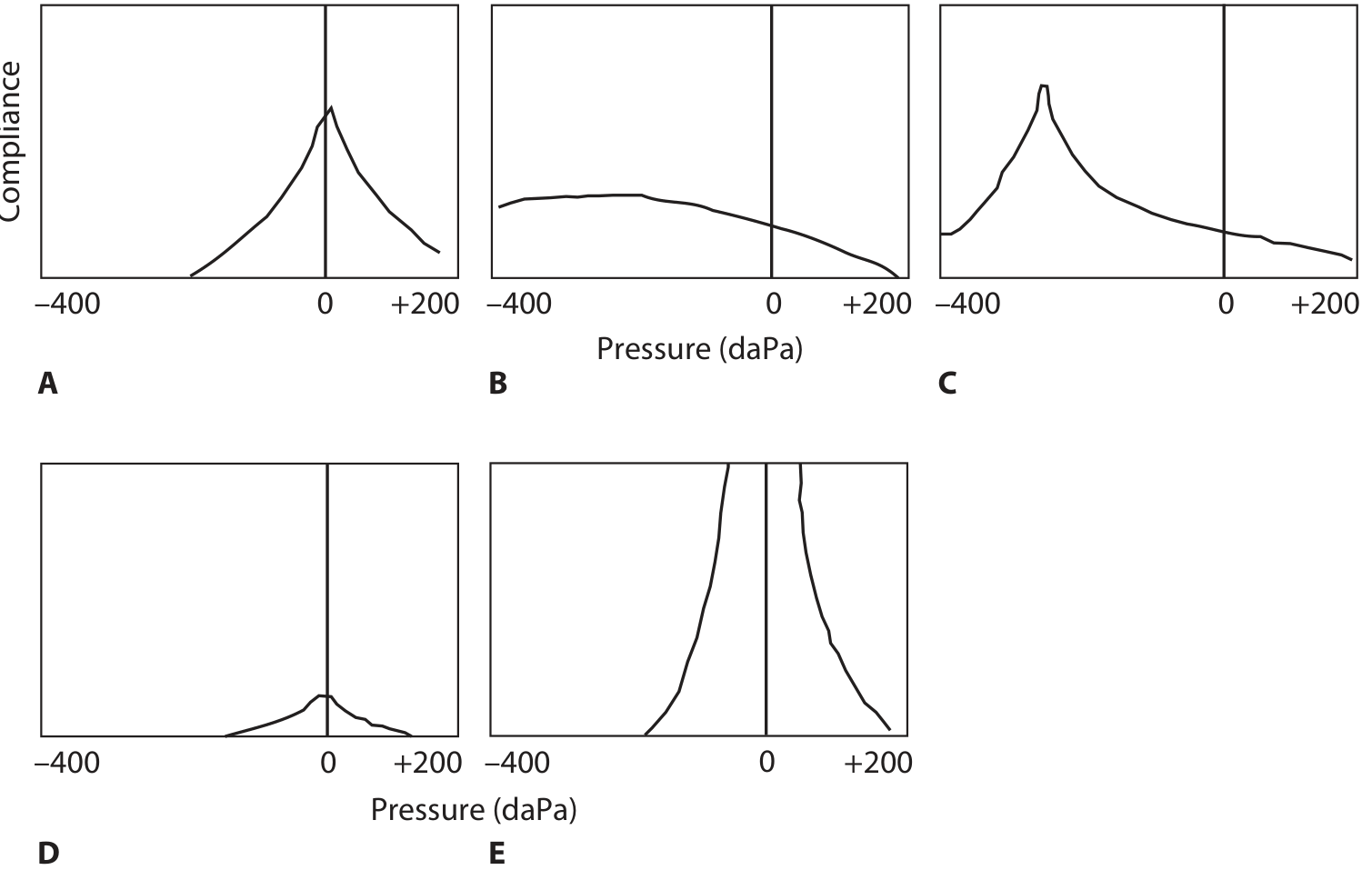
Figure: Type A (normal), Type B (flat/no peak), Type C (negative pressure peak), Type As (shallow peak), Type Ad (deep/high peak)
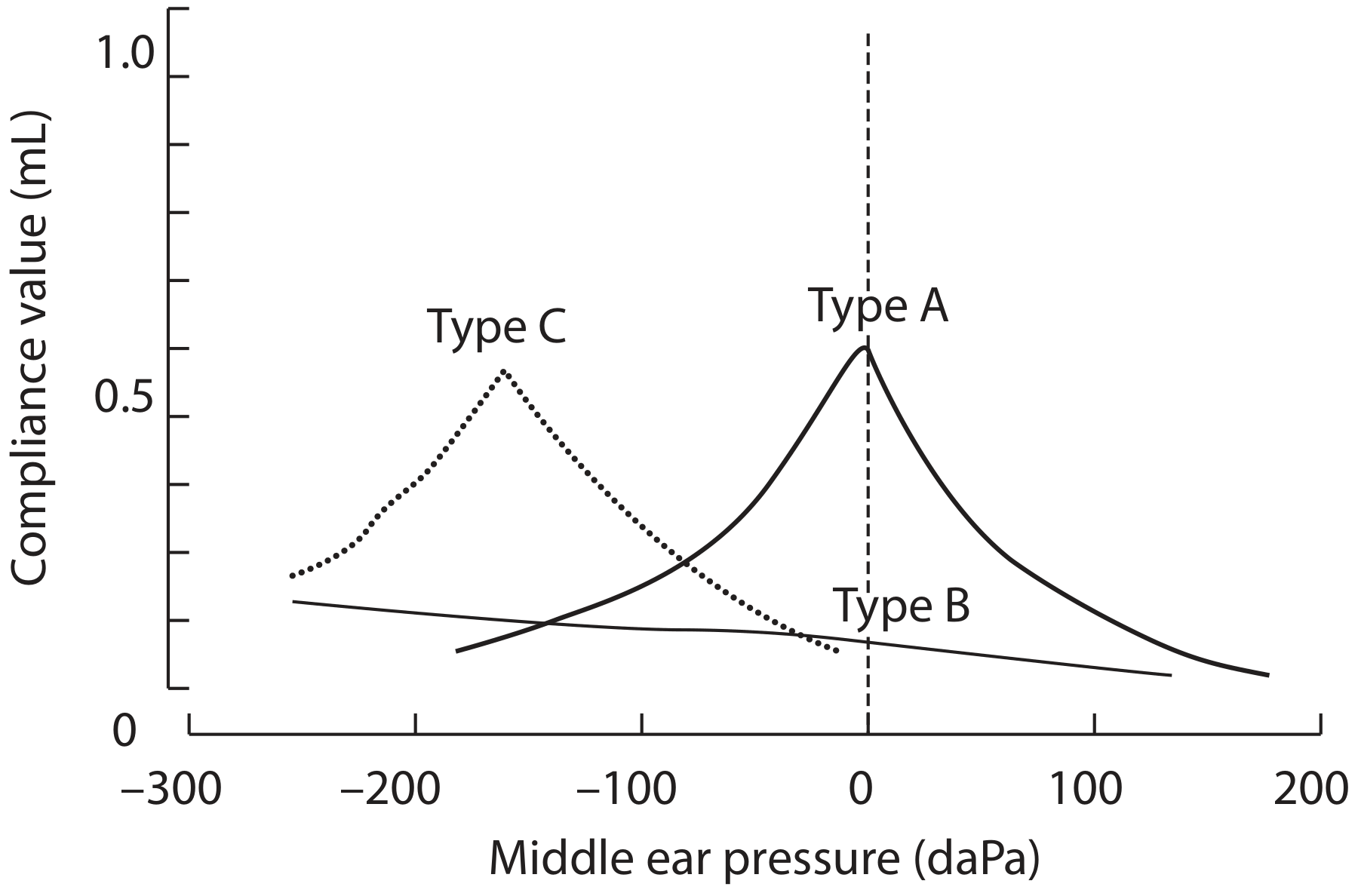
| Type | Appearance | Clinical Interpretation |
|---|---|---|
| A | Sharp peak at 0 daPa (-100 to +100 daPa range) | Normal middle ear pressure and mobility |
| As (A shallow) | Low, shallow peak near 0 | Reduced mobility - otosclerosis, TM scarring, malleus fixation |
| Ad (A deep) | Tall, high peak near 0 | Hypercompliant - flaccid TM or ossicular disarticulation |
| B | Flat, no discernible peak | Fluid in middle ear (OME); if large ear canal volume = perforation or patent PE tube |
| C | Peak shifted to negative pressure (beyond -100 daPa adults, -150 daPa children) | Eustachian tube dysfunction, retracted TM, negative middle ear pressure |
Key diagnostic notes:
- Type B with normal ear canal volume = middle ear effusion (sensitivity 56-73%, specificity 50-98% for OME at myringotomy)
- Type B with large ear canal volume = TM perforation or patent tympanostomy tube
- Type B with very small ear canal volume = probe occlusion or against canal wall
- Scott-Brown's Otorhinolaryngology, Vol 2, p. 164
- K.J. Lee's Essential Otolaryngology, pp. 304-305
Normative Values
| Age | Admittance (mL) | Tympanometric Width (daPa) | Ear Canal Volume (mL) |
|---|---|---|---|
| 3-10 years | 0.25 - 1.05 | 80 - 160 | 0.3 - 0.9 |
| Adults (>18 yr) | 0.3 - 1.7 | 50 - 114 | 0.9 - 2.0 |
Tympanometric Width (TW): A line is drawn at half the height of the compliance peak; the width at that intersection (in daPa) is the TW. The poorer the compliance, the broader the TW.
- K.J. Lee's Essential Otolaryngology, p. 305
Additional Tympanometry Metrics
- Static Acoustic Admittance: A metric of middle ear mobility
- Equivalent Ear Canal Volume: Volume of air between probe tip and TM; if TM is absent or perforated, the measurement includes the middle ear cavity as well
- Tympanometric Peak Pressure: The pressure at which compliance is maximum; shifts negative with poor Eustachian tube function
POLITZERIZATION
Background
Politzerization is named after Adam Politzer (1835-1920), the foremost teacher of otologic diagnosis and therapy of the Vienna school, who made seminal contributions connecting the Eustachian tube to middle ear pathology. The technique was one of the earliest nonsurgical methods of Eustachian tube inflation.
- Shambaugh Surgery of the Ear
Technique
Politzerization is the insufflation of air into the middle ear via the Eustachian tube using a Politzer bag (a rubber bulb and catheter). The procedure:
- The tip of the Politzer bag is placed at one nostril
- The other nostril is occluded
- The patient swallows or says "kuh-kuh" (to elevate the soft palate and close the nasopharynx from the oropharynx)
- The bag is squeezed at the moment of swallowing/phonation, forcing air up through the Eustachian tube into the middle ear
During swallowing/phonation, the soft palate seals the nasopharynx, meaning the insufflated air is directed preferentially through the Eustachian tube orifice into the middle ear.
Mechanism: Pressure equalization via forced air insufflation, exploiting the transient opening of the Eustachian tube during swallowing. This contrasts with the Valsalva maneuver (forced exhalation against a closed mouth and nose) and Toynbee maneuver (swallowing with a closed glottis).
- Cummings Otolaryngology, p. 2508
Clinical Applications
Politzerization is used in the treatment and assessment of:
| Condition | Role |
|---|---|
| Obstructive Eustachian tube dysfunction | Forcibly re-opens a collapsed tube |
| Otitis media with effusion (OME/glue ear) | Aids drainage and pressure equalization |
| Acute otitis media | Adjunctive pressure equalization |
| Barotrauma / aeroplane ear | Emergency equalization measure |
| Serous/secretory otitis media | Conservative management alongside medical therapy |
Modern equivalents that achieve the same purpose include the Otovent™ (a balloon device the patient inflates via the nostril, generating positive nasal pressure) and the Ear Popper® (a handheld device delivering regulated positive pressure).
- Scott-Brown's Otorhinolaryngology, Vol 2, p. 1042
Relationship to Tympanometry
Politzerization can be used in conjunction with tympanometry to assess Eustachian tube function. In the inflation-deflation test, a tympanometry probe records middle ear pressure changes before and after politzerization (or Valsalva maneuver). A shift in tympanometric peak pressure from negative toward 0 daPa after inflation confirms that the Eustachian tube was successfully opened.
Tympanometric findings in ETD that may prompt politzerization:
- Type C tympanogram (persistent negative middle ear pressure)
- Type B tympanogram with small ear canal volume (effusion without perforation)
- Cummings Otolaryngology, p. 2508; Scott-Brown's Otorhinolaryngology, Vol 2
Summary Comparison
| Feature | Tympanometry | Politzerization |
|---|---|---|
| Type | Diagnostic test | Therapeutic procedure |
| What it measures/does | Middle ear compliance and pressure | Forcibly inflates the middle ear via ET |
| Equipment | Impedance meter with probe tone | Politzer bag / Otovent / Ear Popper |
| Key indication | OME diagnosis, ET dysfunction, perforation assessment | Obstructive ETD, OME, barotrauma |
| Result format | Tympanogram curve (Type A/B/C/As/Ad) | Clinical improvement; confirmed by post-procedure tympanometry |
This is a shared conversation. Sign in to Orris to start your own chat.