
What is a urine lipstick test? What is it used for and what are the types of dipsticks if there are any? And also to help me better understand this urine lipstick test for what the test looks like or what the instruments used in this test look like? Give me some images and some videos to help me understand better.
I think you mean a urine dipstick test (not "lipstick") - a quick bedside urinalysis tool. Let me pull up detailed information from the medical library and find images/videos for you.
Searching sources...
Reading File
Searching the Web
urine dipstick test urinalysis images instruments types
Now let me search the medical library and fetch images in parallel.
Finding Sources
Loading Image
Loading Image
Reading File
Loading Image
Searching the Web
urine dipstick test color chart interpretation leukocytes nitrite glucose protein blood
Loading Image
Loading Image
Finding Sources
I now have excellent images and solid textbook + web information. Let me compile the full answer.
Urine Dipstick Test
You likely meant urine dipstick (not "lipstick") - an easy mistake to make! A urine dipstick is a plastic strip with chemically treated pads used to rapidly analyze urine.
What Is It?
A urine dipstick (also called a urine reagent strip or urine test strip) is a thin plastic strip with multiple color-changing chemical pads attached along its length. You briefly dip it into a urine sample, wait a specific number of seconds for each pad, and compare the resulting colors to a reference chart on the bottle. It is a rapid, low-cost, point-of-care test that gives results within 1-2 minutes without any lab equipment.
It is part of a broader assessment called urinalysis (UA), which can also include a visual inspection of urine color and clarity, and microscopic examination of urine sediment.
What Is It Used For?
The dipstick is used to screen for or monitor a wide range of conditions affecting the kidneys, urinary tract, liver, and metabolism:
| Condition | Parameter Detected |
|---|---|
| Urinary tract infection (UTI) | Leukocyte esterase, Nitrite |
| Diabetes mellitus | Glucose, Ketones |
| Kidney disease / Nephrotic syndrome | Protein |
| Liver disease / hemolytic anemia | Bilirubin, Urobilinogen |
| Hematuria (blood in urine) | Blood/Hemoglobin |
| Rhabdomyolysis | Blood (actually myoglobin - false-positive) |
| Dehydration / renal function | Specific Gravity |
| Acid-base assessment | pH |
As noted in Rosen's Emergency Medicine: "Myoglobinuria causes a false-positive result for blood in urine dipstick testing. The drawback of this test is its inability to distinguish among heme compounds."
The Instrument: What It Looks Like
Image 1 - The dipstick strips and bottle (with color reference chart):
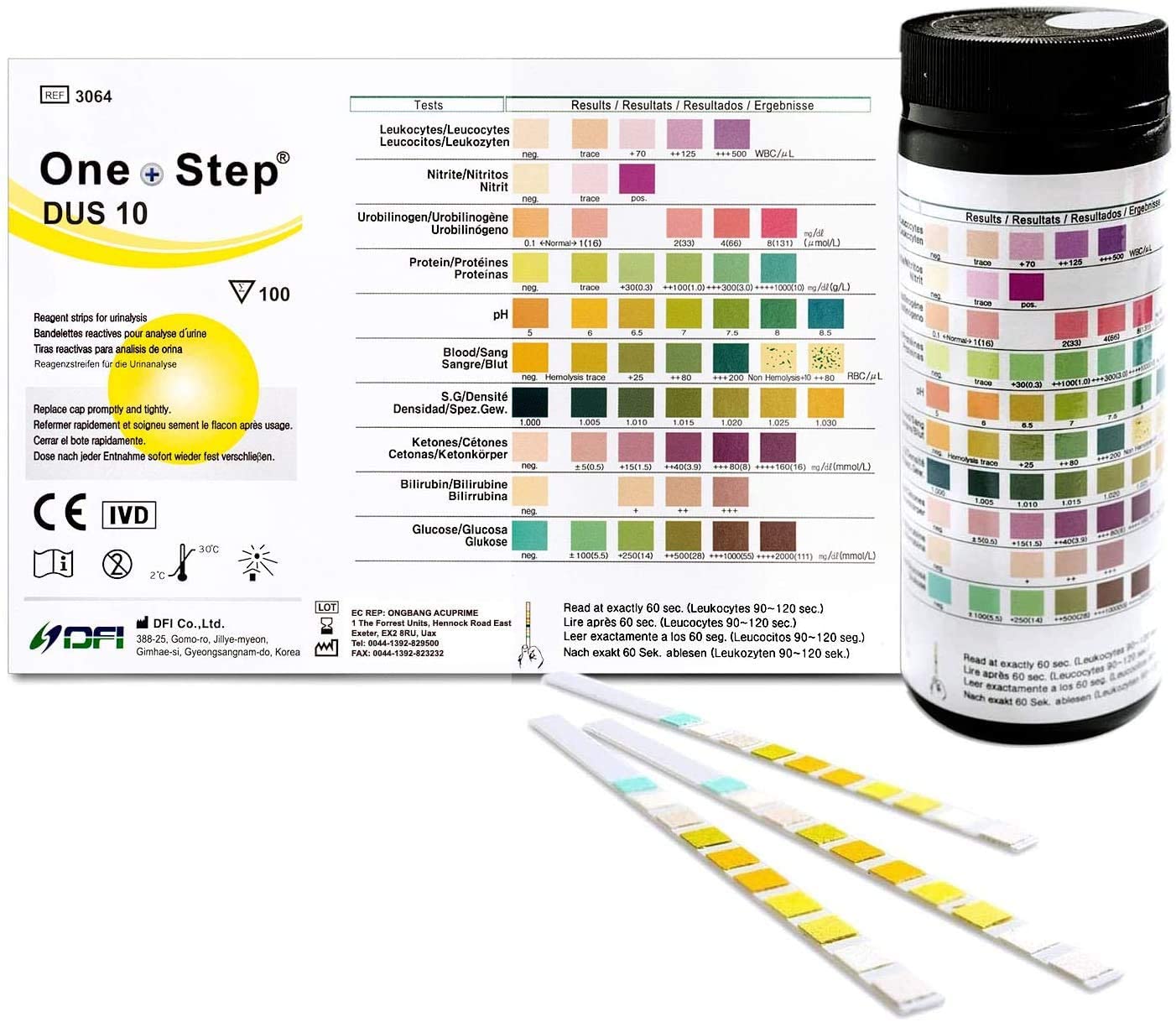
This shows the physical dipstick strips alongside the container they come in. The color reference chart is printed directly on the bottle.
Image 2 - Close-up of the reference color chart on the bottle:
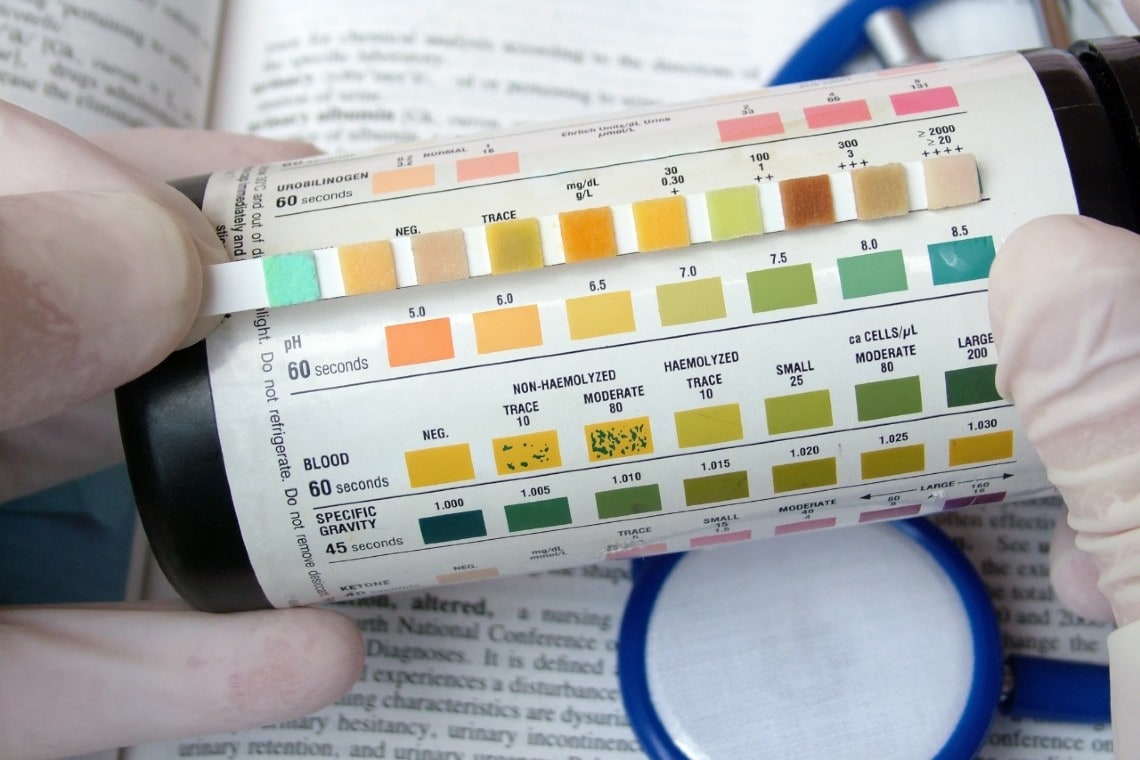
You can see labels like pH, Blood, Urobilinogen, Specific Gravity, and Ketones with their corresponding color gradients and time requirements.
How to Read Results - Detailed Color Chart
Image 3 - Full 10-parameter dipstick color interpretation chart:

Image 4 - Real-world color chart on a dipstick bottle:
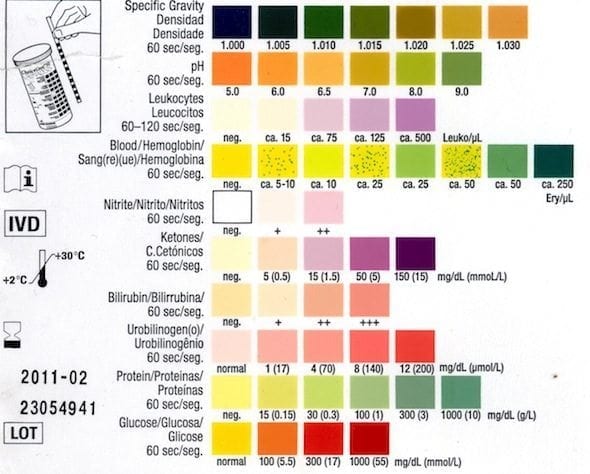
Types of Dipstick Strips
Dipsticks are classified by the number of parameters (pads) they test simultaneously:
| Type | Parameters Tested | Common Use |
|---|---|---|
| Uristix (2-pad) | Glucose + Protein | Quick diabetes/kidney screen |
| 4-pad strip | pH, Protein, Glucose, Blood | Basic screen |
| 7-pad strip | pH, Protein, Glucose, Blood, Ketones, Bilirubin, Urobilinogen | General medicine |
| 10-pad strip (e.g. Multistix 10 SG, Combur-10) | All parameters below | Standard hospital urinalysis |
| Specialized strips | e.g., Nitrite/Leukocyte only | UTI-focused rapid testing |
The 10 Parameters on a Standard 10-Pad Dipstick:
- Leukocyte Esterase - enzyme released by white blood cells; suggests infection/inflammation. Read at 60-120 seconds.
- Nitrite - bacteria convert dietary nitrates to nitrites; positive = gram-negative bacteria (e.g., E. coli). Read at 60 seconds. Any pink color = positive.
- Urobilinogen - normal is 0.1-1.0 mg/dL; elevated suggests liver disease or hemolytic anemia.
- Protein - normally negative; positive may indicate kidney disease, preeclampsia, or infection. Read at 60 seconds.
- pH - normal urine is 4.5-8.0; acidic in rhabdomyolysis, alkaline in UTIs caused by urease-splitting organisms.
- Blood/Hemoglobin - detects RBCs, hemoglobin, or myoglobin; cannot distinguish between them.
- Specific Gravity - reflects urine concentration; normal 1.003-1.030; low in diabetes insipidus.
- Ketones - normally negative; positive in diabetic ketoacidosis, starvation, or low-carb diets.
- Bilirubin - normally negative; positive suggests liver disease or biliary obstruction.
- Glucose - normally negative; positive indicates blood glucose exceeding the renal threshold (~180 mg/dL), as in diabetes.
Common Brand Names
- Multistix (Siemens) - widely used in hospitals
- Combur-Test (Roche)
- Clinistix (glucose only)
- Albustix (protein only)
- One Step DUS 10 (shown in image above)
How the Test Is Performed (Step-by-Step)
- Collect a midstream clean-catch urine sample in a sterile cup
- Remove one dipstick from the bottle and replace the cap immediately
- Dip the entire strip into urine for 1-2 seconds
- Remove it and drag the edge along the rim to remove excess urine
- Hold the strip horizontally (prevents reagent mixing between pads)
- At specified time intervals (30-120 seconds depending on the pad), compare each pad's color to the reference chart
- Document and interpret results
Video Guide
Here is an excellent step-by-step demonstration video from Geeky Medics showing exactly how to perform a urine dipstick test in a clinical setting:
Urinalysis - Urine Dipstick Test OSCE Guide (Geeky Medics, YouTube) - covers gathering equipment, inspecting the urine sample, dipping the stick, and interpreting results. It has over 181,000 views and is widely used by medical students.
Important Limitations
- Leukocyte esterase has a sensitivity of ~75-95% for UTI - a negative result does NOT rule out infection in symptomatic patients
- Nitrite is highly specific but insensitive - gram-positive bacteria (Enterococcus, Staphylococcus) do NOT produce nitrites
- Blood pad cannot distinguish hematuria from hemoglobinuria or myoglobinuria - always correlate with microscopy
- Vitamin C (ascorbic acid) can cause false-negative results for blood and glucose
- Contaminated or old samples can give false positives, especially for leukocyte esterase
The dipstick is a screening tool, not a definitive diagnostic test. Positive or suspicious results are typically followed by urine microscopy and culture.
Show me CT scan that has perenephric fat stranding around the kidney and also a normal CT scan for reference
Searching sources...
Reading File
Searching the Web
perinephric fat stranding CT scan kidney radiology image
Searching the Web
normal kidney CT scan axial cross section radiology reference image
Good, I have several strong image URLs. Let me fetch the best ones in parallel - the perinephric stranding cases from Radiopaedia/JETem and the normal kidney CTs.
Loading Image
Loading Image
Loading Image
Loading Image
Finding Sources
Excellent - the textbook library has actual CT images of perinephric fat stranding. Let me pull those textbook images now.
Reading File
Reading File
Loading Image
I have the exact textbook CT image URLs. Let me fetch those now along with a normal kidney CT from the textbook.
Loading Image
Loading Image
Loading Image
I now have a rich set of high-quality images from authoritative textbooks and radiology sources. Here is the full comparison:
Perinephric Fat Stranding vs. Normal Kidney on CT
🟢 NORMAL Kidney CT - Reference
Image 1 - Normal kidneys, coronal view with contrast (LITFL):
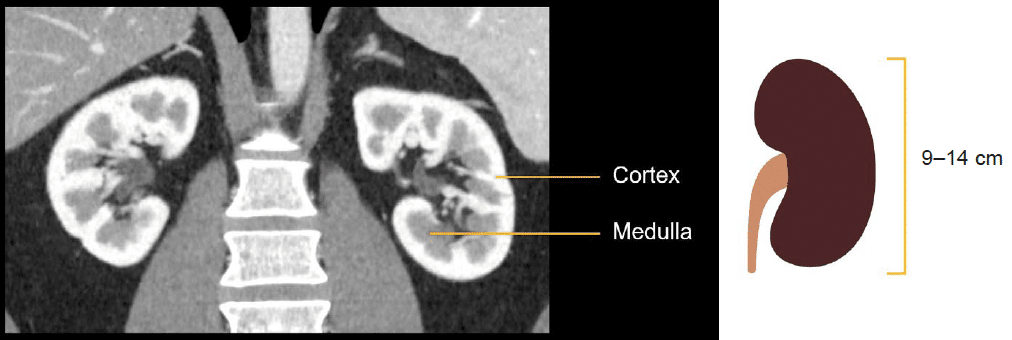
On a normal CT, the kidneys appear as smooth, bean-shaped organs with:
- A bright enhancing outer cortex surrounding a slightly less dense inner medulla
- Clean, dark perirenal fat - the fat surrounding the kidney appears uniformly jet-black (very low density, around -100 HU) with no haziness, no linear streaks
- A well-defined Gerota's fascia that is invisible because there is no edema to thicken it
- Smooth kidney contours
- Normal size: 9-14 cm in length
Image 2 - Pyelonephritis on CT (heterogeneous enhancement, enlarged right kidney):
(from Grainger & Allison's Diagnostic Radiology)
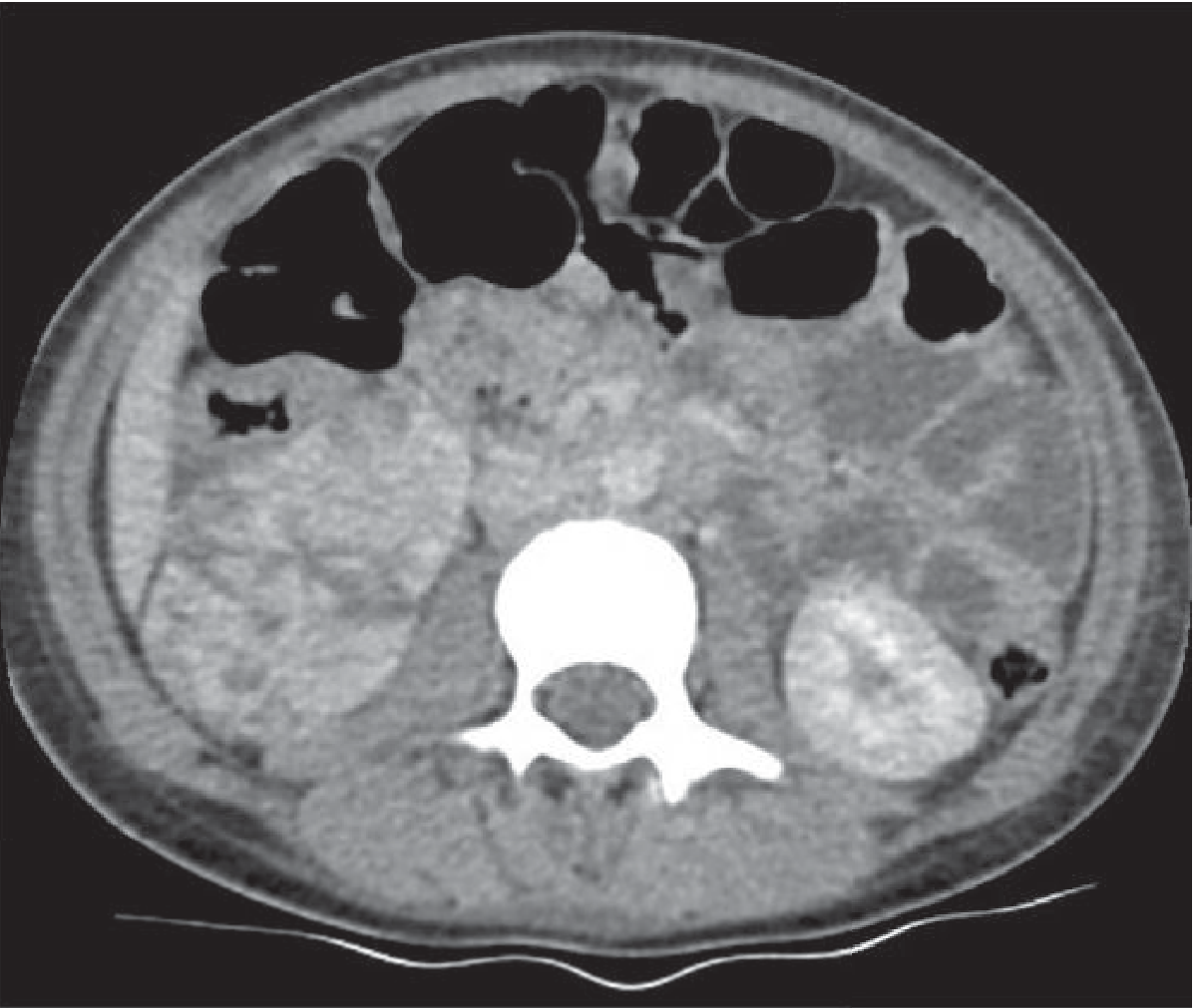
This axial CT (without obvious stranding yet) shows an enlarged right kidney with heterogeneous enhancement from pyelonephritis - compare the left (normal density) kidney on the right side of the image vs. the diseased right kidney on the left. The surrounding fat here begins to look hazier than normal.
🔴 ABNORMAL - Perinephric Fat Stranding
What Is It?
Perinephric (or perirenal) fat stranding refers to linear or wispy soft-tissue density streaks appearing in the normally pitch-black perinephric fat on CT. On an unenhanced CT, fat registers around -100 Hounsfield Units (HU) - it appears near-black. When inflammation, edema, or engorged lymphatics infiltrate this fat, its density rises, producing grey hazy streaks instead of clean black fat.
Image 3 - Acute Focal Nephritis with perinephric fat stranding (axial + coronal, arrows marked)
(from Grainger & Allison's Diagnostic Radiology, Fig. 26.16)
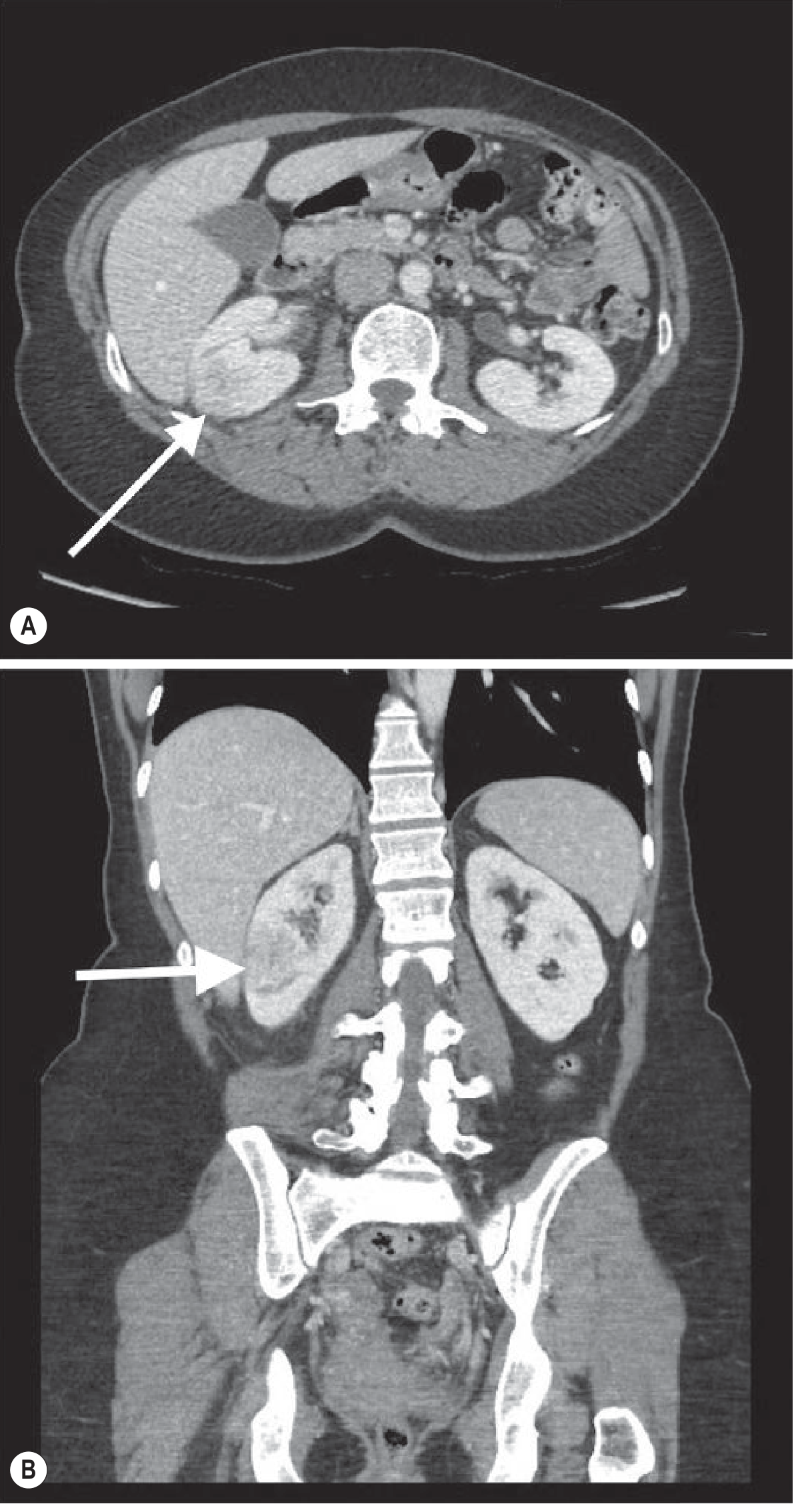
- Panel A (axial/top): The white arrow points to the perinephric fat stranding around the right kidney. Notice how the fat surrounding that kidney has lost its clean black appearance - it shows hazy grey linear streaks instead. Compare with the left kidney's cleaner, blacker surrounding fat.
- Panel B (coronal/bottom): The white arrow again points to the stranding along the right kidney's lateral border. The fat is visibly dirtier and denser compared to the left side.
Image 4 - Left pyelonephritis with perinephric stranding + ureteric stone (coronal CT with contrast)
(from Grainger & Allison's Diagnostic Radiology, Fig. 27.6)
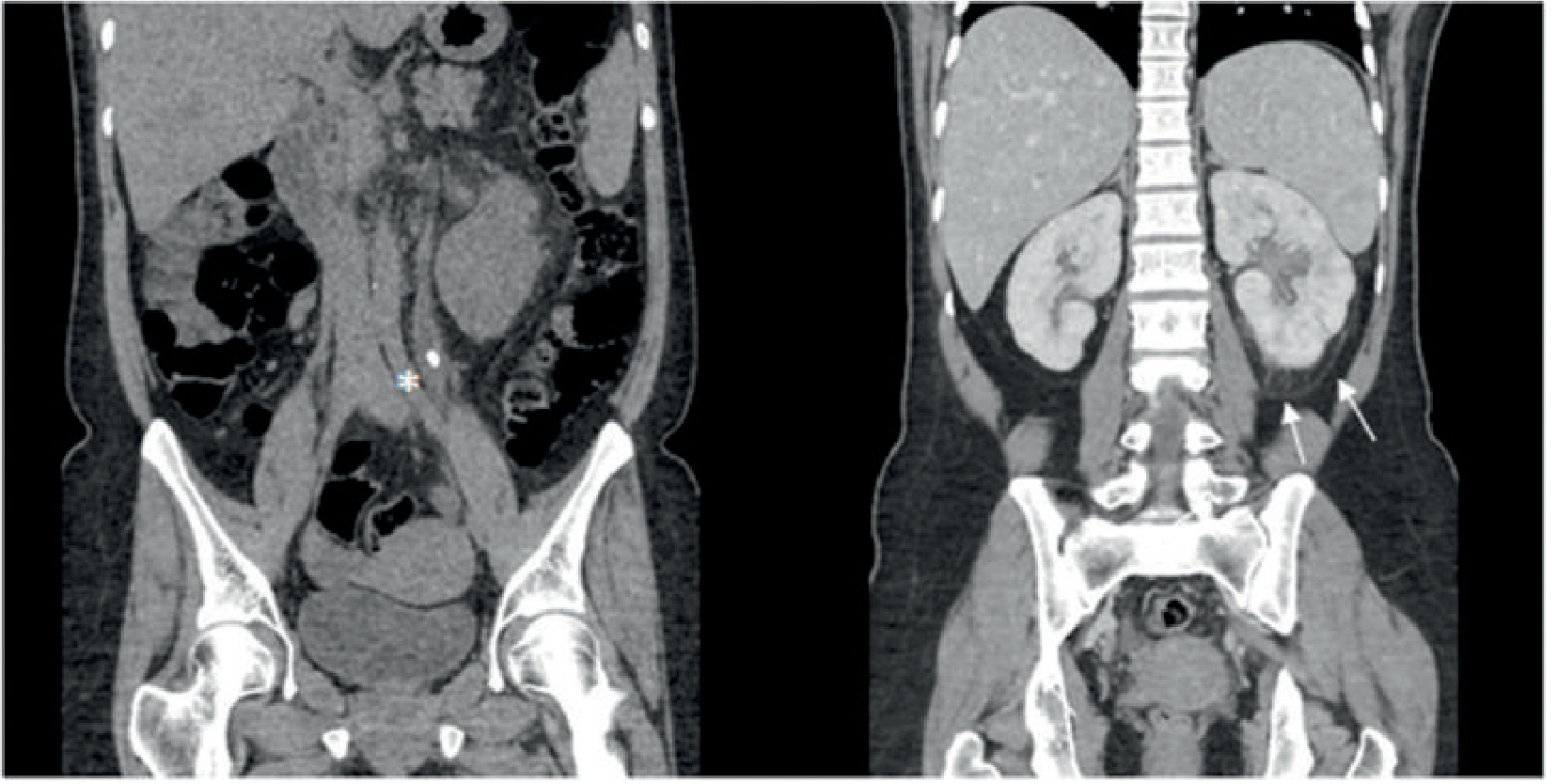
This is a side-by-side pair: the left panel shows the unenhanced CT-KUB (the blue asterisk marks the obstructing calculus in the left mid-ureter), and the right panel is the contrast-enhanced image. The white arrows on the right image point to left perinephric fat stranding at the lower pole of the left kidney - the hazy grey streaks in the fat below the kidney, along with mild hydronephrosis above. The right kidney's perinephric fat (visible on the right side of that image) is clean and dark by comparison.
Image 5 - Acute pyelonephritis, sagittal view with red arrows (JETem/UCI Emergency Medicine):

The three red arrows point to the hazy streaky tissue in the fat surrounding the kidney on this sagittal (side) view. The kidney itself shows heterogeneous enhancement from severe acute pyelonephritis.
Image 6 - Coronal CT showing left perinephric stranding with red circle (Radiopaedia):

The red circle encircles the affected left kidney. Compare the left vs. right kidneys - the right kidney has clean black fat around it, while the left kidney (circled) shows hazy grey dirty fat all around the capsule, plus the collecting system appears dilated (hydronephrosis from obstruction).
Key Differences at a Glance
| Feature | Normal CT | Perinephric Fat Stranding |
|---|---|---|
| Perinephric fat | Jet-black, uniform | Grey, hazy, wispy streaks |
| Gerota's fascia | Invisible / thin | Thickened, visible |
| Kidney contour | Smooth | May be indistinct |
| Kidney size | 9-14 cm | Often enlarged |
| Kidney enhancement | Uniform | Heterogeneous / wedge-shaped areas |
| HU of perirenal fat | ~-100 HU | Less negative (closer to soft tissue) |
Causes of Perinephric Fat Stranding
- Acute pyelonephritis (most common)
- Ureteric obstruction / nephrolithiasis (from elevated calyceal pressure causing forniceal rupture and edema)
- Renal infarction
- Renal trauma
- Renal cell carcinoma (extension into perinephric space)
- Xanthogranulomatous pyelonephritis
- Renal abscess
As stated in Tintinalli's Emergency Medicine: "Secondary signs of ureteral obstruction include ureteral dilatation, stranding of perinephric fat, dilatation of the collecting system..." and from Grainger & Allison's Diagnostic Radiology: "Perinephric fat stranding... is a nonspecific finding" - meaning it tells you something is wrong in that area but requires clinical context to determine the exact cause.
This is a shared conversation. Sign in to Orris to start your own chat.