
Cotrimaxolefpr 5 marks pharmacology
Quick Answer: Cotrimoxazole (Co-trimoxazole) is a fixed-dose combination of Trimethoprim + Sulfamethoxazole (TMP-SMX) in a 1:5 ratio (80mg TMP + 400mg SMX). It acts by sequentially blocking folate synthesis in bacteria - SMX inhibits dihydropteroate synthase and TMP inhibits dihydrofolate reductase, producing synergistic bactericidal activity.
Searching sources...
Reading File
Finding Sources
Finding Sources
Reading File
Reading File
Reading File
Reading File
Reading File
Let me get the Lippincott section on cotrimoxazole specifically and the Katzung clinical uses section:
Reading File
Reading File
Reading File
Reading File
Loading Image
Reading File
Loading Image
I now have comprehensive information from Lippincott's and Katzung's to write a complete 5-mark pharmacology answer on Cotrimoxazole. Here is the full answer:
Cotrimoxazole - Pharmacology (5 Marks)
Definition & Composition
Co-trimoxazole (TMP-SMX) is a fixed-dose combination of:
- Trimethoprim (TMP) + Sulfamethoxazole (SMX) in a 1:5 ratio
- Single-strength tablet: TMP 80 mg + SMX 400 mg
- Double-strength tablet: TMP 160 mg + SMX 800 mg
- Brand names: Bactrim, Septra
The combination was chosen because both drugs have similar half-lives (~10-12 hours) and show synergistic bactericidal activity together.
Mechanism of Action (Sequential Blockade of Folate Synthesis)
Cotrimoxazole produces synergism by blocking two sequential steps in tetrahydrofolic acid (THF) synthesis:
| Step | Drug | Enzyme Blocked | Effect |
|---|---|---|---|
| Step 1 | Sulfamethoxazole | Dihydropteroate synthase (competes with PABA) | Blocks incorporation of PABA into dihydrofolic acid |
| Step 2 | Trimethoprim | Dihydrofolate reductase | Prevents conversion of dihydrofolate → tetrahydrofolate |
Result: THF deprivation → no purines, no thymidylate, no DNA synthesis → bactericidal effect (SMX alone is only bacteriostatic)
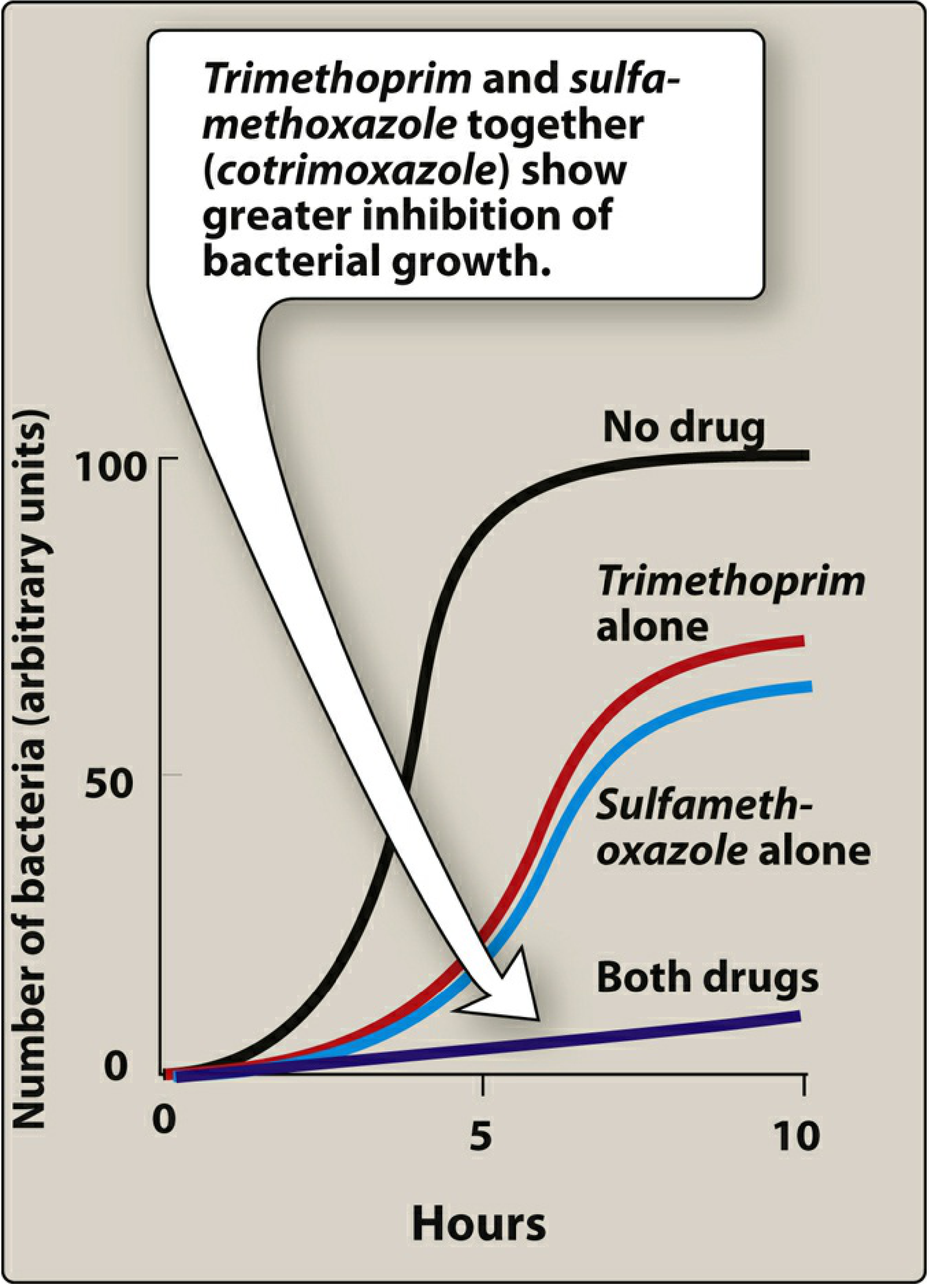
Trimethoprim is 20-50 times more potent than sulfonamides alone and has much higher affinity for bacterial dihydrofolate reductase than human dihydrofolate reductase - this accounts for selective toxicity.
Synergism diagram (Lippincott, p. 1037):
Antibacterial Spectrum
Cotrimoxazole has a broader spectrum than sulfonamides alone:
Gram-positive: S. aureus (including MRSA), Listeria monocytogenes
Gram-negative: E. coli, H. influenzae, Legionella pneumophila, Proteus mirabilis, Salmonella typhi, Shigella spp.
Others: Pneumocystis jirovecii, Toxoplasma gondii, Nocardia spp., Stenotrophomonas maltophilia
NOT active against: Anaerobes, Mycoplasma, Chlamydia, Pseudomonas aeruginosa (except Stenotrophomonas)
Pharmacokinetics
- Route: Oral (well absorbed) or IV (for severe infections)
- Distribution: Widely distributed throughout body; crosses the blood-brain barrier and placenta
- Special property: Trimethoprim is a weak base - concentrates in acidic prostatic and vaginal fluids, making it highly useful for prostatitis
- Protein binding: Both drugs bound to serum albumin
- Elimination: 50-60% TMP and 30-50% SMX excreted unchanged in urine within 24 hours
- Dose reduction needed when creatinine clearance < 30 mL/min
When 1 part TMP is given with 5 parts SMX, peak plasma concentrations reach a 1:20 ratio, which is optimal for synergistic activity.
Therapeutic Uses
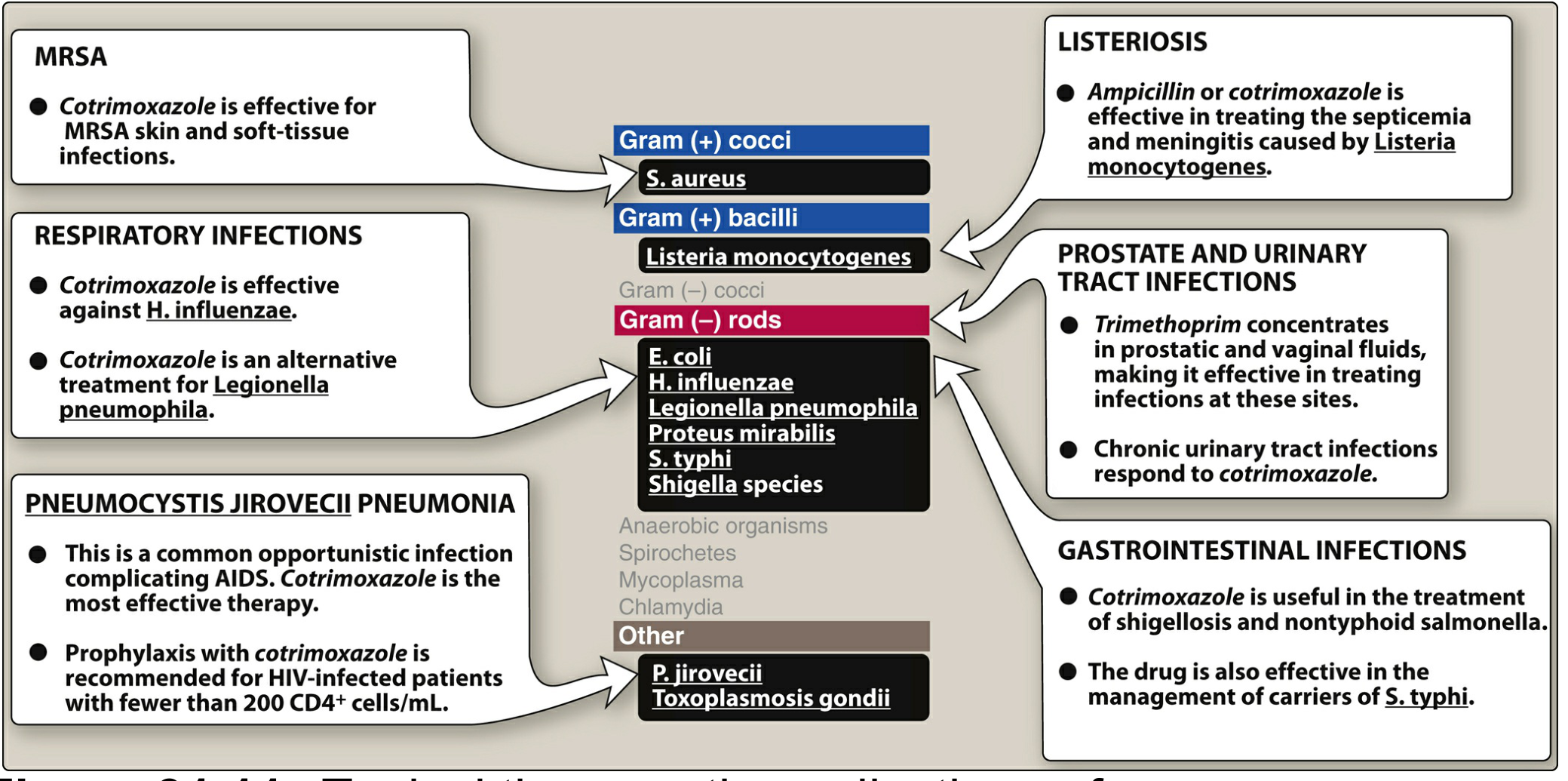
- Urinary tract infections - most common use; drug of choice for uncomplicated UTIs
- Pneumocystis jirovecii pneumonia (PCP) - drug of choice; both treatment and prophylaxis in HIV patients with CD4 < 200 cells/mL
- Prostatitis - TMP concentrates in prostatic fluid
- MRSA skin and soft tissue infections
- Shigellosis and Salmonellosis (including typhoid carriers)
- Nocardiosis - drug of choice
- Listeria meningitis (in penicillin-allergic patients)
- Toxoplasmosis prophylaxis in immunocompromised
- Stenotrophomonas maltophilia infections - drug of choice
- Traveler's diarrhea, respiratory infections (H. influenzae)
Adverse Effects
| Adverse Effect | Mechanism |
|---|---|
| Nausea, vomiting | Most common GI side effects |
| Skin rash, Stevens-Johnson syndrome | Hypersensitivity (sulfonamide component) |
| Crystalluria | SMX precipitates in acidic/concentrated urine; prevent with hydration + alkalinization |
| Megaloblastic anemia, leukopenia, granulocytopenia | TMP-induced folate deficiency (treat with folinic acid/leucovorin) |
| Hemolytic anemia | G6PD-deficient patients |
| Kernicterus | SMX displaces bilirubin from albumin in neonates |
| Hyperkalemia | TMP has potassium-sparing effect (blocks ENaC - similar to amiloride) |
| Photosensitivity | Sulfonamide component |
Resistance
Resistance requires simultaneous mutations in both components - hence less frequent than resistance to either drug alone. Mechanisms include:
- Altered dihydrofolate reductase (reduced TMP binding) - plasmid-encoded, spread via conjugative transposons
- Overproduction of dihydrofolate reductase
- Reduced cell permeability / efflux pumps
- Significant resistance now documented in E. coli (up to 30%)
Contraindications
- Neonates/infants < 2 months and pregnant women at term - risk of kernicterus
- Severe renal or hepatic impairment (reduce dose)
- G6PD deficiency - risk of hemolytic anemia
- Avoid with methenamine (crystallization in acidic urine)
Drug Interactions
- Warfarin - SMX inhibits CYP2C9 → increased anticoagulation; also displaces warfarin from albumin
- Methotrexate - displacement from albumin → toxicity
- Phenytoin - CYP2C9 inhibition → elevated phenytoin levels
- ACE inhibitors / potassium-sparing diuretics - additive hyperkalemia risk
Sources: Lippincott Illustrated Reviews: Pharmacology, pp. 1035-1041; Katzung's Basic and Clinical Pharmacology, 16th Ed., pp. 1301-1303; Goodman & Gilman's Pharmacological Basis of Therapeutics
This is a shared conversation. Sign in to Orris to start your own chat.