
Hey so for dry skin sensitive ane prone skin girl aged 23 years she had her her acne since her puberty...but most of t was closed comedones intermittently once she has fungal acne....later followed by closed comedones her menarche was 12 yrs old ....but during her 22 end and around 23 years she turned 23 in June...she is experiencinging inflammatory acne ....she is an clerk in ph....indian student....so she uses skin care accordingly,
So yeah.....now you are an dermatologist.....explain to her step by step what is basically acne how different type of acne is caused what causes inflammatory acne.....with and without pus .. especially during my periods and if i have a crash diet....comedones showp up and dung periods I have inflammatory acne....i have anua azelaic acid and bpo cream bit I don't what to use exactly for this ...am on tazoretene nt sure of the name tho ,the retinoid before the one I was using retinoid......is tretinoin ,so now the thing is i use vit c serum in ph is ....Belo essentials 15 percent serum and followed by celimax toner ,followed by anua azelaic only dung break out now i introduced la roche posay mela b3 serum for he dark spots and i have mild melasma in forehead ....followed by cerave moisturizing cream nd Y.O.U sunscreen the one with blue cap before that I was using the sunscreen from Y.O.U for sensitive skin.....
🧬 PART 1: What is Acne - The Basic Biology
| Factor | What it does |
|---|---|
| 1. Excess sebum production | Clogs the pore from inside |
| 2. Abnormal shedding of skin cells inside the follicle (hyperkeratosis) | Dead cells don't shed normally, they stick together and block the pore |
| 3. Cutibacterium acnes (C. acnes) bacteria | Lives inside your follicle, feeds on sebum, triggers immune response |
| 4. Inflammation | Immune cells attack, causing redness, swelling, pus |
🔒 PART 2: How Closed Comedones Form (Your Puberty-Onset Pattern)
🔴 PART 3: How Inflammatory Acne Forms - With AND Without Pus
Papule (inflammatory acne WITHOUT pus)
Pustule (inflammatory acne WITH pus)
Nodule / Cyst
🩸 PART 4: Why Your Acne Worsens Around Your Period (Premenstrual Flares)
🍄 PART 5: Your History of Fungal Acne (Malassezia Folliculitis)
💊 PART 6: Your Current Actives - What Each One Does and How to Use Them
Tazarotene (your current retinoid)
- Normalizing follicular keratinocyte differentiation - breaks up that sticky dead cell plug
- Preventing new microcomedones from forming
- Reducing inflammation around existing lesions
- Has some effect on PIH over time
Benzoyl Peroxide (BPO)
- Works best at 2.5-5% concentration (same efficacy as 10%, less irritation)
- Important: do not layer BPO on top of vitamin C - they oxidize each other and cancel out
- BPO can bleach fabrics and hair - use on clean white pillowcases
- For dry sensitive skin: use as a spot treatment or short-contact wash, not a leave-on all over the face
Azelaic Acid (your Anua product)
- Antibacterial - kills C. acnes
- Comedolytic - normalizes keratinocyte turnover mildly
- Inhibits tyrosinase - fades PIH and is safe for melasma (one of the only topicals with good evidence for melasma and inflammatory acne at the same time)
- Anti-inflammatory
- Does NOT increase photosensitivity
🧴 PART 7: Your Current Routine - What's Working, What Needs Adjusting
Morning Routine (AM)
Issues to address:
Evening Routine (PM)
- Gentle cleanser (something like CeraVe Hydrating Cleanser - no foaming strips)
- Hydrating toner (Celimax - if hydrating)
- CeraVe Moisturizing Cream (buffer)
- Tazarotene - apply to DRY skin, thin layer, avoid eye area and corners of mouth
- Optional: second thin layer of CeraVe over the top if very dry
📋 PART 8: Suggested Revised Routine for You
AM (Morning)
| Step | Product | Why |
|---|---|---|
| 1. Cleanser | Gentle, non-stripping | Prep |
| 2. Toner | Celimax (hydrating) | Hydration before actives |
| 3. Vitamin C | Belo 15% | Antioxidant, brightening, fades PIH |
| 4. Azelaic Acid | Anua (daily, whole face) | Acne + PIH + melasma - workhorse |
| 5. Niacinamide serum | LRP Mela B3 | Further PIH/melasma correction |
| 6. Moisturizer | CeraVe Moisturizing Cream | Barrier repair - critical for dry skin |
| 7. Sunscreen | Y.O.U blue cap SPF 50 | NON-NEGOTIABLE - protects melasma |
PM (Evening)
| Step | Product | Why |
|---|---|---|
| 1. Double cleanse | Oil cleanser + gentle cleanser | Remove sunscreen properly |
| 2. Toner | Celimax | Hydration |
| 3. Moisturizer | CeraVe (thin layer first - buffer) | Reduces tazarotene irritation |
| 4. Tazarotene | Thin pea-size for whole face | Comedolytic + anti-inflammatory |
| BPO | Use on alternate nights OR spot-treat only | Anti-bacterial |
⚠️ PART 9: Special Notes for Your Situation
- Inflammatory acne is expected due to hormonal changes - do NOT panic-spot-treat with everything at once
- Stick to azelaic acid + BPO spot treatment on active pustules
- Do NOT increase retinoid frequency - your skin is already sensitized
- Keep barrier repair as priority: CeraVe is your best friend these days
- Cortisol rises → sebum rises → closed comedones appear within 2-3 weeks
- The fix is not more actives - it is eating enough, especially healthy fats (omega-3s) and reducing refined sugar and high glycemic index foods (evidence links high GI diet to acne flares)
- Consistent retinoid use prevents the comedones from forming in the first place
- Mild forehead melasma responds well to: daily SPF (primary treatment), azelaic acid, niacinamide
- The LRP Mela B3 serum (niacinamide-based) is a smart addition
- Do NOT skip sunscreen even on cloudy or indoor days - visible light and heat also trigger melasma
- Tazarotene over time also helps with mottled pigmentation (off-label use for melasma is established)
- Malassezia folliculitis looks like uniform, slightly itchy bumps, usually same size
- Avoid products with high oleic-acid oils (coconut oil, olive oil) if Malassezia is active
- Azelaic acid and BPO are NOT effective against Malassezia - antifungal treatment is needed
- If it returns, see a dermatologist for topical ketoconazole or ciclopirox
🔑 Quick Summary
- Your acne history makes total sense: hormonal onset → closed comedones → hormonal/diet triggers → inflammatory flares perimenstrually
- Tazarotene is your strongest tool - use it consistently at night, buffered with moisturizer
- BPO is for bacterial targeting - use it carefully, not nightly with tazarotene
- Azelaic acid (Anua) is your daily workhorse - safe for melasma, acne, and PIH simultaneously
- Vitamin C AM + Niacinamide (LRP Mela B3) AM are a good brightening stack - can be layered with a gap
- Sunscreen daily is not optional - it is the most important thing you can do for your melasma
- Do NOT use more actives during a breakout - you need less, not more, on sensitized skin
I used celimax toner now using probiotic cica ampoule from skin 1004 ,followed by azelaic acid ,now i use la roche posay mela b3 serum followed by ordinary barrier repair solution followed by althea 147 cream ...for retinoid instead of azelaic acid and melasyl serum i use tazoretone ... followed by rest is same one day of ordinary bha and aha peel ...now i think of using the entire night of the week during periods and a week before periods ....then for rest threw weeks keeping the routine same....also i wanna use pro bio cica ampoule and ordinary barrier repair solution that's non negotiable for me.....and I will be introducing ordinary peptide serum only during retinoid nyts multipeptide +HA serum....now i want you to comment on this.....my concern is I need a even toned brightened skin. Without spots .....I don't want to take any cross pathis size ma in this med field ofc i have to wear makeup up so am thinking of keeping la rohe posay mela b3 serum in nyt ...and using suganda depigmentation serum In am but sill on the other side.....i want to keep one prdt constantly that is this mela b3 serum but the concern is hat since am gonna wear makeup up will the effects will be the same..... honestly I don't want anymore closed comedones or inflammatory acne and I want to reduce my existing spots.....will be introducing pdrn soon Into this routine what's your comment on his explain me....and how I can work on this....micellar water from garnier he one with oil followed by cerave hydrating cleanser is my double cleansing rotuine.....now sumarise allt hese data....i provided and discuss with me...
PDRN topical serum skin acne hyperpigmentation evidence 2024 2025
Suganda depigmentation serum ingredients tranexamic acid kojic India skincare
📋 MASTER SUMMARY: Your Full Skin Profile
🧴 YOUR FULL CURRENT ROUTINE - Let Me Map It Out First
AM (Morning)
- Garnier Micellar Water with oil (makeup removal/first cleanse)
- CeraVe Hydrating Cleanser
- Skin 1004 Probiotic Cica Ampoule
- Anua Azelaic Acid
- LRP Mela B3 Serum (niacinamide + melasyl)
- The Ordinary Barrier Support Solution
- Althea 147 Cream (moisturizer)
- Y.O.U Sunscreen (blue cap, SPF 50)
PM (Evening) - Regular nights
PM - Tazarotene nights
- Double cleanse
- Probiotic Cica Ampoule (non-negotiable)
- The Ordinary Barrier Support Solution (non-negotiable)
- Tazarotene
- Althea 147 cream
- Planning to add: TO Multipeptide + HA Serum on retinoid nights only
PM - Exfoliation night (once a week)
⚠️ ISSUES I'VE IDENTIFIED - Let me be direct
🔴 ISSUE 1: Tazarotene + Probiotic Cica Ampoule + Barrier Solution TOGETHER is a stacking problem
- Double cleanse (Garnier micellar oil → CeraVe hydrating cleanser)
- Probiotic Cica Ampoule (lightest layer, thin ampoule - this is okay before as it's watery and won't block penetration much)
- Wait 2 min, let it absorb fully
- Tazarotene (pea-size, whole face minus eye area and lip corners)
- Wait 10-15 min (let it absorb)
- TO Barrier Support Solution + Althea 147 cream (seal it all in)
🔴 ISSUE 2: The Ordinary AHA+BHA Peel on the SAME WEEK as tazarotene is too much
🔴 ISSUE 3: Your proposed period week plan needs refinement
- In the week before your period (late luteal phase): skin is already inflamed, sensitized, more reactive, oil production is up
- Using tazarotene every single night during this phase = maximum retinoid irritation at the moment your skin is most vulnerable
- This will likely worsen your inflammatory acne by disrupting your barrier further and causing retinoid dermatitis that mimics or worsens inflammation
| Week | Retinoid Frequency | Focus |
|---|---|---|
| Week 1-2 (post-period, follicular) | 4-5 nights/week | Retinoid is your workhorse here - skin is most tolerant |
| Week 3 (mid-cycle) | 3-4 nights/week | Maintain |
| Week 4 (premenstrual) | 2-3 nights/week MAX | Scale back, prioritize barrier repair |
| Period itself | 1-2 nights or skip | Barrier repair priority, spot treat only |
✅ ISSUE 4: Peptides on Retinoid Nights - Smart, With One Caveat
✅ ISSUE 5: Keeping LRP Mela B3 in PM + Adding Suganda Depigmentation in AM - This is Smart
- 2% Alpha Arbutin - inhibits tyrosinase enzyme, directly fades dark spots
- 3% Tranexamic Acid - reduces melanocyte activation, excellent for PIH and melasma
- 5% Niacinamide - inhibits melanin transfer to keratinocytes, anti-inflammatory
- Azelaic Acid (small amount) - additional tyrosinase inhibition
✅ ISSUE 6: Will Mela B3 at Night Work the Same as AM?
- Your AM is already busy with Suganda (tranexamic acid + arbutin) which are also depigmenting
- PM application means the active ingredients work undisturbed for 7-8 hours of sleep
- No UV exposure to oxidize or reduce activity
📌 ISSUE 7: Makeup + Skincare Efficacy - Your Concern
- Not waiting long enough between layers (stacking too fast = pilling + no absorption)
- Using a silicone-heavy primer immediately over an actives serum that hasn't absorbed
- Heavy makeup removal at night that is too harsh (stripping) - your Garnier micellar oil is gentle, good choice
- Use mineral/non-comedogenic makeup where possible (especially foundation)
- Avoid thick heavy coverage foundations daily if possible - let skin breathe
- Always double cleanse at night - this is what you're already doing correctly
- Do NOT use micellar water alone (without the second CeraVe cleanse) on nights when you wear heavy makeup + sunscreen
🧬 PDRN - My Comment
- Injectable PDRN has good clinical evidence for wound healing, photoaging, and post-procedure skin recovery
- Topical PDRN evidence is much weaker - molecules are large and skin penetration is limited without physical delivery (microneedling, mesotherapy)
- Most topical PDRN products work as a soothing, anti-inflammatory, barrier-supportive ingredient rather than deep regeneration
- For acne PIH specifically: limited direct evidence, but the anti-inflammatory and hydration-supporting effects are genuine
✨ YOUR OPTIMIZED FULL ROUTINE
AM (Final)
| Step | Product | Purpose |
|---|---|---|
| 1 | Garnier Micellar Oil + CeraVe Hydrating Cleanser | Clean, no strip |
| 2 | Skin 1004 Probiotic Cica Ampoule | Calming, barrier prep |
| 3 | Suganda Depigmentation Serum (new AM addition) | Alpha arbutin + TA + niacinamide for PIH/melasma |
| 4 | Anua Azelaic Acid (daily, whole face) | Acne + PIH + melasma support |
| 5 | TO Barrier Support Solution | Barrier reinforcement |
| 6 | Althea 147 Cream | Moisturizer/seal |
| 7 | Y.O.U SPF 50 (blue cap) | NON-NEGOTIABLE for melasma |
PM - Regular nights (non-retinoid)
| Step | Product | Purpose |
|---|---|---|
| 1 | Double cleanse | Remove day's buildup |
| 2 | Probiotic Cica Ampoule | Calming |
| 3 | LRP Mela B3 Serum | PM depigmentation (melasyl + niacinamide) |
| 4 | TO Barrier Support Solution | Barrier |
| 5 | Althea 147 Cream | Seal |
PM - Tazarotene nights (4-5x/week in week 1-2; 2-3x in premenstrual week)
| Step | Product | Purpose |
|---|---|---|
| 1 | Double cleanse | - |
| 2 | Probiotic Cica Ampoule | Buffer + calm |
| 3 | Tazarotene (pea-size, full face) | Retinoid |
| 4 | Wait 10-15 min | - |
| 5 | TO Multipeptide + HA Serum | Hydration + barrier support post-retinoid |
| 6 | TO Barrier Support Solution | Seal |
| 7 | Althea 147 Cream | Final seal |
PM - Peel night (once every 2 weeks MAX, NOT in the same week as heavy retinoid use)
| Step | Product |
|---|---|
| 1 | Double cleanse |
| 2 | TO AHA+BHA Peel (max 10-15 min for sensitive skin, not full 30 min) |
| 3 | Rinse well |
| 4 | Probiotic Cica Ampoule |
| 5 | LRP Mela B3 |
| 6 | Barrier Solution + Althea 147 |
🩸 PERIMENSTRUAL WEEK PROTOCOL (Week before + during period)
| What to do | What to avoid |
|---|---|
| Reduce tazarotene to 2 nights max | Daily tazarotene |
| Prioritize barrier: Cica + barrier solution + Althea | The AHA/BHA peel - skip entirely this week |
| Spot-treat active pustules with BPO | Introducing anything new |
| Keep Suganda + LRP Mela B3 as usual | Over-exfoliating, hot water on face |
| Drink more water, reduce sugar/high GI foods | Picking at breakouts (PIH worsens) |
🎯 Summary of Key Decisions
| Your Plan | My Verdict |
|---|---|
| Probiotic Cica Ampoule - non-negotiable | ✅ Keep - great calming/prebiotic layer |
| TO Barrier Support - non-negotiable | ✅ Keep - move it to AFTER retinoid though |
| Peptide + HA on retinoid nights | ✅ Smart - goes after tazarotene |
| LRP Mela B3 in PM | ✅ Even better than AM |
| Suganda Depigmentation in AM | ✅ Excellent choice for PIH + melasma |
| AHA+BHA peel once a week | ⚠️ Reduce to once every 2 weeks, not same week as heavy retinoid |
| Tazarotene every night during periods | ❌ Backfires - scale DOWN during premenstrual phase |
| PDRN introduction | ✅ Safe, soothing addition - realistic expectations on benefits |
| Makeup on top | ✅ Does not reduce efficacy of absorbed actives |
Am.a med student I want to know what is menstruation,what happens during menstruation what does each cycle and phase comsists of ....how to calculate my next period date ideally and how to implement skin care efficiently.....
🩸 MENSTRUATION - A Complete Medical Guide for a Med Student
Start With This Diagram - Your Master Reference
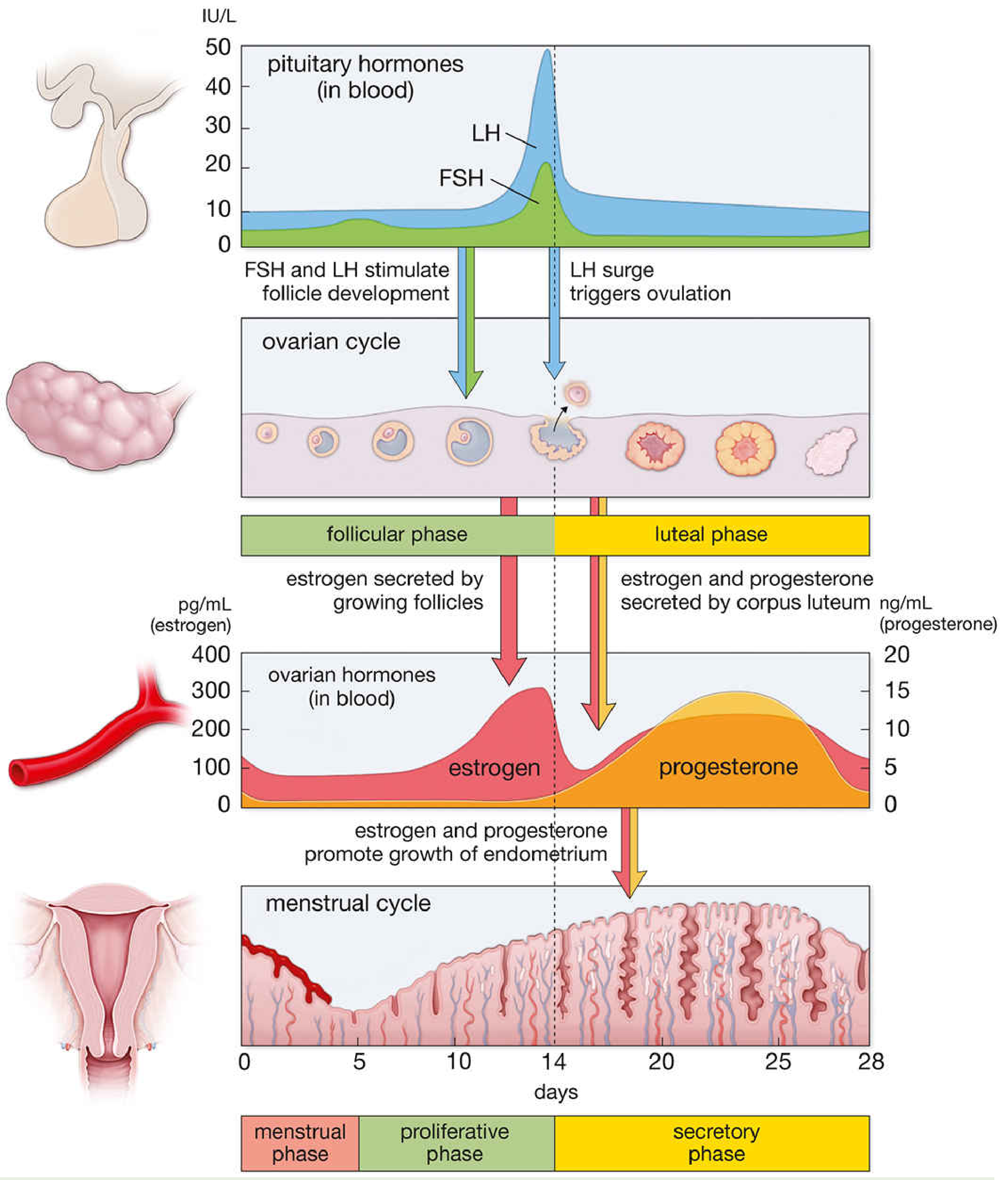
PART 1: What IS Menstruation? - The Definition
- Hypothalamus (GnRH pulse generator)
- Anterior Pituitary (FSH + LH secretion)
- Ovaries (follicle development, estrogen + progesterone secretion)
- Uterus (endometrial response)
PART 2: The Two Parallel Cycles Running Simultaneously
| Ovarian Cycle | Uterine (Endometrial) Cycle | |
|---|---|---|
| What changes | Follicle → ovulation → corpus luteum | Endometrium: builds up → sheds |
| Phase 1 | Follicular phase (Days 1-14) | Menstrual + Proliferative phase |
| Phase 2 | Luteal phase (Days 14-28) | Secretory phase |
| Controlled by | FSH + LH from pituitary | Estrogen (Phase 1) + Progesterone (Phase 2) |
PART 3: The Full Cycle - Day by Day, Phase by Phase
🔴 PHASE 1: Menstrual Phase (Days 1-5)
- The egg was not fertilized
- Corpus luteum degenerated (luteolysis)
- Estrogen AND progesterone levels crashed simultaneously
- This sudden hormone withdrawal is the trigger
- Spiral arteries (which supply the functional endometrial layer) go into vasospasm - they constrict and cut off blood supply
- The functional layer becomes ischemic (no oxygen)
- Tissue dies and the arterial walls break down
- Prostaglandins (especially PGF2α) are released - these cause further vasoconstriction AND uterine muscle contractions
- The dead, ischemic endometrial layer + blood = menstrual flow
- This flows out through the cervix for 4-5 days
- Volume: 30-80 mL blood loss is normal
- Blood (arterial + venous)
- Fragments of endometrial stroma and glands
- Prostaglandins
- Tissue fluid
- It does NOT clot normally because plasminogen activators in the endometrium actively lyse clots as they form (that's why menstrual blood is typically liquid)
- FSH begins to rise again (because estrogen and progesterone are now low - no negative feedback)
- A new cohort of 10-20 primary follicles begins to be recruited
🟢 PHASE 2: Proliferative Phase (Days 5-14) - "The Rebuilding Phase"
- Rising FSH stimulates granulosa cells in primary follicles to grow
- Granulosa + theca cells together synthesize estradiol (E2) - the dominant estrogen
- By Days 5-7, one follicle becomes the dominant follicle (Graafian follicle) - the rest undergo atresia
- Endometrium regenerates: surface epithelium covers the raw, post-menstrual surface first
- Endometrial thickness increases 2-3 fold (from ~1-2 mm to 8-10 mm)
- Uterine glands grow longer and straight (not yet secreting)
- Spiral arteries elongate
- Water content increases
- Cervical mucus becomes thin, clear, and "spinnbarkeit" (stretchy) - maximally receptive to sperm
- Early follicular: low estrogen → negative feedback → keeps FSH/LH in check
- Late follicular (around Day 12-13): estrogen peaks above 200 pg/mL threshold → POSITIVE feedback switch → triggers the LH surge
⚡ OVULATION - Day 14 (in a textbook 28-day cycle)
- Estrogen's positive feedback causes a massive, sharp spike in LH (and a smaller FSH spike)
- LH surge begins ~36-48 hours before ovulation
- Ovulation occurs 10-12 hours after the LH PEAK (or ~34-36 hours after surge onset)
- LH activates proteolytic enzymes (collagenases) that digest the follicle wall
- The dominant follicle ruptures (you can sometimes feel this as Mittelschmerz - brief unilateral pelvic pain)
- The secondary oocyte (still in meiosis II) is expelled with the cumulus oophorus into the fallopian tube
- Fimbriae sweep it in
- Window of fertilization: 12-24 hours after ovulation
- Sperm can survive in female tract for up to 5 days (hence fertile window = Day 10-14 approximately)
🟡 PHASE 3: Luteal Phase / Secretory Phase (Days 14-28)
- The ruptured follicle's granulosa and theca cells don't die - they luteinize
- They become the corpus luteum (yellow body - loaded with lipid droplets)
- The corpus luteum secretes BOTH progesterone (dominant, rises to 10-20 ng/mL) AND estrogen (secondary)
- This is maintained by LH from the pituitary
- If no fertilization → corpus luteum degenerates at Day 24-26 (luteolysis)
- If fertilization → embryo secretes hCG by Day 8-10 post-fertilization, which "rescues" the corpus luteum
- Progesterone transforms the proliferative endometrium into the secretory endometrium
- Uterine glands become wide, tortuous, corkscrew-shaped (key histology feature)
- Glands secrete glycogen-rich fluid - this is the "uterine milk" that nourishes the embryo before implantation
- Spiral arteries become increasingly coiled and prominent
- Endometrial stroma becomes edematous
- Decidualization begins (stromal cells enlarge into decidual cells - ready to support implantation)
- High progesterone → negative feedback on hypothalamus → reduces GnRH pulse frequency → suppresses FSH and LH → prevents a new follicle from maturing mid-cycle (smart design - you don't ovulate twice in one cycle)
- Corpus luteum degenerates → estrogen and progesterone fall → spiral arteries spasm → ischemia → menstruation begins again (Day 28/1)
PART 4: The Hormone Timeline - A Clean Summary
| Hormone | Where made | Peaks | Function |
|---|---|---|---|
| GnRH | Hypothalamus | Pulsatile throughout; peaks late follicular | Stimulates FSH + LH release |
| FSH | Anterior pituitary | Early follicular + small midcycle surge | Follicle growth, estrogen synthesis |
| LH | Anterior pituitary | MASSIVE midcycle surge (Day 14) | Triggers ovulation, forms corpus luteum |
| Estradiol (E2) | Granulosa/theca cells → corpus luteum | Day 12-13 (pre-ovulation peak) + luteal peak | Endometrial proliferation, LH surge trigger, cervical mucus |
| Progesterone | Corpus luteum | Luteal phase (Days 14-28, peaks Day 21) | Secretory endometrium, negative feedback, basal body temp rise |
| Inhibin B | Granulosa cells | Follicular phase | Inhibits FSH (fine-tunes follicle selection) |
PART 5: How to Calculate Your Next Period Date
Basic Formula
But "28 days" is just the average. How do you find YOUR cycle length?
- Period starts: May 5 → next period starts June 2 = 28 days
- Period starts: June 2 → next period starts July 1 = 29 days
- Period starts: July 1 → next period starts July 29 = 28 days
- Average: (28 + 29 + 28) / 3 = 28.3 days → round to 28
Ovulation date calculation (important for your skin!)
- 28 - 14 = Day 14 → ovulation around Day 14
- 32 - 14 = Day 18 → ovulation around Day 18
The Premenstrual Window (when your skin flares)
PART 6: Mapping This to Your Skincare - The Cycle-Based Skincare Schedule
🔴 Days 1-5: MENSTRUAL PHASE
- Minimal actives - just your Cica ampoule + barrier solution + CeraVe + SPF
- Skip tazarotene for Days 1-3 if skin feels irritated
- Gentle double cleanse only
- No AHA/BHA peel this week
- Spot treat active pustules with BPO only
🟢 Days 6-13: FOLLICULAR / PROLIFERATIVE PHASE
- Maximum tazarotene frequency: 4-5 nights/week
- Your AHA/BHA peel can be used here (once, mid-week)
- All your brightening actives (Suganda, LRP Mela B3) are working at their best here because inflammation is lowest
- Introduce any new product during this phase only (lowest reactivity)
- PDRN serum (when you start): start in this phase
⚡ Day 14 (approx): OVULATION
🟡 Days 15-22: EARLY LUTEAL PHASE
- Maintain tazarotene 3-4 nights/week - this is where it's actually preventing the next breakout
- Continue full brightening routine AM and PM
- Azelaic acid daily (whole face) - this is anti-comedogenic in the background
- Do NOT reduce actives here - this is when the acne is being formed, even though you can't see it yet
🟠 Days 23-28: LATE LUTEAL / PREMENSTRUAL PHASE
- Tazarotene: 2 nights max. Use the sandwich method strictly (moisturize before AND after)
- Skip the AHA/BHA peel entirely this week
- Keep Suganda AM + LRP Mela B3 PM as usual (these are not irritating)
- BPO: spot treat only on active pustules
- Priority: barrier repair - Cica ampoule + TO Barrier Solution + Althea 147
- Drink more water. Reduce sugar + dairy + high GI foods in this week specifically (these spike insulin → spikes androgens → more sebum)
Your Personal Skincare Calendar Template
CYCLE DAY     PHASE              TAZAROTENE    PEEL    FOCUS
Days 1-5     Menstrual          0-1x/week     NO      Barrier repair
Days 6-13    Follicular         4-5x/week     YES*    MAX actives, brighten
Day 14       Ovulation          4-5x/week     NO      Continue
Days 15-22   Early luteal       3-4x/week     NO      Prevent microcomedones
Days 23-28   Late luteal        2x/week       NO      Calm, barrier repair

*Peel only ONCE in Days 6-13. Never in Days 23-28.
Quick Med School Summary (Exam-Ready)
| Uterine | Days | Ovarian | Driver |
|---|---|---|---|
| Menstrual | 1-5 | Follicular | FSH → new follicle recruitment |
| Proliferative | 5-14 | Follicular | Estrogen → endometrial rebuild |
| Secretory | 14-28 | Luteal | Progesterone → secretory transformation |
- FSH rises first → follicle grows → estrogen rises
- Estrogen >200 pg/mL for >50h → POSITIVE feedback → LH surge
- LH surge → ovulation 36h later
- Post-ovulation: corpus luteum forms → progesterone dominates
- No pregnancy → luteolysis → estrogen/progesterone fall → menstruation
Hey so now this is matter since I use celimax barrier repair toner in am ....I want to follow it up with something more for hydration what to use ....i use snail mucin....is it ok or should I use Hyaluronic acid serum so the concept goes like celimax toner for hydration and snail mucin for repair in AM and skin 1004 probio cica ampoule for soothing and an HA serum for hydration in pm how does t sound and am thinking of going with iunik beta glucan serum or snail mucin for om extra hydration you say what shall I use snail mucin in pm too or opt for HA acid serum.....
First: Understand What Each Ingredient Actually Does
| Ingredient | Type | Mechanism | Skin layer it works at |
|---|---|---|---|
| Hyaluronic Acid (HA) | Humectant | Pulls water from dermis/environment into the epidermis | Epidermis (surface-mid) |
| Snail Mucin (COSRX/etc.) | Humectant + film-former + repair | Draws moisture + forms a protective film + contains growth factors (allantoin, glycoprotein) for repair | Epidermis + surface barrier |
| Beta Glucan (iUNIK) | Humectant + anti-inflammatory | Pulls moisture deeply + calms redness + mild barrier support | Deeper epidermis, very soothing |
| Celimax Barrier Repair Toner | Hydrating toner | Delivers immediate surface hydration, preps skin for absorption | Surface/stratum corneum |
| Skin 1004 Probio Cica Ampoule | Soothing + mild humectant | Centella soothes, ferments hydrate, probiotic filtrate calms | Epidermis + barrier |
Your Question Answered Directly
AM - What to pair with Celimax Barrier Repair Toner?
-
Snail mucin does everything HA does PLUS more. It hydrates (like HA) AND has allantoin which has mild anti-inflammatory + skin-smoothing properties + supports wound healing. For post-acne skin with PIH, this is actually useful extra work being done.
-
HA has a critical limitation you need to know: Pure HA serums, especially with larger molecular weight HA only, can actually PULL water OUT of your skin in low-humidity environments (like air-conditioned offices/pharmacies). If you don't seal it immediately with a moisturizer, HA can backfire on dry skin. Snail mucin has its own film-forming ability so it is more forgiving.
-
In AM you already have multiple actives coming (Suganda serum, azelaic acid, LRP Mela B3) - snail mucin as a light hydrating + repair base layer before those actives makes more sense than a pure HA serum.
- CeraVe Hydrating Cleanser
- Celimax Barrier Repair Toner (pat in, not wipe)
- Snail Mucin (COSRX 96% or similar - light layer, absorb fully)
- Suganda Depigmentation Serum
- Anua Azelaic Acid
- LRP Mela B3 Serum
- TO Barrier Support Solution
- Althea 147 Cream
- Y.O.U SPF 50
PM - Snail Mucin again OR iUNIK Beta Glucan OR HA serum?
Final Routine Structure - Both AM and PM
AM (Complete)
| Step | Product | Role |
|---|---|---|
| 1 | Garnier Micellar Oil → CeraVe Cleanser | Cleanse |
| 2 | Celimax Barrier Repair Toner | First hydration hit |
| 3 | Snail Mucin | Humectant + repair base |
| 4 | Suganda Depigmentation Serum | Tranexamic acid + arbutin + niacinamide |
| 5 | Anua Azelaic Acid | Acne + PIH + melasma |
| 6 | LRP Mela B3 Serum | Niacinamide + melasyl |
| 7 | TO Barrier Support Solution | Lipid barrier reinforcement |
| 8 | Althea 147 Cream | Seal + moisturize |
| 9 | Y.O.U SPF 50 (blue cap) | UV protection |
PM - Regular nights (non-retinoid)
| Step | Product | Role |
|---|---|---|
| 1 | Double cleanse | Remove sunscreen + makeup |
| 2 | Skin 1004 Probio Cica Ampoule | Soothe + probiotic repair |
| 3 | iUNIK Beta Glucan Serum | Deep hydration + anti-inflammatory |
| 4 | LRP Mela B3 Serum | PM depigmentation |
| 5 | TO Barrier Support Solution | Lipid barrier |
| 6 | Althea 147 Cream | Seal |
PM - Retinoid nights (tazarotene)
| Step | Product | Role |
|---|---|---|
| 1 | Double cleanse | - |
| 2 | Skin 1004 Probio Cica Ampoule | Soothe + probiotic repair |
| 3 | Snail Mucin (thin layer) | Pre-retinoid hydration + repair buffer |
| 4 | Wait 2 min | - |
| 5 | Tazarotene | Retinoid |
| 6 | Wait 10-15 min | - |
| 7 | TO Multipeptide + HA Serum | Post-retinoid hydration |
| 8 | TO Barrier Support Solution | Seal |
| 9 | Althea 147 Cream | Final seal |
So to directly answer your three questions:
Beta glucan is highly piced to be honest suggest an Indian equivalent serum
best Indian brand hydrating serum beta glucan hyaluronic acid affordable acne prone skin 2024 2025 India
Minimalist Deconstruct Dot and Key hydrating serum HA beta glucan India acne sensitive skin
Minimalist multi peptide HA serum OR Deconstruct hydrating serum OR Plum HA serum India acne prone dry skin review price
Indian Alternatives to iUNIK Beta Glucan Serum
🥇 #1 - The Deconstruct Oil-Free Hydrating Serum
- 3-weight HA means it hydrates at different depths (high MW = surface film, low MW = deeper penetration) - this partially replicates how beta glucan works deeper than single-weight HA
- Niacinamide adds anti-inflammatory + skin barrier support - relevant for your acne + PIH
- "Oil-free" formulation means it won't trigger closed comedones - critical for you
- Indian dermatologist Dr. Aanchal Panth (dermatology community trusted name) specifically recommends this for acne-prone + combination skin
- Lightweight texture - works well under other products and on retinoid nights
🥈 #2 - Minimalist Multi-Peptide + HA Serum
🥉 #3 - Plum 2% Hyaluronic Acid Face Serum
Bonus Budget Option - Minimalist Niacinamide 5% Serum
My Direct Recommendation for You
| Night type | Replace iUNIK Beta Glucan with |
|---|---|
| Regular non-retinoid PM nights | Deconstruct Oil-Free Hydrating Serum (₹449) - best fit overall |
| Retinoid nights | Minimalist Multipeptide + HA (you already have this) - use it post-tazarotene as planned |
| Period week (high sensitivity) | Plum HA + B5 Serum (₹395) - gentlest option |
What's the concentration of niaciamide in deconstruct one's you suggested
https://thedeconstruct.in/products/oil-free-hydrating-face-s…
- 1% niacinamide = mild soothing, very gentle, minimal brightening effect
- 5% niacinamide = meaningful anti-inflammatory, some PIH benefit
- 10% niacinamide = full sebum control + visible PIH reduction (can irritate dry/sensitive skin)
- LRP Mela B3 (which contains niacinamide at a functional concentration - ~5%)
- Suganda Depigmentation Serum (5% niacinamide in AM)
Hey instead of just plain HA for hydration what if I add an multi peptide +HA serum form ordinary or minimalist in my routine daily during PM
Multi-Peptide + HA vs Plain HA - The Difference
| Function | Plain HA | Multi-Peptide + HA |
|---|---|---|
| Hydration | ✅ | ✅ |
| Barrier repair signaling | ❌ | ✅ (peptides signal fibroblasts) |
| Collagen/elastin support | ❌ | ✅ |
| Post-acne skin recovery | ❌ | ✅ |
| Reduces retinoid irritation | Partially | Better - peptides actively support repair |
TO vs Minimalist - Which One?
| The Ordinary Buffet (Multi-Peptide + HA) | Minimalist Multi-Peptide + HA | |
|---|---|---|
| Price | ~₹1,150-1,300 | ~₹599 |
| Peptides included | Matrixyl 3000, Matrixyl Synthe'6, Leuphasyl, Argireline, others - very comprehensive | Matrixyl 3000, Syn-Ake, others - solid but fewer |
| HA | Yes (multiple weights) | Yes |
| Texture | Watery, absorbs fast | Similar - lightweight |
| Acne-prone compatibility | ✅ Non-comedogenic | ✅ Non-comedogenic |
| Best for | Richer peptide profile, more anti-aging signaling | Budget-friendly, still effective |
Where It Fits in Your PM Routine
Regular (non-retinoid) PM nights:
- Double cleanse
- Skin 1004 Probio Cica Ampoule
- Multipeptide + HA Serum ← goes here, after ampoule
- LRP Mela B3 Serum
- TO Barrier Support Solution
- Althea 147 Cream
Retinoid (tazarotene) PM nights:
- Double cleanse
- Skin 1004 Probio Cica Ampoule
- Snail mucin (thin layer - pre-retinoid buffer)
- Tazarotene → wait 10-15 min
- Multipeptide + HA Serum ← post-retinoid hydration
- TO Barrier Support Solution
- Althea 147 Cream
Bottom Line
Can I still add snail mucin in non retinoid nights if so how will it be effective
What Snail Mucin Adds That Peptide + HA Doesn't
| Function | Multipeptide + HA | Snail Mucin (96% filtrate) |
|---|---|---|
| Humectant hydration | ✅ HA | ✅ Mucopolysaccharides |
| Collagen signaling (deep dermis) | ✅ Peptides | ❌ |
| Surface wound healing + repair | ❌ | ✅ Allantoin |
| Skin-smoothing / texture | Partially | ✅ Glycoproteins |
| Anti-inflammatory (surface level) | Mild | ✅ More pronounced |
| Post-acne mark recovery | Minimal | ✅ Active role |
| Film-forming barrier on surface | ❌ | ✅ |
Yes or No - Is the Combination Worth It?
- Active post-acne marks (PIH) - snail mucin's allantoin + glycoprotein actively supports this
- Residual inflammation from hormonal acne - snail mucin calms this
- Dry + sensitized skin from tazarotene use - snail mucin's film-forming property adds a moisture-locking layer that a watery peptide serum alone doesn't provide
- Texture concerns from closed comedones - glycoproteins in snail mucin smooth the surface over time
How to Layer It Correctly
Non-Retinoid PM Nights - Updated Order:
| Step | Product | Why |
|---|---|---|
| 1 | Double cleanse | - |
| 2 | Skin 1004 Probio Cica Ampoule | Soothe, probiotic |
| 3 | Multipeptide + HA Serum | Watery - goes first, deep repair |
| 4 | Snail Mucin | Slightly thicker - surface repair + moisture film |
| 5 | LRP Mela B3 Serum | Depigmentation |
| 6 | TO Barrier Support Solution | Lipid barrier |
| 7 | Althea 147 Cream | Final seal |
One Practical Flag
Hey so i use in philippines right now Y.O.U sunscree the one for sensitive skin before and now i use y.o.Us unscreen with blue cap
Now back to India I want an exact sunscreen.....that's as equal to y.o.i sensitive sunscreen i found few prdts like formularx sunscreen ,but that's an tinted one ,so can't use it often , minimalist light fluid sunscreen ,and deconstruct oat and ceramide sunscreen now the thing here is that whether since it's an gel formulation is it suitable for my skin type ,also simple hydrating fluid sunscreen and PHF sunscreen...now rank all these sunscreens accordingly
Y.O.U sensitive skin sunscreen ingredients SPF Philippines white cap formulation
Minimalist light fluid sunscreen SPF 50 ingredients acne prone dry skin India review 2024 2025
https://incidecoder.com/products/be-minimalist-light-fluid-s…
Deconstruct oat ceramide sunscreen Simple hydrating fluid PHF sunscreen India ingredients SPF review acne dry sensitive skin
https://incidecoder.com/products/deconstruct-oats-and-cerami…
Simple hydrating light fluid sunscreen India SPF 50 ingredients PHF sunscreen India acne dry sensitive skin
First: What the Y.O.U Sensitive Skin Sunscreen Does That You're Replacing
- Very lightweight fluid/milky texture
- Fragrance-free
- Gentle on the barrier - no stinging
- Suitable for dry + sensitive skin
- Adequate UV protection for Philippine/tropical sun
Full Ranking - All 5 Sunscreens For Your Skin Type
🥇 Rank 1 - Simple Hydrating UV Fluid SPF 50 PA++++
- Formulation type: Fluid - same lightweight, fluid texture as Y.O.U. Not a gel, not a cream. Fluid specifically means it spreads easily, absorbs fast, sits comfortably under makeup
- Key ingredients: Hyaluronic Acid + Glutathione + Amino Acids - hydrating actives built INTO the sunscreen, which is exactly what dry skin needs
- Specifically marketed for: Dry + Sensitive skin (that's you, exactly)
- No white cast
- PA++++ - maximum UVA protection rating - critical for your melasma
- Dimethicone base - gives a smooth skin-feel, plays well with makeup on top
- Price: ₹449 for 40ml - reasonable
🥈 Rank 2 - Minimalist Light Fluid SPF 50 PA++++
- Formulation: Fluid - runny, water-light texture, blends immediately into skin
- UV filters: Tinosorb M (broad-spectrum, covers UVA + UVB + visible blue light) - this is actually a superior UV filter compared to most Indian sunscreens. For melasma especially, protection against visible light matters
- No white cast, no fragrance, no stinging - confirmed by r/IndianSkincareAddicts community
- Photostable - doesn't degrade in sunlight
- 50ml for ₹399 - best value on this list
🥉 Rank 3 - Deconstruct Oat + Ceramide Gel Sunscreen SPF 50 PA++++
- Contains Squalane - an emollient that's excellent for dry + acne-prone skin, non-comedogenic, adds lipid moisture
- Contains oat extract - calming for sensitive/reactive skin (relevant for your perimenstrual flares)
- Contains ceramides - barrier repair built in
- Primarily water + polymer thickeners = can feel slightly drying for very dry skin in low-humidity environments
- Designed by Deconstruct specifically for sensitive AND oily skin (their own website says "oily + sensitive") - note oily comes first
- The squalane and ceramides partially compensate for this, but you'd need to seal it well with your Althea 147 cream
Rank 4 - FormularyX Tinted Sunscreen
Rank 5 - PHF Sunscreen
Final Ranking Summary
| Rank | Sunscreen | Best for | Price | Texture |
|---|---|---|---|---|
| 🥇 1 | Simple Hydrating UV Fluid SPF 50 | Dry + sensitive, closest to Y.O.U | ₹449 | Fluid |
| 🥈 2 | Minimalist Light Fluid SPF 50 | Best UV filter tech, all skin types | ₹399 | Fluid |
| 🥉 3 | Deconstruct Oat + Ceramide Gel | Sensitive + oily/combination primarily | ₹449 | Gel |
| 4 | FormularyX Tinted | Weekend/no-makeup + melasma | - | Cream/fluid |
| 5 | PHF Sunscreen | Need more info to rank fairly | ~₹300 | - |
My Direct Recommendation For You
It's not PHF sunscreen it's sunscreen from the brand called P.H.D
PHD skincare brand India sunscreen SPF 50 ingredients review acne sensitive skin
https://phdbeauty.com/products/niacinamide-dry-touch-matte-s…
PHD Panthenol hydrating gel sunscreen India ingredients SPF 50 dry sensitive skin review
P.H.D Brand - Two Sunscreens, Very Different Profiles
P.H.D Niacinamide Dry Touch Matte Sunscreen SPF 50 PA++++
- Texture: Matte finish, dry touch, oil-control
- Key ingredients: Niacinamide + Centella Asiatica + UV filters with blue light protection
- Designed for: Oily + acne-prone skin primarily
- Skin feel: Non-sticky, mattifying
P.H.D Panthenol Hydrating Gel Sunscreen SPF 60 PA++++
- Texture: Gel - lightweight, non-greasy
- Key ingredients: Panthenol (Vitamin B5) - a humectant + skin-restoring ingredient, SPF 60 (higher than the others)
- Designed for: Dry + sensitive skin - panthenol is specifically a barrier-repairing ingredient
- Skin feel: Hydrating, comfortable, non-sticky
- Users with dry skin specifically praise it as "best for dry skin"
UPDATED Full Ranking - All 5 Sunscreens for Your Skin
| Rank | Sunscreen | Texture | Dry Skin Suitability | Key Benefit for You | Price |
|---|---|---|---|---|---|
| 🥇 1 | Simple Hydrating UV Fluid SPF 50 | Fluid | ✅✅ Specifically for dry/sensitive | HA + Glutathione + Amino acids built in | ₹449 |
| 🥈 2 | Minimalist Light Fluid SPF 50 | Fluid | ✅✅ All skin types, no drying | Tinosorb M - best UV filter for melasma | ₹399 |
| 🥉 3 | P.H.D Panthenol Hydrating Gel SPF 60 | Gel | ✅ Good with caveats | SPF 60 (highest here) + Panthenol repairs barrier | ~₹349-399 |
| 4 | Deconstruct Oat + Ceramide Gel SPF 50 | Gel | ⚠️ Primarily oily/sensitive | Ceramides + Squalane compensate for gel base | ₹449 |
| 5 | FormularyX Tinted | Fluid/cream | ✅ For dry skin | Iron oxides help melasma - weekend only option | - |
| (P.H.D Matte - not for you) | P.H.D Niacinamide Dry Touch Matte | Matte | ❌ Drying for dry skin | Good for oily skin, not yours | ~₹349 |
The Gel Texture Question - Answered for P.H.D Panthenol Specifically
- Panthenol (B5) is a humectant that actively pulls and holds moisture - it counteracts the typical drying nature of gel bases
- SPF 60 means you'd need less product volume to achieve full protection (more efficient coverage)
- Multiple dry skin users specifically call it out as hydrating and comfortable
Final Straight Answer
What about dermaco 1 percent hyaluronic acid getk sunscreen.....
Dermaco 1% hyaluronic acid gel sunscreen SPF 50 India ingredients review acne sensitive dry skin
The Derma Co 1% Hyaluronic Acid Aqua Gel Sunscreen SPF 50 PA++++
Ingredient Profile - This is Genuinely Impressive
| Ingredient | What it does for you |
|---|---|
| Sodium Hyaluronate (1%) | Humectant - 24hr hydration, plumps dry skin |
| 5 Ceramides (EOP, NG, NP, AS, AP) | Full ceramide complex - identical to what CeraVe uses. Repairs and maintains skin barrier |
| Panthenol (B5) | Skin-restoring humectant, soothes irritation |
| Niacinamide | Anti-inflammatory, PIH reduction (though concentration not disclosed) |
| Glycerin | Humectant, skin-identical |
| Tocopheryl Acetate (Vit E) | Antioxidant, UV damage repair |
| Xylitol complex | Prebiotic-like, supports skin microbiome |
| 6 UV filters | Broad spectrum including Tinosorb M (same as Minimalist) |
The Gel Texture Question - Same Answer as Before
- The ceramide complex + panthenol + HA inside the formula itself compensate significantly for the gel base
- It's an "aqua gel" not a "matte gel" - aqua gel formulations are intentionally more hydrating than standard gels
- It does NOT have alcohol or silica (which typically exacerbate dryness in gel sunscreens)
Where It Now Sits in Your Ranking
| Rank | Sunscreen | Texture | Dry Skin Fit | Standout Feature | Price |
|---|---|---|---|---|---|
| 🥇 1 | Dermaco 1% HA Aqua Gel SPF 50 | Aqua gel | ✅✅ Best ingredient deck | 5 ceramides + HA + panthenol + niacinamide + 6 UV filters - all in one | ₹549-699 |
| 🥈 2 | Simple Hydrating UV Fluid SPF 50 | Fluid | ✅✅ Dry/sensitive targeted | Closest to Y.O.U texture, fluid not gel | ₹449 |
| 🥉 3 | Minimalist Light Fluid SPF 50 | Fluid | ✅✅ All skin types | Tinosorb M UV filter, best value | ₹399 |
| 4 | P.H.D Panthenol Hydrating Gel SPF 60 | Gel | ✅ Good | SPF 60, panthenol | ~₹349 |
| 5 | Deconstruct Oat + Ceramide Gel | Gel | ⚠️ Oily/sensitive primary | Squalane + ceramides | ₹449 |
My Honest Take on Dermaco for You Specifically
- Ceramide complex directly supports your barrier - relevant because tazarotene is compromising it nightly
- Niacinamide inside means one less active you need to worry about stacking in AM (though concentration is low)
- HA + Panthenol = dual humectant system inside the sunscreen itself
- Cult-favourite recommendation by Dr. Aanchal Panth (Indian dermatologist) for 3+ years - that consistent recommendation matters
- 6 UV filters including Tinosorb M = excellent protection for your melasma
- At ₹549-699 it's the priciest option here - though for 50g with this ingredient density it's arguably the best rupee-per-benefit ratio
- Some users report it feeling "slightly heavy" - on dry skin this is unlikely to be a problem (heavier = more comfortable for you), but it may not be as featherlight as Simple or Minimalist fluid formulas
Now .... comparing H.O.CL sprays ....in pH i used hocl spray from brand called Dr.O it was fune ....but the luxe organic hocl spray suited really well for my skin now suggest H.O.C.L spray available in india ,that's as equal to luxe organic h.o.cl spray
Luxe Organix HOCL spray ingredients concentration pH hypochlorous acid
hypochlorous acid HOCL spray India brand acne sensitive skin 2024 2025
First: What Luxe Organix HOCL Spray Actually Is
- Concentration: 0.02% = 150 ppm Hypochlorous Acid
- Ingredients: Water, Sodium Chloride, Hypochlorous Acid - that's it. 3 ingredients only
- pH: Slightly acidic (4-6 range) - stable and skin-safe
- Irritation index: 0.00% - essentially zero irritation potential
- What it does: Antibacterial mist, kills C. acnes on contact, reduces redness, calms active breakouts, safe for sensitive skin
Indian HOCL Sprays - Ranked Against Luxe Organix
🥇 Rank 1 - Minimalist HOCL Skin Relief Spray 150 ppm
| Parameter | Luxe Organix | Minimalist |
|---|---|---|
| HOCL concentration | 150 ppm (0.02%) | 150 ppm - exact match |
| Ingredients | Water, NaCl, HOCl | Water, HOCl - minimal |
| Fragrance | None | None |
| Alcohol | None | None |
| pH | Slightly acidic | Slightly acidic |
| Volume | 100ml | 200ml - double the volume |
| Skin types | All, sensitive/acne | All skin types |
🥈 Rank 2 - The Derma Co Hypochlorous Anti-Acne Spray
❌ What to Avoid - The "Salt Water" Problem
- No chlorine smell at all
- No disclosed ppm concentration on the label
- Very cheap (under ₹200 for 200ml)
- Vague claims like "electrolyzed water" with no ppm stated
- Dr. Algar brand falls into this category - concentration not publicly verified
How to Use HOCL in Your Routine
- Spray on top of makeup mid-day when skin feels oily, itchy, or irritated
- Keeps C. acnes population down throughout the day
- Safe over makeup - won't disturb it
- After double cleanse, before any serums - spray, let air dry, then proceed with routine
- Acts as a gentle antibacterial first step especially during breakout week
- Use liberally on active papules/pustules - it reduces bacterial load and inflammation without irritating sensitized skin
- Better than spot-applying BPO on already-reactive perimenstrual skin
- Quick spray to prevent sweat-triggered breakouts before you can double cleanse
Bottom Line
My concern is that luxe prganx HOCL spray has panthenol and stuffs for soothing but minimalist ditn have it ...but dermaco has it that's the confusion
Luxe Organix hypochlorous acid spray full ingredients list panthenol aloe soothing Philippines
Dermaco hypochlorous anti acne spray full ingredients list ppm concentration India
The Full Ingredient Comparison - Side by Side
| Ingredient | Luxe Organix | Minimalist | Dermaco |
|---|---|---|---|
| Water | ✅ | ✅ | ✅ |
| Hypochlorous Acid | ✅ 150ppm | ✅ 150ppm | ✅ (ppm not disclosed) |
| Sodium Chloride | ✅ | ✅ | ✅ |
| Glycerin (humectant) | ❌ | ❌ | ✅ |
| Allantoin (soothing/repair) | ❌ | ❌ | ✅ |
| Phenoxyethanol + Ethylhexylglycerin | ❌ | ❌ | ✅ (preservative) |
Here's the Thing - You Were Right to Question This
What Dermaco's Extras Actually Do
Updated Verdict - Which One for You
-
Your skin is dry + sensitized from tazarotene - the added glycerin and allantoin in Dermaco mean the spray is actively hydrating and soothing, not just antibacterial. Minimalist's pure HOCL can feel slightly astringent on very dry skin.
-
Allantoin = meaningful benefit for you - you have post-acne marks, retinoid irritation, and perimenstrual inflammation. Allantoin directly supports skin healing in all three scenarios.
-
You already tolerated Luxe Organix well - Luxe Organix's simplicity (3 ingredients) means you have no baseline irritant to attribute sensitivity to. Dermaco adds only gentle, well-tolerated ingredients (glycerin + allantoin are among the safest in skincare). Low risk of a bad reaction.
-
One con to flag honestly: Dermaco's ppm is not publicly disclosed. This is the only weakness vs Minimalist's transparent 150 ppm spec. However Dermaco is a dermatologist-formulated brand with strong accountability - it's unlikely their HOCL is underdosed.
Final Ranking - Updated
| Rank | Product | Best For |
|---|---|---|
| 🥇 1 | Dermaco Hypochlorous Anti-Acne Hydrating Spray | Your skin - dry, sensitive, retinoid-using, acne-prone. HOCL + glycerin + allantoin = antibacterial + soothing + healing |
| 🥈 2 | Minimalist HOCL 150 ppm | Pure HOCL if you want zero extras, transparent concentration, oily/combo skin types |
I just skipped my night skincare routine so used now used sandwich mehid and applied retinol got like only Two hours is it ok for retinol to work in this two hours .....
How Retinoids Actually Work - The Timeline
- Normalize follicular keratinization (prevents comedones)
- Reduce inflammatory mediators
- Accelerate cell turnover
The "8 Hours Overnight" Myth - Clarified
- Tretinoin (not tazarotene) degrades with UV exposure - so daytime use wastes product
- Skin repair and cell turnover naturally peak at night (circadian rhythm)
- Convenience - you're not going anywhere, so extended contact doesn't interfere with your day
What Actually Matters More Than Duration
- Consistency - using it regularly (4-5x/week) matters more than any single night's contact time
- Correct application - dry skin, thin layer, right sandwich technique (which you did)
- Not washing it off within 30 minutes - you're well past that
hey suggest exact indian equivalent or a valid price prdts that's available in india for the following in terms of goal, formulation and texture 1.celimax dual barrier repair toner 2.cos rx snail mucin 3. Ordinary barrier repair solution
Celimax dual barrier repair toner ingredients texture hydrating ceramide India equivalent
Indian equivalent snail mucin serum COSRX 96% hydrating repair acne prone skin India brand 2024 2025
Ordinary buffet barrier support solution ingredients ceramide cholesterol fatty acid Indian equivalent brand
Dermaco snail peptide 96 serum ingredients full list India price vs COSRX snail mucin
Indian brand barrier repair serum ceramide cholesterol sphingolipid fatty acid Minimalist Deconstruct Dermaco 2024 2025
1. Celimax Dual Barrier Creamy Toner → Indian Equivalent
- 5 types of ceramides + Aquatide (patented peptide that stimulates barrier building) + panthenol + HA + phytosphingosine
- Texture: creamy toner - thicker than a regular toner, almost lotion-like
- Goal: Deep barrier repair + intense hydration in a first-step toner format
- Not just a prep toner - it's doing serious barrier work
Option A - Minimalist Ceramide 0.3% + Bisabolol Moisturizer (thin layer as toner)
- Contains ceramides + bisabolol (anti-inflammatory)
- Lightweight enough to use as a first thin hydration layer post-cleanse
- Not as ceramide-dense as Celimax but directionally similar
- Texture: lighter than Celimax but closest in the Indian market for this step
Option B - Dot & Key 12% Barrier Boost Serum (HA + Ceramides)
- HA + ceramides in a serum format
- Goes right after cleansing, same slot as Celimax
- Closest match in goal: hydration + barrier support as a first active layer
- Texture: serum/fluid - lighter than Celimax's creaminess but same barrier intent
2. COSRX Advanced Snail 96 Mucin → Indian Equivalent
- 96% Snail Secretion Filtrate - single hero ingredient, almost nothing else
- Texture: slightly viscous, gel-like, sticky when first applied but absorbs into skin
- Goal: Humectant hydration + surface wound healing + allantoin for repair + glycoprotein for texture smoothing
| Parameter | COSRX 96% | Dermaco Snail Peptide 96 |
|---|---|---|
| Snail filtrate | 96% | 96% - same |
| Added actives | Minimal | 2% Niacinamide + 2% Peptide complex |
| Texture | Sticky gel | Similar gel |
| Goal | Hydration + repair | Hydration + repair + niacinamide bonus |
| Price | ₹725-900 | ~₹499-599 |
3. The Ordinary Soothing & Barrier Support Solution → Indian Equivalent
- Sphingolipids (plant-derived ceramide precursors) + Cholesterol + Fatty acids - this is the lipid trio that makes up your skin's actual barrier mortar
- Cyanocobalamin (Vitamin B12) - anti-redness, anti-inflammatory
- Allantoin - soothing
- Texture: thin pink-tinted serum, watery but lipid-rich
- Goal: Replenish the exact lipid components of the stratum corneum - proper barrier rebuilding, not just surface hydration
- Contains ceramides (covers the sphingolipid component)
- Bisabolol covers the anti-inflammatory/soothing role (like B12 in TO)
- Does NOT have cholesterol or fatty acids explicitly - this is the gap
- But for the price point and availability, it's the closest
Complete Summary Table
| Product | What it does | Best Indian Equivalent | Price |
|---|---|---|---|
| Celimax Dual Barrier Creamy Toner | Ceramide + peptide + HA toner step | Dot & Key 12% Barrier Boost Serum (HA + Ceramides) | ₹599-699 |
| COSRX Snail 96 Mucin | 96% snail mucin hydration + repair | Dermaco Snail Peptide 96 Hydrating Serum | ₹499-599 |
| TO Barrier Support Solution | Sphingolipid + cholesterol + fatty acid lipid triad | Minimalist Ceramide 0.3% (partial) OR your existing CeraVe Moisturizing Cream already covers this | ₹349 or already owned |
Hey what about hyphen ceramide toner
Hyphen ceramide toner ingredients full list texture SPF India acne dry sensitive skin review
https://incidecoder.com/products/hyphen-ceramide-toner-essen…
Hyphen Ceramide + 5% Rice Water Milky Toner Essence
What's Inside - The Good
| Ingredient | Role |
|---|---|
| 5 Ceramides (1, 2, 3, 4, 6II) | Full ceramide complex - same as CeraVe/Celimax |
| Beta-Glucan | Deep humectant + anti-inflammatory - this is the iUNIK beta glucan alternative you were looking for earlier, built INTO this toner |
| Rice Water (5%) | Brightening + mild exfoliation + soothing |
| Sodium Hyaluronate | HA for hydration |
| Allantoin | Soothing, skin repair |
| Snow Mushroom Extract | Humectant stronger than HA |
| Oat Extract | Calming, barrier support |
| Trehalose + Urea + Sodium PCA | NMF (Natural Moisturizing Factor) components - skin-identical humectants |
The Red Flags - Be Aware
How It Compares to Celimax Dual Barrier Toner
| Parameter | Celimax Dual Barrier | Hyphen Ceramide Toner |
|---|---|---|
| Ceramides | 5 types ✅ | 5 types ✅ |
| Peptides/Aquatide | ✅ Aquatide (patented) | ❌ No peptides |
| Beta-Glucan | ❌ | ✅ |
| Rice Water | ❌ | ✅ |
| Snow Mushroom | ❌ | ✅ |
| Allantoin | ✅ | ✅ |
| Comedogenic risk | Low | ⚠️ Isopropyl Myristate present |
| Texture | Creamy toner | Milky toner |
| Price | ~₹1,200-1,500 (imported) | ₹499-599 ✅ |
My Verdict for Your Specific Skin
- If your closed comedones are currently well-controlled (tazarotene is managing them) - you may be able to tolerate it since the retinoid is normalizing follicular keratinization. Monitor for 4 weeks.
- If your closed comedones are still active or you're in a breakout phase - avoid this and go with the Dot & Key Barrier Boost Serum instead (no IPM, ceramides + HA, cleaner formula for acne-prone skin).
What about cerulean cream toner
Cerulean cream toner India ingredients full list ceramide barrier repair acne sensitive skin
https://incidecoder.com/products/cerulean-cream-toner
Cerulean Cream Toner - Full Analysis
What's Inside
| Ingredient | Role | Flag |
|---|---|---|
| Glycerin | Humectant - superstar, 0 comedogenicity | ✅ |
| Butylene Glycol | Humectant + penetration enhancer | ✅ Comedogenicity: 1 (safe) |
| Bisabolol | Anti-inflammatory, soothing | ✅ |
| Glyceryl Glucoside | Humectant | ✅ |
| Glyceryl Caprylate | Natural preservative + mild antimicrobial | ✅ |
| Sweet Almond Oil | Emollient, fatty acids | ⚠️ Comedogenicity: 1-3 |
| Ethyl Olivate Esters | Olive-derived emollient | ⚠️ Oleic acid content |
| Glyceryl Stearate Citrate | Emulsifier | Neutral |
The Key Issues for Your Skin
🔴 Issue 1: Sweet Almond Oil (Comedogenicity 1-3)
🔴 Issue 2: Ethyl Olivate Esters (Olive-derived)
✅ What it does well
Cerulean vs Hyphen vs Dot & Key - Head to Head for Your Skin
| Product | Ceramides | Comedogenic Risk | Best For |
|---|---|---|---|
| Cerulean Cream Toner | ❌ None found | ⚠️ Sweet almond oil + olive ester | Dry/normal skin without acne tendency |
| Hyphen Ceramide Toner | ✅ 5 types | ⚠️ Isopropyl Myristate | Dry skin, acne-prone with caution |
| Dot & Key Barrier Boost Serum | ✅ Ceramides + HA | ✅ Clean, low risk | Acne-prone + dry - safest pick |
Verdict for You - Direct Answer
Suggest a good 10 percent niacinamide serum for my skin type
It should has soothing and hydrating ingredients as well ...
Important Flag Before Recommending 10% Niacinamide
- Flushing and redness (niacin flush - more common at 10%+)
- Tingling and irritation, especially when skin barrier is already compromised by tazarotene
- Counterproductive when you're in a retinoid-sensitized state
- Suganda Depigmentation Serum: 5% niacinamide (AM)
- LRP Mela B3: functional niacinamide concentration (PM)
- Dermaco Sunscreen: contains niacinamide
- Dermaco Snail Peptide 96: 2% niacinamide
But If You Still Want It - Here's My Recommendation
best 10% niacinamide serum India dry sensitive acne prone skin soothing hydrating ingredients 2025
The Reality Check First
| Product | Niacinamide | When |
|---|---|---|
| Suganda Depigmentation | 5% | AM |
| LRP Mela B3 | ~5% | PM |
| Dermaco Sunscreen | Low % | AM |
| Dermaco Snail Peptide 96 | 2% | PM |
Best 10% Niacinamide Serums for Dry + Sensitive + Acne-Prone Indian Skin
🥇 Plum 10% Niacinamide + PHA Face Serum
- 10% niacinamide as the core active
- Contains PHA (Polyhydroxy Acid) - the gentlest exfoliant, suitable for sensitive skin. Unlike AHA/BHA, PHA is also a humectant, so it hydrates while mildly exfoliating
- Formulated with hydrating and soothing co-ingredients - exactly what you asked for
- Specifically designed for dry/sensitive skin (the other options in her list are for oily/combo)
- No zinc (zinc at high % can be drying - problematic for your skin type)
- Fragrance-free
🥈 Minimalist Niacinamide 10% + Zinc 1%
- Zinc sulfate is added for sebum control - useful for oily skin, slightly drying for dry/sensitive skin
- The formula is more bare-bones - less soothing co-ingredients
- Dr. Aanchal recommends this specifically for oily + acne-prone + combination skin
🥉 Dot & Key Niacinamide 10% + Hyaluronic Acid Serum
- 10% niacinamide + HA combination
- HA adds hydration buffer alongside the niacinamide
- Good for dry skin because the HA compensates for any tightness
- Slightly pricier than Plum without a meaningful advantage for your specific concerns
Summary Table
| Product | Best For | Dry Skin Fit | Key Co-Ingredients | Price |
|---|---|---|---|---|
| 🥇 Plum 10% Niacinamide + PHA | Dry + sensitive | ✅✅ | PHA (gentle exfoliant + humectant) | ₹549 |
| 🥈 Minimalist 10% + Zinc | Oily + combo + acne | ⚠️ Zinc drying | Zinc sulfate (sebum control) | ₹527 |
| 🥉 Dot & Key 10% + HA | Normal to dry | ✅ | Hyaluronic acid | ₹599 |
My Direct Recommendation
It's to include during gym rotuine or usual casual routine
Gym Routine = Completely Different Skincare Logic
- Sweat - mixes with sebum, occludes pores, raises skin pH
- Heat - dilates pores, increases sebum flow
- Physical touch - hands on face, equipment contact
- Post-gym cleanse need - actives sitting on skin during sweat = irritation risk
What Your Gym Routine Should Actually Look Like
Pre-Gym (Before workout)
- Gentle rinse or wipe with micellar water (remove any leftover AM skincare residue if going straight from pharmacy/class)
- Thin layer of CeraVe Moisturizing Cream - protects barrier during sweat
- Sunscreen if going outdoors (Y.O.U or Simple fluid) - non-negotiable even for gym if you're outside at any point
- That's it. No serums, no actives, no niacinamide
During Gym
- PHD or Dermaco HOCL spray - mist on face mid-workout if skin feels hot/irritated. Keeps bacterial load down, reduces sweat-triggered breakout risk. This is where HOCL earns its place perfectly.
- Don't wipe sweat with hands or dirty towels - use a clean tissue pat
Post-Gym (Most important step)
- CeraVe Hydrating Cleanser (single cleanse, no double cleanse needed - no sunscreen/makeup)
- If it's your PM slot: proceed with your full PM routine (tazarotene night or regular)
- If it's midday: just moisturize + reapply sunscreen and go
So Where Does the 10% Niacinamide Fit?
This is for gym and casual nearby or stay at home evening rotuine
What This Routine Needs to Do
- Lightweight, breathable - won't clog pores during sweat
- Minimal product layers - you're not wearing full makeup
- Still protective (SPF if going out even briefly)
- Soothing and hydrating post-cleanse
- No heavy actives that react badly with heat and sweat
Your Gym / Casual / Stay-Home Evening Routine
If Going to Gym or Stepping Out Casually (Daytime)
| Step | Product | Why |
|---|---|---|
| 1 | CeraVe Hydrating Cleanser | Clean slate |
| 2 | HOCL Spray (Dermaco) | Anti-bacterial prep, calms skin pre-sweat |
| 3 | CeraVe Moisturizing Cream (thin layer) | Barrier protection during sweat |
| 4 | Sunscreen - Simple Hydrating Fluid or Minimalist Light Fluid | SPF even for 10 min outdoor exposure - melasma doesn't care how short the sun exposure is |
Stay-Home Evening / Casual Indoor Routine
| Step | Product | Why |
|---|---|---|
| 1 | Garnier Micellar Oil + CeraVe cleanser | Clean properly |
| 2 | Dermaco HOCL spray | Antibacterial reset |
| 3 | Skin 1004 Probio Cica Ampoule | Calm + soothe |
| 4 | Snail Mucin (Dermaco 96) | Hydration + repair |
| 5 | CeraVe Moisturizing Cream | Seal |
Now - Where Does the 10% Niacinamide Fit Here?
| Step | Product |
|---|---|
| 1 | Double cleanse |
| 2 | HOCL spray |
| 3 | Cica Ampoule |
| 4 | Plum 10% Niacinamide + PHA ← goes here |
| 5 | Snail Mucin |
| 6 | CeraVe cream |
- No heat/sweat to trigger niacin flush
- PHA in the Plum formula does mild overnight exfoliation - perfect for stay-home evenings
- Niacinamide works on your PIH and sebum regulation overnight
- No retinoid conflict since you're skipping tazarotene this night
- You wake up with calmer, slightly smoother skin
Summary
| Day Type | Use 10% Niacinamide? | Routine Complexity |
|---|---|---|
| Gym day | ❌ No | Minimal 4-step |
| Casual outdoor | ❌ No (keep it light) | Minimal 4-step |
| Stay-home evening (no retinoid) | ✅ Yes - perfect slot | Medium 6-step |
| Regular work/pharmacy day PM | Depends on retinoid night or not | Full routine |
Why I want to include niacinamide in gym routine whether it's am or pm
Why i should not use..... niacinamide during gym coz my am rotuine is separate ,pm it's separate ......but during gn still my dogs is on barrier repair so I just wanna use..... niacinamide for barrier repair.....
When will my credits reset
Apart from micellar water suggest an cleanser for double cleansing deep pore cleansing gentle but effective coz I tried cleansing oil but it doesn't work for me