

1000355481.jpg
Explain me
This is a Forensic Medicine syllabus projected in a classroom. Let me explain each topic in detail.
Searching sources...
Reading File
Finding Sources
Finding Sources
Finding Sources
Finding Sources
Finding Sources
Finding Sources
Reading File
Reading File
Finding Sources
Finding Sources
Finding Sources
Reading File
Reading File
Now I have enough information to give you a comprehensive explanation of your Forensic Medicine syllabus. Here it is:
Forensic Medicine Syllabus - Full Explanation
The image shows a Forensic Medicine & Toxicology course syllabus divided into 6 content blocks (Contents 1-6), with a Midterm Exam after Contents 3.
CONTENTS 1 - Introduction to Forensic Medicine
What is Forensic Medicine?
Forensic medicine (from Latin "forensis" = marketplace, where justice was once dispensed) is the branch of medicine that applies medical knowledge to legal purposes. It has two main arms:
- Medical Jurisprudence - the legal aspects of medical practice (e.g., consent, medical negligence, professional ethics)
- Forensic Pathology - using medicine to aid criminal investigation (e.g., determining cause of death, injuries)
Key concepts covered:
- Definition and scope of forensic medicine
- Medical ethics and medicolegal duties of a doctor
- Legal procedures - writing medical reports, court testimony
- Consent (informed, implied, emergency), medical negligence
- The concept of Corpus Delicti (body of crime - proving a crime occurred)
- Identification of persons (living and dead): age, sex, race, stature, fingerprinting (dactylography), dental records
Source: P C Dikshit Textbook of Forensic Medicine and Toxicology
CONTENTS 2 - Necrology
Necrology is the study of death - its types, signs, and medicolegal importance.
Key topics:
| Sub-topic | Details |
|---|---|
| Definition of death | Somatic/systemic death vs. cellular/molecular death |
| Types of death | Natural, unnatural (accident, suicide, homicide) |
| Signs of death | Cooling of body (algor mortis), stiffening (rigor mortis), discoloration (livor mortis / post-mortem lividity) |
| Time since death (PMI) | Estimated using rigor mortis, decomposition, stomach contents |
| Decomposition | Putrefaction, adipocere formation, mummification |
| Autopsy (post-mortem) | Medicolegal autopsy vs. clinical autopsy, procedures, findings |
| Sudden death | Death within 24 hours of onset of symptoms from natural causes |
| Brain death | Legal and clinical criteria; organ donation implications |
Medicolegal importance: Establishing the time, cause, and manner of death is central to criminal investigations.
CONTENTS 3 - Forensic Medicine of Injuries + MIDTERM EXAM
This block covers the study of wounds, injuries, and their medicolegal significance.
Types of injuries:
| Type | Description | Typical Weapon |
|---|---|---|
| Abrasion | Superficial skin scraping | Rough surface |
| Contusion/Bruise | Bleeding under skin | Blunt force |
| Laceration | Tear/irregular wound | Blunt force |
| Incised wound | Clean-cut wound | Sharp-edged weapon (knife) |
| Stab/Puncture wound | Depth > length | Pointed object |
| Firearm wounds | Entry & exit wound patterns | Guns |
| Bite marks | Dental impressions | Human/animal |
Key medicolegal questions in injury assessment:
- Was the injury ante-mortem (before death), peri-mortem (at time of death), or post-mortem?
- Was it self-inflicted (suicidal) or inflicted by another (homicidal)?
- What was the weapon used?
- What is the age of the injury (healing stages)?
Regional injuries such as head trauma, spinal injuries, and thoracic injuries are also studied in a forensic context.
CONTENTS 4 - Injury & Death due to Asphyxiation, Traffic Accidents, and Electricity
A. Asphyxiation (Asphyxial Deaths)
Asphyxia = death from deprivation of oxygen to the tissues.
Types:
- Hanging - suspension by ligature around neck (suicidal most common)
- Strangulation - manual (throttling) or ligature (homicidal most common)
- Smothering - mouth and nose blocked
- Drowning - water fills the airways
- Choking - obstruction within the airway
- Traumatic asphyxia - chest compression (e.g., crowd crush)
- Positional/Postural asphyxia - body position restricts breathing
Classic signs of asphyxia at autopsy:
- Petechial hemorrhages (tiny burst blood vessels) in eyes, face, lungs
- Cyanosis (bluish discoloration)
- Congestion of organs
- Froth at mouth/nose (drowning)
- Ligature marks on neck
B. Traffic Accidents
- Types of injuries: pedestrian vs. vehicle, occupant injuries
- Run-over injuries, bumper fractures, windshield injuries
- Distinguishing driver from passenger
- Role of seatbelts and airbags in injury pattern
C. Electrical Injuries
- Low voltage (household AC): causes cardiac arrest; entry/exit burns may be subtle
- High voltage: causes extensive burns, charring, "crocodile skin" pattern
- Lightning: produces filigree burns (Lichtenberg figures - branching lightning-bolt patterns on skin), ruptured eardrums
- Electrocution marks: important for identifying the point of contact
CONTENTS 5 - Forensic Toxicology
Forensic Toxicology deals with the medical and legal aspects of the harmful effects of chemicals/poisons on human beings. - The Essentials of Forensic Medicine and Toxicology, 36th Ed.
"A poison is a substance (solid, liquid or gaseous), which if introduced in the living body will produce ill-health or death by its constitutional or local effects or both." - Parikh's Textbook
Classification of poisons:
| Category | Examples |
|---|---|
| Corrosives | Strong acids (H₂SO₄, HCl), strong alkalis (NaOH) |
| Irritants | Arsenic, phosphorus, copper sulfate, food poisoning |
| Neurological | Opiates, barbiturates, organophosphates, alcohol |
| Cardiac | Digitalis, aconitine |
| Asphyxiants | CO (carbon monoxide), cyanide |
Key topics:
- Routes of poisoning (oral, inhalation, skin absorption, injection)
- General symptoms of poisoning and emergency management
- Post-mortem findings in poisoning cases
- Viscera preservation for toxicological analysis
- Medico-legal aspects: Sections 284, 299, 300, 304A, 324, 326, 328 IPC deal with offenses related to administration of poisons
- Drug abuse and its forensic significance (alcohol, narcotics, sedatives)
CONTENTS 6 - Sexual Perversion, Sex Crimes & Role of Pathology in Forensic Medicine
A. Sexual Perversion
Deviations from normal sexual behavior studied in a medicolegal context:
- Fetishism, voyeurism, exhibitionism, sadism, masochism, necrophilia, pedophilia
- Important for criminal profiling and court proceedings
B. Sex Crimes
- Rape - medical examination of the victim, collection of evidence (seminal stains, DNA), hymen assessment, signs of recent intercourse
- Sexual assault - physical injuries, bite marks, defense wounds
- POCSO Act (Protection of Children from Sexual Offences)
- Medicolegal examination of both victim and accused - what to document and how
- DNA evidence - its role in identification and prosecution
C. Role of Pathology in Forensic Medicine
- Histopathology in determining cause and time of death
- Wound aging using histological changes (inflammatory response, fibroblast activity)
- Identifying diseases that may have contributed to death
- Organ-specific pathological findings in various types of deaths (poisoning, asphyxia, head trauma)
- Forensic serology: blood grouping, identification of biological stains (blood, semen, saliva)
Summary Table
| Contents | Topic | Key Focus |
|---|---|---|
| 1 | Introduction | Definition, scope, medicolegal duties, consent, identification |
| 2 | Necrology | Death types, signs, autopsy, time of death |
| 3 | Forensic Injuries | Wound types, weapon identification, ante/post-mortem changes |
| -- | MIDTERM EXAM | Contents 1-3 |
| 4 | Asphyxia, Traffic, Electricity | Cause of death investigation in specific scenarios |
| 5 | Forensic Toxicology | Poisons, their effects, detection, legal aspects |
| 6 | Sex Crimes & Pathology | Sexual offenses, forensic pathology's role |
This is a rigorous, clinically and legally oriented subject that trains you to be a medicolegal expert - bridging medicine and law.
Explain me more detaly
Asking for Preferences
Which topic(s) would you like me to explain in more detail?
I'll go deep on all 6 topics. Let me pull detailed content from the forensic medicine textbooks simultaneously.
Diving deeper...
Reading File
Finding Sources
Finding Sources
Finding Sources
Finding Sources
Finding Sources
Reading File
Reading File
Reading File
Reading File
Reading File
Reading File
Finding Sources
Finding Sources
Reading File
Reading File
Reading File
Reading File
Here is a fully detailed explanation of all 6 topics from your Forensic Medicine syllabus, drawn directly from authoritative forensic medicine textbooks.
CONTENTS 1 - Introduction to Forensic Medicine (Detailed)
What Exactly Is It?
Forensic Medicine is the application of medical knowledge for the purposes of both civil and criminal law. The word "forensic" comes from the Latin "forensis" meaning marketplace - in ancient times, justice was dispensed in public marketplaces. - P C Dikshit Textbook of Forensic Medicine
There are three closely related but distinct branches:
| Term | Meaning |
|---|---|
| Forensic Medicine | Applying medicine to solve legal questions (e.g., cause of death, nature of injury, sexual offence) |
| Medical Jurisprudence | Legal aspects of the practice of medicine (doctor-patient relationship, medical negligence, rights & duties of doctors) |
| Medical Ethics | Moral principles guiding the medical profession in dealing with patients, colleagues, and the State |
| Medical Etiquette | Conventional laws of courtesy between members of the medical profession |
Sub-branches of Forensic Medicine
- Forensic Pathology - morbid anatomy, pathology of injuries, cause of death
- Forensic Psychiatry - legal aspects of mental illness (criminal responsibility, competency)
- Forensic Toxicology - poisons and their legal implications
- Forensic Serology - identification of biological fluids (blood, semen, saliva) for legal use
- Forensic Radiology - X-rays, CT, MRI used for medico-legal purposes
- Forensic Anthropology - identification from skeletal remains
Role of the Forensic Expert
A forensic doctor is called upon to:
- Examine and describe injuries (nature, age, weapon used)
- Determine cause and manner of death at autopsy (post-mortem)
- Examine victims of sexual offences
- Give expert testimony in court
- Issue medico-legal certificates
- Estimate age of living persons or skeletal remains
Key Legal Concepts
Consent:
- Informed consent - patient must understand the procedure before agreeing
- Implied consent - assumed in emergencies when patient cannot respond
- Consent by guardian - for minors or mentally incapable persons
Medical Negligence (4 D's):
- Duty - doctor must have a duty of care toward the patient
- Dereliction - there was a breach of that duty
- Damage - harm occurred to the patient
- Direct causation - the breach directly caused the harm
Malingering - faking or exaggerating illness for personal gain (e.g., avoiding work, claiming insurance)
Therapeutic Misadventure - a medical mishap occurring despite proper care, without negligence
CONTENTS 2 - Necrology (Detailed)
What Is Necrology?
Necrology is the scientific study of death - its definition, types, signs, and the changes that happen to the body after death (post-mortem changes). This is called forensic taphonomy - the chronological study of biological changes following death. - The Essentials of Forensic Medicine & Toxicology, 36th Ed.
Types of Death
| Type | Description |
|---|---|
| Somatic death | Complete, permanent cessation of vital functions (heart, lungs, brain) |
| Molecular/Cellular death | Individual cells die hours to days after somatic death |
| Brain death | Irreversible cessation of all brain functions including brainstem; legally accepted as death |
| Natural death | From disease or old age |
| Unnatural death | Accidental, suicidal, or homicidal |
| Sudden death | Unexpected death within 24 hours of onset of symptoms from a natural cause |
Post-Mortem Changes (Sequential)
Stage 1: Immediate Changes (Signs of Somatic Death)
- Insensibility and loss of movement - but caution: can occur in fainting, epilepsy, electrocution
- Cessation of respiration - complete stoppage for >5 minutes is irrecoverable
- Cessation of circulation - stoppage of heartbeat for >5 minutes is accepted as death
Stage 2: Early Changes (Cellular Death)
A. Pallor of skin - blood drains from capillaries; skin becomes pale and waxy
B. Changes in the Eye:
- Cornea becomes dull and cloudy within hours
- Pupils dilate (mydriasis) and lose light reflex
- Tache noire - black band across the sclera if eye left open (drying artifact, not a sign of disease)
C. Primary flaccidity - muscles go completely limp immediately after death
D. Cooling of the Body (Algor Mortis):
- Body temperature falls ~1°C per hour in normal conditions
- Affected by: ambient temperature, body weight, clothing, humidity
- Used to estimate the Post-Mortem Interval (PMI) - time since death
E. Post-Mortem Lividity (Livor Mortis / Hypostasis):
- Blood, under gravity, settles into dependent parts of the body, causing purple-red discoloration
- Starts: 1-2 hours after death
- Fixed: 6-8 hours (stains become permanent - blood clots in capillaries)
- Medicolegal importance: If lividity is on the back but body found face-down, the body was moved after death
F. Rigor Mortis (Death Stiffening):
- Muscles stiffen due to depletion of ATP and accumulation of lactic acid
- Starts: 1-2 hours after death (jaw and neck first)
- Complete: 6-12 hours
- Passes off: 24-48 hours (muscles become flaccid again as decomposition begins)
- Order: jaw → neck → trunk → limbs (Nysten's Law: head to foot)
- Cadaveric Spasm - instantaneous rigor at the moment of death, seen in drowning (victim grasps weeds) or gunshot to brain
Stage 3: Late Changes (Decomposition)
Putrefaction:
- Green discoloration begins in the right iliac fossa (cecum area) around Day 2-3 (bacteria from gut)
- Spreads over entire abdomen
- Gas formation causes body to bloat
- Skin blisters, bullae filled with reddish fluid
- "Marbling" - greenish-black network of blood vessels visible under skin
- Smell of putrefaction - hydrogen sulfide, methane, ammonia gases
Adipocere Formation:
- Body fat converts to a hard, soap-like substance (saponification)
- Occurs in moist, warm environments (bodies in water or buried in clay)
- Preserves the body shape for months to years
- Medicolegal value: helps identify the body
Mummification:
- Skin becomes dry, hard, leathery
- Occurs in hot, dry, well-ventilated environments (deserts)
- Preserves the body for years
Suspended Animation (Apparent Death)
A condition where signs of life are absent but the person is NOT dead. Can occur in:
- Yoga trance, severe fainting, drowning, electrocution, narcotic poisoning, newborns, hypothermia
Medicolegal importance: A doctor must be very careful before certifying death - premature burial has historically occurred. Brain death criteria must be confirmed.
CONTENTS 3 - Forensic Medicine of Injuries (Detailed)
Classification of Injuries
- Mechanical - blunt/sharp weapons, firearms, fractures
- Thermal - heat (burns, scalds) and cold (frostbite, hypothermia)
- Chemical - acids, alkalis (corrosives, irritants)
- Physical - electricity, lightning, X-rays, radioactivity
- Legal classification - Simple injury vs. Grievous Hurt (IPC Sec. 320)
- Manner - Suicidal / Homicidal / Accidental
- Timing - Ante-mortem (before death) / Post-mortem (after death)
Blunt Force Injuries (Produced by Blunt Objects)
1. Abrasion
- Superficial scraping of the skin (epidermis only)
- No gap in wound edges, minimal bleeding
- Types: Scratch, Graze, Pressure (contact), Impact abrasion
- Medicolegal value: Shape can tell the weapon used; can indicate direction of force; shows ante-mortem injury (scab/crust formation)
2. Contusion (Bruise)
- Collection of blood in tissues due to rupture of blood vessels from blunt trauma; no break in skin surface
- Size, shape, and location help identify weapon and manner of injury
Aging a Bruise (Important for Court):
| Time | Color |
|---|---|
| Fresh | Red/blue |
| 1-2 days | Blue/purple |
| 3-5 days | Greenish |
| 5-7 days | Yellow |
| 1-2 weeks | Fading/normal |
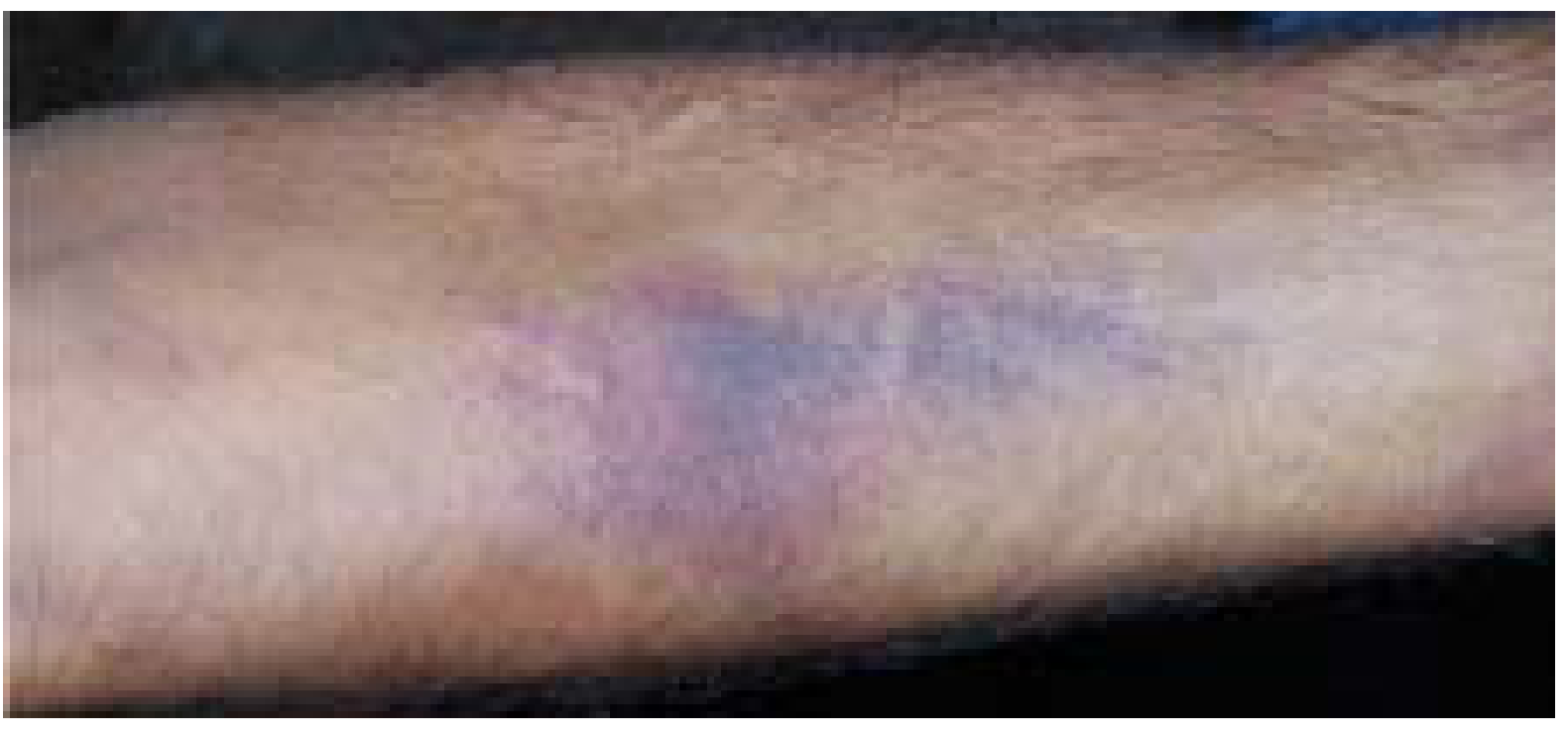
Contusion (bruise) - blunt force injury (P C Dikshit Textbook of Forensic Medicine)
Special bruises:
- Black eye (Raccoon eyes) - bilateral periorbital bruising suggesting base of skull fracture
- Patterned bruise - shape of weapon imprinted on skin (e.g., belt buckle, chain links)
- Shifting bruise - blood tracks along tissue planes; appears at a site distant from actual injury (e.g., bruise of neck muscles appears on chest days later)
3. Laceration
- Tearing/splitting of skin and deeper tissues by blunt force
- Margins are irregular and ragged, tissue bridges (strands of nerves/vessels) cross the wound
- Distinguished from incised wounds (which have clean, sharp margins)
Sharp Force Injuries
4. Incised Wound (Cut)
- Length > Depth
- Caused by a sharp-edged weapon (knife, razor, sword, glass)
- Clean, straight edges with sharp ends (tailing at one end)
- Bleeds profusely
- Suicidal incised wounds: Multiple parallel cuts ("hesitation marks"), usually on wrists, neck, left side (right-handed person)
- Homicidal: Usually on hands (defense wounds), face, back
5. Stab Wound (Puncture)
- Depth > Length
- Caused by a pointed instrument (knife tip, screwdriver, ice pick)
- External wound appears small but internal damage can be massive
- Shape of wound tells about the weapon:
- Both edges sharp = double-edged knife (dagger)
- One edge sharp, one blunt = single-edged knife
- Circular = round-pointed instrument
Defense Wounds
- Injuries on the forearms, hands, and fingers when a victim tries to protect themselves
- Suggest homicide (victim was alive and conscious during the attack)
Fabricated/Self-Inflicted Wounds
- Deliberately created to falsely accuse someone (common in dowry disputes)
- Usually superficial, multiple, accessible areas, no defense wounds
Firearm Wounds
| Feature | Entry Wound | Exit Wound |
|---|---|---|
| Size | Smaller | Larger |
| Margins | Inverted (pushed in) | Everted (pushed out) |
| Abrasion collar | Present | Absent |
| Blackening/Tattooing | Present if close range | Absent |
| Shape | Round/oval | Irregular, ragged |
Medicolegal importance: Range of firing (contact, near, distant) can be determined from the presence and extent of blackening and tattooing around entry wound.
Ante-Mortem vs. Post-Mortem Injuries
| Feature | Ante-Mortem | Post-Mortem |
|---|---|---|
| Vital reaction | Present (inflammation, redness) | Absent |
| Bleeding | Profuse, clotted | Minimal, watery |
| Bruising | Present | Absent |
| Healing | Evidence of healing | No healing |
| Histology | Inflammatory cells | No cellular response |
CONTENTS 4 - Asphyxiation, Traffic Accidents & Electricity (Detailed)
A. Asphyxia
Asphyxia literally means "pulselessness" - but medically it refers to oxygen deprivation at the tissue level, leading to death. - The Essentials of Forensic Medicine & Toxicology, 36th Ed.
Cardinal Signs of Asphyxia (Found at Autopsy):
- Cyanosis - bluish discoloration of lips, fingernails, face
- Petechial hemorrhages (Tardieu's spots) - tiny pinpoint burst blood vessels in the whites of eyes, eyelids, face, lungs (from increased venous pressure)
- Congestion of internal organs - engorged, dark organs
- Fluidity of blood - blood remains liquid (does not clot) due to hypoxia
- Left heart empty, right heart filled with dark fluid blood
Types of Mechanical Asphyxia:
1. Hanging
-
Suspension by a ligature encircling the neck; the constricting force is the weight of the body
-
"Hanging is always suicidal in nature, unless otherwise the contrary is proved beyond reasonable doubt"
-
Mechanisms of death in hanging:
- Airway blocked (needs 15 kg tension)
- Venous congestion - jugular veins blocked (needs only 2 kg tension!)
- Carotid artery compression - cerebral anemia, coma in 10-15 seconds
- Vagal inhibition - stimulation of carotid bodies causes cardiac arrest
- Fracture/dislocation of cervical vertebrae (judicial hanging - sudden drop)
-
Typical hanging: Knot at back of neck (occiput) - ligature mark runs obliquely upward
-
Atypical hanging: Knot anywhere else (side, front)
-
Complete hanging: Body fully suspended
-
Partial hanging: Only head and chest off the ground (even body weight of head ~5-6 kg is sufficient)
Post-mortem findings in hanging:
- Ligature mark: oblique, non-continuous, pale/parchment-like groove
- Face: pale (if arterial compression) or congested/cyanosed
- Tongue: protruded, cyanosed
- Petechiae in eyes (conjunctival)
2. Strangulation
- Manual strangulation (Throttling): Hands around the neck - typically HOMICIDAL
- Ligature strangulation: Cord/rope around neck, NOT using body weight - often HOMICIDAL
- Findings: continuous, horizontal ligature mark (unlike oblique in hanging), fingerprint bruises on neck
3. Smothering
- Mouth and nose blocked by hand, pillow, or plastic bag
- Common in infanticide, elderly, and disabled victims
4. Drowning
- Wet drowning: Water enters and fills the lungs (most common)
- Dry drowning: Laryngospasm prevents water entry; asphyxia occurs without water in lungs
- Secondary (near) drowning: Victim survives initial event but dies within 24 hours
- Findings at autopsy: frothy fluid in airways, waterlogged "emphysematous" lungs, diatoms (microscopic algae) in organs (proves ante-mortem drowning in that specific water source)
5. Traumatic Asphyxia
- Compression of the chest by heavy weight (e.g., crowd crush, burial under debris, "burking")
- Severe congestion and petechiae of face, neck, upper chest
B. Traffic Accident Injuries
Types of injuries vary by victim type:
Pedestrian hit by vehicle:
- Primary impact injuries - bumper hits legs (bumper fracture of tibia/fibula)
- Secondary impact - body thrown onto hood/windshield (head and thorax injuries)
- Tertiary impact - body hits the ground (contusions, lacerations)
- Run-over injuries - massive crush injury, tire tread marks on body
Occupant injuries (inside vehicle):
- Driver vs. passenger differentiation is important (legal/insurance issues)
- Driver: steering wheel injury (chest/abdomen), foot pedal mark on sole, airbag abrasions to face
- Passenger: dashboard injuries, windshield lacerations
- Seatbelt injuries - "seatbelt sign" - bruising across chest/shoulder
Time of accident determination:
- Headlight filament analysis (if hot filament was deformed = lights were ON at time of crash)
- Blood alcohol level of driver
- Tire marks, skid marks analysis
C. Electrical Injuries
Low Voltage (Household AC, <1000V):
- Most deaths from ventricular fibrillation (cardiac arrest)
- Entry and exit burn marks may be subtle or absent
- Often accidental (touching live wire)
High Voltage (>1000V):
- Extensive deep burns, charring, "crocodile skin" (dry, scaly burned skin)
- Clothing may catch fire
- Intense muscle contractions can cause fractures
Electrical Mark (Joule Burn):
- Firm, yellowish-white or grayish area of skin at point of contact
- Raised edges, depressed center (cup-shaped)
- Pathognomonic (definitive) sign of electrocution
Lightning Strike:
- Enormous voltage (millions of volts) but very brief duration
- Lichtenberg figures (Filigree burns / Keraunographic markings): Branching, fernlike reddish patterns on skin - caused by electron showers in the skin; pathognomonic of lightning strike
- Other findings: ruptured eardrums, magnetized metal objects on body, vaporization of metal (jewelry melts)
- Most deaths occur when a person shelters under a tree
CONTENTS 5 - Forensic Toxicology (Detailed)
Definitions
"Forensic toxicology deals with the medical and legal aspects of the harmful effects of chemicals on human beings." - The Essentials of Forensic Medicine & Toxicology, 36th Ed.
"A poison is a substance (solid, liquid or gaseous), which if introduced in the living body, or brought into contact with any part thereof, will produce ill-health or death by its constitutional or local effects or both." - The Essentials of Forensic Medicine & Toxicology, 36th Ed.
The real legal difference between medicine and poison is the intent with which it is given. - Parikh's Textbook
Classification of Poisons
1. Corrosives (destroy tissue at point of contact)
| Poison | Features |
|---|---|
| Strong acids (H₂SO₄, HCl, HNO₃) | Burns mouth/throat, brown-black eschar |
| Strong alkalis (NaOH, KOH) | Soft, soapy, gray-white burns - "saponification" |
| Phenol (carbolic acid) | White coating, burns become leathery; systemic cardiac/CNS toxicity |
2. Irritants (cause inflammation)
| Type | Examples |
|---|---|
| Inorganic | Arsenic (most common in India), phosphorus, antimony |
| Organic | Castor seeds (ricin), croton oil |
| Mechanical | Powdered glass |
| Putrid | Ptomaine poisoning (food spoilage) |
Arsenic poisoning (chronic): Garlic odor of breath, Mee's lines on nails (white transverse lines), rain-drop pigmentation, polyneuropathy
3. Neurological/Systemic Poisons
Opiates (morphine, heroin, codeine):
- "Pinpoint pupils" (miosis) - classic sign
- Respiratory depression, unconsciousness, coma
- Treatment: Naloxone (antidote)
Organophosphates (pesticides - most common cause of poisoning deaths in India):
- Inhibit acetylcholinesterase → acetylcholine accumulates
- Muscarinic effects: SLUDGE (Salivation, Lacrimation, Urination, Defecation, GI cramps, Emesis) + bradycardia, miosis
- Treatment: Atropine (antidote) + Pralidoxime (PAM)
Alcohol (Ethanol):
- Legal limit for driving in India: 30 mg/100 mL blood
- 80-100 mg%: impaired judgment
- 150-200 mg%: ataxia, slurred speech
- 300 mg%: stupor
- 400+ mg%: coma, respiratory failure, death
Carbon Monoxide (CO):
- Cherry-red discoloration of skin and organs (carboxyhemoglobin)
- Binds hemoglobin with 200-250x greater affinity than O₂
- Sources: incomplete combustion, car exhaust, house fires
4. Forensic Investigation of Poisoning
Steps in a medicolegal poisoning case:
- Examine the scene (bottles, food, vomit)
- Collect ante-mortem blood, urine
- Post-mortem: preserve viscera (stomach + contents, liver, kidneys, brain, blood)
- Viscera preservation: Use saturated NaCl or rectified spirit (NOT formalin, which destroys organic poisons)
- Chemical analysis in Forensic Science Laboratory (FSL)
- Histopathological examination of organs
Legal Sections (IPC) related to poisoning:
- Sec. 299/300: Culpable homicide/murder by poison
- Sec. 328: Administering poison to cause harm
- Sec. 284: Negligent conduct with poisonous substances
- Sec. 304A: Death by negligence
CONTENTS 6 - Sexual Perversion, Sex Crimes & Role of Pathology in Forensic Medicine (Detailed)
A. Sexual Perversions (Paraphilias)
These are deviations from normal sexual behavior studied in a medicolegal context for criminal profiling and court purposes:
| Perversion | Description |
|---|---|
| Fetishism | Sexual arousal from inanimate objects (shoes, clothing) |
| Voyeurism | Sexual pleasure from watching others undress/have sex ("peeping Tom") |
| Exhibitionism | Exposing genitals to strangers for gratification |
| Sadism | Sexual pleasure from inflicting pain on others (can lead to rape-murder) |
| Masochism | Sexual pleasure from receiving pain |
| Sadomasochism (S&M) | Combination of above |
| Necrophilia | Sexual activity with corpses (highly relevant to forensic pathology) |
| Pedophilia | Sexual attraction to prepubescent children (covered by POCSO Act in India) |
| Transvestism | Sexual arousal from wearing clothing of opposite sex |
| Bestiality | Sexual acts with animals |
B. Sex Crimes
Rape - Medicolegal Examination
"Rape is not a medical diagnosis - it is a matter of jurisprudence. The examiner should testify to their examination, including the presence or absence of any trauma, and any evidence collected." - DiMaio's Forensic Pathology, 3rd Ed.
Three key questions to ask the victim:
- Did the assailant's penis penetrate the vulva?
- Did the assailant ejaculate?
- Did the assailant wear a condom?
Examination protocol of the victim:
- Full history of the assault (time, place, acts performed)
- Document emotional state (victims can appear calm OR hysterical - both are valid)
- Examine all clothing for stains, tears, missing buttons, foreign material
- Examine for bruises, bite marks, defense wounds on body
- Check pubic hair for foreign hairs - do pubic hair combings
- Internal pelvic examination with unlubricated speculum (lubricant destroys evidence)
- Document hymen status, vaginal lacerations
- Collect swabs: vaginal, cervical, rectal, oral
- Swabs analyzed for: spermatozoa (survive up to 72 hours in vagina) and DNA profiling
Evidence collection - "Rape Kit":
- Blood and urine for toxicology (was victim drugged?)
- Blood grouping of seminal fluid
- DNA of perpetrator from sperm/epithelial cells
- Bite mark swabs for salivary DNA
- Under-fingernails scrapings (victim's DNA of attacker)
In India - Legal Framework:
- IPC Section 375 (now BNS 2023): Definition of rape
- POCSO Act, 2012 - Protection of Children from Sexual Offences (below 18 years)
- Two-finger test is BANNED by Supreme Court of India (2022) - it is degrading and scientifically unreliable
C. Role of Pathology in Forensic Medicine
1. Histopathology in Wound Aging
Tissue examination under microscope helps date injuries accurately:
| Time Since Injury | Histological Finding |
|---|---|
| 0-3 hours | Neutrophil infiltration begins |
| 6-12 hours | Neutrophils abundant |
| 1-3 days | Macrophages and monocytes arrive |
| 3-5 days | Fibroblasts appear (repair phase) |
| 1-2 weeks | Collagen formation, scar tissue |
2. Forensic Serology
- Blood group determination from stains (ABO system, Rhesus)
- Identification of species of blood (human vs. animal - precipitin test)
- Semen identification: Phosphatase test (acid phosphatase in semen), Christmas tree staining for sperm
- Saliva identification: Amylase test
3. Forensic DNA Analysis
- Gold standard for identification in criminal cases
- Sources: blood, semen, saliva, hair roots, skin cells
- PCR (Polymerase Chain Reaction) amplifies tiny amounts of DNA
- STR (Short Tandem Repeat) profiling - creates individual DNA fingerprint
- Used in: rape cases, paternity disputes, mass disasters, identifying unknown bodies
4. Autopsy in Forensic Pathology
Types of autopsy:
| Type | Purpose | Ordered by |
|---|---|---|
| Medico-legal (forensic) | Determine cause/manner of death in suspicious deaths | Police/Magistrate |
| Clinical/Hospital | Understand disease process | Family/hospital |
| Academic | Teaching/research | Institution |
Autopsy findings in specific deaths:
- Drowning: Waterlogged lungs, froth, diatoms
- Strangulation: Petechiae, neck muscle hemorrhage, hyoid bone fracture
- Poisoning (CO): Cherry-red organs
- Electrocution: Joule burns, ventricular fibrillation (confirmed by exclusion)
- Sharp force homicide: Multiple stab wounds, defensive wounds on hands
Quick Revision Summary
| Topic | Core Concept | Key Exam Point |
|---|---|---|
| Intro | Forensic medicine bridges law and medicine | 4 D's of negligence |
| Necrology | Study of death and post-mortem changes | Rigor mortis order: Nysten's Law |
| Injuries | Wound classification by weapon and manner | Ante-mortem vs. post-mortem reaction |
| Asphyxia | O₂ deprivation; Tardieu's spots are hallmark | Partial hanging needs only head weight (5-6 kg) |
| Toxicology | Poison's legal definition = intent | Organophosphate = SLUDGE; CO = cherry red |
| Sex crimes | Doctor testifies to findings, not to rape | Two-finger test banned in India |
This is a shared conversation. Sign in to Orris to start your own chat.