
4.Describe The Different Types Of INTESTINAL MOVEMENTS (Small Intestine) And Their Significance.
Reading File
Now let me search the medical library for intestinal movements of the small intestine.
Finding Sources
Finding Sources
Finding Sources
Reading File
Excellent content found in Guyton. Let me read more and also check Medical Physiology for additional detail.
Reading File
Reading File
Reading File
Reading File
I now have comprehensive material from Guyton & Hall and Medical Physiology. Let me also fetch the segmentation figure to include it in the answer.
Loading Image
Reading File
I now have all the information needed for a comprehensive answer. Let me compile it.
Types of Intestinal Movements (Small Intestine) and Their Significance
Movements of the small intestine can be broadly divided into mixing (non-propulsive) and propulsive contractions. In practice, this separation is somewhat artificial, as most movements contribute to both functions to some degree.
1. Mixing Contractions (Segmentation Contractions)
Mechanism
When a segment of the small intestine becomes distended with chyme, stretching of the intestinal wall triggers localized, concentric contractions of the circular muscle at regularly spaced intervals. These contractions divide the intestinal lumen into oval segments resembling a "chain of sausages."
- As one set of segmentation contractions relaxes, a new set fires between the previous ones, effectively "chopping" the chyme 2-3 times per minute.
- The circular muscle contracts in the propulsive (upstream) segment while the receiving (downstream) segment relaxes, and vice versa.
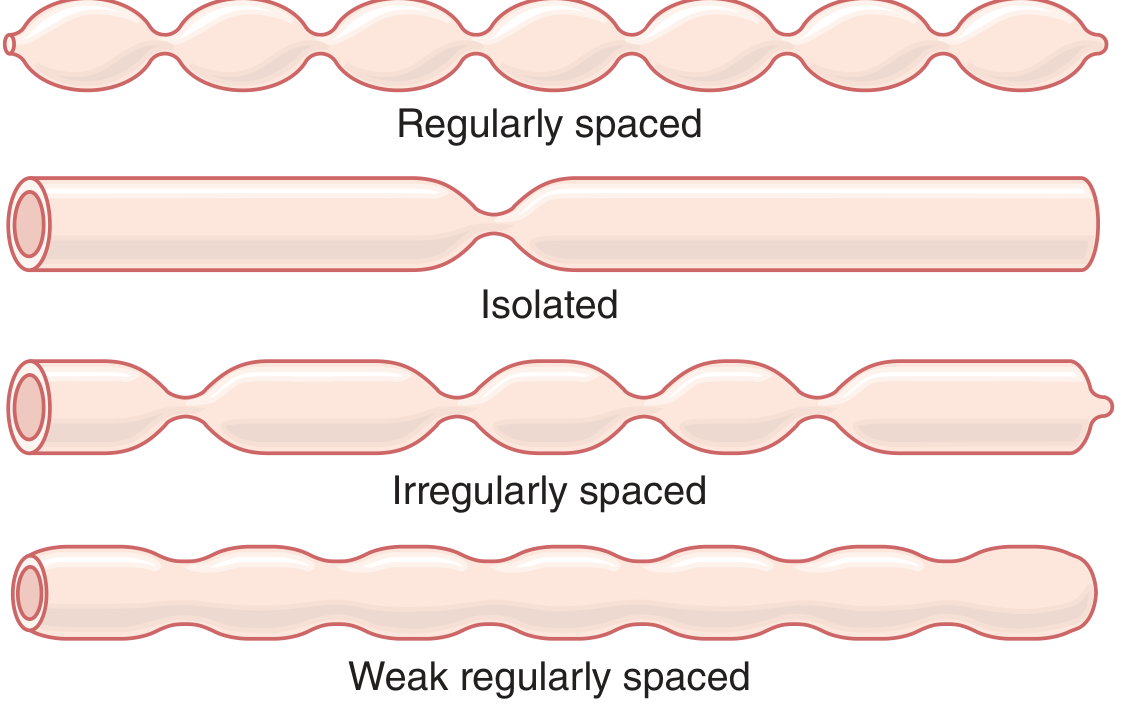
Frequency
- Duodenum and proximal jejunum: up to 12 contractions/minute (set by the basic electrical rhythm / slow waves)
- Terminal ileum: 8-9 contractions/minute (lower frequency of slow waves distally)
Control
- Dependent on background excitation from the myenteric (Auerbach's) nerve plexus
- Blocking with atropine makes these contractions exceedingly weak, demonstrating the essential role of enteric nervous system excitation
- Segmentation increases markedly after a meal (fed state)
Significance
- Mixing of chyme with pancreatic, biliary, and intestinal secretions - essential for digestion
- Reduces the unstirred water layer adjacent to intestinal epithelial cells, promoting absorption
- Some net caudad (anal) propulsion - segmentation contractions often travel 1 cm in the anal direction during their brief duration, contributing weakly to propulsion
- Maximizes mucosal contact with nutrients, enhancing absorption efficiency
2. Propulsive Contractions (Peristalsis)
Mechanism
Peristaltic waves are coordinated contractions in which:
- The circular muscle contracts and the longitudinal muscle relaxes in the upstream/propulsive segment
- The circular muscle relaxes and the longitudinal muscle contracts in the downstream/receiving segment
This creates a wave that moves chyme toward the anus.
Characteristics
| Feature | Value |
|---|---|
| Velocity | 0.5-2.0 cm/sec (faster proximally, slower distally) |
| Travel distance | Usually 3-5 cm; rarely >10 cm before dying out |
| Net forward movement | ~1 cm/min |
| Transit time | 3-5 hours from pylorus to ileocecal valve |
Control
- Initiated by chyme distending the duodenum and the gastroenteric reflex (stomach distension triggers peristalsis via the myenteric plexus)
- Hormones that enhance peristalsis: gastrin, CCK, insulin, motilin, serotonin
- Hormones that inhibit peristalsis: secretin, glucagon, GLP-1
- Gastroileal reflex: eating triggers enhanced peristalsis in the ileum, forcing chyme through the ileocecal valve into the cecum
Significance
- Propulsion of chyme from pylorus toward the ileocecal valve
- Spreads chyme along the intestinal mucosa, increasing contact surface for digestion and absorption
- Clears residue distally for elimination
3. Peristaltic Rush (Powerful, Rapid Peristalsis)
A special variant of peristalsis triggered by intense irritation of the intestinal mucosa (e.g., severe infectious diarrhea, toxins).
- Involves autonomic nervous reflexes + intrinsic myenteric plexus activation
- Powerful contractions travel long distances within minutes
- Sweeps intestinal contents rapidly into the colon, relieving the small intestine of irritants and excessive distension
Significance
- A protective reflex: rapidly expels noxious/toxic chyme from the small intestine
- Clinical correlate: the profuse, watery diarrhea in infectious enteritis
4. Migrating Motor Complex (MMC) - Interdigestive Movement
The MMC is the motility pattern of the fasting state. It consists of synchronized, rhythmic contractions that sweep slowly from the stomach to the terminal ileum.
Phases
| Phase | Description |
|---|---|
| Phase 1 | Prolonged quiescent period |
| Phase 2 | Increasing action potential frequency and contractility |
| Phase 3 | Peak electrical and mechanical activity (a few minutes) |
| Phase 4 | Declining activity merging into the next quiescent period |
- Cycle interval in humans: 90-120 minutes
- Usually originates in the stomach; ~25% begin in the duodenum or proximal jejunum
- During MMC, particles >2 mm in diameter can pass from stomach into the duodenum
Control
- Motilin (22-amino acid peptide from duodenal mucosa) is the primary hormonal driver - released just before phase 3 onset
- Enteric nervous system and extrinsic innervation also contribute
- Feeding terminates the MMC and initiates the fed motor pattern
Significance
- "Housekeeper of the intestine": clears undigested food debris, bacteria, desquamated cells, and secretions from the small intestine
- Prevents bacterial overgrowth by regularly sweeping bacteria toward the colon
- Allows passage of large particles from the stomach that cannot be broken down to <2 mm
- Clinical note: MMC disruption contributes to small intestinal bacterial overgrowth (SIBO)
5. Movements of the Muscularis Mucosae and Villi
These are local movements distinct from the muscular propulsion above:
- Muscularis mucosae contractions create short folds in the intestinal mucosa
- Villous contractions: individual smooth muscle fibers from the muscularis mucosae extend into each villus, causing them to alternately shorten and elongate ("villous pump")
Significance
- Increase mucosal surface area exposed to chyme - enhancing absorption
- "Milk" the lacteals: villous pumping squeezes lymph (including chylomicrons) out of the central lacteal and into the lymphatic system, facilitating fat absorption
- Renew the film of chyme in contact with the absorptive epithelium
Summary Table
| Movement | Type | Frequency/Rate | Primary Significance |
|---|---|---|---|
| Segmentation | Mixing | 8-12/min | Mixes chyme with digestive secretions; promotes absorption |
| Peristalsis | Propulsive | 0.5-2 cm/sec; weak | Propels chyme toward ileocecal valve |
| Peristaltic Rush | Strong propulsive | Rapid, long distance | Expels noxious/irritant chyme; protective reflex |
| MMC (fasting) | Slow propulsive | Every 90-120 min | Clears intestine; prevents bacterial overgrowth |
| Villous contractions | Local | Intermittent | Lacteal milking; renews absorptive film |
Sources: Guyton and Hall Textbook of Medical Physiology, p. 793-794; Medical Physiology (Boron & Boulpaep), p. 1285-1286
This is a shared conversation. Sign in to Orris to start your own chat.