
Biological mesh is used when and which mesh is better for recurrent hernia
Reading File
Biological mesh is used in contaminated fields, infected wounds, complex abdominal wall defects, and in patients where synthetic mesh is contraindicated. For recurrent hernias, the choice depends on the wound class and prior mesh history.
Searching sources...
Finding Sources
Finding Sources
Searching PubMed
biological mesh hernia repair recurrent
Good results found. Let me read the key textbook sections now in parallel.
Reading File
Reading File
Reading Article
PMID: 37542774
Now let me get more details from the textbooks on indications and types of biological mesh, and get the meta-analysis on contaminated fields.
Finding Sources
Reading Article
PMID: 39666204
Finding Sources
Finding Sources
Reading File
Finding Sources
Reading File
Finding Sources
Reading File
Finding Sources
Excellent content from Sabiston. Let me read the full recurrent hernia management section:
Reading File
I have gathered comprehensive information. Now let me also fetch the mesh placement diagram for a visual illustration.
Loading Image
I now have comprehensive information from multiple authoritative sources. Here is the full answer:
Biological Mesh in Hernia Repair
What Is Biological Mesh?
Biological meshes are sheets of sterilised, decellularised connective tissue derived from:
- Human dermis (e.g., AlloDerm - human acellular dermal matrix)
- Porcine dermis (e.g., PermaCOL, Strattice)
- Porcine intestinal submucosa (e.g., Surgisis)
- Bovine pericardium (e.g., Tutomesh)
They act as a scaffold to encourage neovascular ingrowth, fibroblast infiltration, and new collagen deposition. In theory, host enzymes break down the biological implant and replace it with normal host fibrous tissue. - Bailey and Love's Short Practice of Surgery 28e, p. 1085
When Is Biological Mesh Used?
Primary Indications
| Situation | Rationale |
|---|---|
| Contaminated / dirty wound (CDC Class III-IV) | Synthetic mesh has high infection and explantation risk; biological mesh can withstand contamination better (in theory) |
| Active mesh infection requiring explantation | Bridge repair or fascial reinforcement without re-implanting synthetic material |
| Emergency hernia repair with bowel resection | Colon/bowel content contaminates the field |
| Entero-cutaneous fistula takedown | Gross contamination |
| Immunocompromised patients | Reduced capacity to fight mesh-associated infection |
| Prior mesh infection / failed synthetic mesh | Contaminated recurrent hernia field |
| Large abdominal wall defects where primary closure is impossible and the field is contaminated | Bridge repair (bridged biological mesh) |
From - Current Surgical Therapy 14e, p. 719: "We prefer primary fascial closure or bridged repair with biological mesh" in the setting of mesh infection requiring excision.
Biological Mesh in Recurrent Hernia
When a hernia recurs, management depends on the prior repair history and wound class:
From Sabiston Textbook of Surgery:
"A recurrence after simple primary repair should be treated as an incisional hernia with an appropriate mesh-based repair... Recurrences after mesh-based repairs are tackled differently."
Key principles for recurrent hernia:
- Obtain prior operative reports and imaging to know exactly where the prior mesh sits.
- Recurrence after primary (no mesh) repair - standard synthetic mesh is appropriate.
- Recurrence after prior mesh repair in a clean field - synthetic mesh remains preferred; consider a different anatomical plane.
- Recurrence with infected/contaminated prior mesh - biological mesh is the choice if the field is contaminated or if mesh must be excised and rebuilt.
- Recurrence requiring bowel resection (fistula, strangulation) - biological mesh because of contamination.
Cross-Linked vs. Non-Cross-Linked Biological Mesh
This is the most clinically important distinction among biological meshes:
| Property | Non-Cross-Linked | Cross-Linked |
|---|---|---|
| Examples | AlloDerm (hADM), Surgisis (SIS) | PermaCOL (porcine dermis), Tutomesh |
| Enzyme degradation | Faster - host enzymes break it down more rapidly | More resistant to enzymatic breakdown |
| Behaviour in infection | Weakens quickly before remodelling, leading to early recurrence | More resistant - resists breakdown even in infected field |
| Tissue remodelling | Better host tissue integration | Less complete remodelling |
| Ideal use | Clean or mildly contaminated fields | Heavily contaminated / grossly infected fields |
Key point from Bailey and Love's: "In the presence of infection, some biological meshes break down more rapidly and weaken before remodelling can occur, leading to early hernia recurrence. Others are more resistant to breakdown, particularly those with chemical cross-linking between the fibrous strands."
So cross-linked meshes (e.g., PermaCOL) are preferred in heavily infected/contaminated fields because they resist enzymatic degradation, while non-cross-linked (e.g., AlloDerm) remodel better in cleaner environments.
Mesh Positioning Diagram
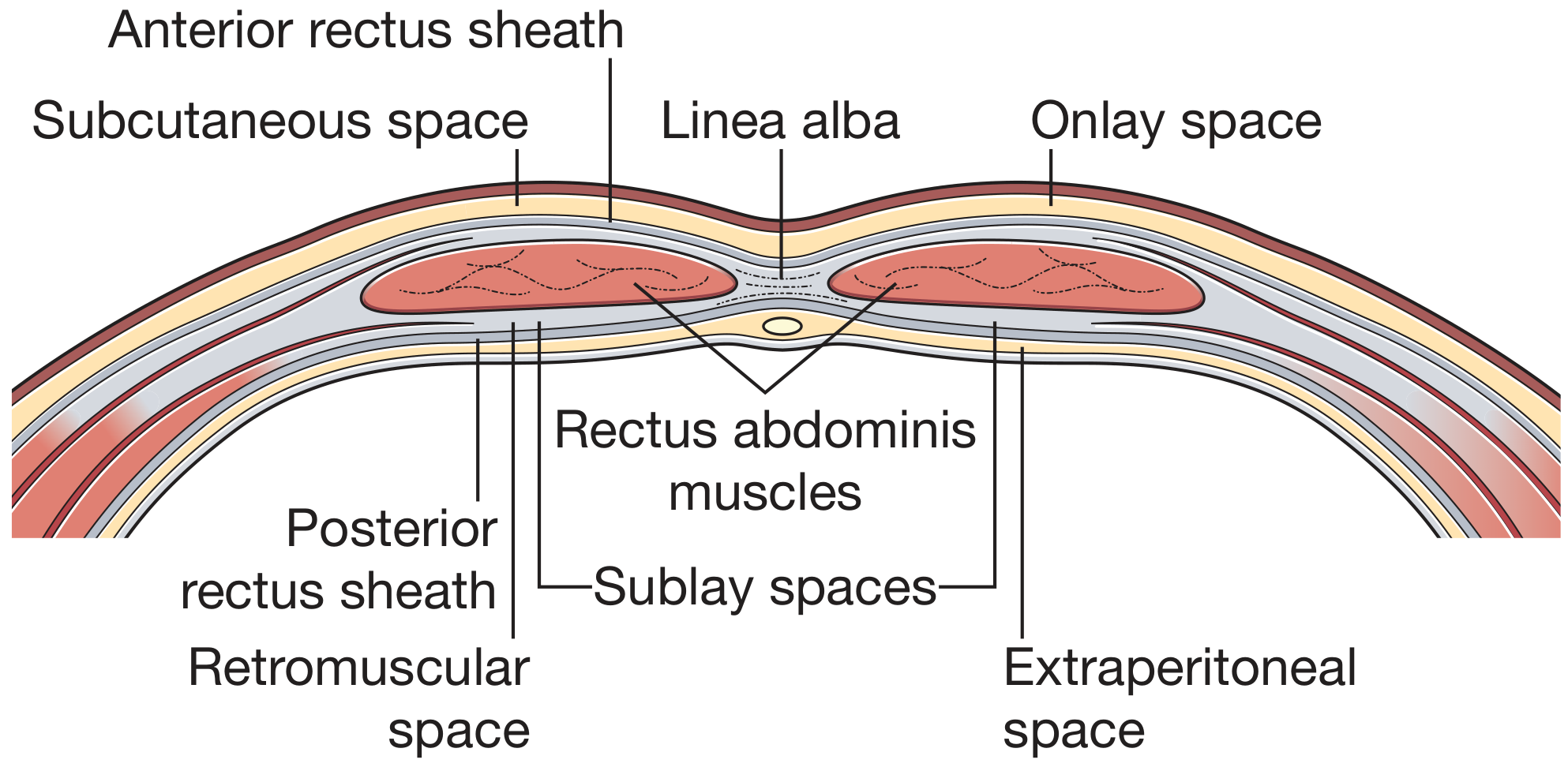
What Does Recent Evidence Say?
Important caveat: Recent meta-analyses have challenged the traditional teaching that biological mesh is always superior in contaminated fields:
-
A 2023 meta-analysis in J Surg Res (Siddiqui et al., 4 RCTs, 758 patients) found that synthetic mesh had lower major complication rates (23.4% vs 38.6%, RR=0.55) and lower recurrence rates (10.3% vs 24.5%, RR=0.44) compared to biological mesh in ventral hernia repair, including contaminated cases.
-
A 2024 meta-analysis in Hernia (Frountzas et al., 11 studies, 1,945 patients) showed that synthetic mesh had significantly lower recurrence rates than biological mesh even in contaminated surgical fields (p<0.0001), with similar SSI rates. The authors concluded: "Synthetic mesh should be considered as a safe and effective option for abdominal wall reconstruction in contaminated surgical fields."
-
A 2025 meta-analysis in Surg Endosc comparing biologic vs. synthetic unabsorbable mesh in contaminated fields further supported synthetic mesh as a viable option.
Clinical Implication: The evidence base is shifting. Modern macroporous, lightweight polypropylene or biosynthetic (slowly absorbable) meshes in contaminated fields may actually perform better than, or at least equivalently to, biological mesh - at a fraction of the cost. Biological mesh remains biologically intuitive but its clinical superiority is not strongly supported by current RCT data.
Practical Summary: Which Mesh for Recurrent Hernia?
| Scenario | Mesh of Choice |
|---|---|
| Recurrence after primary repair, clean field | Synthetic (polypropylene, lightweight, macroporous) |
| Recurrence after prior mesh, clean, different plane possible | Synthetic (retrorectus/Rives-Stoppa preferred) |
| Recurrence with infected prior mesh (CDC class III-IV) | Biological (cross-linked) e.g., PermaCOL, or consider biosynthetic |
| Recurrence with bowel resection / fistula | Biological mesh (cross-linked preferred) or biosynthetic |
| Complex abdominal wall reconstruction, contaminated | Traditionally biological; emerging evidence supports synthetic macroporous mesh |
Cost consideration: Biological meshes are significantly more expensive than synthetic options. Their precise role in abdominal wall hernia repair has yet to be fully established. - Bailey and Love's 28e
This is a shared conversation. Sign in to Orris to start your own chat.