
Role of mental health in current world acct to park n suryakantha spm
Reading File
Now let me search the medical library for mental health content from Park's SPM and Suryakantha's SPM.
Finding Sources
Finding Sources
I found Park's textbook. Let me now look for both Park's SPM and Suryakantha's SPM entries on mental health.
Finding Sources
Finding Sources
Only Park's SPM is available (no Suryakantha in the library). Let me read the key sections from Park's now - the main mental health chapter, NMHP, causes of mental ill-health, and warning signals.
Reading File
Reading File
Good, I have some content. Let me now read the main mental health chapter section, warning signals, comprehensive mental health programme, and NMHP.
Reading File
Reading File
Excellent content flowing in. Let me now read the NMHP section and the comprehensive mental health action plan, as well as the beginning of the main mental health chapter.
Reading File
Reading File
Now let me read the definition and global burden section of the mental health chapter, and the warning signals section.
Reading File
Reading File
Now let me get the definition of mental health and the global burden / importance section from the beginning of the chapter.
Reading File
I now have comprehensive content. Let me fetch the prevalence chart image and compile the complete answer.
Loading Image
I now have all the information needed. Note: Suryakantha's SPM is not available in the library - only Park's SPM is present. I'll compile a thorough answer based on Park's textbook and note the absence of Suryakantha. Let me also check if there's a block with the global burden/WHO section for mental health.
Reading File
I now have all the content needed to write a comprehensive answer. Here is the complete response based on Park's Textbook of Preventive and Social Medicine.
Note: Suryakantha's Textbook of Community Medicine is not available in the library database. The answer below is drawn entirely from Park's Textbook of Preventive and Social Medicine (the standard SPM reference for Indian medical examinations).
Role of Mental Health in the Current World
As per Park's Textbook of Preventive and Social Medicine
1. Definition of Mental Health
WHO defines mental health as "a state of well-being in which an individual realizes his or her own abilities, can cope with the normal stress of life, can work productively and is able to make a contribution to his or her community."
Park's textbook further elaborates: Mental health is the balanced development of the individual's personality and emotional attitudes which enable him to live harmoniously with his fellow-men. It is not merely a matter of interpersonal relations - it also reflects the relationship of the individual towards the community, society, and its institutions.
By the WHO definition of health itself, mental health is an inseparable component: "Health is a state of complete physical, mental and social well-being and not merely the absence of disease or infirmity."
2. Problem Statement (Global Burden)
World
Mental disorders are truly universal - they are found in people of all regions, all countries, and all societies. The global estimates of major mental disorders are:
| Disorder | Global Burden |
|---|---|
| Depression | 300 million |
| Bipolar affective disorder | 60 million |
| Dementia | 50 million |
| Schizophrenia and other psychoses | 23 million |
The burden continues to grow with significant impact on health and major social, human rights, and economic consequences in all countries. Mental disorders account for 11% of all years lived with disability globally, particularly for women. A recent study estimated that the cumulative global impact of mental disorders in terms of lost economic output will amount to US$ 16.3 trillion between 2011 and 2030.
India - National Mental Health Survey (NMHS 2015-16)
Conducted across 12 states, the key findings are:
- Nearly 150 million Indians aged 13 and above are likely to be suffering from one or more mental health problems.
- Mental health problems are comparatively more prevalent in urban areas.
- Mental health disorder in young adolescents was 7.3%.
- Neurosis and stress-related disorders (phobias, anxiety) affected twice as many women compared to men.
- Alcohol use disorder in men was 4.6% among the 18+ population; illicit substance use disorders = 0.6%.
- Less than 2% had severe mental illness (psychosis or bipolar disorder); among them, ~50% had moderate to severe disability.
- 0.9% are at high risk of suicide.
- The median monthly expenditure on mental disorder treatment ranged between INR 1000-2500.
Current morbidity (excluding tobacco use disorders): 10.6% of individuals above 18 years. Lifetime prevalence: 13.7%.
3. Prevalence of Mental Disorders in India (NMHS)
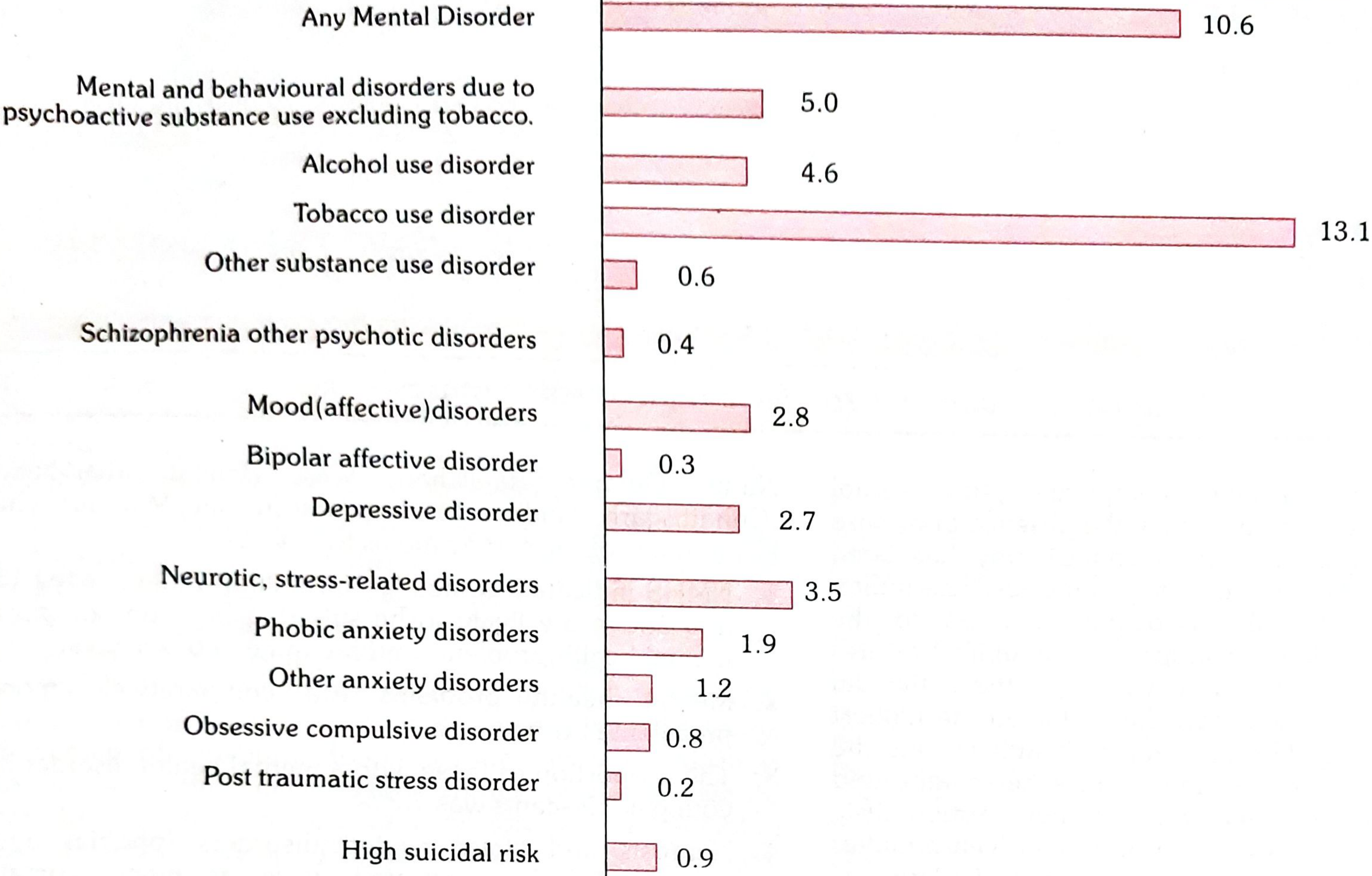
4. Social Consequences of Mental Illness
Mental disorders frequently lead individuals and families into poverty. Other consequences include:
- Homelessness and inappropriate incarceration are far more common among the mentally ill.
- Due to stigma and discrimination, persons with mental disorders often have their human rights violated - denial of economic, social, and cultural rights including the right to work, education, and reproductive rights.
- They may be subject to unhygienic and inhuman living conditions, physical/sexual abuse, neglect, and harmful treatment in health facilities.
- Denial of civil and political rights: right to marry, right to vote, personal liberty.
- These factors constitute a significant impediment to national and international development goals.
5. Characteristics of a Mentally Healthy Person
A mentally healthy person has three main characteristics:
- Feels comfortable about himself - reasonably secure and adequate; neither underestimates nor overestimates his ability; has self-respect.
- Feels right towards others - able to be interested in others, form lasting friendships, feel part of a group, like and trust others, and take responsibility for neighbours and fellow-men.
- Able to meet the demands of life - able to tackle problems as they arise, is not bowled over by emotions of fear, anger, love, or guilt; takes responsibilities.
6. Warning Signals of Poor Mental Health
William C. Menninger drew up the following 13 questions as a mental health self-assessment tool. Help is necessary if the answer to any is definitely "yes":
- Are you always worrying?
- Are you unable to concentrate without known reasons?
- Are you continually unhappy without justified cause?
- Do you lose your temper easily and often?
- Are you troubled by regular insomnia?
- Do you have wide mood fluctuations from depression to elation, incapacitating you?
- Do you continually dislike being with people?
- Are you upset when the routine of life is disturbed?
- Do your children consistently get on your nerves?
- Are you constantly bitter?
- Are you afraid without real cause?
- Are you always right and others always wrong?
- Do you have numerous aches and pains for which no physical cause is found?
7. Types of Mental Illness
Major Illnesses (Psychoses) - "Insane," out of touch with reality:
- Schizophrenia - patient lives in a dream world
- Manic Depressive Psychosis - symptoms vary from heights of excitement to depths of depression
- Paranoia - extreme suspicion, progressive delusions
Minor Illnesses:
- Neurosis/Psychoneurosis - unable to react normally to life situations; morbid fears, compulsions, obsessions
- Personality and Character Disorders - legacy of unfortunate childhood experiences
ICD-10 Classification includes:
- Organic, including symptomatic, mental disorders (e.g., dementia)
- Disorders due to psychoactive substance use (e.g., alcohol, opioids)
- Schizophrenia, schizotypal and delusional disorders
- Mood (affective) disorders
- Neurotic, stress-related and somatoform disorders
- Behavioural syndromes with physiological disturbances (e.g., eating disorders)
- Disorders of adult personality and behaviour
- Mental retardation
- Disorders of psychological development
- Behavioural and emotional disorders of childhood and adolescence
8. Causes of Mental Ill-Health
Mental illness, like physical illness, is due to multiple causes (agent, host, environment):
- Organic conditions - cerebral arteriosclerosis, neoplasms, metabolic/neurological/endocrine diseases, chronic diseases (TB, leprosy, epilepsy)
- Heredity - e.g., a child of two schizophrenic parents is 40 times more likely to develop schizophrenia
- Social/environmental causes - worries, anxieties, emotional stress, tension, frustration, unhappy marriages, broken homes, poverty, industrialization, urbanization, changing family structure, population mobility, economic insecurity, cruelty, rejection, neglect
Environmental factors (non-psychosocial):
- Toxic substances: carbon disulfide, mercury, manganese, lead
- Psychotropic drugs: barbiturates, alcohol, griseofulvin
- Nutritional: deficiency of thiamine, pyridoxine
- Minerals: iodine deficiency
- Infective agents: measles, rubella during prenatal/perinatal/postnatal period affecting brain development
9. Mental Health Services in the Community
Mental health services are concerned not only with early diagnosis and treatment but also with preservation, promotion, and prevention. The services comprise:
- Early diagnosis and treatment
- Rehabilitation
- Group and individual psychotherapy
- Mental health education
- Use of modern psychoactive drugs
- After-care services
10. Comprehensive Community Mental Health Programme
Since 95% of psychiatric cases can be treated with or without hospitalization close to their homes, the current trend is full integration of psychiatric services with other health services. The Community Mental Health Programme includes:
- In-patient services
- Out-patient services
- Partial hospitalization
- Emergency services
- Diagnostic services
- Pre-care and aftercare services (foster home placement, home visiting)
- Education services
- Training
- Research and evaluation
11. National Mental Health Programme (NMHP), India
Launched in 1982, the NMHP aims to ensure availability of mental health care services for all, especially for underprivileged populations.
Aims:
- (a) Prevention and treatment of mental and neurological disorders and their associated disabilities
- (b) Use of mental health technology to improve general health services
- (c) Application of mental health principles in total national development to improve quality of life
Objectives:
- Ensure availability and accessibility of minimum mental health care for all, particularly the most vulnerable
- Encourage application of mental health knowledge in general health care and social development
- Promote community participation and self-help
Programme Strategies:
- Integration of mental health with primary health care through NMHP
- Provision of tertiary care institutions for treatment
- Eradicating stigmatization and protecting the rights of mentally ill patients through the Central Mental Health Authority and State Mental Health Authority
District Mental Health Programme (DMHP) components:
- (a) Training of mental health team workers
- (b) Public education to increase awareness and reduce stigma
- (c) OPD and indoor services for early detection and treatment
- (d) Providing community-level data for planning and research
DMHP Promotive and Preventive Activities:
- School mental health services: life skills education, counselling
- College counselling services through trained teachers/counsellors
- Workplace stress management (formal and informal sectors, including farmers, women)
- Suicide prevention: counselling centres at district level, helplines, IEC
At present, the NMHP covers 517 districts in 36 states. The National Human Rights Commission also monitors the programme.
12. WHO Comprehensive Mental Health Action Plan 2013-2020
Vision: A world in which mental health is valued, promoted and protected; mental disorders are prevented; and persons affected can exercise the full range of human rights and access high-quality, culturally-appropriate health and social care in a timely way.
Overall goal: Promote mental well-being, prevent mental disorders, provide care, enhance recovery, promote human rights, and reduce mortality, morbidity, and disability.
Four Objectives:
- Strengthen effective leadership and governance for mental health
- Provide comprehensive, integrated, and responsive mental health and social care in community-based settings
- Implement strategies for promotion and prevention in mental health
- Strengthen information systems, evidence, and research for mental health
13. Mental Health in Industry (Occupational Health Context)
The goal of occupational health is not only to keep workers physically healthy but mentally and psychologically stable. Industrial workers are susceptible to the effects of love, recognition, rejection, job satisfaction, rewards, and discipline.
Goals of mental health in industry:
- To promote the health and happiness of workers
- To detect signs of emotional disturbance early
- To refer for appropriate care when needed
All content sourced from: Park's Textbook of Preventive and Social Medicine, Chapter on Mental Health.
Note on Suryakantha: Suryakantha's Textbook of Community Medicine is not available in this library. The content above covers Park's SPM comprehensively. In Suryakantha's text, mental health is similarly discussed under community medicine with the same WHO definition, NMHP details, and Global Burden of Disease framework - the core content is consistent with what Park's covers above.
Drug addiction defination
According to WHO, drug addiction is a state of periodic or chronic intoxication produced by the repeated consumption of a drug, characterized by: (1) an overpowering desire to continue taking the drug and to obtain it by any means, (2) a tendency to increase the dose, (3) psychological and generally physical dependence on its effects, and (4) detrimental effects on the individual and society.
Searching sources...
Finding Sources
Finding Sources
Reading File
Reading File
Here is the complete answer on the definition of drug addiction, drawn from Park's Textbook of Preventive and Social Medicine:
Drug Addiction - Definition
Definition (Park's SPM)
"Drug addiction is a state of periodic or chronic intoxication detrimental to the individual and society, produced by the repeated intake of habit-forming drugs."
- Park's Textbook of Preventive and Social Medicine
Related Definitions (WHO)
Drug:
"Any substance that, when taken into the living organism, may modify one or more of its functions." (WHO)
Drug Abuse:
Self-administration of a drug for non-medical reasons, in quantities and frequencies which may impair an individual's ability to function effectively, and which may result in social, physical, or emotional harm.
Drug Dependence (WHO):
"A state, psychic and sometimes also physical, resulting from the interaction between a living organism and a drug, characterized by behavioural and other responses that always include a compulsion to take the drug on a continuous or periodic basis in order to experience its psychic effects, and sometimes to avoid the discomfort of its absence."
Criteria to Call a Person a Drug Addict
To label someone a drug addict, all three of the following criteria must be satisfied:
| # | Criterion | Description |
|---|---|---|
| 1 | Psychological Dependence | An overpowering desire (compulsion) to take the drug and obtain it by any means |
| 2 | Physical Dependence | On withdrawal, the patient shows withdrawal symptoms - irrational/violent behaviour, nausea, diarrhoea, watering of eyes and nose |
| 3 | Development of Tolerance | A tendency to increase the dose progressively to get the same effect |
Reasons for Drug Dependence
Park's lists the following reasons why individuals develop drug dependence:
- Curiosity and natural tendency to experiment with drugs
- Disturbed home environment: broken homes, indifferent parents, lack of communication between parents and children
- Escape phenomenon from tensions and frustrations (e.g., unemployment, examination failure)
- Impact of disco culture, mobile, TV, internet
- Ignorance regarding the habit-forming nature of drugs
Dependence-Producing Drugs (ICD-10 Classification)
ICD-10 recognizes the following psychoactive drug classes whose self-administration may produce mental and behavioural disorders including dependence:
- Alcohol
- Opioids
- Cannabinoids
- Sedatives or hypnotics
- Cocaine
- Other stimulants including caffeine
- Hallucinogens
- Tobacco
- Volatile solvents
- Other psychoactive substances and combinations
Management of Drug Addiction
Though drug addiction is a social problem, the first step is medical care:
- (a) Identification of drug addicts and motivation for detoxification
- (b) Detoxification (requires hospitalization)
- (c) Post-detoxification counselling and follow-up (clinic and home visits)
- (d) Rehabilitation
Simultaneously, changes in environment (home, school, college, social circle) are essential - a complete break with the previous peer group is necessary, as otherwise the chances of relapse are near 100%.
Psychotherapy has a valuable place in management.
Preventive measures: Public education through TV, radio, leaflets, and posters. The Narcotic Drugs and Psychotropic Substances Act (1985) was enacted by the Government of India to combat the problem.
Source: Park's Textbook of Preventive and Social Medicine
Community mental health problems
Community mental health problems include the major psychiatric disorders (depression, schizophrenia, substance use), suicide, alcohol/drug dependence, and mental health issues in special populations (children, elderly, women). From an SPM perspective, the community approach emphasizes prevention, early detection, and integration with primary health care rather than hospital-based treatment.
Searching sources...
Finding Sources
Finding Sources
Finding Sources
Finding Sources
Finding Sources
Finding Sources
Finding Sources
Now let me read the key sections - "Mental health and addictions", the block12 mental health section (likely geriatric/child), and the NCD + mental health section.
Reading File
Reading File
Reading File
Now let me read the alcoholism section and the symptoms of drug addiction section, plus the DMHP thrust areas.
Reading File
Reading File
Now let me read the alcohol consequences and suicide/drug symptoms sections.
Reading File
Reading File
Now let me read the alcoholism consequences and the prevention section from Park's.
Reading File
I now have comprehensive content to write a thorough answer on Community Mental Health Problems as per Park's SPM. Here it is:
Community Mental Health Problems
As per Park's Textbook of Preventive and Social Medicine
1. Introduction
Mental health problems occur everywhere and become more prominent when major killer diseases are brought under control. There is a tendency toward increased prevalence of mental disease when society shifts from an agricultural to an industrial economy, and when people move from the warm intimacy of a village community to the isolation of big cities.
Community mental health problems encompass a wide spectrum - from major psychoses and neuroses to substance use disorders, alcoholism, and tobacco dependence. They are not the exclusive preserve of any special group; they are truly universal, found in people of all regions, all countries, and all societies.
2. Major Community Mental Health Problems
The principal community mental health problems as discussed in Park's SPM are:
A. Psychoses (Major Mental Illnesses)
| Psychosis | Key Feature |
|---|---|
| Schizophrenia | Patient lives in a dream world; split from reality |
| Manic Depressive Psychosis | Mood swings from heights of excitement to depths of depression |
| Paranoia | Extreme suspicion and progressive delusions |
B. Neuroses and Minor Mental Illnesses
- Psychoneurosis - patient is unable to react normally to life situations; exhibits morbid fears, compulsions, and obsessions
- Personality and Character Disorders - legacy of unfortunate childhood experiences
C. Alcoholism
A world-wide social and medical problem. Over the past 30-40 years, alcohol consumption has increased in quantity and frequency. The age at which drinking starts has declined. Population groups at greatest risk are those undergoing rapid socio-economic and cultural changes who view alcohol as a symbol of prestige.
Global burden:
- In 2016, harmful alcohol use resulted in ~3 million deaths worldwide and 132.6 million DALYs - i.e., 5.1% of all DALYs
- Mortality from alcohol consumption is higher than that caused by TB, HIV/AIDS, and diabetes
- Men: 2.3 million deaths and 106.5 million DALYs attributable to alcohol
- Women: 0.7 million deaths and 26.1 million DALYs
Alcohol as a drug: By pharmacological definition, alcohol is a sedative/tranquillizer/hypnotic/anaesthetic depending on quantity consumed. It is the only drug whose self-induced intoxication is socially acceptable.
WHO response to alcohol includes:
- Reducing demand through taxation and pricing
- Raising public awareness
- Providing accessible and affordable treatment for alcohol-use disorders
- Implementing screening and brief intervention programmes for hazardous drinking
D. Drug Dependence
Definition (WHO): "A state, psychic and sometimes also physical, resulting from the interaction between a living organism and a drug, characterized by behavioural responses that always include a compulsion to take the drug on a continuous or periodic basis in order to experience its psychic effects, and sometimes to avoid the discomfort of its absence."
ICD-10 recognized dependence-producing drug classes:
- Alcohol
- Opioids
- Cannabinoids
- Sedatives/Hypnotics
- Cocaine
- Other stimulants (including caffeine)
- Hallucinogens
- Tobacco
- Volatile solvents
- Multiple/combined substances
Commonly abused drugs and their effects:
| Drug | Key Effect |
|---|---|
| Amphetamines/Cocaine | Mood elevation, elation, sense of well-being; CNS stimulants |
| Cannabis/Marijuana | Dreamy altered consciousness, euphoria, paranoia; psychic dependence |
| Heroin (Narcotics) | Worst addiction - strong craving; rapid tolerance development |
| LSD | Intense perceptual distortions, colour/auditory intensification; no physical dependence |
| Alcohol | Sedative, progressive dependence, organ damage |
Symptoms of Drug Addiction (Warning Signs):
- Loss of interest in sports and daily routine
- Loss of appetite and body weight
- Unsteady gait, clumsy movements, tremors
- Reddening and puffiness of eyes, unclear vision
- Slurring of speech
- Fresh injection marks on body; blood stains on clothes
- Nausea, vomiting, and body pain
- Drowsiness or sleeplessness, lethargy
- Acute anxiety, depression, profuse sweating
- Changing mood, temper tantrums
- Depersonalization and emotional detachment
- Impaired memory and concentration
- Presence of needles, syringes, and strange packets at home
Environmental/Social Risk Factors for Drug Abuse:
| Factor | Examples |
|---|---|
| Social | Unemployment, migration to cities, broken homes, relaxed parental control |
| Environmental | Areas with drug-using gangs, delinquency, drug trade |
| Personal | Living away from home, early school dropout, early exposure to drugs |
E. Tobacco Dependence
Tobacco causes ~7 million premature deaths per year globally - far more than all other psychoactive substances combined.
-
6 million deaths from direct tobacco use
- ~890,000 deaths from second-hand smoke exposure
- 80% of the world's 1.1 billion smokers live in low-middle-income countries
- Risks: chronic bronchitis, emphysema, CVD, lung cancer, peptic ulcer
- Adolescent smoking is driven by peer pressure, sibling/parental modelling, and out-of-home employment
- Women smokers: increased adverse effects of oral contraceptives, osteoporosis, impaired fertility, spontaneous miscarriage, intrauterine growth retardation
3. Special Situations Where Mental Health is Critical
Park's highlights specific critical periods of life when external pressure tends to break mental health:
- Mother after childbirth
- Child at entry into school for the first time
- Child entering secondary school
- Decision about a future career
- Starting a new family
- Time of widowhood
Health workers should help people during these periods by showing sympathy, understanding, and social contact.
4. Socioeconomic and Human Rights Consequences
Mental disorders frequently lead individuals and families into poverty. Community-level consequences include:
- Homelessness and inappropriate incarceration
- Stigmatization and discrimination
- Violation of human rights - denial of right to work, education, reproductive rights
- Exclusion from civil and political rights (right to marry, vote, participate in public life)
- Unhygienic living conditions; physical and sexual abuse in institutions
- Economic impact: Cumulative global economic loss from mental disorders estimated at US$ 16.3 trillion between 2011 and 2030
5. Mental Health and NCDs (SDG Framework)
Under the Sustainable Development Goals (SDGs), mental health is linked with NCDs:
- Target 3.4: One-third reduction in premature NCD mortality by 2030, including suicide mortality
- Target 3.5: Substance abuse including harmful use of alcohol, along with mental health
- Mental health disorders account for 11% of all years lived with disability globally
6. Community Mental Health Programme
Since 95% of psychiatric cases can be treated close to home (with or without hospitalization), the current global trend is full integration of psychiatric services with general health services.
Components of the Community Mental Health Programme:
- In-patient services
- Out-patient services
- Partial hospitalization
- Emergency services
- Diagnostic services
- Pre-care and after-care services (foster home placement, home visiting)
- Education services
- Training
- Research and evaluation
7. National Mental Health Programme (NMHP), India
Launched in 1982, covering 517 districts in 36 states.
Thrust Areas (NMHP):
- District Mental Health Programme in enlarged, more effective form covering the entire country
- Streamlining/modernization of mental hospitals (moving away from custodial role)
- Upgrading psychiatry departments in medical colleges; enhancing psychiatric content in UG and PG curriculum
- Strengthening Central and State Mental Health Authorities
- Research and training in community mental health, substance abuse, and child/adolescent psychiatric clinics
District Mental Health Programme (DMHP) Promotive/Preventive Activities:
- School mental health services: life skills education, counselling
- College counselling via trained teachers/counsellors
- Workplace stress management (formal and informal sectors)
- Suicide prevention: counselling centres at district level, helplines, sensitization workshops, IEC
8. Mental Healthcare Act, 2017
- Enacted to protect and promote the rights of persons with mental illness
- Aligned India's laws with the UN Convention on the Rights of Persons with Disabilities
- Ensures health care, treatment, and rehabilitation in the least restrictive environment
- Suicide has been decriminalized under this Act
- Regulates both public and private mental health sectors within a rights framework
9. Prevention and Control
Prevention of drug dependence and alcoholism includes:
- Education of target groups (youth, school students) through TV, radio, leaflets, posters
- Narcotic Drugs and Psychotropic Substances Act, 1985 (India) - enacted to combat the problem
- Peer counselling and community support groups
- Changes in environment (home, school, social circle) are essential alongside medical treatment
- Psychotherapy for the individual addict
- Complete break from the drug-using peer group (otherwise relapse rate approaches 100%)
Source: Park's Textbook of Preventive and Social Medicine
This is a shared conversation. Sign in to Orris to start your own chat.