
Grades of clubbing
Reading File
Finding Sources
Searching Images
finger clubbing grades Schamroth window test
Searching PubMed
"nail clubbing"[MeSH Terms]
Reading File
Reading File
query_images_db
The textbooks in the library describe the features of clubbing but don't give a numbered grading scheme. The grades below are the standard bedside 4-grade scheme from my own knowledge. It is not from a cited source, and some books order the early grades differently.
Clinical grades of clubbing
| Grade | Finding |
|---|---|
| 1 | Fluctuation (sponginess) of the nail bed. The nail rocks on the underlying tissue because the nail bed is softened. The nail-fold angle is still normal. |
| 2 | Loss of the Lovibond angle. The normal angle of about 160° between the nail plate and proximal nail fold becomes 180°. |
| 3 | Parrot-beak or drumstick appearance. The nail is more curved in both directions and the distal phalanx is bulbous. The pulp is swollen. |
| 4 | Hypertrophic pulmonary osteoarthropathy (HPOA). Clubbing is accompanied by periostitis of the long bones, so the wrists and ankles are painful and swollen. The skin over the fingertips may look shiny, and there may be striations on the nail. |
Bedside tests
- Lovibond angle: About 160° is normal. In clubbing it is 180° or more (Andrews' Diseases of the Skin, p. 898).
- Schamroth sign: When the dorsal surfaces of the same finger on each hand are placed together, normal fingers leave a diamond-shaped window. In clubbing the window is lost (Andrews' Diseases of the Skin, p. 898). Fitzpatrick's gives an angle between the nail margins greater than 30° as the positive sign.
- Phalangeal depth ratio: The distal phalangeal depth divided by the interphalangeal depth is above 1 in clubbing. I recalled this from memory and did not find it in the library excerpts.
- Fluctuation: The nail base feels spongy and mobile when pressure is applied over the matrix. This is the grade 1 sign.
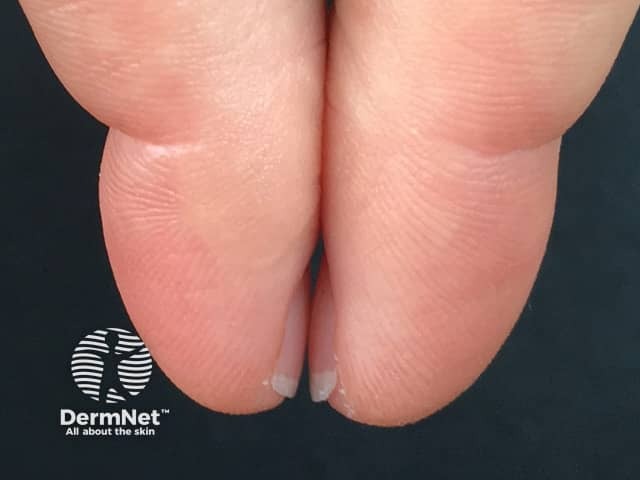
Points worth remembering
- Early clubbing is subtle and easy to miss. It has to be separated from simple nail curvature, chronic paronychia and Heberden nodes (Fishman's Pulmonary Diseases and Disorders, p. 448).
- COPD alone does not cause clubbing. Clubbing in a COPD patient should make you look for a second process, usually lung cancer (Fishman's, p. 448).
- Clubbing is usually bilateral. Unilateral clubbing can point to arterial insufficiency of that limb (Fitzpatrick's Dermatology).
- Clubbing of the toes only suggests a patent ductus arteriosus with reversed shunt (differential clubbing) (Fishman's, p. 448).
- Clubbing is often painless, but HPOA is the painful form. It is classically seen in men with bronchogenic carcinoma (Andrews', p. 898).
- Common causes:
- Pulmonary: lung cancer, bronchiectasis, lung abscess, empyema, interstitial lung disease, cystic fibrosis.
- Cardiac: cyanotic congenital heart disease, infective endocarditis.
- GI and hepatic: cirrhosis, inflammatory bowel disease, celiac disease.
- Other: HIV (about 36% of patients), thyroid disease, and hereditary or idiopathic forms (including pachydermoperiostosis).
I searched PubMed for systematic reviews and meta-analyses from the last two years on clubbing. None were relevant, so nothing contradicts the above.
This is a shared conversation. Sign in to Orris to start your own chat.