
Prednisolone mode of action
Reading File
Finding Sources
Finding Sources
Finding Sources
Reading File
Finding Sources
Finding Sources
Finding Sources
Reading File
Finding Sources
Finding Sources
Loading Image
Finding Sources
Here is a comprehensive breakdown of prednisolone's mode of action:
Prednisolone — Mode of Action
Prednisolone is a synthetic glucocorticoid (corticosteroid) with potent anti-inflammatory and immunosuppressive properties (relative potency ~4× hydrocortisone). Its actions are pluripotent, operating at the molecular, cellular, and systemic levels.
1. Receptor Binding (Molecular Mechanism)
Prednisolone is lipophilic and freely crosses cell membranes. Inside the cell it binds to the cytosolic glucocorticoid receptor (GR). The drug–receptor complex then:
- Translocates into the nucleus
- Binds to glucocorticoid response elements (GREs) on DNA
- Regulates gene transcription — upregulating anti-inflammatory genes (e.g., lipocortin/annexin A1, IL-10) and downregulating pro-inflammatory genes (cytokines, adhesion molecules, enzymes)
"On entering cells, they bind to the glucocorticoid receptor. The complex passes into the nucleus and regulates the transcription of DNA. Among the genes affected are those involved in inflammatory responses." — Lippincott Illustrated Reviews: Pharmacology
2. Inhibition of Inflammatory Mediators
- Inhibits NF-κB — a master transcription factor driving production of TNF-α, IL-1, IL-2, IL-6, and other pro-inflammatory cytokines (shown in the diagram below)
- Suppresses phospholipase A₂ via lipocortin induction → reduces arachidonic acid release → less prostaglandin and leukotriene synthesis
- Reduces production of COX-2, chemokines, and adhesion molecules (ICAM-1, E-selectin)
3. Immunosuppressive Effects
- T lymphocytes are the primary target — corticosteroids rapidly reduce lymphocyte populations by lysis and redistribution
- Suppress T-cell activation, proliferation, and cytokine secretion (particularly IL-2)
- Reduce trafficking of leukocytes (neutrophils, macrophages, eosinophils) to sites of inflammation
- Inhibit macrophage function and antigen presentation
"The T lymphocytes are the most affected. The steroids are able to rapidly reduce lymphocyte populations by lysis or redistribution." — Lippincott Illustrated Reviews: Pharmacology
4. Mechanism of Action Diagram
The diagram below illustrates how corticosteroids suppress both cytokine production and inflammatory mediators, acting via NF-κB inhibition (top center):
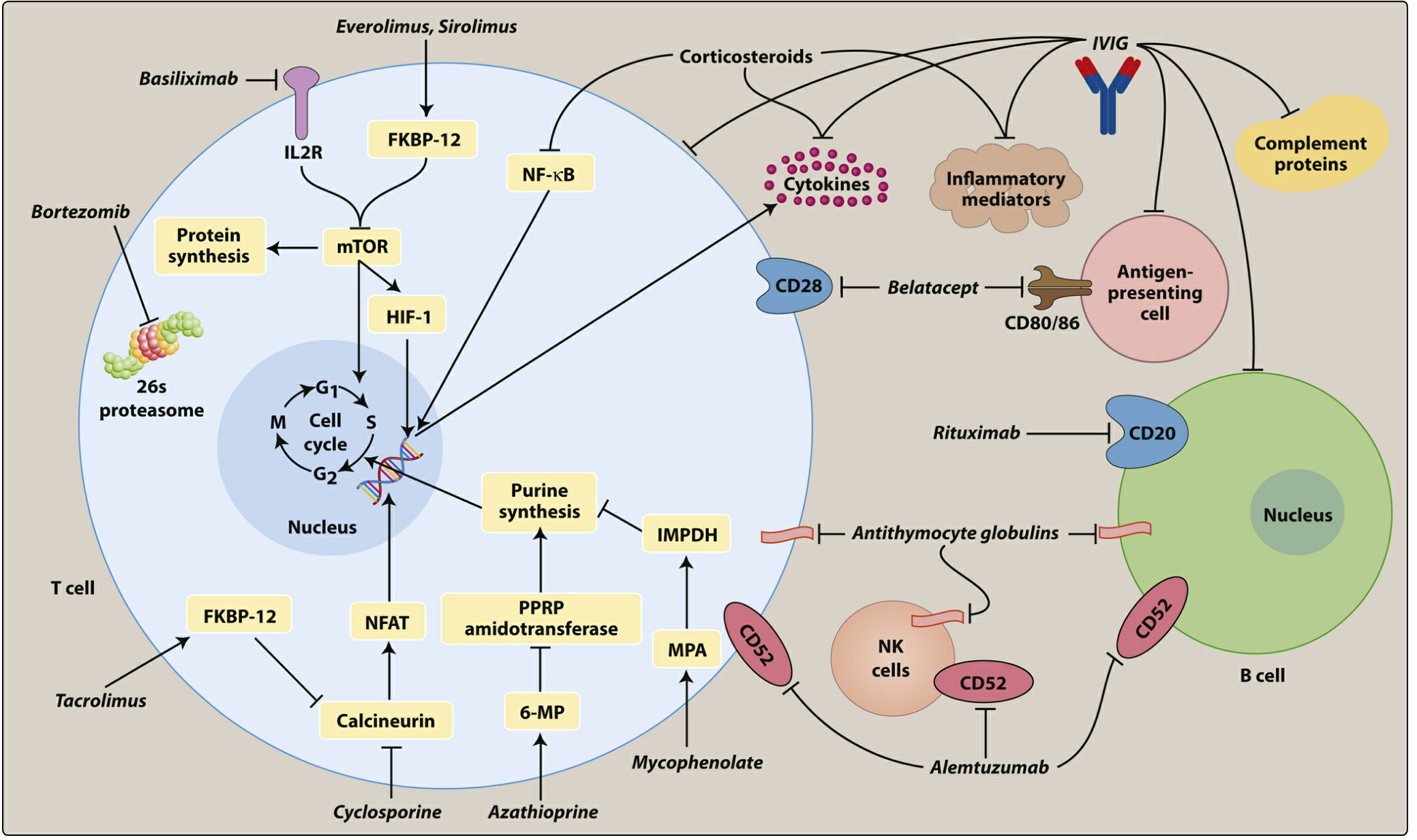
Corticosteroids inhibit NF-κB → reduce cytokines and inflammatory mediators. IL-2R = interleukin-2 receptor; NFAT = nuclear factor of activated T cells; mTOR = mammalian target of rapamycin.
— Lippincott Illustrated Reviews: Pharmacology, Fig. 38.8
5. Summary Table
| Level | Effect |
|---|---|
| Molecular | Binds GR → nuclear translocation → gene regulation via GREs |
| Transcriptional | Inhibits NF-κB; suppresses cytokine gene expression (TNF-α, IL-1, IL-2, IL-6) |
| Eicosanoid pathway | Induces lipocortin → inhibits phospholipase A₂ → ↓ prostaglandins & leukotrienes |
| Cellular | T-lymphocyte lysis/redistribution; ↓ macrophage & neutrophil function |
| Vascular | ↓ vascular permeability and leukocyte margination |
Key Indications (from mechanism)
- Autoimmune diseases (RA, SLE, vasculitis)
- Organ transplant rejection prevention (in combination)
- Asthma, COPD exacerbations
- Inflammatory bowel disease
- Allergic and dermatologic conditions
Important Note on Toxicity
The same transcriptional mechanism underlying its benefits also drives adverse effects with prolonged use: hyperglycemia, Cushing syndrome, osteoporosis, adrenal suppression (assumed at >20 mg/day for >3 weeks), immunosuppression (risk of opportunistic infections), cataracts, and psychiatric effects.
— The Washington Manual of Medical Therapeutics
This is a shared conversation. Sign in to Orris to start your own chat.