
Define school of psychology 15 mark
- Structuralism - studied the structure of consciousness through introspection (Wundt, Titchener)
- Functionalism - focused on the purpose/function of mental processes (James, Dewey)
- Behaviorism - emphasized observable behavior over mental states (Watson, Skinner)
- Psychoanalysis - unconscious drives and early experience (Freud)
- Gestalt - perception as a whole, not just its parts (Wertheimer, Köhler)
- Humanism - human potential, free will, self-actualization (Maslow, Rogers)
- Cognitive - mental processes like memory, thinking, problem-solving
schools of psychology definition major schools structuralism functionalism behaviorism
schools of psychology 15 marks essay gestalt humanistic cognitive psychoanalysis
Schools of Psychology
Definition
1. Structuralism (1879 - early 1900s)
- Method: Introspection - trained participants reported their inner experiences in response to stimuli.
- Core Elements of Mind: Sensations, feelings, and images.
- Titchener further formalized this school in America, identifying over 44,000 basic sensory elements.
- Criticism: Introspection is subjective and unreliable; the method cannot be verified externally.
2. Functionalism (early 1900s)
- Focus: The function and purpose of mental processes and behaviors.
- Method: More objective - used experiments, observation, and animal studies.
- Contribution: Led to applied psychology, educational psychology, and industrial/organizational psychology.
- Criticism: Critics argued it lacked a clear, unified framework.
3. Psychoanalysis (Late 1800s - 1900s)
- Core Concepts: The unconscious mind, the id/ego/superego, defense mechanisms, dream analysis, free association.
- Freud's Iceberg Model: Consciousness is only the tip; the vast majority of mental activity is unconscious.
- Psychosexual Stages: Oral, anal, phallic, latency, and genital stages of development.
- Contribution: Laid the groundwork for psychotherapy and clinical psychology.
- Criticism: Lack of empirical/scientific support; theories are difficult to test or falsify.
4. Behaviorism (1913 - 1960s)
- Classical Conditioning (Pavlov): Learning through association (e.g., Pavlov's dogs).
- Operant Conditioning (Skinner): Learning through reinforcement and punishment.
- Key Principle: All behavior is learned from the environment; the mind is a "black box."
- Contribution: Behavior therapy, behavior modification, and learning theories in education.
- Criticism: Ignores mental processes, emotions, and biological influences. Oversimplifies complex human behavior.
5. Gestalt Psychology (1910s - 1930s)
- Focus: Perception and how the mind organizes stimuli into meaningful wholes.
- Key Principles (Laws of Perceptual Organization): Proximity, Similarity, Closure, Continuity, Figure-Ground.
- Insight Learning: Köhler demonstrated that animals solve problems through sudden understanding, not just trial and error.
- Contribution: Laid the foundation for cognitive psychology and Gestalt therapy.
- Criticism: Principles are descriptive, not explanatory; limited scope beyond perception.
6. Humanistic Psychology (1950s - 1960s)
- Maslow's Hierarchy of Needs: Physiological - Safety - Love/Belonging - Esteem - Self-Actualization.
- Rogers' Person-Centered Therapy: Emphasizes unconditional positive regard, empathy, and genuineness.
- Core Beliefs: People are inherently good and motivated toward self-actualization.
- Contribution: Influenced counseling, psychotherapy, education, and organizational management.
- Criticism: Too idealistic; concepts like "self-actualization" are difficult to measure scientifically.
7. Cognitive Psychology (1960s - present)
- Focus: Thinking, memory, attention, language, problem-solving, perception, and decision-making.
- Key Methods: Reaction time experiments, computer modeling, brain imaging (later).
- Contribution: Foundation of modern neuroscience, artificial intelligence, and cognitive-behavior therapy (CBT).
- Criticism: Early models were overly mechanistic and undervalued emotion and social context.
8. Biological/Biopsychology School (20th century - present)
- Focus: How brain structures, neurotransmitters, and genetics influence behavior and mental processes.
- Methods: Brain scans (MRI, fMRI, EEG), lesion studies, twin studies.
- Contribution: Understanding of neurological disorders, mental illness, and the genetic basis of behavior.
Summary Table
| School | Founder(s) | Key Focus | Method |
|---|---|---|---|
| Structuralism | Wundt, Titchener | Elements of consciousness | Introspection |
| Functionalism | James, Dewey | Purpose of mental processes | Observation |
| Psychoanalysis | Freud | Unconscious drives | Free association, dream analysis |
| Behaviorism | Watson, Skinner | Observable behavior | Experimentation |
| Gestalt | Wertheimer, Köhler | Perception as a whole | Phenomenological observation |
| Humanistic | Maslow, Rogers | Self-actualization, free will | Case studies, interviews |
| Cognitive | Neisser, Piaget | Mental processes | Experimentation, modeling |
| Biological | Sperry, Lashley | Brain and biology | Brain imaging, genetics |
Conclusion
Make a visual poster showing timeline of psychology schools
A visually rich educational timeline poster titled "Schools of Psychology Through History". The poster has a dark navy blue background with a horizontal golden timeline arrow running across the middle. Along the timeline, each school of psychology is represented as a colorful card or bubble with the year, school name, founder(s), and a one-line description. The schools shown in chronological order are: 1. 1879 - Structuralism (Wundt, Titchener) - "Elements of consciousness via introspection" - yellow card 2. 1890s - Functionalism (William James, Dewey) - "Purpose of mental processes" - green card 3. 1900s - Psychoanalysis (Sigmund Freud) - "Unconscious drives and early experience" - purple card 4. 1910s - Gestalt Psychology (Wertheimer, Köhler) - "The whole is greater than its parts" - orange card 5. 1913 - Behaviorism (Watson, Skinner, Pavlov) - "Only observable behavior matters" - red card 6. 1950s - Humanistic Psychology (Maslow, Rogers) - "Self-actualization and human potential" - teal card 7. 1960s - Cognitive Psychology (Piaget, Neisser) - "Mind as information processor" - blue card 8. 1970s - Biopsychology (Sperry, Lashley) - "Brain, genes, and biology of behavior" - pink card Cards alternate above and below the timeline. Each card has a small icon (brain, eye, magnifying glass, etc.). The title at the top is bold white serif font. A footer reads "Evolution of Psychological Thought". Clean, academic, poster-style infographic design.
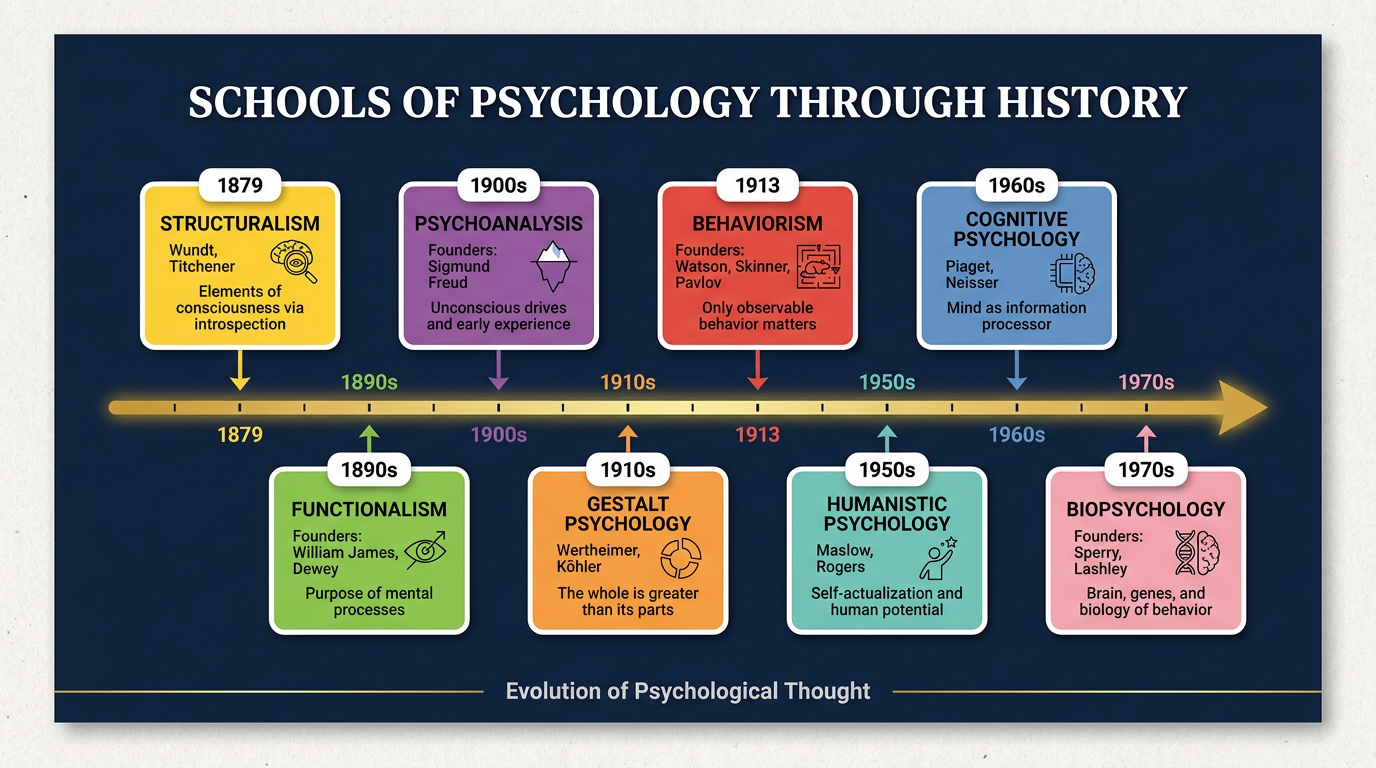
- 1879 - Structuralism (Wundt, Titchener)
- 1890s - Functionalism (William James, Dewey)
- 1900s - Psychoanalysis (Freud)
- 1910s - Gestalt Psychology (Wertheimer, Köhler)
- 1913 - Behaviorism (Watson, Skinner, Pavlov)
- 1950s - Humanistic Psychology (Maslow, Rogers)
- 1960s - Cognitive Psychology (Piaget, Neisser)
- 1970s - Biopsychology (Sperry, Lashley)