
Klebsiella pneumoniae
I'll start by reading the medical library skill, then search for comprehensive information on Klebsiella pneumoniae.
Quick Answer: Klebsiella pneumoniae is a Gram-negative, encapsulated, non-motile facultative anaerobe in the Enterobacteriaceae family. It is a major opportunistic pathogen causing pneumonia, urinary tract infections, bacteremia, and liver abscesses - particularly in immunocompromised hosts. It has become a significant concern due to the emergence of multidrug-resistant strains, including carbapenem-resistant Klebsiella pneumoniae (CRKP).
Searching sources...
Reading File
Now I'll run parallel searches across the library and PubMed simultaneously.
Finding Sources
Finding Sources
Searching PubMed
"Klebsiella pneumoniae"[MeSH Terms]
Searching Images
Klebsiella pneumoniae gram stain morphology culture
Good. Now let me read the key textbook sections for detailed content.
Reading File
Reading File
Reading File
Searching Images
Klebsiella pneumoniae lung pneumonia histology
Now let me get more clinical details - microbiology, treatment, and resistance mechanisms.
Finding Sources
Finding Sources
Let me get the detailed clinical section from Harrison's and the microbiology textbook.
Reading File
Finding Sources
Excellent - I now have very rich content. Let me fetch the hypervirulent Klebsiella image from Harrison's and get the treatment details.
Loading Image
Reading File
I now have comprehensive data. Let me compile the full, detailed answer.
Klebsiella pneumoniae
Classification & Microbiology
Klebsiella pneumoniae is a Gram-negative, non-motile, encapsulated, lactose-fermenting, facultatively anaerobic rod belonging to the family Enterobacteriaceae. Key microbiological features:
- Capsule (K antigen): Large polysaccharide capsule - the organism's primary virulence factor. Blocks complement deposition and opsonophagocytosis. Gives colonies a glistening, mucoid appearance on agar. On Gram stain, a visible negative space (halo) may be seen around the rods.
- Indole negative (unlike K. oxytoca, which is indole positive)
- Non-motile (unlike most Enterobacteriaceae)
- Ferments lactose (produces acid and gas)
- Urease and ONPG positive
(Quick Compendium of Clinical Pathology 5th ed., p. 180; Sherris & Ryan's Medical Microbiology, 8th ed.)
Pathotypes
There are two clinically important pathotypes:
| Feature | Classical Kp (cKp) | Hypervirulent Kp (hvKp) |
|---|---|---|
| Host | Immunocompromised, debilitated | Previously healthy individuals |
| Setting | Hospital/healthcare-associated | Community-acquired |
| Geography | Global | Asia, South Africa (emerging globally) |
| Key infection | HAP, VAP, UTI, BSI | Primary liver abscess, endophthalmitis, meningitis |
| Metastatic spread | Rare | Yes - from liver abscess to eye, CNS, lungs |
| Resistance | High (ESBL, KPC) | Usually susceptible (but MDR strains emerging) |
| String test | Variable | Often positive (hypermucoviscous) |
| Biomarkers | - | iucA, iroB, peg-344, rmpA, rmpA2 (all 5 = definitive) |
(Harrison's Principles of Internal Medicine, 22nd ed., 2025)
Virulence Factors
- Polysaccharide capsule - antiphagocytic, anti-complement
- Lipopolysaccharide (LPS/O antigen) - endotoxin activity, serum resistance
- Fimbriae (type 1 and type 3) - adhesion to uroepithelium and respiratory mucosa
- Siderophores (in hvKp: aerobactin iucA, salmochelin iroB) - iron acquisition, greatly enhance virulence
- Rmp proteins (rmpA, rmpA2) - upregulate capsule production, confer hypermucoviscosity
- Outer membrane proteins - contribute to antibiotic resistance
Clinical Syndromes
1. Pneumonia
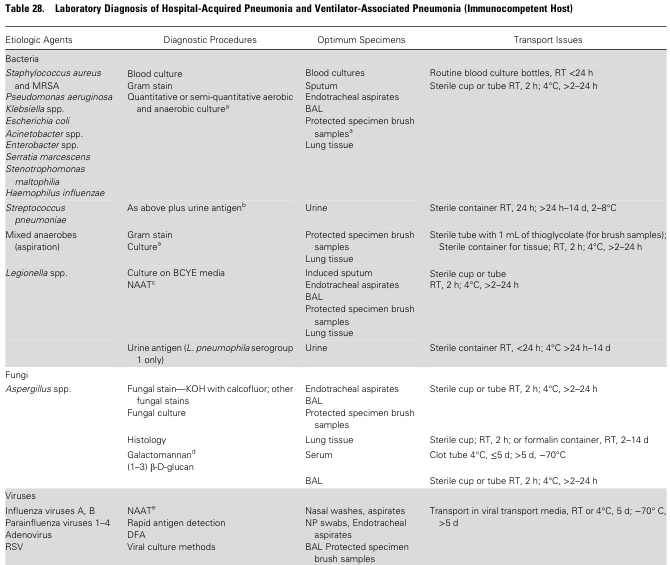
K. pneumoniae is the most frequent cause of Gram-negative bacterial pneumonia.
- Classic population: Chronic alcoholics, malnourished patients, diabetics, COPD patients, debilitated elderly
- Classic features: Lobar consolidation (often upper lobe, right side), "currant jelly sputum" (thick, blood-tinged mucoid sputum due to abundant capsular polysaccharide), "bulging fissure sign" on CXR
- Modern presentations are often less dramatic - patchy infiltrate rather than massive lobar consolidation
- Complications: lung abscess, empyema, pulmonary necrosis, pleural effusion
- Hospital-acquired: ventilator-associated pneumonia (VAP) is a major concern
(Robbins, Cotran & Kumar Pathologic Basis of Disease; Robbins & Kumar Basic Pathology)
2. Urinary Tract Infection
- cKp causes only 1-2% of UTIs in healthy adults but 5-17% of complicated UTIs (structural/functional abnormalities, catheter use)
- hvKp more commonly presents as renal or prostatic abscess via bacteremic spread rather than ascending infection
3. Primary Liver Abscess (hvKp hallmark)
- Characteristic of the hypervirulent pathotype, especially in Southeast Asia
- Occurs in previously healthy, often younger individuals
- CT shows solitary right lobe abscess
- Metastatic spread to eye (endophthalmitis - can cause blindness), CNS, lungs, joints
- Often requires percutaneous drainage + prolonged antibiotics
4. Bacteremia / Sepsis
- Klebsiella bacteremia can arise from any infected site: urinary tract (15-30%), respiratory tract (15-30%), abdominal (hepatic abscess) (15-30%), intravascular device (5%)
- Associated with high mortality in MDR strains
5. Other Infections
- Neonatal sepsis and meningitis in LMICs
- Wound and soft tissue infections
- Rhinoscleroma (K. rhinoscleromatis) - chronic granulomatous nasal infection; Mikulicz cells
- Granuloma inguinale/Donovanosis (K. granulomatis)
- Pneumonia in severely malnourished children in low- and middle-income countries
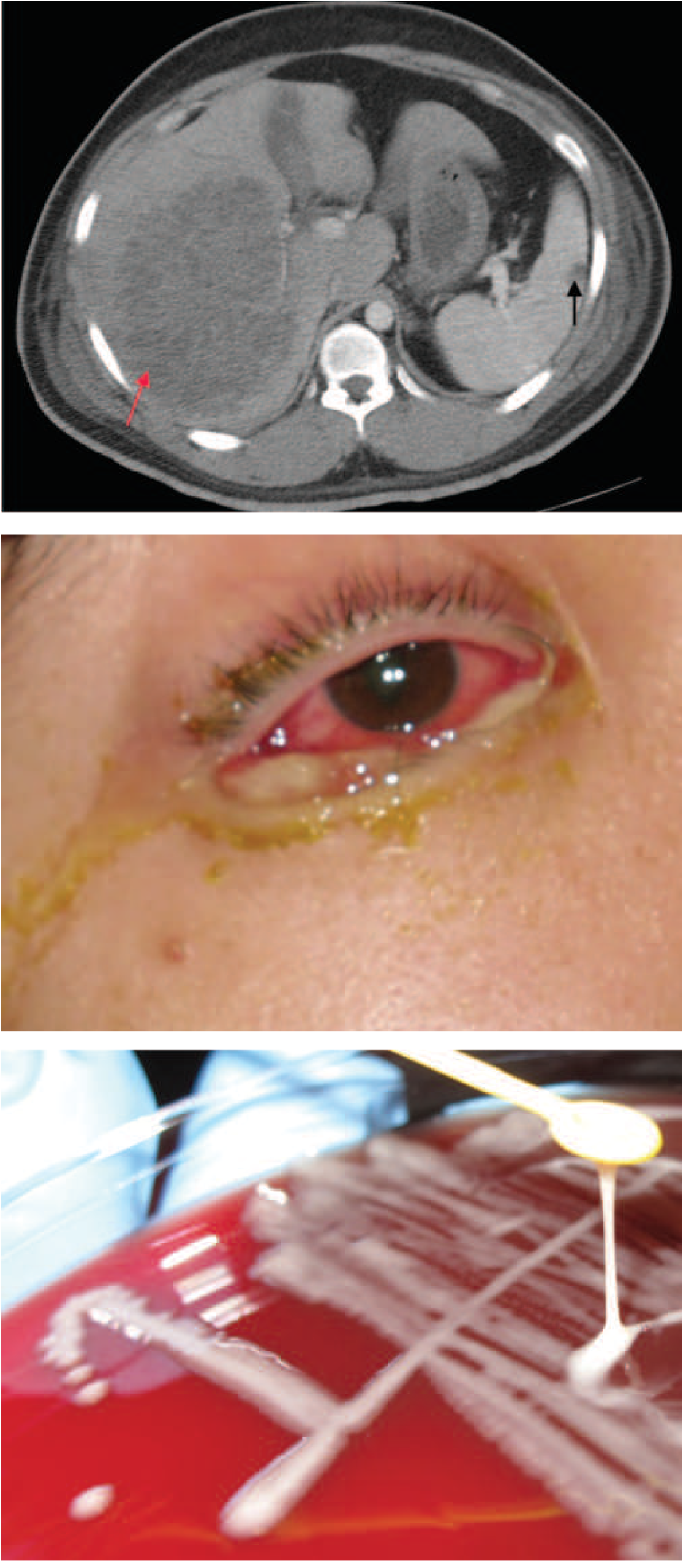
Clinical Image - Hypervirulent K. pneumoniae
The image below (from Harrison's Principles, 22nd ed.) shows:
- Top: Abdominal CT of a healthy 24-year-old - primary liver abscess (red arrow) with metastatic spread to the spleen (black arrow)
- Middle: Endophthalmitis in a healthy 33-year-old
- Bottom: Positive string test - mucoid colony stretching >5 mm with inoculating loop, indicating hypermucoviscous phenotype
Laboratory Diagnosis
- Gram stain: Gram-negative rods, sometimes with visible capsular halo
- Grows readily on standard media (blood agar, MacConkey agar - pink/lactose-fermenting)
- Mucoid, glistening colonies; string test can be performed
- Indole negative (K. pneumoniae sensu stricto); Urease positive
- Definitive hvKp identification: PCR/genomic detection of all 5 biomarkers: iucA, iroB, peg-344, rmpA, rmpA2
(Harrison's Principles of Internal Medicine, 22nd ed.)
Antibiotic Resistance - Major Concern
K. pneumoniae is a WHO priority pathogen for antimicrobial resistance research.
Resistance Mechanisms
| Mechanism | Details |
|---|---|
| Intrinsic ampicillin resistance | Chromosomal penicillinase |
| ESBL (Extended-Spectrum Beta-Lactamase) | Most commonly CTX-M type; hydrolysis of 3rd-gen cephalosporins and penicillins; ~25% of US hospital isolates (higher in Asia, South America, Africa) |
| AmpC beta-lactamase | Resistance to beta-lactam/beta-lactamase inhibitor combinations |
| KPC (K. pneumoniae Carbapenemase) | Serine carbapenemase; most common carbapenemase in the US; confers resistance to virtually all beta-lactams; now found in many Enterobacteriaceae (hence renamed CRE) |
| MBL (Metallo-beta-lactamase) | NDM-type; high prevalence in Eastern Europe, Asia; not inhibited by avibactam |
| OXA-48 | Oxacillinase-type carbapenemase |
| Porin loss + efflux pumps | Contribute to high-level carbapenem resistance |
(Quick Compendium of Clinical Pathology 5th ed.; Harrison's 22nd ed.)
Treatment by Resistance Profile
| Organism | Preferred Treatment |
|---|---|
| Susceptible Kp | 3rd-gen cephalosporins, fluoroquinolones, TMP-SMX |
| ESBL-producing Kp | Carbapenems (meropenem, ertapenem); oral options limited |
| KPC-producing CRE | Ceftazidime-avibactam, meropenem-vaborbactam, imipenem-cilastatin-relebactam |
| NDM-producing CRE | Cefiderocol, aztreonam-avibactam, polymyxins (combination) |
| Extensively resistant | Consult Infectious Diseases; combination therapy |
(Harriet Lane Handbook, 23rd ed.; Harrison's 22nd ed.; Washington Manual of Medical Therapeutics)
Risk Factors for Acquisition
- Hospitalization / LTCF residence
- Mechanical ventilation (VAP)
- Indwelling urinary catheter (complicated UTI)
- Diabetes mellitus
- Chronic alcoholism
- COPD / structural lung disease
- Immunosuppression (neutropenia, transplant, steroids)
- Broad-spectrum antibiotic use (selects for MDR strains)
- Asian origin / travel (for hvKp and NDR strains)
Epidemiology (2025 Update)
A 2025 systematic review and meta-analysis (PMID 41208438) analyzed the global prevalence of hypervirulent K. pneumoniae, highlighting that hvKp is no longer confined to Asia and is an emerging global threat - particularly as MDR and hvKp lineages increasingly converge. A 2024 systematic review (PMID 38147789) documented secondary Klebsiella infections in COVID-19 patients as a major contributor to mortality in the pandemic era.
Summary Table
| Feature | Detail |
|---|---|
| Gram stain | Gram-negative rod |
| Motility | Non-motile |
| Capsule | Large polysaccharide (K antigen) - mucoid colonies |
| Indole | Negative (K. pneumoniae); Positive (K. oxytoca) |
| Key infections | Pneumonia, UTI, liver abscess, bacteremia |
| Classic sputum | "Currant jelly" (thick, blood-tinged) |
| Classic patient | Alcoholic/diabetic/malnourished OR healthy young (hvKp) |
| String test | Positive in hvKp (hypermucoviscous) |
| Key resistance genes | ESBL (CTX-M), KPC, NDM, OXA-48 |
| Carbapenemase prevalence (US) | ~8.6% of K. pneumoniae isolates (USNHSN 2015-2017) |
This is a shared conversation. Sign in to Orris to start your own chat.