
In depth define describe and tell advantages of CO2 absorber for 20 mark answer in anaesthesia exam
Reading File
Now let me search the medical library and web in parallel for comprehensive CO2 absorber content.
Finding Sources
Finding Sources
Searching the Web
CO2 absorber anaesthesia soda lime baralyme composition mechanism advantages exam
Good. Now let me pull the detailed textbook content from Barash and Morgan & Mikhail.
Reading File
Reading File
Finding Sources
Excellent. I now have rich content from Barash and Morgan & Mikhail. Let me fetch the absorber diagram and get a bit more content on chemical reactions and indicators.
Reading File
Loading Image
I now have comprehensive, high-quality content from Barash's Clinical Anesthesia and Morgan & Mikhail's Clinical Anesthesiology. Let me compile the full 20-mark answer.
CO2 Absorber in Anaesthesia - 20-Mark Answer
Introduction
The CO2 absorber is an integral component of the circle breathing system in anaesthesia. It chemically removes carbon dioxide from exhaled gases, allowing rebreathing of unused oxygen and anaesthetic agents. Without it, CO2 would accumulate in the circuit, causing hypercapnia. The concept was first introduced by Dennis Jackson in 1915, who developed early CO2 absorption techniques for closed-circuit anaesthesia.
- Barash Clinical Anesthesia 9e, p.2003
Definition
A CO2 absorber is a canister-based device containing granules of alkaline chemical absorbents that chemically react with and neutralise exhaled CO2 from the patient in a closed or semi-closed anaesthetic circuit, preventing its rebreathing.
The Absorber Canister - Physical Description
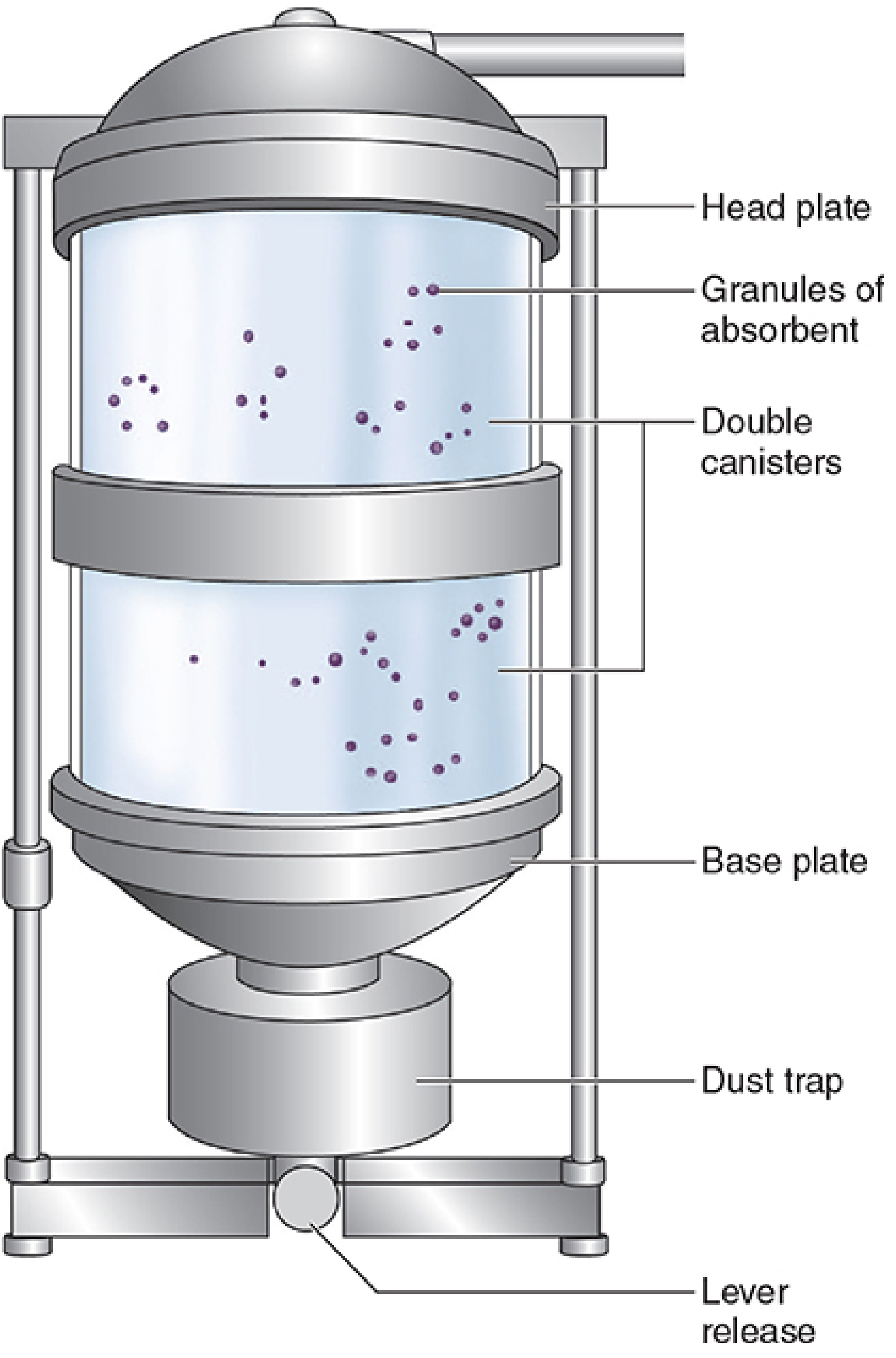
The absorber canister consists of:
- Double canisters in series - arranged to ensure complete CO2 absorption, require less frequent changes, and lower gas flow resistance
- Head plate and base plate - enclose the granules
- Transparent walls - allow visual monitoring of indicator dye colour change
- Baffle system - directs gas through the centre to minimise channeling through loosely packed areas, ensuring greater use of the absorbent
- Dust trap at the base - collects dust and moisture
- Lever release mechanism - for canister removal/replacement
Contemporary workstations (GE Healthcare, Dräger) use proprietary canisters that allow exchange while maintaining breathing circuit integrity.
The tidal volume should not exceed the air space between granules, which is approximately 50% of the absorber's capacity, to ensure complete absorption.
- Morgan & Mikhail Clinical Anesthesiology 7e, p.92-93
Types of CO2 Absorbents
1. Soda Lime (Most Commonly Used)
Composition (High-Moisture Soda Lime):
| Component | Percentage |
|---|---|
| Calcium hydroxide Ca(OH)₂ | ~80% |
| Water | ~15% |
| Sodium hydroxide NaOH | ~4% |
| Potassium hydroxide KOH | ~1% |
| Silica (hardening agent) | Small amounts |
- Small amounts of silica are added to form calcium and sodium silicate, producing a harder, more stable pellet that reduces dust formation
- NaOH acts as the catalyst for CO2-absorptive properties
- KOH acts as an activator
Granule Size: 4-8 mesh (number of openings per linear inch in a sieve). This is a compromise between:
- Smaller granules = greater surface area = better absorption
- Smaller granules = higher resistance to gas flow
Absorptive Capacity: Soda lime can absorb 26 litres of CO2 per 100 g of absorbent (19% of its weight in CO2).
- Barash Clinical Anesthesia 9e, p.2003-2004
2. Calcium Hydroxide Lime (Amsorb / Amsorb Plus)
Composition:
- Calcium hydroxide Ca(OH)₂ (primary component)
- Calcium chloride CaCl₂
- Calcium sulfate (hardening agent)
- Polyvinylpyrrolidone (increases hardness and porosity)
Key feature: Contains NO strong bases (no NaOH or KOH). This is its most significant advantage.
Disadvantages: Approximately 50% less absorptive capacity than soda lime; generally higher cost per unit.
- Barash Clinical Anesthesia 9e, p.2004
3. Baralyme (Barium Hydroxide Lime)
Composition:
-
~20% barium hydroxide Ba(OH)₂
-
Calcium hydroxide
-
Indicator dyes: Mimosa Z and ethyl violet (initially pink, turns blue-gray when exhausted)
-
Efficiency is comparable to soda lime per unit volume, but because of its higher density, it is only half as efficient per unit mass
-
Produces more heat than soda lime (highly exothermic)
-
Largely withdrawn from clinical use due to higher risk of toxic compound formation
4. Lithium Hydroxide (LiOH) - Litholyme
Reaction: 2LiOH + CO₂ → Li₂CO₃ + H₂O
- Lower exothermic reactivity → reduced fire risk
- Does not degrade volatile anaesthetics
- Higher cost, but allows lower fresh gas flows with sevoflurane, offsetting the cost advantage
- Available outside the US; limited availability in some markets
5. SpiraLith Ca (Micropore Inc.)
-
Supplied on a polymer matrix base, rolled as a fixed spiral in a cylinder
-
Contains no lithium or indicator dye - requires inspired CO2 monitoring
-
Advantage: Exhausted absorbent can be recycled by the manufacturer
-
Barash Clinical Anesthesia 9e, p.2010
Chemistry of CO2 Absorption
CO2 absorption is a chemical process, not a simple physical one. It proceeds as a series of reactions:
Step 1 - CO2 reacts with water to form carbonic acid:
CO₂ + H₂O → H₂CO₃
Step 2 - Carbonic acid reacts with NaOH/KOH (fast reaction):
H₂CO₃ + 2NaOH → Na₂CO₃ + 2H₂O H₂CO₃ + 2KOH → K₂CO₃ + 2H₂O
Step 3 - Sodium/potassium carbonates react with Ca(OH)₂ (slower, over minutes):
Na₂CO₃ + Ca(OH)₂ → CaCO₃ + 2NaOH K₂CO₃ + Ca(OH)₂ → CaCO₃ + 2KOH
The NaOH and KOH are regenerated - they act as true catalysts. The final end product is calcium carbonate (CaCO₃), and the absorbent is exhausted when all hydroxides have been converted to carbonates.
By-products: Heat and water are released during the reaction. This exothermic reaction warms and humidifies inspired gases - a physiological benefit.
- Barash Clinical Anesthesia 9e, p.2003-2004; Morgan & Mikhail 7e, p.91
Indicator Dyes
Exhaustion of the absorbent is signalled by colour change of a pH-sensitive indicator dye:
| Indicator | Fresh Colour | Exhausted Colour | Used In |
|---|---|---|---|
| Ethyl violet | White/colourless | Violet/purple | Soda lime (most common) |
| Mimosa Z | Pink | White/colourless | Baralyme |
| Ethyl violet + Mimosa Z | Pink | Blue-gray | Baralyme |
| Clayton Yellow | Orange | Yellow | Some formulations |
Important caveat: Indicators can revert to their original colour after a rest period despite the absorbent being exhausted. Therefore, continuous inspired CO2 monitoring (capnography) is the primary method of detecting absorbent exhaustion, with visual colour change as a secondary indicator only.
Toxic Byproducts - A Critical Safety Consideration
Compound A
- Produced from sevoflurane degradation by soda lime (especially desiccated absorbent with strong bases)
- Nephrotoxic in certain animals; not conclusively shown to be harmful in humans at clinical concentrations
- Risk increased by: higher sevoflurane concentrations, prolonged exposure, low fresh gas flows, dry absorbent
- Absent or markedly reduced with calcium hydroxide lime (Amsorb)
Carbon Monoxide (CO)
-
Produced when desflurane, enflurane, isoflurane (less so sevoflurane) degrade in desiccated absorbent containing strong bases (NaOH/KOH)
-
Greatest risk with desflurane; occurs at higher temperature with sevoflurane
-
Can cause clinically measurable carboxyhemoglobin concentrations
-
Virtually eliminated by using strong-base-free absorbents (Amsorb, Litholyme)
-
Prevention: Never allow fresh gas to flow continuously through unused absorber canisters (desiccates the absorbent)
-
Morgan & Mikhail 7e, p.92; APSF guidelines
Signs of CO2 Absorbent Exhaustion
- Colour change of indicator dye
- Rising inspired CO2 on capnograph (most reliable)
- Canister feels warm to touch (exothermic reaction ongoing) - or absence of warmth when exhausted
- Patient develops signs of hypercapnia (tachycardia, hypertension, increased respiratory effort, arrhythmias)
Ideal Properties of a CO2 Absorbent
The ideal absorbent should have:
- High CO2 absorptive efficiency
- Low resistance to gas flow
- No reactivity with common anaesthetic agents
- No toxicity to patients or staff
- Ease of handling
- Low cost
- Reliable indicator of exhaustion
- Adequate moisture content (prevents desiccation and toxic byproduct formation)
- Barash Clinical Anesthesia 9e, p.2003
Advantages of CO2 Absorbers
1. Prevention of Hypercapnia
The primary function - removes CO2 from exhaled gas in closed/semi-closed circuits, preventing CO2 rebreathing and the dangerous physiological consequences of hypercapnia (respiratory acidosis, cardiovascular stimulation, arrhythmias).
2. Enables Low Fresh Gas Flow (LFF) Anaesthesia
By absorbing CO2, the circuit does not need to be "washed out" with high fresh gas flows. This directly enables low-flow and minimal-flow anaesthesia techniques.
3. Significant Cost Reduction
Reduced fresh gas flows mean dramatically less volatile anaesthetic agent is consumed. Reducing FGF from 3.0 L/min to 1.0 L/min saves approximately 50% of total volatile anaesthetic consumption. This is a major economic benefit.
4. Reduction of Environmental Pollution
Volatile anaesthetic agents are potent greenhouse gases (e.g., desflurane has a global warming potential ~2,500x that of CO2). Low-flow anaesthesia enabled by CO2 absorbers substantially reduces atmospheric emissions. Healthcare accounts for approximately 4.6-4.7% of global greenhouse gas emissions, with anaesthetic agents contributing disproportionately.
5. Humidification and Warming of Inspired Gases
The exothermic chemical reaction releases water vapour. This warms and humidifies the inspired gas mixture, which:
- Reduces heat loss from the respiratory tract
- Decreases the risk of postoperative hypothermia
- Helps maintain mucociliary function
6. Conservation of Oxygen
Less oxygen is wasted in flushing the circuit at high FGFs. In resource-limited settings, this is an important consideration.
7. Reduced Pollution of the Operating Theatre Environment
Lower FGFs mean less gas escapes into the operating room atmosphere, reducing occupational exposure of staff to trace anaesthetic agents.
8. Enables Closed-Circuit Anaesthesia
With a CO2 absorber, a fully closed circuit becomes possible (FGF equals only the patient's O2 consumption ~250 mL/min), allowing maximum economy and minimum environmental impact.
9. Maintains Anaesthetic Depth Stability
In low-flow circuits with a CO2 absorber, the reservoir of anaesthetic agent within the circuit buffers against rapid changes in delivered concentration, providing greater stability of anaesthetic depth.
10. Indicator Function
Built-in colour indicator dyes provide a bedside warning system (secondary to capnography) for exhaustion of the absorbent.
Precautions and Disadvantages
| Concern | Detail |
|---|---|
| Toxic byproducts | Compound A (sevoflurane) and CO (desflurane) from strong-base absorbents |
| Desiccation hazard | Dry absorbent greatly increases toxic byproduct formation |
| Indicator unreliability | Colour may reverse even when exhausted |
| Fire risk | Exothermic reaction + desiccated absorbent + accumulation of CO (flammable) |
| Granule dust | Can cause circuit leaks if lodged in O-ring gaskets |
| Volatile anaesthetic absorption/release | Dry soda lime can absorb then slowly release anaesthetic agents, causing unpredictable depth |
Summary Table: Comparison of CO2 Absorbents
| Property | Soda Lime | Amsorb (Ca(OH)₂ lime) | Baralyme | Litholyme |
|---|---|---|---|---|
| Main constituent | Ca(OH)₂ | Ca(OH)₂ + CaCl₂ | Ba(OH)₂ + Ca(OH)₂ | LiOH |
| Strong bases | Yes (NaOH, KOH) | No | No/minimal | No |
| Compound A production | Yes | No/minimal | Yes | No |
| CO production | Yes (if dry) | No | Yes (if dry) | No |
| Absorptive capacity | 26 L CO₂/100 g | ~13 L CO₂/100 g (50% less) | Equal to SL by volume | High |
| Indicator | Ethyl violet | Yes | Mimosa Z | Yes |
| Cost | Low | Higher | Low | Higher |
| Fire risk | Moderate | Lower | Higher | Low |
Clinical Bottom Line
The CO2 absorber is not merely a passive component - it is the element that makes rebreathing systems economically, physiologically, and environmentally viable. Modern strong-base-free absorbents (Amsorb, Litholyme) largely solve the problem of toxic byproduct formation, enabling safe low-flow and minimal-flow anaesthesia with significant patient safety, cost, and environmental benefits. Continuous capnographic monitoring remains mandatory regardless of the absorbent type used.
References (Textbook Sources):
- Barash, Cullen, and Stoelting's Clinical Anesthesia 9th edition, Chapter 25 - Anaesthesia Equipment (pp. 2003-2010)
- Morgan & Mikhail's Clinical Anesthesiology 7th edition, Chapter 3 - The Breathing Circuit (pp. 91-94)
- OpenAnesthesia: Carbon Dioxide Absorbers (current clinical guidelines)
- APSF: Low Flow and CO2 Absorbents (patient safety guidelines)
Soda lime baralyme and ambsorb for 10 mark answer
Based on the previous session's textbook content already in context, I have rich detail on all three absorbents. Let me pull any additional specific details from the library quickly.
Searching sources...
Finding Sources
Finding Sources
Reading File
I now have all the detail needed. Here is a complete, exam-ready 10-mark answer.
Soda Lime, Baralyme, and Amsorb - 10-Mark Answer
Introduction
CO2 absorbents are alkaline chemical agents used in the circle breathing system to remove exhaled CO2 and prevent its rebreathing. The three principal absorbents are Soda Lime (most widely used), Baralyme (barium hydroxide lime), and Amsorb (calcium hydroxide lime). Each differs in composition, chemistry, efficiency, and safety profile.
1. Soda Lime
Composition (High-Moisture formulation)
| Component | Proportion |
|---|---|
| Calcium hydroxide Ca(OH)₂ | ~80% |
| Water | ~15% |
| Sodium hydroxide NaOH (catalyst) | ~4% |
| Potassium hydroxide KOH (activator) | ~1% |
| Silica (hardening agent) | Small amounts |
- Silica forms calcium and sodium silicate, producing harder, more stable pellets with less dust
- Hardness and absorptive efficiency vary inversely - so minimal silica is used in contemporary preparations
- Granule size: 4-8 mesh - optimal balance between surface area (absorption) and resistance to gas flow
Chemical Reactions
Step 1: CO₂ + H₂O ⇌ H₂CO₃ (carbonic acid)
Step 2: H₂CO₃ + 2NaOH (KOH) ⇌ Na₂CO₃ (K₂CO₃) + 2H₂O + Heat
Step 3: Na₂CO₃ (K₂CO₃) + Ca(OH)₂ ⇌ CaCO₃ + 2NaOH (KOH)
- NaOH/KOH are regenerated (act as true catalysts)
- Final product: Calcium carbonate (CaCO₃)
- Absorbent is exhausted when all hydroxide has been converted to carbonate
- Some CO2 reacts directly with Ca(OH)₂ but this is a much slower reaction
Absorptive Capacity
- 26 litres of CO₂ per 100 g of absorbent (can absorb ~19% of its weight in CO2)
Indicator Dye
- Ethyl violet - colourless/white when fresh → turns violet/purple when exhausted
- Colour can revert to original after a rest period even when absorbent is truly exhausted - capnography remains the primary monitoring tool
Advantages
- Highest absorptive capacity among common absorbents
- Low cost
- Widely available
- Reliable, well-established clinical track record
Disadvantages
-
Strong bases (NaOH, KOH) cause degradation of volatile anaesthetics when desiccated:
- Sevoflurane → Compound A (potentially nephrotoxic, especially in animals)
- Desflurane/isoflurane/enflurane → Carbon monoxide (CO) when absorbent is desiccated
-
Exothermic reaction raises temperature - fire risk with desiccated absorbent
-
Dust formation from granule breakdown
-
Barash Clinical Anesthesia 9e, p.2003-2005
2. Baralyme (Barium Hydroxide Lime)
Composition
| Component | Proportion |
|---|---|
| Barium hydroxide Ba(OH)₂ | ~20% |
| Calcium hydroxide Ca(OH)₂ | Remainder |
| Indicator dyes: Mimosa Z + Ethyl violet | Small amounts |
Chemical Reaction
Ba(OH)₂ + CO₂ → BaCO₃ + H₂O
Ca(OH)₂ + CO₂ → CaCO₃ + H₂O
End products are barium carbonate and calcium carbonate.
Indicator Dye
- Initially pink → turns blue-gray on exhaustion (due to Mimosa Z + ethyl violet combination)
Absorptive Capacity
- Equal to soda lime per unit volume
- However, because of its greater density, only half as efficient per unit mass compared to soda lime
Advantages
- Efficient per unit volume
- No need for added NaOH/KOH activators (Ba(OH)₂ is itself reactive)
- More robust granules, less dust formation than soda lime
Disadvantages
-
More exothermic than soda lime - greater heat generation raises fire risk
-
Still contains sufficient alkali to produce Compound A and CO when desiccated, similar to soda lime
-
Barium compounds are potentially toxic if granule dust is inhaled or ingested
-
Largely withdrawn from clinical use because of its higher fire/explosion risk and greater toxic byproduct formation compared to newer alternatives
-
Half as efficient per unit mass (heavier to transport/handle)
-
Barash Clinical Anesthesia 9e, p.2004; Sciencedirect CO2 Absorbents review
3. Amsorb (Calcium Hydroxide Lime)
Composition
| Component | Role |
|---|---|
| Calcium hydroxide Ca(OH)₂ | Primary absorbent |
| Calcium chloride CaCl₂ | Absorption enhancer |
| Calcium sulfate | Setting/hardening agent |
| Polyvinylpyrrolidone | Increases hardness and porosity |
- Contains NO strong bases (no NaOH, no KOH) - this is its defining and most important feature
Chemical Reaction
Ca(OH)₂ + CO₂ → CaCO₃ + H₂O
A direct, single-step reaction without need for NaOH/KOH catalysis.
Absorptive Capacity
- 10.2 litres of CO₂ per 100 g - approximately 50% less than soda lime
- This is the most significant clinical limitation
Indicator Dye
- Colour-change indicator present; specific formulation varies by manufacturer
Advantages (KEY distinguishing features)
- No Compound A production - absence of strong bases means sevoflurane is not degraded, making Amsorb safe for low-flow sevoflurane anaesthesia
- No carbon monoxide production - even when desiccated, does not produce CO from desflurane or other volatile agents
- Reduced fire risk - lower exothermic reactivity compared to soda lime and baralyme
- Safer for low-flow and minimal-flow anaesthesia - removing the constraint of toxic byproduct production allows fresh gas flows below 1 L/min
- Reduced anaesthetic consumption - low-flow techniques save ~50% of volatile agent costs, largely offsetting Amsorb's higher unit price
- Environmental benefit - lower volatile agent emissions into the atmosphere
- No desiccation hazard from strong bases
Disadvantages
-
~50% lower absorptive capacity - canisters must be changed more frequently
-
Higher cost per unit than soda lime
-
Requires larger or more frequent canister changes
-
Barash Clinical Anesthesia 9e, p.2003-2004; Morgan & Mikhail 7e, p.92
Comparison Table
| Property | Soda Lime | Baralyme | Amsorb |
|---|---|---|---|
| Main constituent | Ca(OH)₂ + NaOH/KOH | Ba(OH)₂ + Ca(OH)₂ | Ca(OH)₂ + CaCl₂ |
| Strong bases | Yes (NaOH, KOH) | Minimal/No | No |
| Absorptive capacity | 26 L/100 g | Equal to SL by volume; ½ by mass | 10.2 L/100 g |
| Compound A (sevoflurane) | Yes | Yes | No |
| Carbon monoxide (dry) | Yes | Yes | No |
| Indicator colour (fresh → exhausted) | White → Violet | Pink → Blue-gray | Yes (varies) |
| Exothermic reaction | Moderate | High | Low |
| Fire risk | Moderate | Higher | Low |
| Cost | Low | Low | Higher |
| Clinical status | Gold standard | Largely withdrawn | Preferred for low-flow |
Clinical Relevance
- Soda lime remains the most widely used due to low cost and high efficiency, but requires adequate hydration and monitoring for toxic byproducts
- Baralyme is largely obsolete - its combination of high exothermy and greater toxic byproduct formation makes it less safe than alternatives
- Amsorb represents the modern preferred choice where low-flow or minimal-flow anaesthesia is practised, particularly with sevoflurane - the absence of strong bases eliminates the principal safety concerns of CO2 absorbers, and the cost savings from reduced volatile agent use largely offset its higher unit price
Key rule: Inspired CO2 monitoring (capnography) is mandatory regardless of absorbent type - colour indicators are unreliable as the sole guide to absorbent exhaustion.
Sources: Barash Clinical Anesthesia 9e pp. 2003-2005; Morgan & Mikhail Clinical Anesthesiology 7e pp. 91-93; OpenAnesthesia CO2 Absorbers; APSF Low-Flow and CO2 Absorbents guidelines
This is a shared conversation. Sign in to Orris to start your own chat.