
muscles of pectoral girdle
Reading File
The pectoral girdle muscles connect the upper limb to the axial skeleton and include muscles like pectoralis major/minor, serratus anterior, trapezius, rhomboids, and levator scapulae. Let me pull the detailed anatomical content from the textbooks.
Searching sources...
Finding Sources
Finding Sources
Reading File
Reading File
Reading File
Reading File
Reading File
Reading File
Now I have all the data needed for a comprehensive answer. Let me also fetch a key anatomical diagram to include.
Loading Image
Loading Image
Here is a complete, textbook-based overview of the muscles of the pectoral girdle.
Muscles of the Pectoral Girdle
The pectoral girdle (shoulder girdle) muscles connect the scapula and clavicle to the axial skeleton, stabilizing and moving the scapula to position the upper limb. They are traditionally divided into posterior and anterior groups, plus a special group that migrated embryologically from the head.
Posterior View - Deep Layer
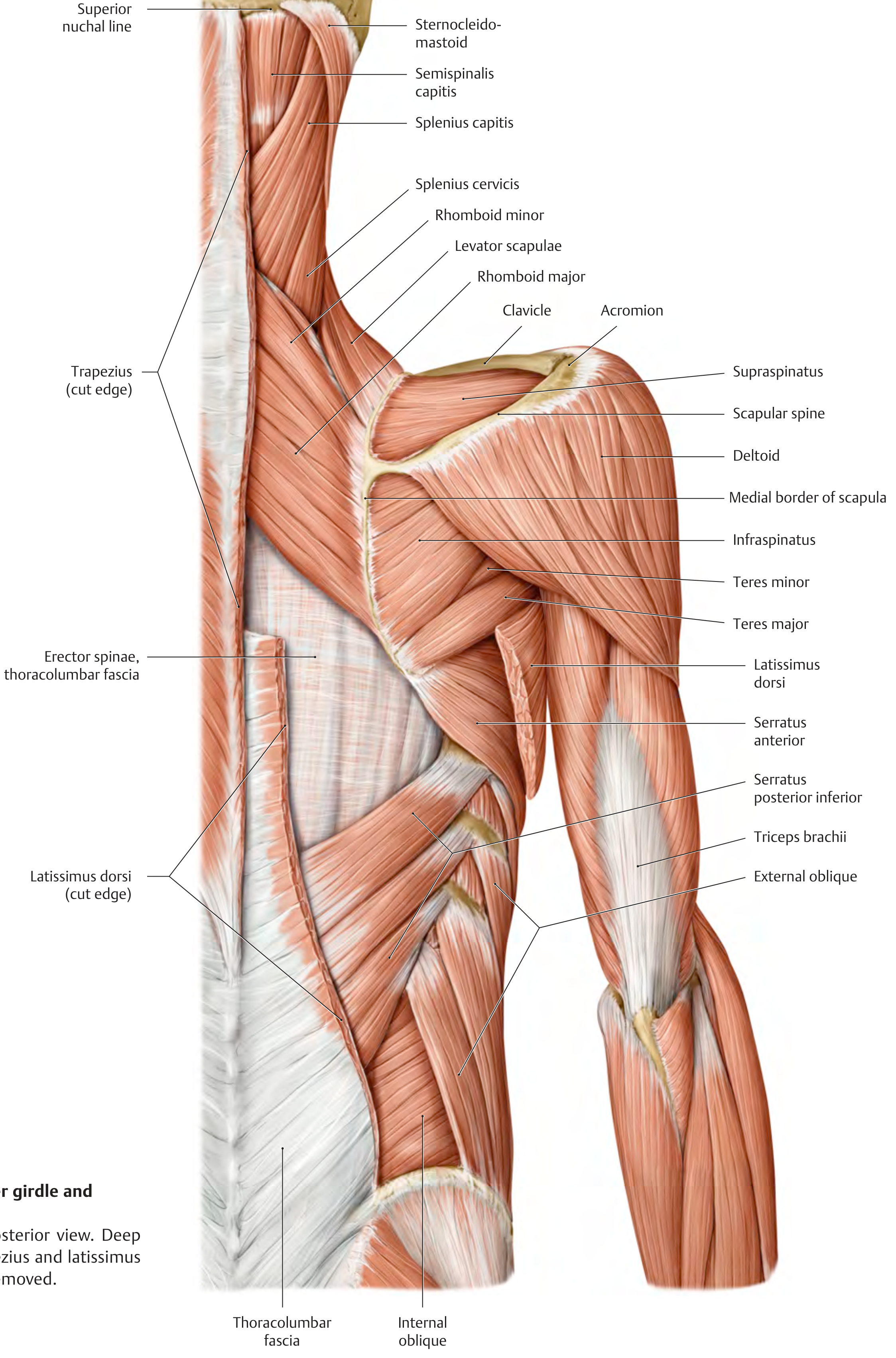
GROUP 1: Muscles Migrated from the Head
1. Trapezius
| Origin | Descending part: occipital bone (superior nuchal line, external occipital protuberance) + spinous processes of all cervical vertebrae via the nuchal ligament; Transverse part: broad aponeurosis at T1-T4 spinous processes; Ascending part: spinous processes of T5-T12 |
| Insertion | Lateral 1/3 of clavicle (descending part), acromion (transverse part), scapular spine (ascending part) |
| Actions | - Descending part: draws scapula obliquely upward, rotates glenoid inferiorly; tilts/rotates head - Transverse part: draws scapula medially - Ascending part: draws scapula medially downward - Entire muscle: steadies scapula on thorax |
| Nerve | Accessory nerve (CN XI) + cervical plexus (C2, C4) |
2. Sternocleidomastoid (SCM)
| Origin | Sternal head: manubrium; Clavicular head: medial 1/3 of clavicle |
| Insertion | Mastoid process and superior nuchal line |
| Actions | Unilateral: tilts head ipsilaterally, rotates it contralaterally; Bilateral: extends head, assists respiration (when head is fixed) |
| Nerve | Accessory nerve (CN XI) + cervical plexus (C2, C3) |
3. Omohyoid
| Origin | Superior border of scapula |
| Insertion | Body of hyoid bone |
| Actions | Depresses (fixes) the hyoid bone |
| Nerve | Ansa cervicalis |
GROUP 2: Posterior Muscles of the Trunk and Shoulder Girdle
4. Levator Scapulae
| Origin | Transverse processes of C1-C4 vertebrae |
| Insertion | Superior angle of the scapula |
| Actions | Draws scapula medially upward (moves inferior angle medially); inclines neck ipsilaterally when scapula is fixed |
| Nerve | Dorsal scapular nerve + cervical spinal nerves (C3, C4) |
5. Rhomboid Minor
| Origin | Spinous processes of C6 and C7 vertebrae |
| Insertion | Medial border of scapula, above the scapular spine |
| Actions | Steadies the scapula; draws scapula medially upward |
| Nerve | Dorsal scapular nerve (C4, C5) |
6. Rhomboid Major
| Origin | Spinous processes of T1-T4 vertebrae |
| Insertion | Medial border of scapula, below the scapular spine |
| Actions | Steadies the scapula; draws scapula medially upward |
| Nerve | Dorsal scapular nerve (C4, C5) |
GROUP 3: Anterior Muscles of the Trunk and Shoulder Girdle
7. Serratus Anterior
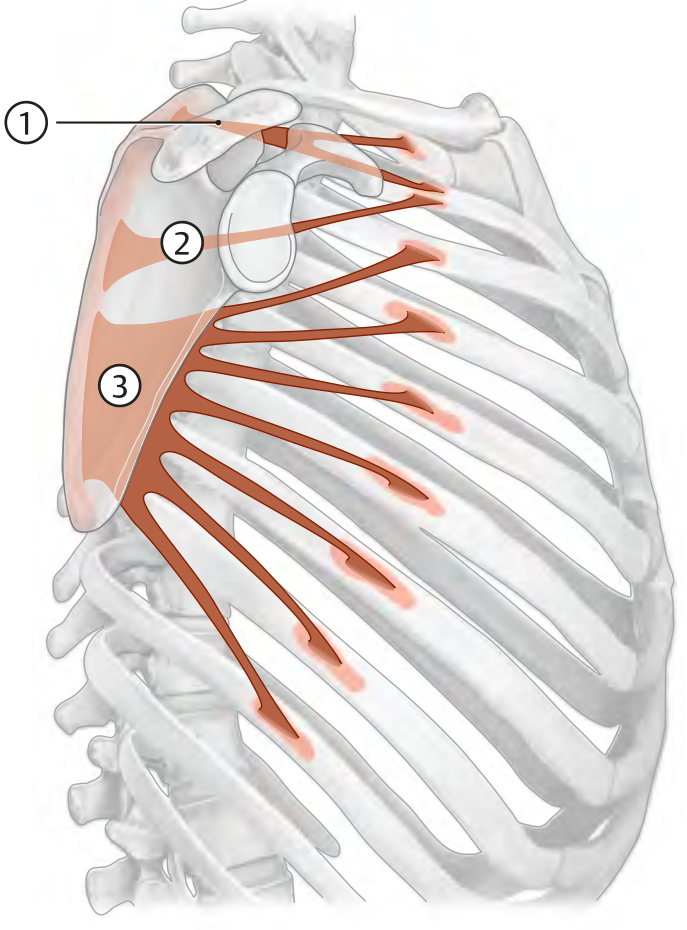
| Origin | 1st through 9th ribs (lateral surfaces) |
| Insertion | Scapula - three parts: (1) costal/dorsal surfaces of superior angle; (2) costal surface of medial border; (3) costal/dorsal surfaces of inferior angle |
| Actions | - Entire muscle: draws scapula laterally forward (protraction); elevates ribs (aids respiration when shoulder girdle is fixed) - Inferior part: rotates scapula so glenoid faces superiorly - allows arm elevation above 90° - Superior part: lowers the raised arm (antagonist to inferior part) |
| Nerve | Long thoracic nerve (C5, C6, C7) |
| Clinical note | Palsy of the long thoracic nerve causes winged scapula - the medial border lifts away from the thoracic wall |
8. Subclavius
| Origin | First rib at the chondro-osseous junction |
| Insertion | Inferior surface of the clavicle (lateral 1/3) |
| Actions | Steadies/depresses the clavicle at the sternoclavicular joint |
| Nerve | Nerve to subclavius (C5, C6) |
9. Pectoralis Minor
| Origin | 3rd through 5th ribs (anterior surfaces) |
| Insertion | Coracoid process of the scapula |
| Actions | Draws scapula downward and forward (inferior angle moves posteromedially); lowers raised arm; rotates glenoid inferiorly; assists respiration |
| Nerve | Medial and lateral pectoral nerves (C8, T1) |
Quick Summary Table
| Muscle | Group | Key Action | Nerve |
|---|---|---|---|
| Trapezius | Head-migrated | Elevates/retracts/stabilizes scapula | CN XI, C2-C4 |
| SCM | Head-migrated | Head rotation/tilt | CN XI, C2-C3 |
| Omohyoid | Head-migrated | Depresses hyoid | Ansa cervicalis |
| Levator scapulae | Posterior | Elevates scapula | Dorsal scapular, C3-C4 |
| Rhomboid minor | Posterior | Retracts + elevates scapula | Dorsal scapular C4-C5 |
| Rhomboid major | Posterior | Retracts + elevates scapula | Dorsal scapular C4-C5 |
| Serratus anterior | Anterior | Protracts/rotates scapula (glenoid up) | Long thoracic C5-C7 |
| Subclavius | Anterior | Stabilizes clavicle | Nerve to subclavius C5-C6 |
| Pectoralis minor | Anterior | Depresses/protracts scapula | Medial/lateral pectoral C8-T1 |
Key Points to Remember
- Scapular rotation (upward): Serratus anterior (inferior part) + trapezius (descending part) work as a force couple to rotate the glenoid superiorly, enabling full arm elevation above 90°.
- Scapular retraction: Rhomboids + trapezius (transverse part) pull the scapula toward the spine.
- Scapular elevation: Levator scapulae + trapezius (descending part).
- Scapular depression: Pectoralis minor + trapezius (ascending part).
- The dorsal scapular nerve (C4-C5) innervates both rhomboids and levator scapulae - a single nerve injury affects all three.
- Winged scapula classically results from long thoracic nerve palsy (serratus anterior paralysis).
Source: THIEME Atlas of Anatomy - General Anatomy and Musculoskeletal System
This is a shared conversation. Sign in to Orris to start your own chat.