
Cubital tunnel boundaries with diagram
Reading File
Finding Sources
Searching the Web
cubital tunnel syndrome anatomy boundaries walls diagram
Reading File
Reading File
Loading Image
Loading Image
Reading Web Page
https://teachmeanatomy.info/upper-limb/areas/ulnar-tunnel
Loading Image
I now have comprehensive information and diagrams. Here is a full breakdown:
Cubital Tunnel - Boundaries and Anatomy
The cubital tunnel (ulnar tunnel) is a fibro-osseous space on the posteromedial aspect of the elbow through which the ulnar nerve passes from the arm into the forearm.
Boundaries
| Wall | Structure |
|---|---|
| Floor | Posterior band of the ulnar collateral ligament + posteromedial elbow joint capsule + groove between the medial epicondyle and olecranon |
| Medial wall | Medial epicondyle of the humerus |
| Lateral wall | Olecranon process of the ulna |
| Roof | Cubital tunnel retinaculum (arcuate ligament of Osborne) - a band of fascia running between the humeral and ulnar heads of the flexor carpi ulnaris (FCU) |
The tunnel is oval in cross-section at rest. During elbow flexion, it flattens to an elliptical shape, increasing intratunnel pressure on the ulnar nerve.
Diagrams
Cross-sectional boundaries showing the retinaculum, medial epicondyle, olecranon, and ulnar nerve:
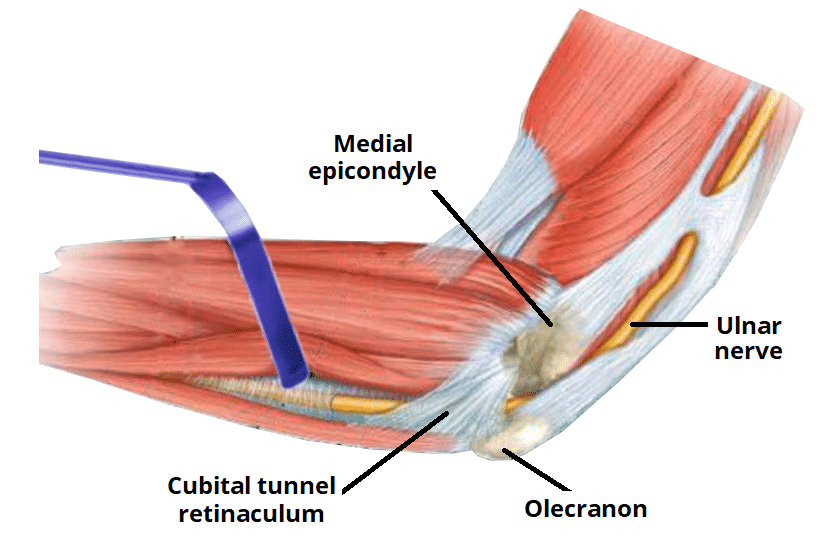
Sites of ulnar nerve compression around the elbow (proximal to distal):

Cubital tunnel syndrome - relationship of FCU heads and tunnel:
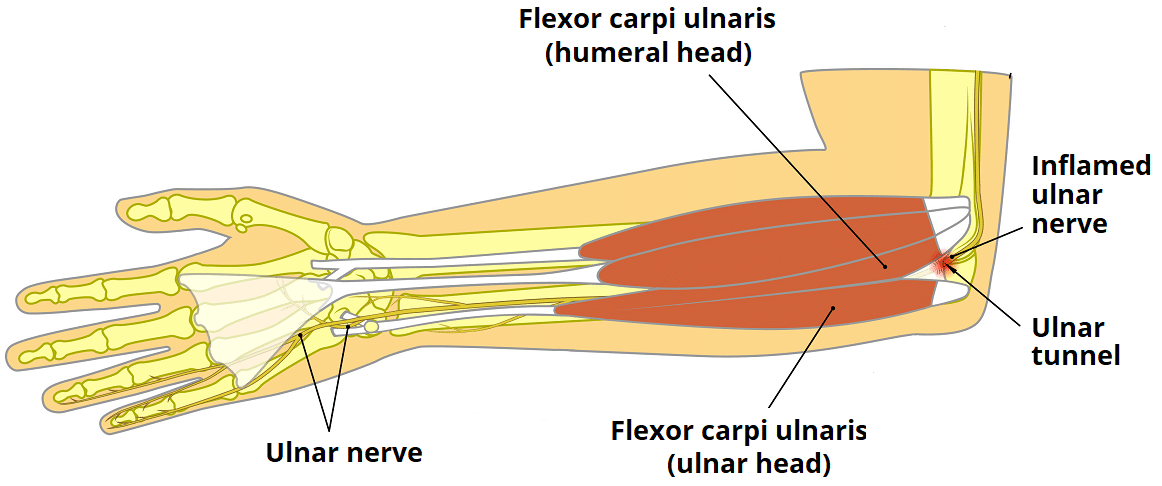
Proximal-to-Distal Compression Sites Along the Ulnar Nerve at the Elbow
The "cubital tunnel" in the broad clinical sense encompasses several potential compression points:
- Arcade of Struthers - ~8 cm proximal to the medial epicondyle; an intermuscular fascial arcade where the nerve transitions from the anterior to posterior compartment
- Medial intermuscular septum - also in the distal arm
- Retroepicondylar groove - the ulnar groove between the medial epicondyle and olecranon (the true cubital tunnel, covered by the cubital tunnel retinaculum)
- Osborne's ligament / Osborne's band (Arcade of Osborne) - the aponeurotic arch between the two heads of FCU, forming the distal exit of the tunnel; this is the most common site of compression
Contents
- Ulnar nerve (primary structure)
- Occasionally small branches of the medial antebrachial cutaneous nerve
Clinical Note
The Sabiston Textbook of Surgery notes that the cubital tunnel retinaculum bridges the medial epicondyle to the olecranon and stabilizes the ulnar nerve during elbow motion. With elbow flexion, the tunnel volume decreases by up to 55%, explaining why flexed-elbow postures (sleeping, phone use) worsen symptoms. - Schwartz's Principles of Surgery, 11th Ed.
List all the possible sites of compress for ulnar nerve
Finding Sources
Searching the Web
all sites of ulnar nerve compression entrapment anatomy proximal distal
Reading File
Reading File
Loading Image
Loading Image
Reading File
You've run out of free credits. Sign up for a free account to continue using Orris.
This is a shared conversation. Sign in to Orris to start your own chat.