
Nervous system
Reading File
The query "nervous system" is quite broad. Let me clarify what you're looking for before diving deep.
Asking for Preferences
What aspect of the nervous system are you interested in? · What level of detail do you need?
Got it - in-depth study notes on nervous system overview and anatomy. Let me pull from the medical library now.
Searching sources...
Finding Sources
Finding Sources
Searching the Web
nervous system overview anatomy divisions CNS PNS study notes
I found key sections in Gray's Anatomy for Students and Histology textbooks. Let me read them now.
Reading File
Reading File
Excellent content from Histology. Now let me read the Gray's Anatomy overview section and get more detail on neurons, CNS structures, and the ANS.
Reading File
Reading File
I now have rich content on overview, development, cells, and neuron types. Let me fetch the key diagram and also read the CNS cellular components section from Gray's.
Loading Image
Loading Image
Reading File
I now have very rich, detailed content from Gray's Anatomy for Students and Histology textbooks. I have everything needed to write comprehensive study notes. Let me compile the full answer now.
The Nervous System - In-Depth Study Notes
1. Definition and Functions
The nervous system enables the body to respond to continuous changes in its external and internal environment. It controls and integrates the functional activities of organs and organ systems. Its three core functions are:
- Sensory - detects stimuli from internal and external environments
- Integration - analyzes, stores, interprets, and decides upon responses
- Motor - initiates and regulates voluntary and involuntary responses
2. Structural Divisions
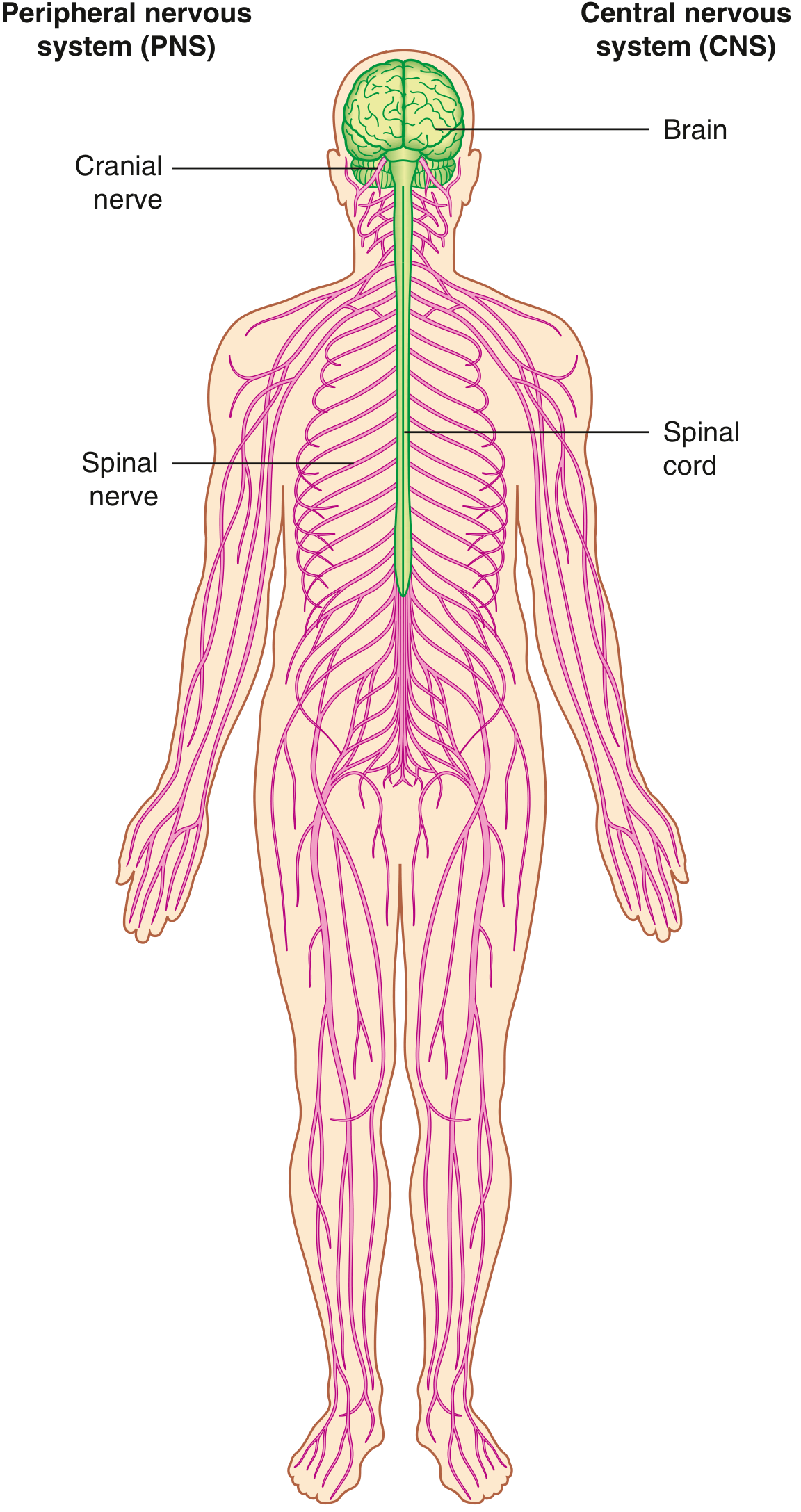
Central Nervous System (CNS)
- Brain - enclosed in the cranial cavity
- Spinal cord - enclosed in the vertebral canal
Peripheral Nervous System (PNS)
Consists of all nervous tissue outside the CNS:
- Cranial nerves (12 pairs)
- Spinal nerves (31 pairs)
- Autonomic nerves
- Ganglia - collections of nerve cell bodies outside the CNS
- Enteric nervous system - intrinsic nervous system of the gut wall
- Specialized sensory and motor nerve endings
3. Functional Divisions
| Division | Location | Control | Targets |
|---|---|---|---|
| Somatic NS (SNS) | Parts of CNS + PNS | Voluntary (conscious) | Skeletal muscle, skin, special senses |
| Autonomic NS (ANS) | Parts of CNS + PNS | Involuntary | Smooth muscle, cardiac muscle, glands |
| Enteric NS | Gut wall | Semi-autonomous | Alimentary canal |
The ANS is further subdivided into:
- Sympathetic division - "fight or flight"
- Parasympathetic division - "rest and digest"
- Enteric division - communicates with CNS via sympathetic and parasympathetic fibers but can function independently
4. Development (Embryology)
The nervous system develops from ectoderm:
- ~Day 18-19: Ectoderm thickens to form the neural plate
- Day 20-21: Neural plate develops a neural groove flanked by neural folds
- The neural folds fuse in a process called neurulation to form the neural tube (with inner neural canal)
- Proliferation of neural tube cells generates the vesicles of the brain and ventricular system
| Primary Vesicle | Secondary Vesicle | Neural Derivatives | Cavity |
|---|---|---|---|
| Prosencephalon (forebrain) | Telencephalon | Cerebral hemispheres | Lateral ventricles |
| Diencephalon | Thalamus, hypothalamus, retina | Third ventricle | |
| Mesencephalon | Mesencephalon | Midbrain | Cerebral aqueduct |
| Rhombencephalon (hindbrain) | Metencephalon | Pons, cerebellum | Part of 4th ventricle |
| Myelencephalon | Medulla | Part of 4th ventricle / central canal |
The PNS is formed by nerve fibers extending out of the CNS plus neurons derived from migratory neural crest cells (also originating from surface ectoderm).
5. Cellular Components
5a. Neurons
The neuron (nerve cell) is the functional unit of the nervous system. It consists of:
| Part | Description | Major Organelles | Primary Function |
|---|---|---|---|
| Dendrites | Tapered extensions of cell body | Cytoskeleton, mitochondria | Collect information from other neurons |
| Soma (cell body / perikaryon) | Contains nucleus; integrates signals | Nucleus, Golgi, Nissl substance, mitochondria | Synthesize macromolecules, integrate signals |
| Axon | Single, cylindrical; may be cm long; myelinated or not | Cytoskeleton, mitochondria, transport vesicles | Conduct information to other neurons |
| Axon terminals (synaptic endings) | Vesicle-filled; apposed to next neuron | Synaptic vesicles, mitochondria | Release neurotransmitters |
Key point: Axons transmit signals away from the cell body; dendrites transmit signals toward the cell body.
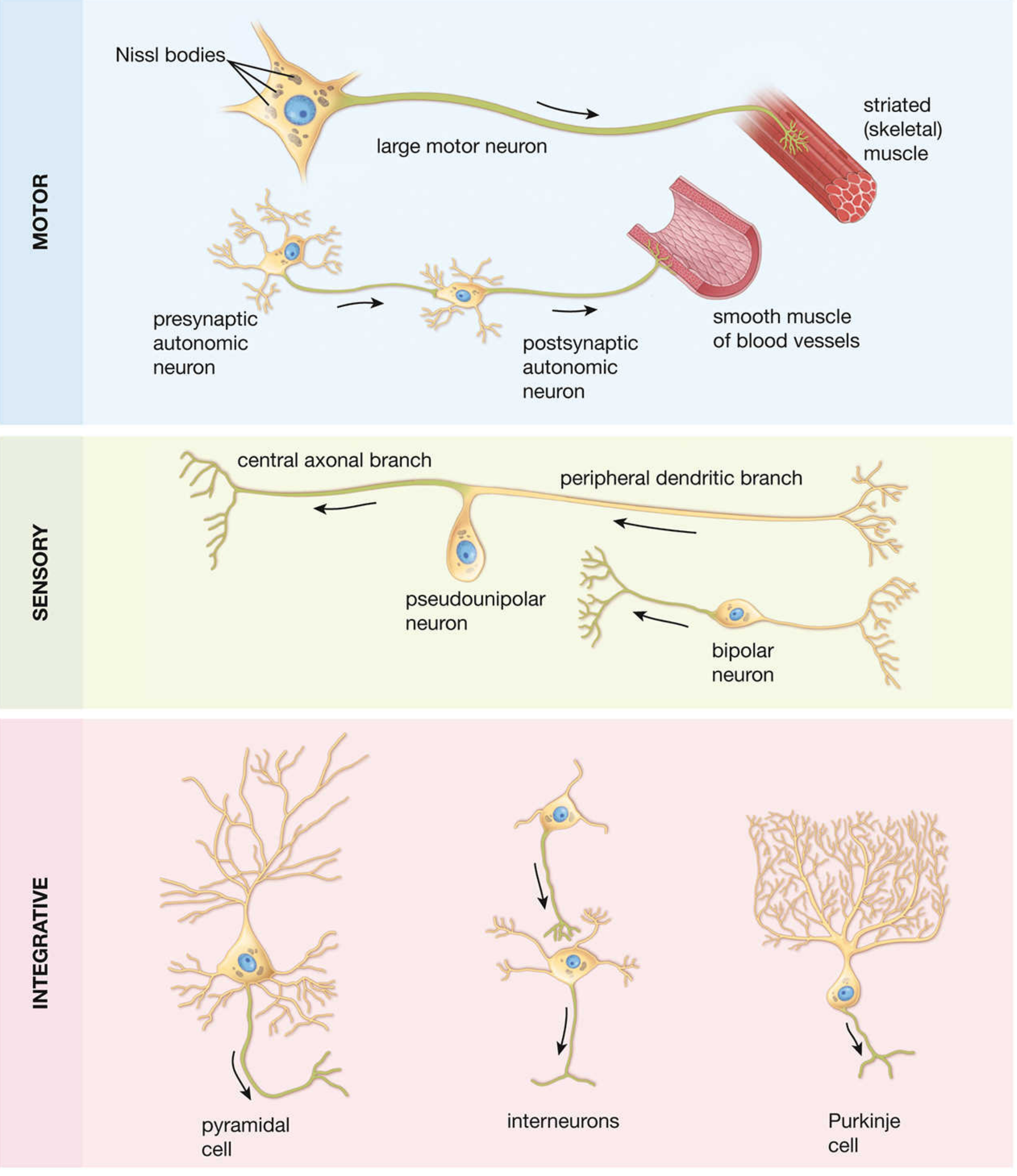
Classification of Neurons by Number of Processes
| Type | Structure | Location / Examples |
|---|---|---|
| Multipolar | 1 axon + 2 or more dendrites | Most CNS neurons; motor neurons, interneurons |
| Bipolar | 1 axon + 1 dendrite | Special senses (retina, cochlea, vestibule, olfactory epithelium) |
| Pseudounipolar (unipolar) | 1 axon that splits into peripheral + central branches close to cell body | Sensory neurons; dorsal root ganglia, cranial nerve ganglia |
Classification of Neurons by Function
| Type | Direction | Role |
|---|---|---|
| Sensory (afferent) | Periphery → CNS | Carry signals from receptors to CNS |
| Motor (efferent) | CNS → periphery | Carry commands from CNS to effectors (muscle, glands) |
| Interneurons (intercalated) | CNS only | Form integrative network between sensory and motor neurons; >99.9% of all neurons |
5b. Glial Cells (Neuroglia)
Supporting (non-conducting) cells that outnumber neurons. Functions include:
- Physical support and protection for neurons
- Insulation of nerve cell bodies/processes to facilitate rapid impulse transmission
- Metabolism and maintenance of ionic environment
- Immune defense
CNS Glia (Central Neuroglia)
| Cell Type | Function |
|---|---|
| Oligodendrocytes | Form the myelin sheath around axons in the CNS |
| Astrocytes | Structural support, blood-brain barrier maintenance, ion buffering, neurotransmitter uptake |
| Microglia | Immune/phagocytic cells of the CNS |
| Ependymal cells | Line ventricles and central canal; involved in CSF production/circulation |
PNS Glia (Peripheral Neuroglia)
| Cell Type | Location | Function |
|---|---|---|
| Schwann cells | Along PNS axons | Form the myelin sheath around PNS axons; surround and isolate axons |
| Satellite cells | Ganglia | Surround neuronal cell bodies; analogous to non-myelinating Schwann cells |
| Enteric glial cells | Gut wall ganglia | Morphologically/functionally similar to CNS glia |
5c. Myelin and Saltatory Conduction
- Glial cells wrap axons in a phospholipid-based myelin sheath, which acts as insulation and greatly increases conduction speed
- Oligodendrocytes myelinate in the CNS; Schwann cells myelinate in the PNS
- Gaps between myelin segments are called nodes of Ranvier - these have high densities of voltage-gated ion channels
- Action potentials "jump" from node to node (saltatory conduction), enabling rapid signal propagation
6. Terms of Orientation
When studying neuroanatomy, the nervous system makes an ~80-90° bend at the midbrain-diencephalic junction, so standard directional terms shift meaning along the neuraxis:
- Rostral = toward the nose/forebrain
- Caudal = toward the tail/spinal cord
- Dorsal = toward the back (posterior in spinal cord; superior in brain)
- Ventral = toward the front (anterior in spinal cord; inferior in brain)
Sectioning planes used in imaging and histopathology:
- Coronal - divides into anterior and posterior parts
- Sagittal - divides into left and right parts (midsagittal = through midline; parasagittal = just off midline)
- Horizontal (axial/transverse) - divides into superior and inferior parts
7. Major Anatomical Regions at a Glance
| Region | Key Structures |
|---|---|
| Cerebral hemispheres | Cerebral cortex, white matter, basal nuclei, limbic structures |
| Diencephalon | Thalamus (relay station), hypothalamus (homeostasis/endocrine), retina |
| Brainstem | Midbrain, pons, medulla oblongata - relays, cranial nerve nuclei, vital centers |
| Cerebellum | Coordination, balance, fine motor control |
| Spinal cord | 31 segments; ascending (sensory) and descending (motor) tracts |
| Ventricular system | Lateral (×2), third, fourth ventricles; filled with CSF |
8. Neural Pathways and Reflex Arcs
- Neural pathways involve multiple neurons linked in chain-like fashion
- Reflex arcs are the simplest neural pathways: sensory neuron → (interneuron) → motor neuron
- In humans, most sensory neurons do not pass directly to the brain; they communicate via synapses with motor neurons in the spinal cord first
- Synapses are specialized contacts between neurons where neurotransmitters are released from presynaptic axon terminals to affect the postsynaptic cell
Quick Reference Summary
Nervous System
├── CNS (Brain + Spinal Cord)
│   ├── Brain: cerebral hemispheres, diencephalon, brainstem, cerebellum
│   └── Spinal cord: 31 segments, ascending/descending tracts
└── PNS (everything outside CNS)
    ├── Somatic NS - voluntary (skeletal muscle)
    └── Autonomic NS - involuntary
        ├── Sympathetic ("fight or flight")
        ├── Parasympathetic ("rest and digest")
        └── Enteric (gut)

Cells:
├── Neurons (functional units): multipolar, bipolar, pseudounipolar
│   └── Functional: sensory, motor, interneurons (>99.9%)
└── Glia (support): CNS = oligodendrocytes, astrocytes, microglia, ependymal
                    PNS = Schwann cells, satellite cells
Sources: Gray's Anatomy for Students (9780323934237); Histology: A Text and Atlas with Correlated Cell and Molecular Biology (9781975181512)
This is a shared conversation. Sign in to Orris to start your own chat.