
seborrheic dermatitis
Reading File
Now I'll search the medical library and PubMed in parallel for seborrheic dermatitis.
Finding Sources
Searching PubMed
"seborrheic dermatitis"[MeSH Terms] AND treatment
Good results from Fitzpatrick's and Goldman-Cecil. Let me read the key sections in parallel.
Reading File
Reading File
Reading File
Now let me get the main comprehensive Fitzpatrick's section on seborrheic dermatitis and fetch the key clinical images.
Finding Sources
Finding Sources
Let me read the dedicated Fitzpatrick's chapter on seborrheic dermatitis and the Dermatology 5e section.
Reading File
Reading File
Excellent content. Now let me get the treatment and differential diagnosis sections, plus fetch the clinical images.
Reading File
Reading File
Loading Image
Now I have comprehensive content from multiple authoritative sources. Let me get the treatment section and one more image.
Reading File
Loading Image
I now have comprehensive, high-quality information from multiple authoritative textbooks. Here is the full response:
Seborrheic Dermatitis
Seborrheic dermatitis (SD) is a common, chronic, relapsing inflammatory skin condition characterized by erythematous, scaly patches in areas rich in sebaceous glands. It affects all ages and races, and is a significant marker of underlying immunosuppression.
Epidemiology
- Prevalence in the general population: 2.35% to 11.30%, with most estimates around 5%.
- Two peaks: infants (onset as early as 2 weeks of life; peak at 3 months) and adults (peak in the 4th-6th decades).
- Male predominance at all ages.
- Prevalence rises sharply in immunosuppression: up to 83% in HIV/AIDS patients, with severity worsening as CD4 counts drop.
- Higher incidence in Parkinson disease, cerebrovascular accidents, and other neurologic conditions.
- Worsens in cold, dry climates; may improve with sun exposure.
- Drug-associated forms reported with neuroleptics, atypical antipsychotics, dupilumab, and tyrosine kinase inhibitors.
(Fitzpatrick's Dermatology, Ch. 26; Dermatology 5e, Ch. 13)
Pathogenesis
The etiology is multifactorial and not fully elucidated. Three main components are implicated:
1. Malassezia (Pityrosporum)
- Malassezia globosa and M. restricta are considered the most important species (14 species total identified in the genus).
- Lipophilic yeasts that colonize sebaceous gland-rich skin. Antifungal therapy suppresses SD, supporting a causal role.
- However, there is no simple quantitative relationship between yeast density and severity - unaffected skin can carry a similar load.
- A mycelial (pathogenic) form, as seen in pityriasis versicolor, has not been detected in SD lesions.
- Malassezia metabolizes sebum triglycerides into unsaturated fatty acids (e.g., oleic acid), which may disrupt the epidermal barrier and trigger inflammation.
2. Sebaceous Gland Activity
- Distribution of lesions mirrors sebaceous gland-dense areas.
- SD appears when sebaceous activity is high (neonates due to maternal hormones; puberty/young adults; older adults).
3. Individual Immune Response
- SD is much more severe and prevalent in immunosuppressed patients.
- Lesional skin shows increased IL-1α, IL-1β, IL-4, IL-12, TNF-α, and IFN-γ.
- CD4+/CD8+ ratio alterations noted in some patients.
- Increased IgA and IgG antibodies in serum, but antibody levels against Malassezia specifically are not consistently elevated.
- Increased histamine and oxidative stress (reactive oxygen species) also implicated.
(Fitzpatrick's Dermatology, Ch. 26; Dermatology 5e, Ch. 13)
Clinical Features
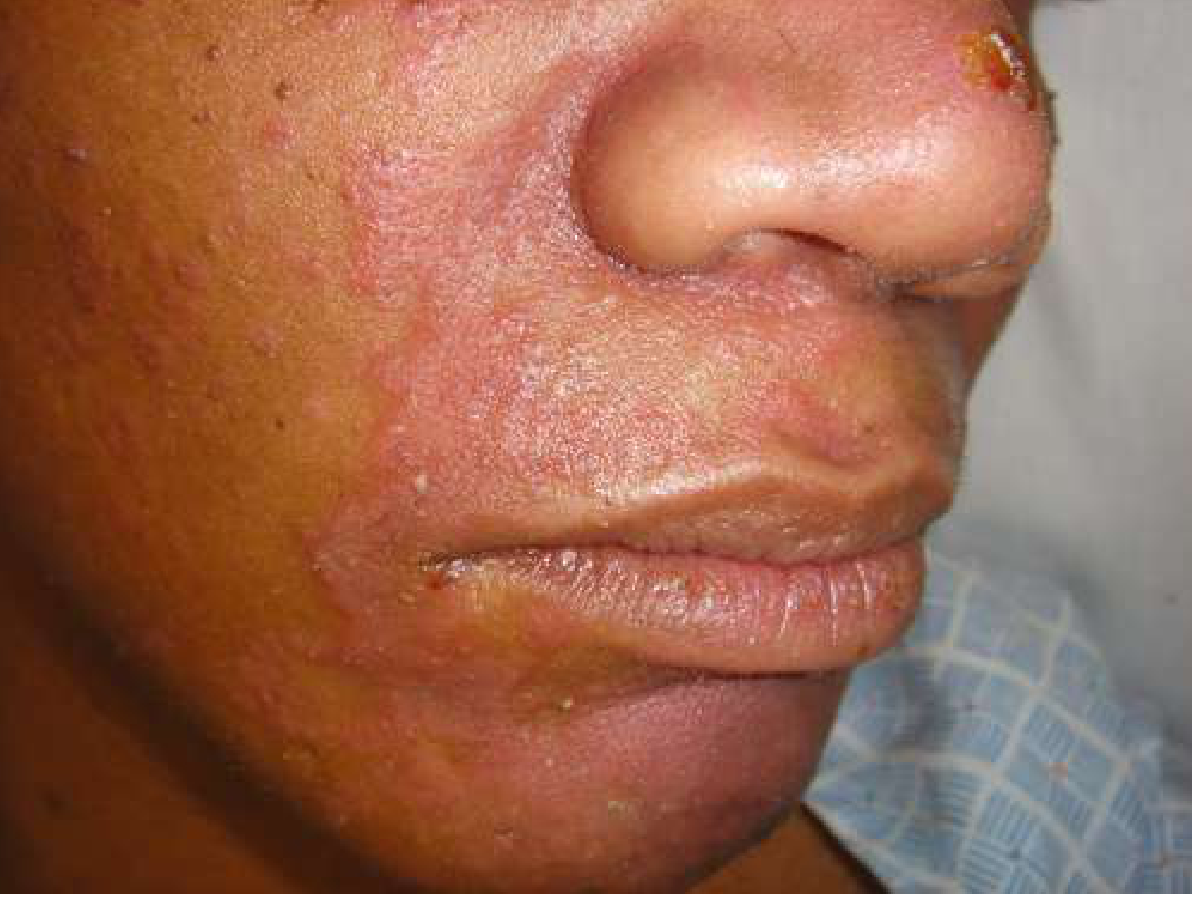
Seborrheic dermatitis: erythematous patches with fine scales on the malar/nasolabial region (Goldman-Cecil Medicine)
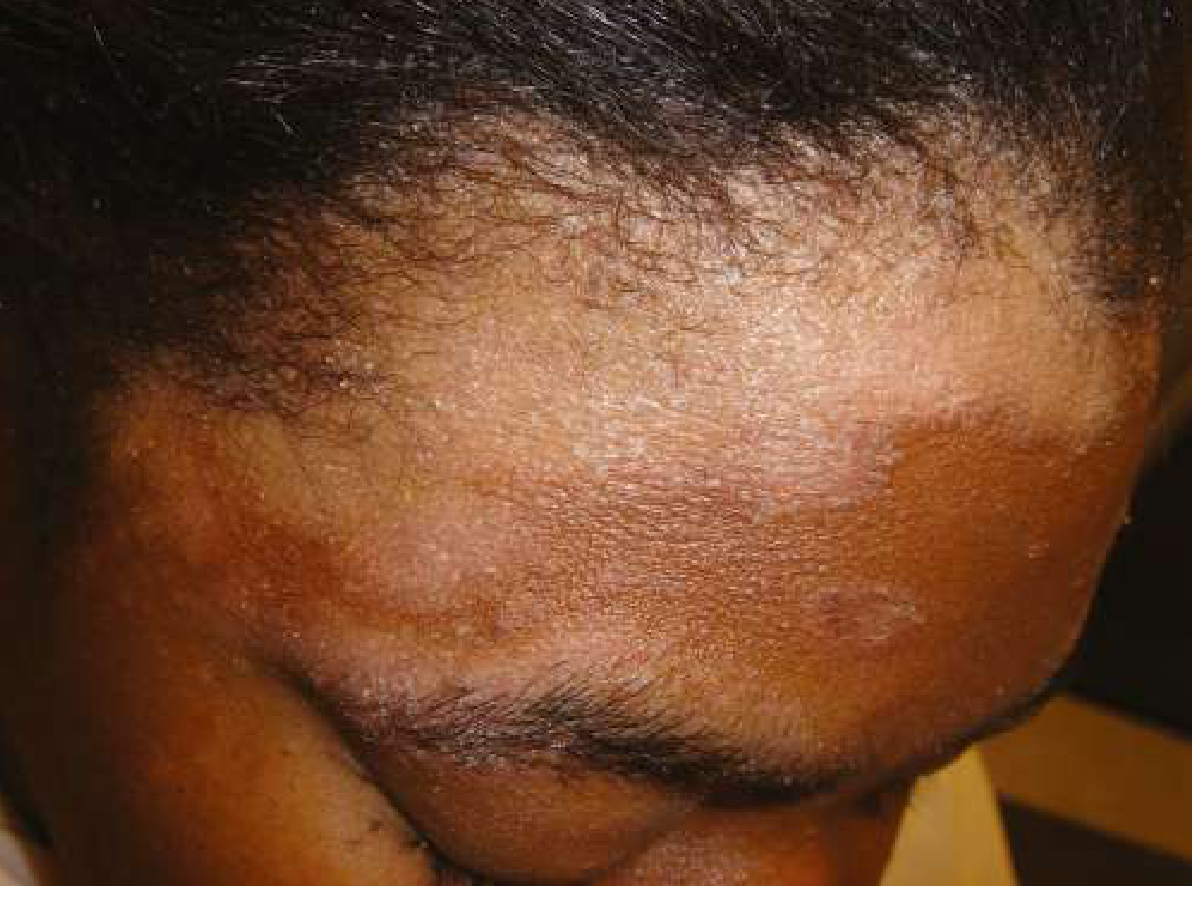
Seborrheic dermatitis in a dark-skinned patient: hypopigmentation with fine scales on the forehead/scalp (Goldman-Cecil Medicine)
Distribution
- Scalp: greasy scales, dandruff - most commonly involved
- Face: nasolabial folds, eyebrows, upper eyelids, glabella, forehead, postauricular areas
- Ears: external auditory canal and auricle
- Trunk: sternal chest (petaloid/arcuate lesions), upper back, umbilicus
- Intertriginous areas: axillae, inguinal folds (less scale, more erythema - easily mistaken for intertrigo)
- Rarely: erythroderma in severe cases
Morphology
- Erythematous patches or plaques with greasy, yellowish scale
- Ranges from mild pinkish scaling to thick adherent crusts
- In dark-skinned individuals: lesions may appear hypopigmented rather than erythematous
- Symptoms: pruritus, burning, tingling
- Course is chronic and relapsing; worsens in winter
Associated conditions
- Pityrosporum folliculitis: diffuse papulopustular eruption at the periphery
- Blepharitis: lid margin involvement
- Infantile SD ("cradle cap"): greasy yellow scale on scalp with mild erythema; in diaper area, overlaps with infantile psoriasis ("seborpsoriasis")
(Fitzpatrick's Dermatology, Ch. 26)
Diagnosis
Diagnosis is clinical. No confirmatory tests are needed in typical presentations.
Histology (if needed)
- Spongiosis, parakeratosis, crusting at follicular ostia
- Superficial perivascular lymphocytic infiltrate
- Presence of Malassezia on skin biopsy
Differential Diagnosis
| Region | Key Differentials |
|---|---|
| Scalp | Psoriasis (thicker silver scale, more discrete plaques), tinea capitis (esp. in children), atopic dermatitis (dry/brittle hair, xerosis), dermatomyositis |
| Face | Rosacea, SLE butterfly rash (spares nasolabial folds, photodistributed), dupilumab-associated facial dermatitis |
| Trunk | Pityriasis rosea (herald patch, collarette scaling, ellipsoid), superficial psoriasis, subacute cutaneous lupus |
| Intertriginous | Inverse psoriasis, erythrasma, candidiasis, intertrigo |
| Infants | Atopic eczema, psoriasis, Langerhans cell histiocytosis, nutritional dermatoses (acrodermatitis enteropathica) |
Key distinction from psoriasis: SD scales are greasy and yellowish; psoriasis scales are thicker, silvery-white, more discrete, and less pruritic. "Sebopsoriasis" refers to overlap cases.
(Dermatology 5e; Fitzpatrick's Dermatology)
Treatment
Infantile SD
- Mild cases: baby oil or mineral oil applied to scalp, gentle combing, mild shampoo - sufficient in most cases.
- Moderate/severe: topical antifungal (ketoconazole 2% cream) ± short courses of low-potency topical corticosteroids.
- Avoid strong keratolytic shampoos or mechanical scale removal.
Adult SD - First Line
- Topical azoles are the mainstay: ketoconazole 2% shampoo (scalp) or cream (body), response rate 75%-90% in double-blind trials.
- Scalp: fluocinolone acetonide 0.01% solution/gel, twice daily x 3-4 weeks; then ketoconazole 2% shampoo daily or every other day for maintenance.
- Face: hydrocortisone 2.5% cream, twice daily x 1-2 weeks initially; then ketoconazole 2% cream as needed.
- Ciclopirox olamine: both antifungal and anti-inflammatory; equally effective as shampoo or cream in randomized trials.
- Low-potency topical corticosteroids: rapid inflammation suppression; found equally efficacious to topical azoles in Cochrane analysis - useful for initial control.
Adult SD - Second Line
- Zinc pyrithione, selenium sulfide, coal tar shampoos
- Topical calcineurin inhibitors (tacrolimus, pimecrolimus): steroid-sparing option, especially useful on the face to avoid atrophy
- Emollients (important adjunct)
Maintenance
- SD relapses if maintenance therapy is not continued. M. furfur has a slow proliferation rate; relapses typically appear after 2 to several weeks. Maintenance therapy should follow this interval.
- Weekly or biweekly antifungal shampoo is a practical maintenance approach.
Systemic Therapy
- Reserved for severe or frequently relapsing disease: weekly fluconazole, itraconazole, or ketoconazole (note: ketoconazole has more activity against M. furfur than other azoles in vitro).
- In HIV patients: topical ketoconazole is first-line per WHO guidelines; add topical corticosteroids for severe/unresponsive cases. ART itself may improve SD. Oral antibiotics if bacterial superinfection present. Prolonged treatment courses often required.
(Dermatology 5e, Ch. 13; Goldman-Cecil Medicine; Fitzpatrick's, Ch. 26 + 168)
Special Populations
HIV/AIDS
- Prevalence up to 83%, severity tracks inversely with CD4 count.
- Extensive scalp, axillae, groin, flexural involvement; thick greasy yellow scalp scale; frequent bacterial superinfection; may progress to erythroderma.
- Often refractory to standard therapy; frequent relapse.
- ART itself can improve SD.
Parkinson Disease and Neurologic Conditions
- SD is significantly more prevalent; the dopaminergic pathway and sebum production are proposed mechanisms.
Infants
- Self-limited in most cases; resolves within the first 1-2 years of life.
- Possible association with later development of adult SD or atopic dermatitis.
Sources: Fitzpatrick's Dermatology (8e), Ch. 26 & 168 | Dermatology 5e, Ch. 13 | Goldman-Cecil Medicine | Harrison's Principles of Internal Medicine 22e
Treatments
Finding Sources
Searching PubMed
"seborrheic dermatitis"[MeSH Terms] AND treatment
Reading File
Reading File
Reading File
Searching PubMed
"seborrheic dermatitis" AND (ketoconazole OR ciclopirox OR tacrolimus OR treatment)
Good data. Let me get the Fitzpatrick's dedicated treatment section and the "unmet needs" paper abstract.
Finding Sources
Reading Article
PMID: 36538948
Reading File
Reading File
I now have comprehensive treatment data from multiple sources. Here is the detailed treatment breakdown:
Seborrheic Dermatitis: Treatments
The goal of treatment is symptomatic control and maintenance - SD can be controlled but not permanently eradicated. Treatments target the two main disease drivers: Malassezia colonization and the host inflammatory response.
General Measures (All Patients)
- Emollients (mineral oil, vegetable oil, petroleum jelly) loosen and soften scales
- Gentle combing/brushing to remove adherent scale - avoid aggressive scraping (worsens inflammation)
- For scalp shampoos: lather and leave in place 3-5 minutes before rinsing to maximize effect
- Identify and address triggers: cold/dry climate, stress, certain medications (neuroleptics, antipsychotics)
Topical Antifungals (First-Line)
The mainstay of adult therapy. Response rate 75%-90% in double-blind trials.
| Agent | Formulation | Dosing | Notes |
|---|---|---|---|
| Ketoconazole 2% | Shampoo (scalp), cream/gel (face/body) | Shampoo: daily or every other day; cream: twice daily as needed | Most studied; available OTC at 1% (shampoo); Rx at 2%; greatest activity against M. furfur of the azoles |
| Ciclopirox olamine | Shampoo or cream | Twice daily | Both antifungal AND anti-inflammatory activity; equally effective to ketoconazole in RCTs |
| Other azoles | Clotrimazole, miconazole creams | Twice daily | Acceptable alternatives |
- SOR: A evidence - Shampoos containing ketoconazole, selenium sulfide, or zinc pyrithione are effective for scalp SD.
- SOR: B evidence - Ketoconazole 2% cream/gel is safe and effective for facial SD.
(Textbook of Family Medicine 9e; Dermatology 5e)
Topical Corticosteroids (First-Line, Adjunct)
- Found equally efficacious to topical azoles in Cochrane analysis for total clearance.
- Best used for initial rapid control of erythema, pruritus, and scaling; not ideal for long-term monotherapy.
- Beware of rebound flares on discontinuation.
| Location | Agent | Regimen |
|---|---|---|
| Face | Hydrocortisone 1-2.5% cream or desonide 0.05% lotion | Twice daily; limit to 1-2 weeks |
| Scalp | Fluocinolone acetonide 0.01% solution/gel | Twice daily x 3-4 weeks |
| Severe scalp | Betamethasone or clobetasol solution (high potency) | Short course only |
| Body/trunk | Low-to-mid potency corticosteroid | Short-term |
Critical warning: High-potency corticosteroids must not be used on the face - risk of steroid-induced rosacea, perioral dermatitis, telangiectasia, and skin atrophy.
(Harrison's 22e; Tintinalli's Emergency Medicine; Fitzpatrick's Ch. 26)
Topical Calcineurin Inhibitors (Second-Line / Steroid-Sparing)
- Tacrolimus 0.1% and pimecrolimus 1% cream
- Block calcineurin, preventing inflammatory cytokine production in T-lymphocytes
- No statistically significant difference from topical corticosteroids in short-term clearance trials
- Advantages over corticosteroids: no risk of telangiectasia, skin atrophy, or steroid rosacea - preferred for the face in long-term or maintenance use
- Useful for maintenance therapy to prevent relapse
- Long-term safety still under monitoring (theoretical lymphoma/malignancy concern with systemic calcineurin inhibitors, though topical risk appears very low)
(Fitzpatrick's Ch. 26)
Medicated Shampoos (OTC, Scalp-Focused)
| Agent | Mechanism | Notes |
|---|---|---|
| Zinc pyrithione | Antifungal + antimicrobial | First-line OTC option |
| Selenium sulfide 2.5% | Antifungal, reduces Malassezia | SOR: A for scalp SD |
| Salicylic acid | Keratolytic | Loosens scale; use caution in neonates (systemic absorption risk) |
| Coal tar | Anti-inflammatory, antiproliferative | Effective but cosmetically less acceptable (odor, staining) |
| Ketoconazole 1% | Antifungal | OTC in many countries |
(Tintinalli's; Textbook of Family Medicine 9e)
Keratolytics
- Salicylic acid - loosens adherent scale before antifungal or steroid application
- Urea/propylene glycol/lactic acid combination - shown highly effective for scalp SD in studies
- Caution in neonates: selenium sulfide and salicylic acid carry risk of percutaneous absorption in infants
Systemic Therapy (Severe / Refractory Cases)
Reserved for widespread, uncontrolled, or frequently relapsing disease:
| Agent | Regimen | Notes |
|---|---|---|
| Itraconazole | 200 mg/day x 7 days/month for several months | Common pulse regimen for maintenance |
| Fluconazole | Weekly dosing | Effective but less activity against M. furfur vs. ketoconazole |
| Terbinafine | 250 mg/day x 4 weeks | SOR: A; effective for moderate-to-severe SD |
| Oral corticosteroids | Low dose, short course only | Reserve for acute severe flares; rebound flares common on stopping |
| Isotretinoin | 0.1-0.5 mg/kg/day | Reduces sebaceous gland activity; for very severe/refractory cases |
(Fitzpatrick's Ch. 26; Textbook of Family Medicine 9e)
Emerging / Novel Therapies
- Topical PDE4 inhibitors (e.g., crisaborole, roflumilast): clinical trials completed as of 2024; data emerging as a potential new class for SD
- Narrow-band UVB phototherapy: shown safe and effective in open-label prospective studies; works via immunomodulatory and anti-inflammatory mechanisms
- Tea tree oil: randomized single-blind study showed benefit in severity, pruritus, and greasiness; antifungal activity against M. furfur confirmed in vitro
(Fitzpatrick's Ch. 26; Jackson et al., J Am Acad Dermatol 2024)
Infantile SD - Specific Approach
| Severity | Treatment |
|---|---|
| Mild (cradle cap) | Baby/mineral oil applied to scalp, gentle combing, mild shampoo |
| Moderate/severe scalp | Mild antifungal shampoo ± low-potency topical corticosteroid (hydrocortisone 1%) |
| Extensive or persistent | Ketoconazole 2% cream |
| Diaper area | Superabsorbent diapers + frequent changes; avoid soap and alcohol-containing products |
| Refractory | Mid-potency steroid (betamethasone valerate 0.1%) short-term only |
- Keratolytics (salicylic acid, selenium sulfide) are dangerous in neonates due to percutaneous absorption.
- Licochalcone 0.025% lotion (plant extract) shown comparable to hydrocortisone 1% in one study.
- Dietary controls and vitamin supplementation are not beneficial in infantile SD.
- Secondary bacterial or fungal infection: appropriate systemic antibiotics/antifungals.
(Fitzpatrick's Ch. 26; Dermatology 5e)
HIV/AIDS Patients
- First-line: topical ketoconazole (WHO guidelines)
- Refractory/severe: add topical corticosteroids ± oral antifungals (ketoconazole preferred over fluconazole/itraconazole for M. furfur activity)
- ART itself may improve SD independently
- Oral antibiotics when bacterial superinfection is present
- Prolonged treatment courses often required; expect frequent relapse
Maintenance Strategy
SD is chronic and relapsing. Once controlled, a maintenance regimen is essential:
- M. furfur has a slow proliferation rate; relapses typically emerge 2 to several weeks after stopping treatment
- Maintenance intervals should mirror this rhythm (e.g., antifungal shampoo 2x/week, or weekly fluconazole for severe cases)
- Topical calcineurin inhibitors are preferred for long-term facial maintenance (avoid steroid side effects)
Sources: Fitzpatrick's Dermatology (8e), Ch. 26 | Dermatology 5e, Ch. 13 | Harrison's Principles of Internal Medicine 22e | Tintinalli's Emergency Medicine | Textbook of Family Medicine 9e | Goldman-Cecil Medicine | Jackson et al., J Am Acad Dermatol 2024 [PMID 36538948]
This is a shared conversation. Sign in to Orris to start your own chat.