
Milwakee in detail with diagram
What do you mean by 'Milwaukee'? Which topic are you referring to?
Milwaukee brace scoliosis orthopaedic CTLSO
Milwaukee brace scoliosis spinal orthosis
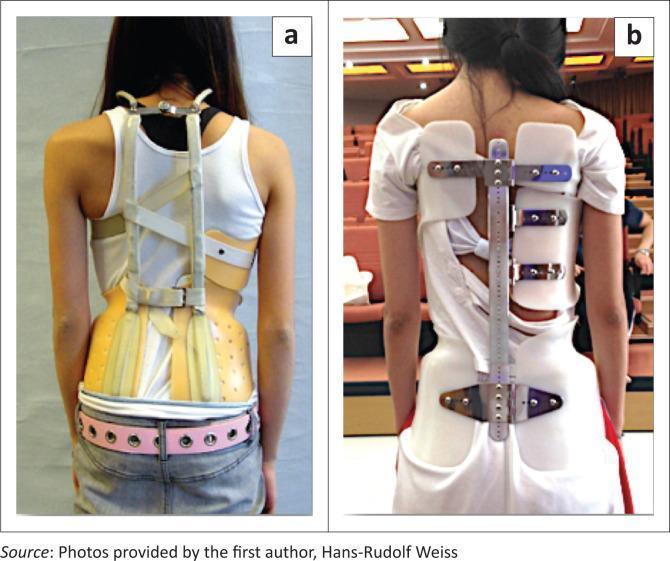
Two clinical photographs (a and b) show the posterior view of patients wearing orthopedic spinal braces for the treatment of scoliosis. Image (a) depicts a Milwaukee brace, a cervico-thoraco-lumbo-sacral orthosis (CTLSO). Visible components include a rigid, molded pelvic section, two posterior vertical metal bars, and a neck ring designed to provide longitudinal traction and lateral stability. Straps and pads are positioned along the torso to apply corrective forces to the spinal curvature. Image (b) shows a Lyon brace (ART brace), which is a rigid thoraco-lumbo-sacral orthosis (TLSO). It features a modular design with a central posterior metal upright, adjustable metal hinges, and molded plastic segments. This brace utilizes a multi-point pressure system for curve correction and is shown configured for a right thoracic curve. Both images illustrate historical and contemporary orthotic interventions used in pediatric and adolescent idiopathic scoliosis to prevent curve progression and manage trunk asymmetry.
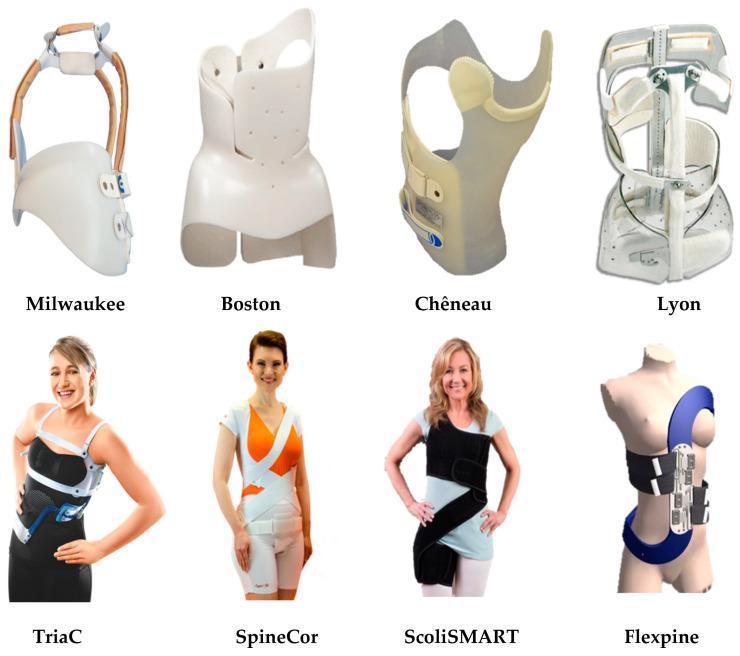
A comparison chart of rigid and soft spinal orthoses used in the non-surgical management of adolescent idiopathic scoliosis. The top row illustrates four types of rigid braces: the 'Milwaukee' brace featuring a pelvic girdle and neck ring connected by metal uprights; the 'Boston' brace, a low-profile thoracolumbosacral orthosis (TLSO); the 'Chêneau' brace, designed for three-dimensional correction; and the 'Lyon' brace, an adjustable multi-shell design. The bottom row demonstrates soft or flexible corrective devices as worn by patients or mannequins: the 'TriaC' brace with semi-rigid components; the 'SpineCor' system utilizing elastic bands; the 'ScoliSMART' suit; and the 'Flexpine' orthosis which employs a tension-based strap mechanism. This visual provides an educational overview of the structural evolution in orthopedic technology, moving from high-profile rigid frames to low-profile, flexible, and dynamic bracing systems aimed at improving patient compliance and mobility while arresting spinal curve progression.
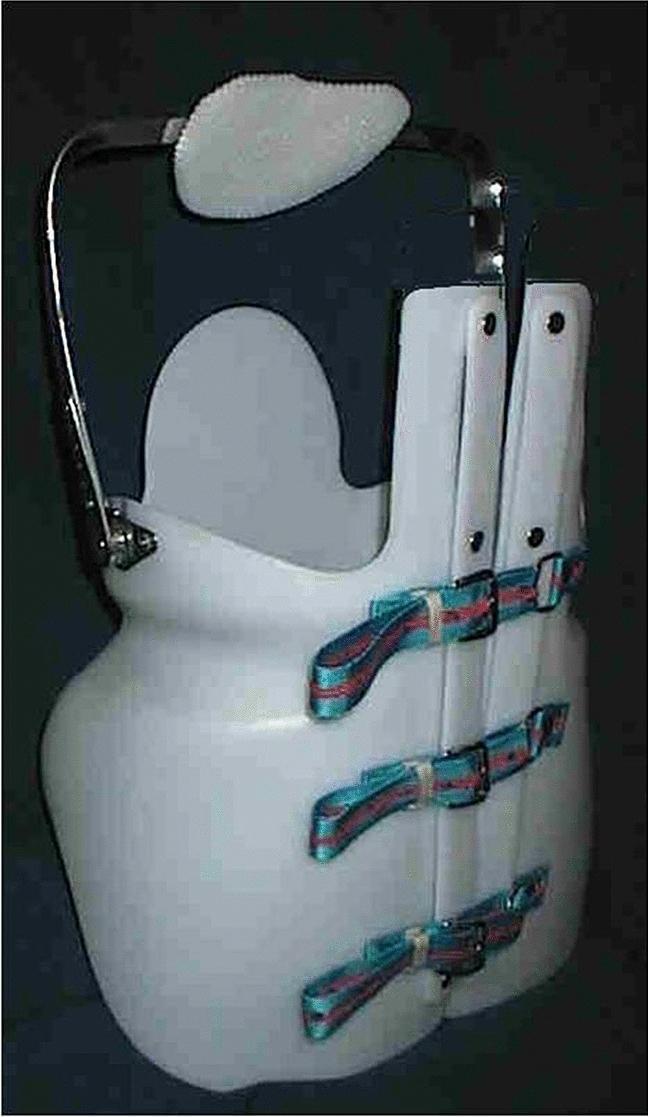
A studio photograph of a Maria Adelaide (MA) brace, a specialized rigid spinal orthosis used in the management of adolescent idiopathic scoliosis and Scheuermann’s kyphosis. The device is a univalve, custom-molded thoracolumbosacral orthosis (TLSO) constructed from white thermoplastic material. Key anatomical features include a posterior thoracic extension for sagittal plane control and a prominent, padded sternal plate supported by a thin metallic superstructure. The closure system consists of three horizontal, adjustable fabric straps in red and blue, secured with metallic buckles on the lateral-anterior aspect to facilitate precise tensioning and correction of spinal curves. The design emphasizes a 'low-profile' approach compared to traditional Milwaukee braces while maintaining corrective pressure at the sternum and spine. This image serves as a clinical reference for orthopedic surgeons, physiotherapists, and orthotists to understand the structural components and closure mechanisms of this specific orthopedic device.
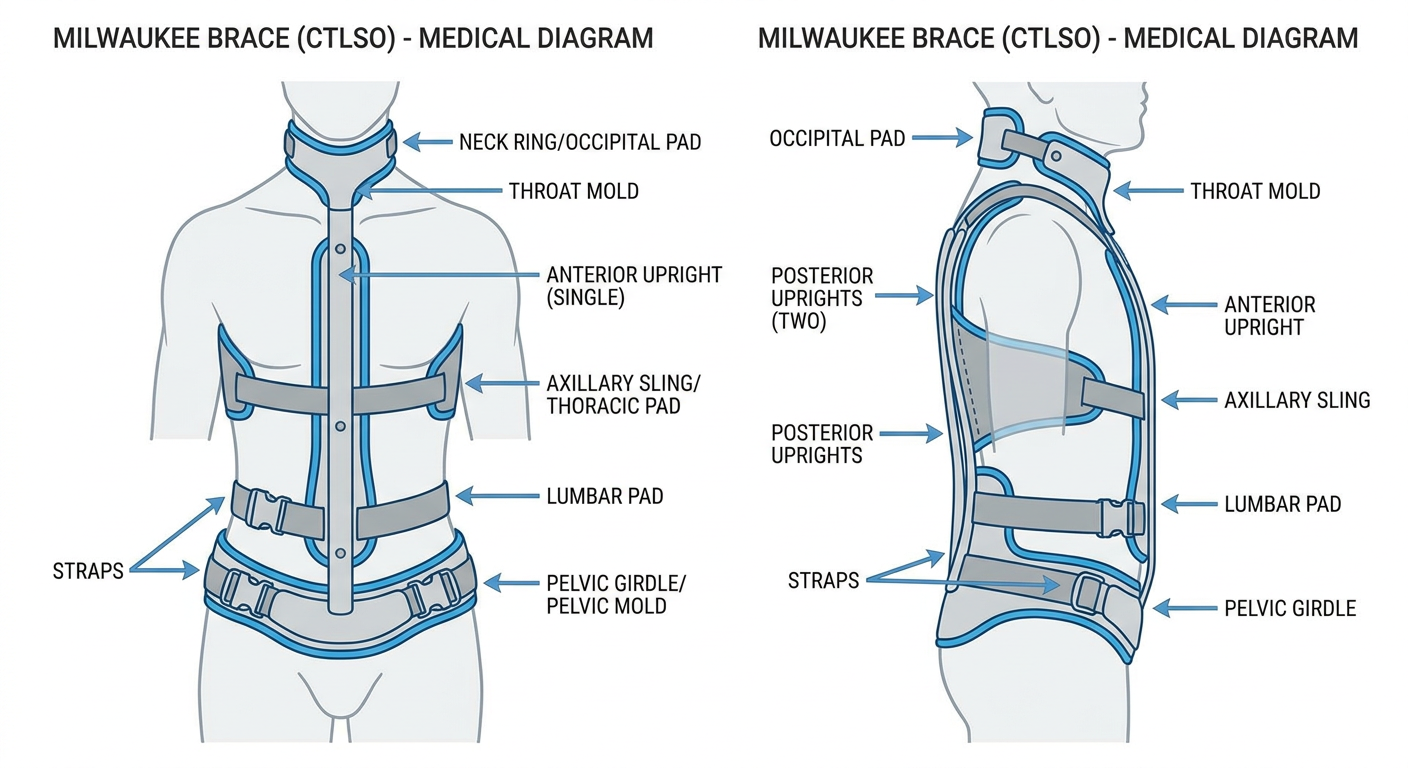
Detailed medical diagram of the Milwaukee brace (CTLSO - cervico-thoraco-lumbo-sacral orthosis) with clear labels pointing to each component: neck ring/occipital pad, throat mold, anterior upright (single), posterior uprights (two), pelvic girdle/pelvic mold, axillary sling/thoracic pad, lumbar pad, and straps. Show frontal and lateral views side by side on white background. Medical illustration style with clean lines and anatomical accuracy.
Milwaukee Brace (CTLSO) - Comprehensive Overview
Generated Diagram
Comparison: Milwaukee vs. Other Scoliosis Braces
Definition
Components
| Component | Description |
|---|---|
| Pelvic girdle | Custom-molded plastic or leather base that fits snugly around the pelvis and sacrum - the foundation of the entire brace |
| Neck ring | Metal ring around the neck with an occipital pad (behind the head) and a throat mold (anteriorly) - provides longitudinal traction |
| Anterior upright | Single metal bar running up the front from pelvic girdle to neck ring |
| Posterior uprights | Two metal bars running up the back from pelvic girdle to neck ring |
| Axillary slings / thoracic pads | Corrective pressure pads attached to the uprights - positioned over the convexity of the curve to apply lateral corrective force |
| Lumbar pad | Padded support applied over the lumbar convexity |
| Straps | Adjustable straps for securing the brace |
Mechanism of Action
- The neck ring applies an upward distracting force via the occipital pad
- The pelvic mold provides a downward counter-force
- The corrective pads apply lateral pressure over the curve convexity
Indications
1. Idiopathic Scoliosis
- Used historically for curves with the apex above T8 (high thoracic / cervicothoracic curves) - the only brace that can address these levels, since a TLSO cannot reach this high
- Currently, lower-profile TLSO/Boston brace is preferred for thoracic curves with apex at T8 or below
- Milwaukee brace still used for infantile idiopathic scoliosis with modest/flexible deformity, and in juvenile idiopathic scoliosis - Miller's Review of Orthopaedics 9th Ed, p.292
- Brace treatment is indicated when a progressive curve is present in a skeletally immature patient (Risser stage 0-2) with a Cobb angle typically in the 25-45 degree range
2. Scheuermann Kyphosis (Kyphosis)
- Historically the mainstay of bracing for Scheuermann kyphosis, though now largely replaced by lower-profile braces
- Indications for brace use: kyphosis 50-75 degrees, at least 1 year of growth remaining (Risser stage 2 or below), curve flexibility of 40-50%
- A modified Milwaukee brace is used but is often not well tolerated due to its high profile and the neck ring - Miller's Review of Orthopaedics 9th Ed, p.296
3. Juvenile Idiopathic Scoliosis
- Initial full-time bracing; can be weaned to part-time (after school + nighttime) as the curve responds
- Part-time use (after school and at night) assessed by RVAD (rib-vertebral angle difference) - if RVAD declines during treatment, part-time wear is adequate - Campbell's Operative Orthopaedics 15th Ed
Wearing Protocol
| Phase | Wear Time |
|---|---|
| Initial (first 12-18 months) | Full-time (23 hrs/day) |
| Once skeletal maturity signs appear | Gradual weaning |
| Part-time protocol | After school + nighttime |
| Nighttime only | Final weaning phase |
Effectiveness
- In adolescent idiopathic scoliosis, bracing has been shown to prevent curve progression to surgical thresholds compared to observation (the BRAIST trial confirmed bracing efficacy)
- About 50% of juvenile idiopathic scoliosis patients progress to surgery despite brace treatment; those with apical vertebra at T8, T9, or T10 have ~80% risk of arthrodesis by age 15 - Campbell's Operative Orthopaedics 15th Ed
- In Scheuermann kyphosis, initial correction in-brace is often achieved, but many patients lose some correction at longer-term follow-up
Disadvantages and Compliance Issues
- High profile - the neck ring is visible above clothing, causing significant psychosocial issues, especially in adolescent girls
- Poor tolerance - the neck ring and throat mold are uncomfortable; major reason it has been replaced by TLSO designs for lower curves
- Psychological sequelae - documented in multiple studies cited in Campbell's Operative Orthopaedics: patients report stigma, anxiety, and reduced quality of life
- Skin pressure areas - under pads and the pelvic mold
- Compliance is a major determinant of outcome; hours of brace wear correlate directly with success
Milwaukee Brace vs. Other Braces
| Feature | Milwaukee (CTLSO) | Boston TLSO | Chêneau |
|---|---|---|---|
| Extent | Pelvis to neck | Pelvis to axillae | Pelvis to axillae |
| Curve apex | Above T8 | T8 and below | T8 and below |
| Neck ring | Yes | No | No |
| Profile | High | Low | Low |
| Compliance | Poor (cosmesis) | Better | Better |
| 3D correction | Limited | Moderate | Good |
Sources
- Campbell's Operative Orthopaedics 15th Ed 2026, Sections on Juvenile Idiopathic Scoliosis and Scheuermann Kyphosis
- Miller's Review of Orthopaedics 9th Edition, Bracing and Scheuermann Disease sections