
Leptin in anorexia and amenorrea caused by this
Reading File
Now I'll run parallel searches across the library and PubMed simultaneously.
Finding Sources
Finding Sources
Searching PubMed
leptin anorexia nervosa amenorrhea hypothalamic
Good results. Now I'll read the most detailed passages from the key sources.
Reading File
Reading File
Reading File
Searching PubMed
leptin AND "hypothalamic amenorrhea"
Now let me get the remaining detailed passage on bone effects, HPG axis, and also read the Kaplan psychiatry section and Harrison's HA section.
Reading File
Reading File
Reading File
I now have comprehensive material. Let me also fetch the amenorrhea algorithm image from Harrison's and search for a leptin-HPG axis diagram.
Loading Image
Searching the Web
leptin mechanism hypothalamic amenorrhea anorexia nervosa GnRH kisspeptin 2024
I have all the information needed for a comprehensive answer. Here it is:
Leptin in Anorexia Nervosa and the Resulting Amenorrhea
1. What is Leptin?
Leptin is a protein hormone synthesized and secreted pulsatilely by adipocytes (fat tissue). Its circulating levels directly reflect the body's energy stores and fat mass. It acts primarily on receptors in the hypothalamus to signal nutritional sufficiency to the neuroendocrine reproductive axis. — Kaplan & Sadock's Comprehensive Textbook of Psychiatry
2. The Core Mechanism: Leptin as a Permissive Signal for Reproduction
The evolutionary logic is fundamental: the hypothalamic GnRH neurons will only permit reproduction when the body has sufficient energy reserves.
"Leptin promotes the production and release of GnRH by hypothalamic neurons, signaling the brain that fat stores are sufficient to support reproductive function. Low levels of leptin — due to starvation, anorexia, or strenuous exercise — are associated with amenorrhea." — Medical Physiology (Boron & Boulpaep)
The pathway:
↓ Body fat (anorexia nervosa)
     ↓
↓ Leptin secretion from adipocytes
     ↓
↓ Leptin signaling at hypothalamus
     ↓
↓ Kisspeptin / KNDy neuron activation
     ↓
↓↓ GnRH pulse frequency & amplitude
     ↓
↓ LH & FSH from anterior pituitary
     ↓
↓ Ovarian estradiol production
     ↓
Amenorrhea (anovulation + no endometrial cycling)
Kisspeptin neurons (in the arcuate nucleus) act as critical intermediaries — leptin stimulates them to drive GnRH release. In anorexia, this whole cascade collapses. — Harrison's Principles of Internal Medicine 22E
3. Why Amenorrhea Occurs in Anorexia Nervosa
In anorexia nervosa, body fat falls, often to ≈22% of total body weight — the threshold below which amenorrhea typically develops. The immediate hormonal cause is reduced LH and FSH secretion by the anterior pituitary, driven by suppressed GnRH pulsatility. — Basic Medical Biochemistry (Lieberman & Peet)
Additional hormonal alterations in anorexia nervosa that compound this:
- High CRH and excess endogenous opioids — both independently inhibit GnRH pulses
- Low T3 (sick euthyroid pattern) and ↑ reverse T3
- Hypercortisolism (despite normal ACTH)
- ↑ Ghrelin — orexigenic peptide elevated in both restricting and binge-purge subtypes; contributes to suppression of the reproductive axis
- ↓ IGF-1 and ↓ insulin-like signaling
Clinically, LH secretion in severe anorexia reverts to a prepubertal pattern (constantly low or sleep-entrained pulses), and amenorrhea may actually precede, coincide with, or follow the weight loss. — Berek & Novak's Gynecology
4. Functional Hypothalamic Amenorrhea (HA)
Anorexia nervosa causes functional hypothalamic amenorrhea — a hypogonadotropic hypogonadism that is potentially reversible.
"Decreased leptin levels are associated with hypothalamic amenorrhea, regardless of whether it is caused by exercise, eating disorders, or is idiopathic." — Berek & Novak's Gynecology
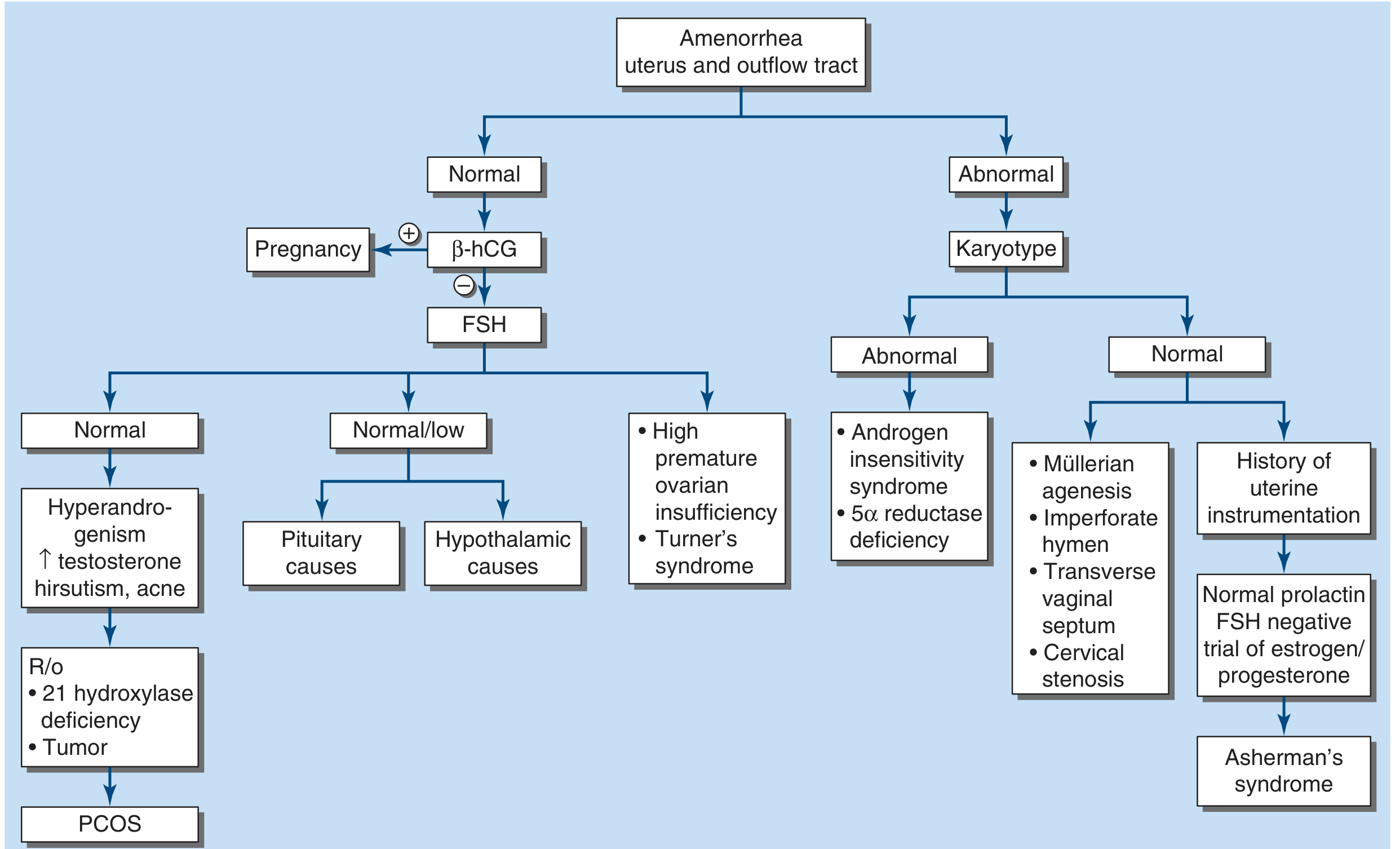
Classification in the amenorrhea diagnostic algorithm:
- β-hCG negative → FSH normal/low → Hypothalamic cause
5. Additional Effects of Low Leptin in Anorexia
| System | Effect of ↓ Leptin |
|---|---|
| HPG axis | ↓ GnRH → ↓ LH/FSH → amenorrhea, anovulation |
| Bone | ↓ Bone mineral density; leptin receptors on bone; contributes to osteoporosis and stress fractures |
| Thyroid | ↓ TRH signaling → low T3 |
| Hematopoiesis | ↓ Leptin-driven hematopoiesis → anemia risk |
| Immunity | ↓ T-cell activation, phagocytosis, cytokine production |
| Mood | Lower leptin correlates with greater depression severity |
6. Therapeutic Implications: Exogenous Leptin
A landmark study (Welt et al., NEJM 2004) showed that recombinant human leptin administration to women with hypothalamic amenorrhea:
- ↑ LH, FSH, and estradiol levels
- ↑ IGF-1 and thyroid hormone
- Restored ovulation and increased bone mineral density
However, a critical caveat: weight loss occurring with leptin administration limits its therapeutic utility, because leptin is itself anorexigenic and further reduces body fat. — Berek & Novak's Gynecology
Summary
In anorexia nervosa, the dramatic reduction in adipose tissue causes leptin deficiency, which removes the critical permissive signal to the hypothalamic-pituitary-gonadal (HPG) axis. Without adequate leptin, GnRH pulsatility collapses, LH and FSH fall, and ovarian estrogen production ceases — producing functional hypothalamic amenorrhea. This is compounded by elevated CRH and opioids from physiological stress. Recovery of menses depends primarily on weight restoration, which recovers leptin levels and re-activates the HPG axis.
Sources: Medical Physiology (Boron & Boulpaep) · Harrison's Principles 22E · Berek & Novak's Gynecology · Basic Medical Biochemistry 6e · Kaplan & Sadock's Comprehensive Textbook of Psychiatry
Leptin and adiponectin in diabetes mallitus
Finding Sources
Finding Sources
Searching PubMed
leptin adiponectin diabetes mellitus insulin resistance
Good first pass. Now I'll read the key detailed passages in parallel.
Reading File
Finding Sources
Finding Sources
Reading File
Finding Sources
Finding Sources
Excellent — found the dedicated adiponectin section. Let me read it fully alongside the Harrison's adipokine passage.
Reading File
Reading File
The adiponectin section was at line ~2888 but got cut off. Let me read it fully.
Reading File
Finding Sources
I now have all the core content needed. Let me also get the biochemical comments on insulin resistance and the thiazolidinedione-adiponectin link.
Reading File
Reading File
I now have comprehensive, detailed content from multiple authoritative textbooks. Here is the full answer:
Leptin and Adiponectin in Diabetes Mellitus
Both are adipokines — hormones secreted by adipose tissue that act as key regulators of glucose and fat metabolism. They have opposing patterns in obesity and type 2 diabetes (T2DM), and understanding them together is critical to understanding insulin resistance.
I. LEPTIN
Origin & Normal Function
Leptin is a protein hormone secreted by adipocytes in proportion to their triglyceride content — the larger the fat cell, the more leptin is released. It signals via receptors linked to JAK-STAT signal transduction. In the hypothalamus, it triggers anorexigenic neuropeptides (e.g., α-MSH, CRH) that suppress appetite, and inhibits orexigenic ones (e.g., NPY, galanin). — Basic Medical Biochemistry (Lieberman & Peet)
Leptin in Type 2 Diabetes / Obesity
| Parameter | Status |
|---|---|
| Serum leptin level | ↑ Elevated (proportional to fat mass) |
| Leptin signaling | Impaired (leptin resistance) |
| Net effect | Failure to suppress appetite; promotes energy surplus |
Leptin resistance is the central problem in T2DM/obesity. Two mechanisms explain it:
- Receptor desensitization from chronic hyperleptinemia — continuous stimulation down-regulates receptor sensitivity
- SOCS3 induction — leptin itself induces suppressor of cytokine signaling-3 (SOCS3), which antagonizes STAT activation, creating a negative feedback loop that becomes constitutively active
"T2DM results from insulin resistance associated with genetic predisposition, obesity, leptin resistance, diet, smoking, and a host of inflammatory mediators causing beta cell loss or dysfunction." — Murray & Nadel's Textbook of Respiratory Medicine
Leptin's Direct Role in Insulin Resistance
From Harrison's Principles 22E: adipocytes in visceral obesity secrete elevated leptin alongside TNF-α, IL-6, resistin, and free fatty acids. These products:
- Impair glucose utilization in skeletal muscle
- Promote hepatic glucose output (gluconeogenesis)
- Impair beta cell function ("lipotoxicity")
- Produce a systemic low-grade inflammatory state that worsens insulin signaling
Leptin in Type 1 Diabetes / Lipodystrophy
Notably, in states of fat deficiency (lipodystrophy), leptin levels are low, and this is associated with severe insulin resistance and diabetes. Exogenous leptin administration reverses insulin resistance and diabetes in mouse models of congenital lipodystrophy — demonstrating that adequate leptin is necessary (not just excessive leptin harmful). — Dermatology 5e
II. ADIPONECTIN
Origin & Normal Function
Adiponectin is the most abundantly secreted hormone from adipocytes. Unlike leptin, its secretion is inversely proportional to adipocyte size — as fat cells enlarge, adiponectin secretion falls. It binds to two receptors:
- AdipoR1 — predominantly in skeletal muscle
- AdipoR2 — predominantly in liver
Both activate two key intracellular pathways:
- AMPK (AMP-activated protein kinase) — the cellular "fuel gauge"
- PPARα (peroxisome proliferator-activated receptor α) — master regulator of fatty acid oxidation
— Basic Medical Biochemistry (Lieberman & Peet)
Adiponectin's Metabolic Actions
Adiponectin
    ├── AdipoR1/R2 →  AMPK activation
    │       ├── Skeletal muscle: ↑ glucose uptake, ↑ fatty acid oxidation
    │       └── Liver: ↑ fatty acid oxidation, ↓ gluconeogenesis, ↓ lipogenesis
    └── PPARα activation
            ├── ↑ Fatty acid oxidation genes
            ├── ↑ Lipoprotein lipase, ↑ apoAI/AII (→ ↑ HDL)
            └── ↓ apoCIII → further ↑ LPL activity
Net result: ↓ blood glucose, ↓ free fatty acids, ↓ triglycerides, ↑ insulin sensitivity
Adiponectin in Type 2 Diabetes / Obesity
| Parameter | Status |
|---|---|
| Serum adiponectin level | ↓ Reduced (obesity suppresses secretion) |
| Insulin sensitivity | ↓ Reduced (loss of AMPK stimulation) |
| Hepatic glucose output | ↑ Increased |
| Triglycerides | ↑ Elevated |
"The production by adipocytes of adiponectin, an insulin-sensitizing peptide, is reduced in obesity, and this may contribute to hepatic insulin resistance." — Harrison's Principles of Internal Medicine 22E
Low adiponectin is also associated with:
- NAFLD/MASLD — reduced hepatic fatty acid oxidation → steatosis and fibrosis
- Dyslipidemia — elevated triglycerides, reduced HDL
- Cardiovascular disease — loss of anti-inflammatory and anti-apoptotic tissue-protective effects
- COPD-like phenotype in animal models (adiponectin-knockout mice)
"Adiponectin exhibits anti-inflammatory, antioxidative, and anti-apoptotic activities; these tissue-protective effects are eliminated in experimental T2DM." — Murray & Nadel's Textbook of Respiratory Medicine
III. COMPARATIVE SUMMARY TABLE
| Feature | Leptin | Adiponectin |
|---|---|---|
| Source | Adipocytes | Adipocytes |
| Level in obesity/T2DM | ↑ High | ↓ Low |
| Receptor signaling | JAK-STAT | AMPK + PPARα |
| Effect on insulin sensitivity | Pro-resistance (via resistance) | Insulin sensitizing |
| Effect on appetite | Suppressive (impaired in resistance) | No direct effect |
| Anti-inflammatory | Proinflammatory at high levels | Anti-inflammatory |
| Thiazolidinedione effect | No direct relationship | ↑ PPARγ → ↑ adiponectin |
| Metformin parallel | AMPK-independent | AMPK-dependent (shared pathway) |
IV. THERAPEUTIC RELEVANCE
Thiazolidinediones (TZDs — e.g., Pioglitazone)
Activate PPARγ in adipose tissue → ↑ adiponectin synthesis and secretion → AMPK activation in liver and muscle → ↓ hepatic fat content and ↑ insulin sensitivity. This is the primary molecular basis for TZD efficacy in T2DM. — Basic Medical Biochemistry 6e
Metformin
Also activates AMPK (via a different upstream mechanism: TORC2 phosphorylation, inhibiting gluconeogenic enzymes). Shares the downstream AMPK pathway with adiponectin.
SGLT-2 Inhibitors (recent evidence)
A 2024 meta-analysis (PMID 38602398) showed SGLT-2 inhibitors reduce inflammatory biomarkers in T2DM, which may partly relate to improvements in adipokine balance.
V. The Vicious Cycle in T2DM
Obesity (↑ visceral fat)
        ↓
↑ Leptin (resistance) + ↓ Adiponectin
        ↓
↓ AMPK activity in liver & muscle
        ↓
↑ Hepatic glucose output + ↓ muscle glucose uptake
        ↓
Hyperglycemia → beta cell exhaustion → T2DM
        ↓
More fat deposition → worse adipokine imbalance (↑ loop)
Sources: Harrison's Principles of Internal Medicine 22E · Basic Medical Biochemistry 6e (Lieberman & Peet) · Murray & Nadel's Textbook of Respiratory Medicine · Kaplan & Sadock's Comprehensive Textbook of Psychiatry · Sleisenger and Fordtran's GI & Liver Disease
This is a shared conversation. Sign in to Orris to start your own chat.