
State the management and prognosis of acute post streptococcal glomerulonephritis.
Reading File
Now let me search the medical library for APSGN management and prognosis in parallel.
Finding Sources
Finding Sources
Searching PubMed
"post-streptococcal glomerulonephritis" AND management
Good. I found two key sections. Let me read them in parallel.
Reading File
Reading File
I have the content but it was truncated. Let me read more of the treatment/prognosis sections from both files.
Reading File
Reading File
I now have comprehensive content from two authoritative sources. Let me also fetch the histology image and search for any additional details from nephrology textbooks in parallel.
Loading Image
Finding Sources
I have comprehensive information from both Goldman-Cecil Medicine sources. I now have everything needed to compose a thorough answer.
Management and Prognosis of Acute Post-Streptococcal Glomerulonephritis (APSGN)
Background (Brief)
APSGN is a postinfectious, immune complex-mediated glomerulonephritis following infection by nephritogenic strains of Group A beta-hemolytic streptococci (occasionally Groups C or G). It predominantly affects children aged 2-18 years (M:F = 2:1). The latency period is 7-10 days after throat infection and 2-4 weeks after skin infection.
Management
1. Eradication of Residual Streptococcal Infection
- If streptococcal infection is still present at the time of diagnosis, benzathine penicillin G 1.2 million units IM is administered to:
- Treat the individual
- Prevent spread of the nephritogenic strain to contacts
- This does NOT alter the course of the glomerulonephritis itself but is important for infection control
2. Supportive / Symptomatic Treatment
Treatment is primarily supportive, targeting the two main clinical problems - volume overload and hypertension.
a. Control of Volume Overload (Edema / Oliguria)
- Loop diuretics (e.g., furosemide) - to manage fluid retention and reduce edema
- Salt restriction - dietary sodium restriction to reduce fluid accumulation
b. Control of Hypertension
- Antihypertensive agents as needed, guided by BP severity
- Diuretics also contribute to BP reduction via volume depletion
c. Management of Specific Complications
| Complication | Management |
|---|---|
| Hypertensive encephalopathy | IV antihypertensives (nitroprusside, labetalol) |
| Pulmonary edema / heart failure | IV furosemide, oxygen, fluid restriction |
| Acute kidney injury / azotemia | Monitor electrolytes, restrict potassium/phosphate; dialysis if severe |
| Nephrotic-range proteinuria | Supportive; more common in elderly |
| Rapidly progressive crescentic GN (rare) | Consider corticosteroids / immunosuppression (rare indication) |
3. No Specific Immunosuppressive Therapy
- Steroids and immunosuppressants are not routinely used - the disease is self-limiting in the vast majority
- Renal biopsy is rarely necessary; it should be considered when there is diagnostic uncertainty or the course is atypical (e.g., absence of complement recovery, prolonged azotemia, or nephrotic syndrome without prior infection)
4. Monitoring During Recovery
- Serial urinalysis (hematuria and proteinuria resolve over weeks to months)
- Serum complement C3 levels - should normalize within 6-8 weeks; persistent low C3 beyond 8 weeks suggests an alternative diagnosis (e.g., MPGN, lupus nephritis)
- Blood pressure monitoring
- Renal function tests (BUN, creatinine)
Prognosis
In Children (Excellent)
- Short-term prognosis is excellent
- Acute symptoms (hematuria, edema, hypertension, oliguria) typically resolve within 2-7 days of supportive treatment
- Proteinuria and microscopic hematuria may persist for several months but eventually resolve
- Complete recovery of kidney function in the vast majority
- Long-term progression to end-stage renal disease (ESRD) is uncommon in the absence of other contributing factors
- Recurrence is rare (immunity develops after infection with the nephritogenic strain)
In Adults (Worse Outcomes)
- More serious morbidity can occur, partly due to preexisting cardiovascular and metabolic disease
- Greater likelihood of azotemia, heart failure, and nephrotic-range proteinuria at presentation
- Underlying kidney disease (especially diabetic nephropathy) is associated with a worse prognosis
- Risk of progression to chronic kidney disease is higher than in children
Factors Associated with Worse Prognosis
| Factor | Significance |
|---|---|
| Advanced age | Higher comorbidity burden |
| Preexisting diabetic nephropathy | Reduces renal reserve |
| Heavy proteinuria at presentation | Marker of more severe injury |
| Crescent formation on biopsy | Risk of RPGN course |
| Persistent hypertension | Ongoing renal injury |
| Delayed complement recovery (>8 weeks) | May indicate alternative/superimposed diagnosis |
Long-Term Outlook
- Subclinical disease (microscopic hematuria + low C3 alone) - resolves completely in essentially all cases
- Clinical APSGN in children - near-complete recovery expected
- Clinical APSGN in adults with comorbidities - subset may develop chronic kidney disease or ESRD over years
- Post-streptococcal GN has been identified as a risk factor for chronic kidney disease in long-term follow-up studies, particularly in indigenous/Aboriginal populations with recurrent or severe disease
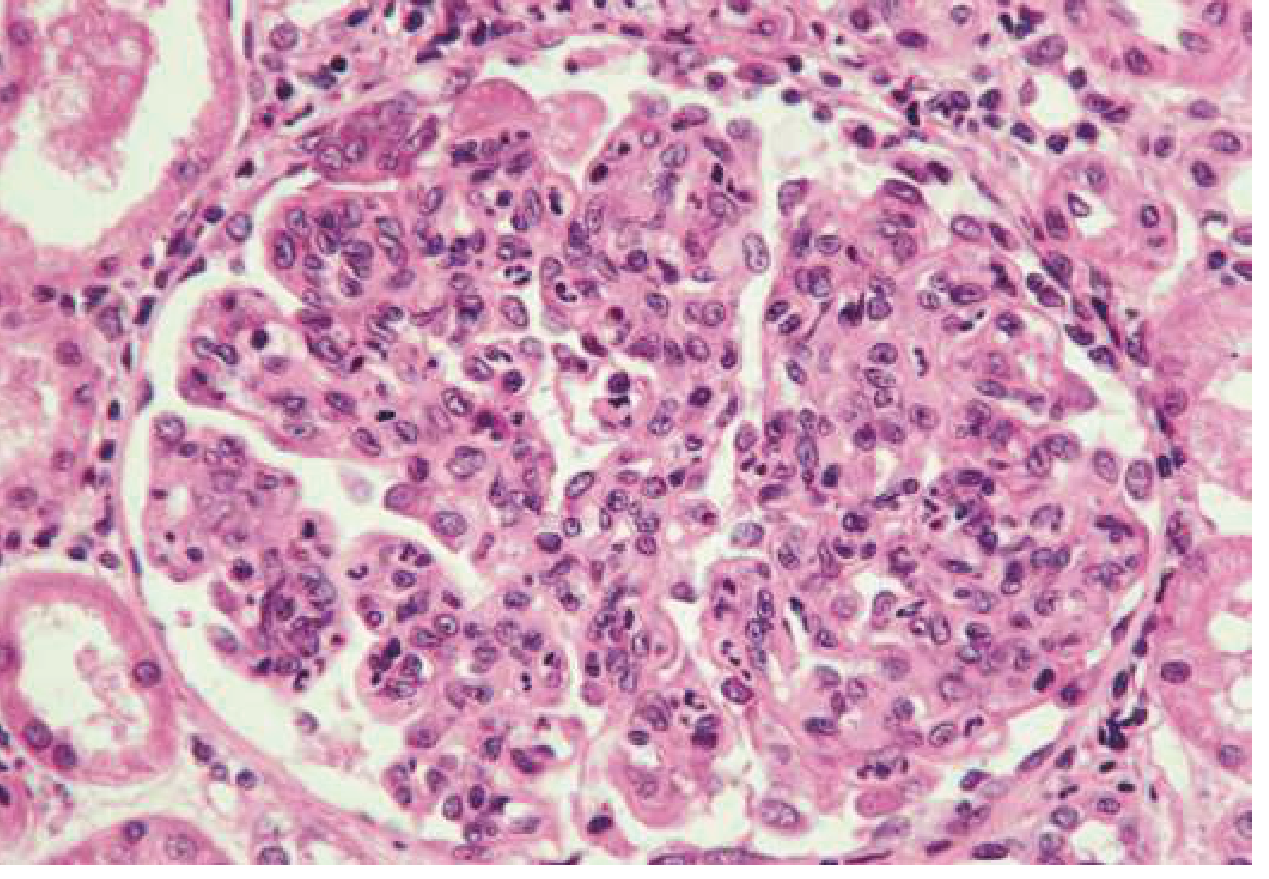
Histology of APSGN: A hypercellular glomerulus densely infiltrated by PMNs. Capillary lumens are compressed. This "endocapillary proliferative" pattern is characteristic.
Sources:
- Goldman-Cecil Medicine, Chapter 269 (Streptococcal Infections - Treatment and Prognosis of PSGN)
- Goldman-Cecil Medicine, Chapter 107 (Glomerular Disorders - Treatment and Prognosis)
- Brenner and Rector's The Kidney (long-term outcomes in adult APSGN)
This is a shared conversation. Sign in to Orris to start your own chat.