
Environmental impact of anesthesia. Green house effect and measures to reduce it 20 mark answer
Reading File
Now let me search the medical library and web in parallel for comprehensive content on environmental impact of anesthesia.
Finding Sources
Finding Sources
Searching the Web
environmental impact of anesthesia greenhouse gases global warming potential volatile anesthetics 2024
Excellent results. Now let me read the key textbook sections in parallel.
Reading File
Reading File
Reading File
I have excellent content from Barash and Miller's. Let me read a bit more from both textbooks to get the complete picture on reduction strategies.
Reading File
Reading File
I now have comprehensive content from Miller's Anesthesia and Barash's Clinical Anesthesia. Let me also search for the GWP table and Miller's environment section for a complete picture.
Reading File
Reading File
I now have comprehensive information from all three major anesthesia textbooks. Let me compile the full 20-mark answer.
Environmental Impact of Anesthesia: Greenhouse Effect and Measures to Reduce It
1. Introduction
The healthcare sector contributes approximately 4-5% of global greenhouse gas (GHG) emissions, and anesthesia is a recognized contributor within this. Volatile anesthetic agents released into the atmosphere behave as potent greenhouse gases, contributing to global warming, ozone depletion, and occupational health hazards. Although volatile anesthetics account for only about 0.1% of total GHG emissions compared to CO2 (82.2%), their high global warming potentials (GWPs) make even small quantities environmentally significant.
- Miller's Anesthesia, 10e; Barash's Clinical Anesthesia, 9e
2. The Greenhouse Effect - Mechanism
The greenhouse effect refers to atmospheric trapping of thermal (infrared) radiation emitted from the Earth's surface, as classified by the Intergovernmental Panel on Climate Change (IPCC) as a major contributor to global warming.
-
Volatile anesthetics (isoflurane, sevoflurane, desflurane) are minimally metabolized in the body and are substantially eliminated through exhalation unchanged.
-
Most waste anesthetic gas (WAG) scavenging systems transfer these gases directly and unchanged into the atmosphere.
-
Once in the atmosphere, these halogenated molecules absorb and re-emit infrared radiation, trapping heat - the greenhouse effect.
-
The radiative efficiency (ability to absorb/emit infrared radiation) and atmospheric lifetime together determine a gas's greenhouse impact.
-
Miller's Anesthesia, 10e, p. 2011-2012
3. Global Warming Potential (GWP)
GWP measures the heat-trapping efficiency and atmospheric lifetime of a gas relative to an equal mass of CO2 (CO2 = GWP of 1) over a 100-year time horizon.
| Agent | GWP (100-year) | Atmospheric Lifetime |
|---|---|---|
| CO2 | 1 (reference) | Very long |
| Nitrous oxide (N2O) | 264 | ~120 years |
| Halothane | 151 | - |
| Isoflurane | ~510 | 3-6 years |
| Sevoflurane | ~195 | 1-5 years (shortest) |
| Desflurane | ~2,540-6,810 | 9-21 years |
Key points:
-
Desflurane has by far the greatest climate impact - its life-cycle GHG emissions are 15 times those of isoflurane and 20 times those of sevoflurane. 1 gram of desflurane equals the warming effect of ~2,600 g of CO2 over 100 years.
-
N2O has a GWP of 264 with an atmospheric lifetime of ~120 years - remarkably stable. It is administered in much larger quantities than volatile agents, making its total burden significant.
-
Sevoflurane has the lowest GWP among current agents and the shortest atmospheric lifetime (1-5 years), making it the most environmentally favorable volatile anesthetic.
-
The amount released into atmosphere (governed by vaporizer settings and fresh gas flow) is equally important in determining real-world impact, not just the GWP.
-
Miller's Anesthesia, 10e, p. 2012; Barash's Clinical Anesthesia, 9e
4. Ozone Depletion
In addition to the greenhouse effect, volatile anesthetics contribute to stratospheric ozone depletion:
-
The ozone layer has been declining approximately 4% per decade since the 1970s.
-
Ultraviolet radiation from the sun breaks the carbon-halogen bonds of halogenated anesthetics in the upper atmosphere, creating halogen radicals that catalytically destroy ozone molecules.
-
Chlorine-containing agents (halothane, isoflurane, enflurane) are more destructive to ozone than fluorine-only agents (sevoflurane, desflurane), since C-F bonds are more resistant to OH attack in the troposphere.
-
In 1999, halothane contributed ~1% and isoflurane/enflurane ~0.02% to total stratospheric ozone depletion.
-
N2O is the primary source of stratospheric nitrogen oxides (NO and NO2), both of which destroy ozone. Despite a lower molecule-for-molecule ozone-depleting potential, N2O is the largest current contributor to ozone depletion due to the sheer volumes used, and is expected to remain so for the rest of this century.
-
Miller's Anesthesia, 10e, p. 2013-2014
5. N2O: A Special Concern
-
Sherman and Cullen (1988) estimated anesthesia contributed approximately 1% of man-made N2O worldwide.
-
In the United States, anesthetic N2O use may represent 3.0% of total N2O emissions.
-
N2O is produced by natural and anthropogenic sources including agriculture (nitrogen-based fertilizers) and combustion of fossil fuels - medical N2O adds to an already heavily burdened atmospheric pool.
-
N2O also contributes to the greenhouse effect directly in addition to ozone depletion.
-
Miller's Anesthesia, 10e, p. 2012
6. Measures to Reduce Environmental Impact
A. Agent Selection
- Avoid desflurane when it offers no clinical advantage over alternatives - its GWP is disproportionately high. The EU Regulation 2024/573 has now regulated fluorinated greenhouse gases including desflurane.
- Avoid or minimize N2O - it contributes both to greenhouse warming and ozone depletion. The clinical benefit must outweigh its environmental cost.
- Prefer sevoflurane over desflurane when a volatile agent is necessary - lower GWP and shorter atmospheric lifetime.
- Consider propofol-based TIVA (Total IntraVenous Anesthesia) - though propofol production and disposal carry their own carbon footprints (life-cycle analysis still ongoing), TIVA eliminates volatile emissions entirely.
B. Low-Flow and Closed-Circuit Anesthesia
- Use low fresh gas flows (FGF) during induction and maintenance:
- Target ~0.7-1 L/min FGF during maintenance.
- Estimate patient oxygen consumption as 5 mL/kg/min (a 100-kg patient requires minimum 500 mL/min).
- Turn off FGF during the intubation phase.
- Monitor exhaled anesthetic concentration to avoid awareness at low flows.
- Closed-circuit anesthesia can reduce environmental impact of all inhaled anesthetics by 80-90%. Low-flow anesthesia produces a lesser but still meaningful reduction.
- Modern anesthesia workstations provide precise control over flow rates, making low-flow techniques feasible for all practitioners.
C. Waste Gas Scavenging and Capture
- Ensure scavenging systems are functional - active scavenging systems (vacuum-based) are standard in contemporary operating rooms.
- Activated charcoal filters (e.g., AGSS - Anesthetic Gas Scavenging Systems with adsorption canisters) can recapture volatile anesthetics from waste gas streams - commercially available in some countries. Technologies that trap and allow redistillation and reuse of recovered anesthetics hold significant promise for reducing both environmental emissions and drug costs.
- Low-flow scavenging systems that recover potent inhaled agents from waste gas flow are being increasingly adopted.
D. Preventing Leaks
- Ensure tight fit of anesthetic mask, ETT cuff, and LMA.
- Inspect for leaks in anesthetic machine and circuit tubing.
- Ensure vaporizers are turned off when the machine is not in use.
- Do not administer inhaled anesthetic until the scavenging system is active.
E. Regional and Neuraxial Anesthesia
- Regional anesthesia (spinal, epidural, peripheral nerve blocks) eliminates the need for volatile agents entirely for suitable procedures.
- Local anesthetic infiltration at the surgical site reduces volatile anesthetic requirements.
- Use of adjuvants (opioids, alpha-2 agonists like dexmedetomidine) reduces MAC requirements, lowering volatile agent consumption.
F. Education and Systems-Level Change
- Physician education about the contribution of inhaled anesthetics to greenhouse warming and ozone depletion must continue.
- Life-cycle assessments (from manufacture to disposal) of all anesthetic techniques should guide evidence-based decisions.
- Professional society guidance (ASA Task Force on Environmentally Sustainable Anesthesia Practice; ESAIC Sustainability Consensus 2024) now formally recommends avoiding N2O and desflurane when they offer no clinical advantage.
- Policy-level changes - regulatory bans (e.g., EU on desflurane) and hospital-level formulary restrictions.
- Miller's Anesthesia, 10e, p. 2014-2015; Barash's Clinical Anesthesia, 9e; PMC 2024 review
7. Healthcare Sector Contribution - Broader Context
-
Even without desflurane and N2O, life-cycle analysis shows that sevoflurane is a major source of CO2 equivalents during general anesthesia.
-
General, spinal, and combined anesthetic approaches for procedures like total knee replacement can produce similar overall carbon footprints when full life-cycle analysis is applied.
-
This underscores that anesthesiology must consider the entire perioperative pathway (manufacturing, transport, equipment, drugs, disposables) rather than just the choice of volatile agent.
-
Anesthesiology is a major contributor to total healthcare pollution broadly.
-
Miller's Anesthesia, 10e, p. 2015
8. Summary Table
| Factor | High Impact | Low Impact |
|---|---|---|
| Volatile agent | Desflurane > Isoflurane | Sevoflurane, TIVA |
| N2O use | High volume use | Avoidance/minimal use |
| FGF | High flow (>2 L/min) | Low flow (0.5-1 L/min) |
| Circuit type | Open/semi-open | Closed circuit |
| Technique | GA with volatile | Regional/neuraxial |
| Scavenging | None/inadequate | Active + charcoal capture |
Key Points (Quick Recall for Exam)
- Volatile anesthetics = potent greenhouse gases; most exhaled unchanged into atmosphere.
- GWP: Desflurane (2540-6810) >> Isoflurane (~510) > Sevoflurane (~195) > N2O (264 but given in huge volumes).
- N2O: longest atmospheric lifetime (~120 years); largest current contributor to stratospheric ozone depletion.
- Desflurane: 15x GHG emissions of isoflurane, 20x of sevoflurane - now banned/restricted in several countries.
- Closed-circuit anesthesia can reduce environmental impact by 80-90%.
- Four pillars of green anesthesia: agent selection, low-flow techniques, scavenging/capture, regional alternatives.
- ASA and ESAIC have published formal guidance on sustainable anesthesia practice.
Sources: Miller's Anesthesia, 10e; Barash's Clinical Anesthesia, 9e; Morgan & Mikhail's Clinical Anesthesiology, 7e; PMC 2024 - Anesthesia and Environmental Impact
Global warming potential of anesthetic gas
Global Warming Potential (GWP) measures how much heat a gas traps relative to CO2 (GWP = 1) over 100 years. Key values: Desflurane ~2540-6810, Isoflurane ~510, Sevoflurane ~195, N2O ~264 (but used in large volumes), Halothane ~151. Desflurane is by far the worst offender.
Searching sources...
Finding Sources
Finding Sources
The Barash table on GHG emissions is exactly what I need. Let me read it directly along with the Miller's GWP section.
Reading File
Reading File
I also have the infographic. Let me fetch it for visual display.
Loading Image
I have all the data needed. Here is a complete, well-structured answer:
Global Warming Potential (GWP) of Anesthetic Gases
What is GWP?
Global Warming Potential (GWP) is a standardized index that measures a gas's heat-trapping efficiency and atmospheric lifetime relative to an equal mass of CO2 (CO2 = GWP of 1) over a 100-year time horizon. It accounts for two key factors:
- Radiative efficiency - the ability of a gas molecule to absorb and re-emit infrared radiation (larger, more complex halogenated molecules trap heat more effectively)
- Atmospheric lifetime - how long the gas persists in the atmosphere before decomposition or deposition
Inhaled anesthetics are minimally metabolized in the body (~3-5%) and are substantially eliminated through exhalation unchanged. Most waste gas scavenging systems transfer these gases directly into the atmosphere, where they act as greenhouse gases.
- Miller's Anesthesia, 10e, p. 2011-2012
GWP Values of Anesthetic Gases
The data below are based on the IPCC Fifth Assessment Report and the ASA Greening the Operating Room data:
| Agent | Atmospheric Lifetime | GWP (100-year) | CO2 Equivalents at 2 L FGF | Equivalent Auto Miles/hr of Use |
|---|---|---|---|---|
| CO2 | Long | 1 (reference) | - | - |
| Sevoflurane @ 2 L FGF | 1.1 years | 130 | 1.0 | 8 |
| Sevoflurane @ 1 L FGF | - | 130 | 0.5 | 4 |
| Isoflurane @ 2 L FGF | 3.2 years | 510 | 2.2 | 18 |
| Isoflurane @ 1 L FGF | - | 510 | 1.1 | 9 |
| N2O (60%) @ 1 L FGF | 114 years | 264-298 | - | 61 |
| Desflurane @ 2 L FGF | 14 years | 2,540 | 49.2 | 400 |
| Desflurane @ 1 L FGF | - | 2,540 | 24.6 | 200 |
| Halothane | - | 151 | - | - |
(GWP range for desflurane cited as 2,540-6,810 across different sources; the Barash table uses 2,540 based on Ryan & Nielsen 2010)
- Barash's Clinical Anesthesia, 9e, Table 2-15; Miller's Anesthesia, 10e, Table 18.5
Agent-by-Agent Analysis
1. Desflurane - Highest Environmental Impact
- GWP: 2,540-6,810 (the highest of all in-use agents)
- Atmospheric lifetime: 9-21 years
- At 1 MAC and 2 L FGF, produces 49.2 CO2 equivalents - equivalent to driving 400 miles per hour of use
- Life-cycle GHG emissions are 15x those of isoflurane and 20x those of sevoflurane
- Has now been withdrawn or banned in many countries including the UK, and regulated under EU Regulation 2024/573 on fluorinated greenhouse gases
- The high GWP is due to its highly fluorinated structure and relatively longer atmospheric lifetime compared to sevoflurane
2. Nitrous Oxide (N2O) - Greatest Total Burden
- GWP: 264-298 (moderate per molecule)
- Atmospheric lifetime: 114-120 years - exceptionally stable, the longest of any anesthetic gas
- Administered in far larger volumes than volatile agents (typically 50-60% inspired concentration vs. <5% for volatiles), making its total GHG burden disproportionately large
- Anesthetic use contributes approximately 1% of man-made N2O worldwide (Sherman & Cullen, 1988); up to 3% of total N2O emissions in the United States
- Also the primary current contributor to stratospheric ozone depletion - it is the dominant source of stratospheric NOx (NO and NO2)
- Its exceptional atmospheric stability means N2O released today will continue trapping heat for over a century
3. Isoflurane - Intermediate Impact
- GWP: 510
- Atmospheric lifetime: 3.2 years
- Moderate environmental footprint; at 2 L FGF produces 2.2 CO2 equivalents (~18 miles/hour)
- Contains chlorine atoms - contributes to both greenhouse warming and ozone depletion (chlorine radicals catalytically destroy ozone)
- Significantly more environmentally favorable than desflurane
4. Sevoflurane - Most Environmentally Favorable Volatile Agent
- GWP: 130-195 (lowest among volatile halogenated anesthetics)
- Atmospheric lifetime: 1-5 years (shortest of all agents)
- At 1 L FGF produces only 0.5 CO2 equivalents - equivalent to just 4 miles/hour
- Contains only C-F bonds (no chlorine) - lower ozone-depleting potential
- Despite being the most favorable volatile, life-cycle analysis still shows it is a major source of CO2 equivalents during general anesthesia, especially at high fresh gas flows
- Halving the FGF from 2 L to 1 L halves its environmental impact
5. Halothane - Historical Context
- GWP: ~151
- Chlorine-containing; contributed ~1% to stratospheric ozone depletion (1999 estimate)
- Now largely withdrawn from use in developed countries for clinical and environmental reasons
Key Concept: GWP Alone is Not the Full Picture
The real-world environmental impact = GWP × amount released into atmosphere
Amount released depends on:
- Vaporizer concentration (MAC delivered)
- Fresh Gas Flow (FGF) rate - higher FGF = more wasted anesthetic
- Duration of anesthesia
- Circuit type (open vs. closed circuit)
This is why reducing FGF is the single most impactful clinical intervention - halving the FGF from 2 L/min to 1 L/min halves the environmental footprint regardless of the agent chosen.
Anesthetic Carbon Footprints - The Bigger Picture
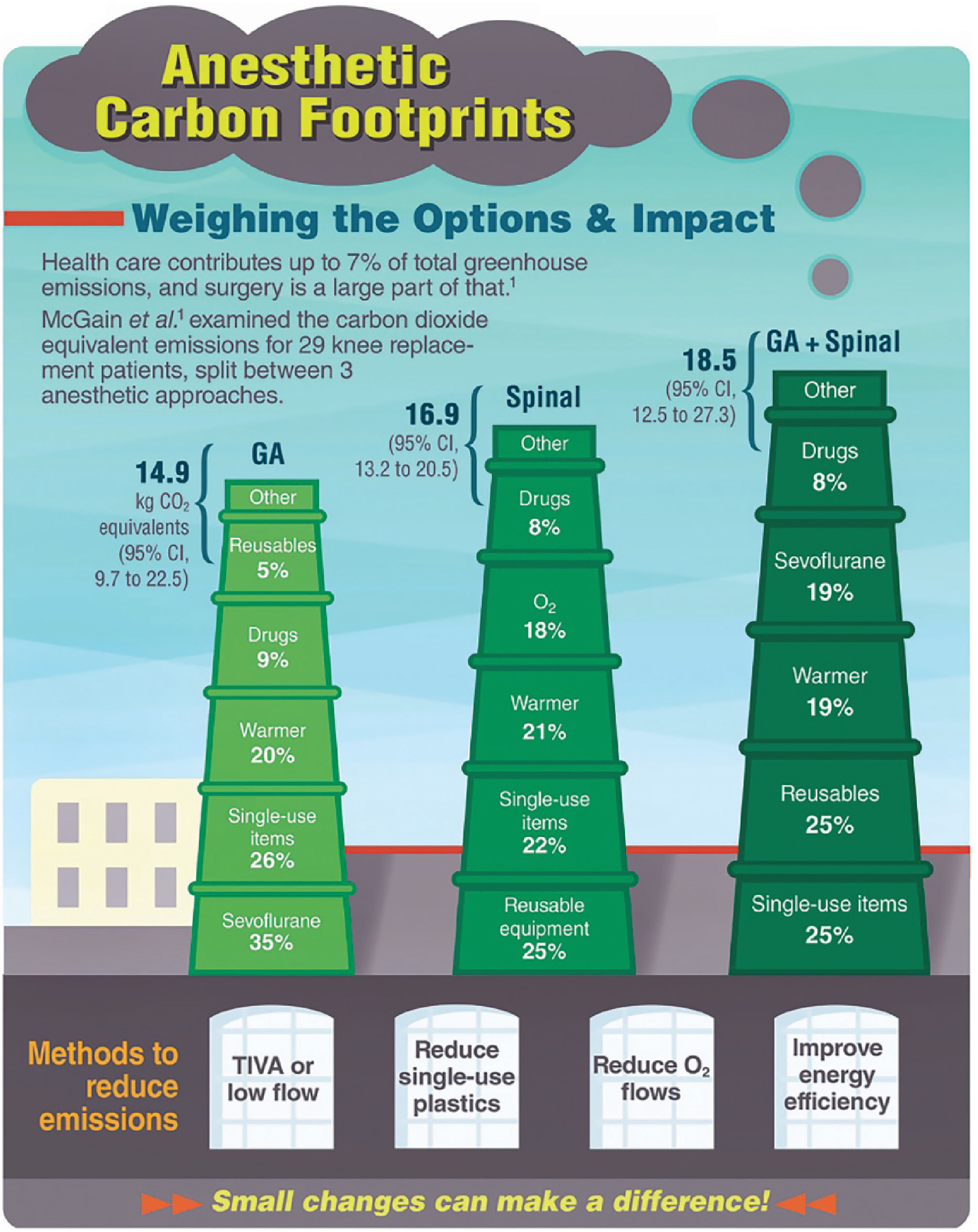
From Barash's Clinical Anesthesia, 9e - adapted from Wanderer & Rathmell, Anesthesiology 2021
This infographic illustrates that for knee replacement surgery:
- GA with sevoflurane: 14.9 kg CO2 equivalents - sevoflurane accounts for 35% of total footprint
- Spinal anesthesia: 16.9 kg CO2 - volatile agents absent, but single-use items (22%) and warmers (21%) dominate
- GA + Spinal combined: 18.5 kg CO2 - highest total
This reveals that even removing volatile agents (switching to spinal) does not necessarily reduce the carbon footprint - single-use plastics and energy consumption are also major contributors.
Quick Summary for Exam
| Memory Aid | GWP |
|---|---|
| Desflurane = Dangerous for environment | ~2,540 |
| Isoflurane = Intermediate | ~510 |
| Sevoflurane = Safest volatile | ~130 |
| Nitrous oxide = Not safe long-term (longest life) | ~264-298 |
-
Rule of thumb: 1 hour of desflurane at 1 MAC, 2 L FGF = driving 400 miles; same for sevoflurane = 8 miles
-
Lowest footprint strategy: Sevoflurane at low flow (1 L/min) or TIVA
-
Avoid: Desflurane (highest GWP) and N2O (longest atmospheric lifetime + largest total volume)
-
Barash's Clinical Anesthesia, 9e; Miller's Anesthesia, 10e
This is a shared conversation. Sign in to Orris to start your own chat.