
Palliative care
Asking for Preferences
What aspect of palliative care are you interested in? · Who is this for?
Asking for Preferences
Which disease context?
Palliative care in oncology is a high-yield topic for medical exams. Let me pull up comprehensive textbook content on this.
Searching sources...
Reading File
Finding Sources
Finding Sources
Finding Sources
Finding Sources
Good finds. Let me read the most relevant sections - the Current Surgical Therapy palliative care intro, the Scott-Brown's HNC palliative care content, and the Sleisenger GI palliative care section.
Reading File
Reading File
Finding Sources
Reading File
Finding Sources
Finding Sources
Reading File
Finding Sources
Reading File
Reading File
Searching PubMed
palliative care cancer integration outcomes
I now have enough material for a thorough exam-prep answer. Let me also grab the WHO ladder diagram and read a bit more on specific symptom management.
Reading File
Loading Image
I now have comprehensive material to write a thorough exam-prep guide on palliative care in oncology. Let me compile this.
Palliative Care in Oncology - Medical Student Exam Guide
1. Definition & WHO Framework
Palliative care is defined by the WHO as "the total active care of patients whose disease is not responsive to curative treatment." Its fundamental principle is to "offer a support system to help patients live as actively as possible until death and help the family cope during the patient's illness and in their own bereavement."
Key features (exam points):
- Care is patient-focused and family-centred
- Addresses physical, psychological, social, and spiritual aspects (4 domains)
- The goal is quality of life, recognized as equally important to survival
- Palliative Medicine became a recognized specialty in the UK in 1987
- The modern hospice movement was founded by Cicely Saunders in the 1960s
2. When to Refer - Indications for Palliative Care in Cancer
Shuman et al. define three key scenarios:
- Unresectable locoregional disease and/or distant metastasis at initial presentation
- Recurrent unresectable disease after treatment
- Patients unable to receive anti-cancer treatment due to disease stage, comorbidity, performance status, or patient preference
Modern concept: Move palliative care "upstream" - integrate it alongside curative/rehabilitative therapy, not only at end of life. Approximately 20% of cancer patients qualify for palliative care at the time of initial diagnosis (with ~5 month average survival in that cohort).
The American Society of Clinical Oncology (ASCO) recommends concurrent palliative care alongside standard oncology treatment - the evidence for this is compelling.
3. The WHO Analgesic Ladder (HIGH YIELD)
The WHO 3-step analgesic ladder governs cancer pain management:
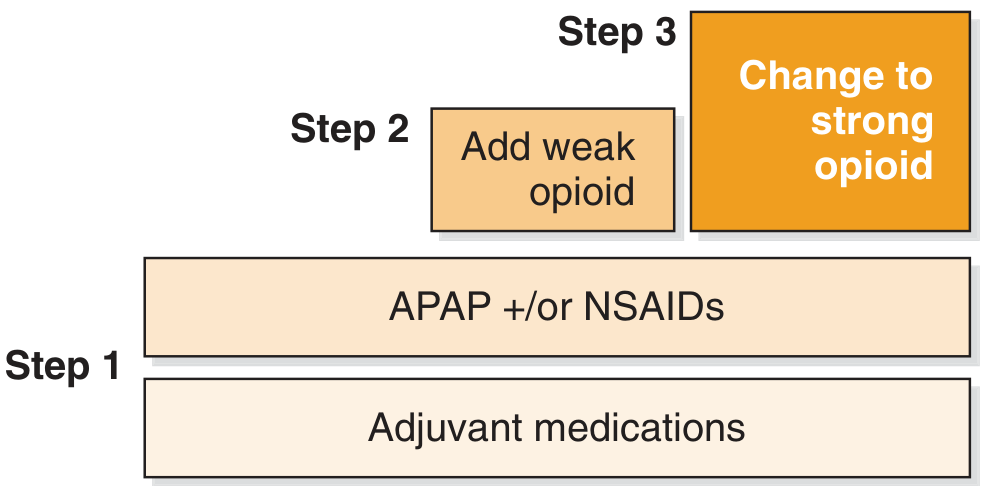
| Step | Pain Severity | Drug Class | Examples |
|---|---|---|---|
| Step 1 | Mild | Non-opioid ± adjuvant | Paracetamol (APAP), NSAIDs |
| Step 2 | Moderate | Weak opioid ± non-opioid ± adjuvant | Codeine, tramadol, hydrocodone |
| Step 3 | Severe | Strong opioid ± non-opioid ± adjuvant | Morphine (first choice), oxycodone, hydromorphone, fentanyl |
WHO's 5 Principles for Analgesic Administration ("By the 5 As"):
| Principle | Meaning |
|---|---|
| By mouth | Oral route preferred - effective, cheap, adjustable |
| By the clock | Regular scheduled dosing (not PRN) for continuous analgesia |
| By the ladder | Severity determines which step to use |
| For the individual | Titrate to each patient |
| Attention to detail | Monitor response AND side effects vigilantly |
(Source: Cummings Otolaryngology; Bailey & Love's Surgery)
4. Cancer Pain - Types & Mechanisms
Pain in cancer is usually mixed:
- Nociceptive pain: ongoing activation of primary afferent nociceptors (somatic or visceral); caused by local compression/invasion
- Neuropathic pain: dysfunction of peripheral or central nervous system; estimated in >1/3 of cancer pain patients; caused by tumor infiltration or treatment-related nerve damage
5. Opioid Management Details (High-Yield)
Morphine protocol:
- Oral morphine (short-acting liquid or tablet) given every 4 hours until adequate dose is titrated
- Once established, convert to slow-release MST (morphine sulfate tablets) every 12 hours
- Breakthrough pain: covered with short-acting morphine or fentanyl (dose = 1/6 of total daily opioid dose)
- Always prescribe laxatives prophylactically (constipation is persistent and predictable)
- Antiemetics for nausea (usually transient)
Opioid-Induced Neurotoxicity (OIN):
Caused by accumulation of opioid metabolites. Clinical features:
- Myoclonus
- Visual peripheral shadows / hallucinations
- Confusion and drowsiness
Management: Consider dose reduction if pain is controlled, or opioid rotation/switching
Routes when oral not possible:
- Subcutaneous infusion of diamorphine - effective and simple (preferred for community)
- Epidural infusion with external pump - for mobile patients
- Intrathecal infusion with computerized pump (risk: infection)
- IV narcotic - reserved for acute crises (e.g., pathological fractures)
6. Adjuvant Analgesics (Neuropathic Pain)
| Drug Class | Examples | Mechanism | Side Effects |
|---|---|---|---|
| Antiepileptics | Gabapentin, pregabalin | Ca²⁺ channel α2δ subunit ligands | Sedation, cognitive impairment, dizziness; renally eliminated - dose reduce in renal failure |
| TCAs | Amitriptyline, nortriptyline | Serotonin/norepinephrine reuptake inhibition + other | QT prolongation, dry mouth, constipation, urinary retention; analgesic effect distinct from antidepressant effect; often dosed at night |
| SNRIs | Duloxetine, venlafaxine | SNRI | Used for chemotherapy-induced peripheral neuropathy |
TCA + gabapentin combination produces better analgesia than either alone for neuropathic pain.
NSAIDs should be continued at all ladder steps unless contraindicated - especially important in frail elderly cancer patients where GI, cardiovascular, and renal risks must be weighed.
7. Neurolytic Techniques for Cancer Pain
Used only when:
- Life expectancy is limited
- Diagnosis is certain
These are invasive procedures (nerve blocks, celiac plexus block for pancreatic cancer, etc.) reserved for refractory cases.
8. Common Symptoms in Advanced Cancer (Prevalence)
In terminal head and neck cancer, patients average 4.7 symptoms in the last 6 months. Key symptoms across all cancer types:
| Symptom | Notes |
|---|---|
| Pain | 62-99% prevalence; most common |
| Dyspnea | Common in lung, pleural, cardiac involvement |
| Nausea/vomiting | Often opioid-related or bowel involvement |
| Fatigue | Nearly universal in advanced cancer |
| Weight loss/cachexia | Multifactorial |
| Dysphagia | Particularly HNC, esophageal cancer |
| Communication difficulties | HNC, laryngeal tumors |
| Respiratory secretions | End-of-life "death rattle" |
| Psychological distress/depression | Social isolation, fear of death |
| Spiritual distress | Part of total pain concept |
9. Special Emergencies in Advanced Cancer
| Emergency | Key Features |
|---|---|
| Airway obstruction | HNC, lung cancer - may need stenting, tracheostomy, or CPAP |
| Terminal haemorrhage | Catastrophic bleeding (carotid blowout in HNC) - anticipatory prescribing important |
| Pathological fracture | Bone metastases - may need IV analgesia + orthopedic input |
| Spinal cord compression (MSCC) | Back pain + neurology - steroids + urgent MRI |
| Hypercalcemia of malignancy | Confusion, polyuria, abdominal pain - bisphosphonates + hydration |
10. Multidisciplinary Team (MDT) in Palliative Care
The MDT is central to specialist palliative care. Members include:
- Palliative medicine physician
- Specialist palliative care nurses
- Physiotherapist / occupational therapist
- Chaplain / spiritual care
- Social worker
- Psychologist / psychiatrist
- Dietitian (cachexia, dysphagia)
- Pharmacist
MDTs operate both within hospices and as advisory teams in hospitals and the community.
11. Settings of Palliative Care
| Setting | Notes |
|---|---|
| Hospice | Dedicated inpatient/day care; specialist symptom management; originally voluntary-funded, now NHS partnerships in UK |
| Hospital | Specialist palliative care teams (SPCTs) provide advisory input |
| Community/Home | Preferred by most patients; requires community nurses, GP support, anticipatory prescribing |
| ICU | Palliative approach for treatment-limitation decisions |
12. Key Exam Concepts & Pitfalls
- Palliative ≠ End-of-life only - early concurrent palliative care improves QoL and, in some studies, even survival
- Opioids are NOT contraindicated in advanced cancer - fear of addiction is not a reason to withhold opioids from a dying patient
- Distinguish addiction vs. dependence: addiction is a psychosocial phenomenon; dependence is a physiological response
- Opioid rotation: if a patient has good pain control but intolerable side effects, rotate to a different opioid
- In renal failure: morphine metabolites (M6G, M3G) accumulate - consider switching to fentanyl or alfentanil (renally safe)
- Gabapentin/pregabalin require dose reduction in renal impairment
- NSAIDs should be used cautiously in frail/elderly cancer patients (GI, renal, CV risks)
- Total pain concept (Cicely Saunders): pain has physical + psychological + social + spiritual components - all must be addressed
13. Recent Evidence (2024-2025)
A recent systematic review on psychedelic-assisted therapy (Cochrane 2024, PMID 39260823) assessed psilocybin and MDMA for anxiety, depression, and existential distress in patients with life-threatening illness - an emerging area of palliative research. A 2025 systematic review (PMID 39778632) examined early palliative care integration in non-oncological populations, reinforcing that concurrent palliative care benefits extend beyond cancer.
Summary Table: WHO Analgesic Ladder at a Glance
Severe pain   → Step 3: Strong opioid (morphine, oxycodone, fentanyl) ± non-opioid ± adjuvant
Moderate pain → Step 2: Weak opioid (codeine, tramadol) ± non-opioid ± adjuvant
Mild pain     → Step 1: Non-opioid (paracetamol, NSAIDs) ± adjuvant

Principles: By mouth | By the clock | By the ladder | For the individual | Attention to detail
Key sources: Cummings Otolaryngology Head and Neck Surgery; Scott-Brown's Otorhinolaryngology Head & Neck Surgery; Bailey and Love's Short Practice of Surgery 28th Ed.
This is a shared conversation. Sign in to Orris to start your own chat.